
That “Ballistics Match” on TV Isn’t as Certain as You Think
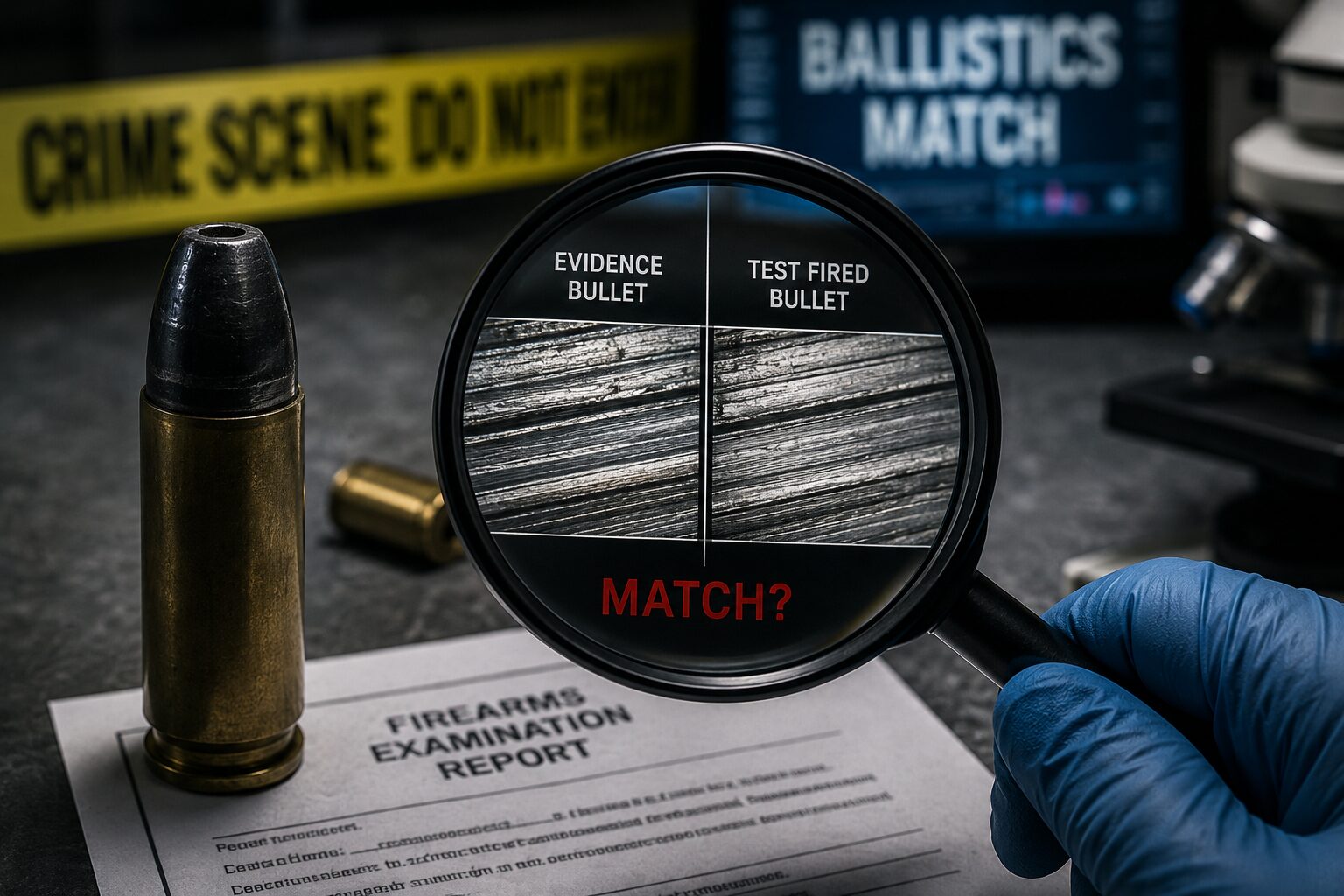
On television, it takes ninety seconds. An analyst slides a crime-scene bullet and a test-fired bullet under a microscope, the scratches line up, and a confident expert tells the jury the round came from the defendant’s gun to the exclusion of every other firearm on earth. Case closed. The trouble is that the real science cannot honestly say that, and courts are finally saying so.
In 2023, the Supreme Court of Maryland ruled in Abruquah v. State that firearms examiners may no longer tell a jury a specific gun fired a specific bullet. The same technique (firearm “toolmark” identification) was central to the case against the D.C. Snipers two decades ago, and it has helped convict people for more than a century. Now a steady wave of appellate scrutiny, reinforced by a 2023 overhaul of the federal expert-evidence rule, is reshaping how this evidence reaches juries. For a defense practice built on the science, it is one of the most important forensic stories of the decade and Texas lawyers should understand exactly where the cracks are.
What Firearms “Toolmark” Analysis Actually Claims
The theory is intuitive. When a gun is manufactured, the machining process leaves tiny imperfections on its surfaces; use, wear, and damage add more. When the gun fires, those surfaces (the firing pin, breech face, barrel) press against the softer metal of the cartridge case and bullet and, the theory goes, stamp a signature into them. An examiner test-fires the suspect weapon, then compares the test rounds against the crime-scene evidence under a split-screen comparison microscope, looking for marks that line up.
Examiners sort those marks into categories. Class characteristics (caliber, the number and direction of the lands and grooves a barrel cuts into a bullet) are shared by every gun of a given type. Subclass characteristics are shared by a batch of guns made on the same tooling. Only individual characteristics (the marks an examiner deems random and unique to one weapon) can support the leap from “this kind of gun” to “this gun.” That leap is the whole ballgame, and it is where the science gets thin.
“Sufficient Agreement” Means “It Looks Like a Match”
How does an examiner decide that the individual marks are a match? Under the standard used by most of the field (the Association of Firearm and Tool Mark Examiners’ (AFTE) Theory of Identification) an examiner may declare an “identification” when there is “sufficient agreement” between two items. And what is sufficient agreement? AFTE defines it as agreement so close that the chance another tool produced it is “a practical impossibility,” and that exceeds the best agreement seen between marks known to come from different tools. Read that twice and the circularity appears: an examiner may call two items a match when the agreement looks like the kind of agreement a match would produce. As one scholar distilled it, examiners may conclude that two casings match when they look like a match.
There is no required number of corresponding marks. No statistical foundation. No defined error rate built into the method itself. The conclusion rests on the examiner’s training, experience, and judgment which is precisely what two landmark scientific reviews flagged.
| What the scientists found
2009 — National Academy of Sciences. In its landmark report on forensic science, the NAS concluded that “the decision of the toolmark examiner remains a subjective decision based on unarticulated standards and no statistical foundation,” and identified “a fundamental problem” in “the lack of a precisely defined process.” 2016 — President’s Council of Advisors on Science and Technology. PCAST examined firearms analysis directly and found it fell short of the scientific criteria for “foundational validity,” citing its subjectivity and the absence of enough properly designed “black-box” studies to establish how often examiners are wrong. PCAST paid particular attention to the problem of experts overstating their conclusions. |
Courts Are Tightening the Screws
For most of the last century, courts admitted firearms identification almost reflexively. That is changing. A line of decisions now lets examiners describe what they see while barring the overconfident leap to certainty:
- United States v. Green (D. Mass. 2005). Judge Nancy Gertner allowed the examiner to describe his observations but refused to let him conclude the casings came from a specific pistol “to the exclusion of every other firearm in the world.” She noted the examiner had taken no notes, no measurements, and no photographs, and admitted the evidence only “reluctantly,” warning that admitting toolmark evidence without documentation, proficiency testing, or proof of reliability lets “sloppy practice” endure, “we should require more.”
- United States v. Glynn (S.D.N.Y. 2008). Judge Jed Rakoff limited the examiner to opining that a match was “more likely than not” — and no stronger.
- Gardner v. United States (D.C. 2016) and United States v. Tibbs (D.C. Superior Court 2019). District of Columbia courts held that an examiner may not testify with absolute or 100% certainty that a bullet was fired from a particular gun to the exclusion of all others, and in Tibbs limited the examiner to saying the firearm “cannot be excluded” as the source.
- Abruquah v. State (Md. 2023). The headline case. In a 4–3 decision by Chief Justice Matthew Fader, the Supreme Court of Maryland held that an examiner may testify that patterns and markings are “consistent or inconsistent” with a particular firearm, but may not testify that a specific gun fired a specific bullet. The defendant’s expert (a former chief of the FBI’s metallurgy laboratory) called the field “more art than science,” and the court refused to rely on a community “dependent for its livelihood” on the method while ignoring disinterested scientists who had studied it.
None of these courts called firearms examiners frauds, and most still let the evidence in. The throughline is narrower and more useful: an examiner can tell the jury what the marks look like, but the law increasingly forbids dressing a subjective judgment in the language of scientific certainty.
The 2023 Rule 702 Amendment Changed the Gatekeeping Math
On December 1, 2023, the federal expert-evidence rule (Federal Rule of Evidence 702) was amended in two ways that matter enormously here. First, it now makes explicit that the party offering an expert must show, by a preponderance of the evidence (more likely than not), that every admissibility requirement is met thereby correcting a generation of decisions that had wrongly treated reliability as a question of “weight, not admissibility” and presumed expert testimony admissible. Second, the rule now requires that an expert’s opinion reflect a reliable application of the method to the facts which is language aimed squarely at “overstatement,” meaning experts claiming more certainty than their discipline can support.
The Advisory Committee said the amendment is “especially pertinent to the testimony of forensic experts,” and commentators have pointed to firearms and toolmark examiners as the textbook example of the overstatement the rule targets. For the defense, the practical effect is a shift in venue: the fight over a “match to the exclusion of all others” moves from cross-examination in front of the jury to a gatekeeping motion in front of the judge where the burden sits on the State.
What This Means in a Texas Courtroom
Texas state courts are not governed by the federal rule but the same battle plays out under Texas Rule of Evidence 702 and Kelly v. State, 824 S.W.2d 568 (Tex. Crim. App. 1992), which supplies Texas’s reliability test for scientific evidence. Kelly asks three things: is the underlying theory valid, is the technique applying it valid, and was the technique properly applied on this occasion? Its non-exclusive factors include the potential rate of error and general acceptance which are the very points on which firearms toolmark analysis is weakest. (Nenno v. State governs the “soft” sciences, but firearms identification is properly analyzed as a hard-science technique under Kelly.)
A Texas-specific trap worth flagging: firearms/toolmarks is an accredited discipline under the Texas Forensic Science Commission, so the lab and the analyst will carry accreditation and licensing. The State will lean on that. But accreditation of a laboratory is not validation of a conclusion. A perfectly accredited lab can still produce a subjective “identification” that overstates what the method supports. Kelly’s third prong (reliable application on this occasion) is independent of accreditation, and that is where the defense should press.
Two honest caveats. No Texas appellate court has yet adopted Abruquah-style limits, and Texas courts have generally admitted firearms identification which is precisely why the pretrial Kelly/702 challenge and a disciplined cross-examination matter so much. And Texas’ judicial-notice doctrine means full gatekeeping hearings are expected “at the dawn of judicial consideration” of a technique; a fresh, well-built record (marshaling the NAS and PCAST findings, Abruquah, and the federal limitation cases as persuasive authority) can reopen a question many assume is settled.
| A defense checklist for firearms toolmark evidence
• Demand a Kelly/702 hearing; don’t let toolmark identification in on its century-old pedigree alone. • Attack the conclusion language: move to bar “match,” “identification,” “practical impossibility,” “to the exclusion of all other firearms,” and “reasonable degree of ballistic certainty.” • Probe the examiner’s documentation: notes, measurements, photographs, bench notes, and whether written protocols were actually followed (Green). • Demand the error-rate and proficiency-testing record, and press the absence of any required number of matching marks. • Separate lab accreditation from conclusion validity. Don’t let the State conflate them. • Build the record for appeal; Texas’s judicial-notice rules reward a thorough gatekeeping hearing. |
There is a deeper lesson here, and it cuts both ways. We made the same point from the other direction in our piece on recovering fingerprints from fired shell casings which is a genuinely promising new technique that still has to clear the same validation bar before it belongs in front of a jury. Whether a forensic method is a century old, like toolmark matching, or brand new, like electrodeposition fingerprinting, the question is the same: not whether courts have always admitted it, and not whether it sounds impressive, but whether the science actually supports the certainty the witness claims. That is the question the defense exists to ask.
At Deandra Grant Law, our defense is built on the science. We read the bench notes, we know where forensic methods are validated and where they are not, and we hold the State to its burden, especially when the evidence arrives wrapped in the certainty of a television crime lab. If you or someone you love is facing charges involving firearms, ballistics, or other forensic evidence, call us at (214) 225-7117. James Lee Bright handles related federal firearms matters in all four Texas federal districts, the Fifth Circuit, and the United States Supreme Court.
Deandra Grant, J.D., M.S., ACS-CHAL Forensic Lawyer-Scientist, is the Managing Partner of Deandra Grant Law. She holds a Master’s in Pharmaceutical Science and a graduate certificate in Forensic Toxicology, completed the “DNA for Lawyers” workshop with Dr. Greg Hampikian at Boise State University, and is the author of 17 books, including the Texas DWI Manual (13th ed.).
Which county your case is filed in changes how it is charged, who prosecutes it, and which court hears it.
Deandra M. Grant, JD, GC, MS, ACS-CHAL Forensic Lawyer-Scientist
She holds a Master of Science in Pharmaceutical Science and a Graduate Certificate in Forensic Toxicology, both from the University of Florida. She is the author of The Texas DWI Manual and has defended Texas DWI cases since 1994.
Charged With a Crime?
Whatever you're facing, a DWI or any criminal charge, the sooner you have a forensic-trained team on it the more we can do. Tell us what happened and we'll review your options, at no cost and no obligation. We're available 24/7 across all six Texas offices.
Request a Free Case Evaluation
Tell us what happened. We'll respond as soon as possible.