
Stalking Charges in Texas: The Statute, the Elements and How to Defend Against Them

Harassment and stalking charges in Texas grow out of some of the most ordinary and most emotionally charged situations there are: a breakup where one person will not stop reaching out, a custody fight where one parent tracks the other, a neighbor or workplace dispute that escalates, or a string of text messages and social-media contacts that one side experienced as threatening and the other thought was normal. What starts as a he-said, she-said conflict can become a criminal case fast, and the two charges sit at very different levels: harassment is a misdemeanor, while stalking is a felony.
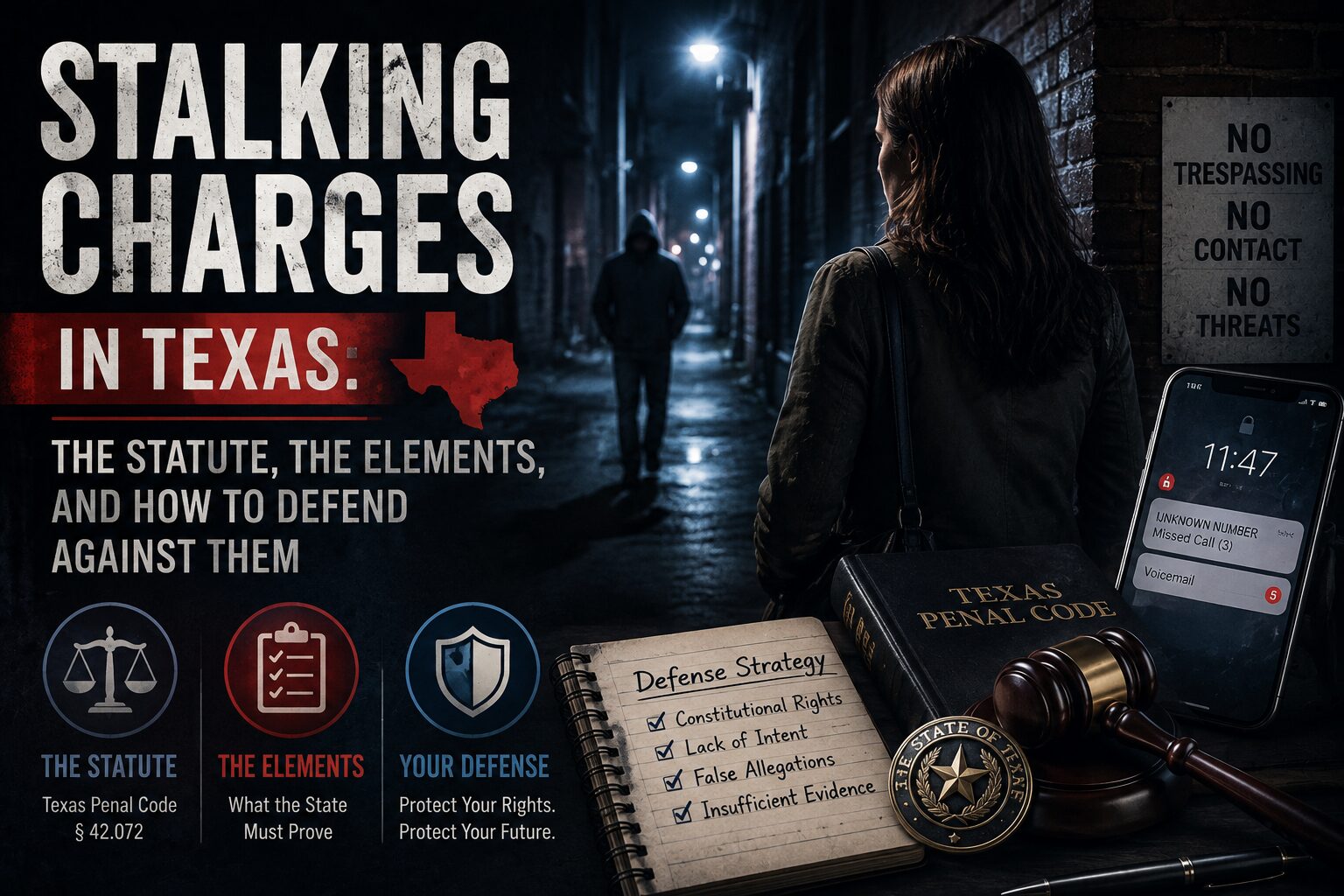
The Texas statutes behind these charges were amended in 2023 and again in 2025, so some of what you may read on older pages is out of date. This guide walks through what harassment and stalking actually require the State to prove, where the law recently changed, the penalties, what happens after an arrest, how the two offenses differ, and the defenses that apply. It is general legal information, not advice about any specific case.
What Is Considered Stalking in Texas?
Stalking is not a single dramatic act. Under Texas law it is a pattern: conduct on more than one occasion, aimed at a specific person, that a reasonable person in the target’s situation would find frightening or seriously distressing. It does not require physical contact, it does not require an explicit threat of violence, and it does not require that the two people ever had a relationship. Following someone, repeatedly showing up where they are, a run of messages or calls, monitoring their movements through an app or a tracker, or contacting them through other people can all be building blocks of a stalking case if the conduct happens more than once and would put a reasonable person in fear or make them feel tormented.
Because the elements are written broadly and turn partly on how the complainant felt, stalking charges often arise from genuinely ambiguous situations. That ambiguity is exactly where a defense lives.
Texas Penal Code § 42.072: The Stalking Statute
The offense is defined in Texas Penal Code § 42.072. Stripped to its structure, the State must prove that the accused, on more than one occasion and as part of the same scheme or course of conduct directed at a specific person, knowingly engaged in conduct that satisfies three things at once:
- Threatening or harassing conduct. The conduct either was an offense under the harassment statute (§ 42.07) or was something the accused knew, or reasonably should have known, the other person would regard as threatening bodily injury or death to them, to a family or household member, or to a dating partner, or as threatening an offense against their property.
- A real effect on the target. The conduct actually placed that person (or a family or household member or dating partner) in fear of bodily injury, death, or an offense against them or their property, or caused them to feel harassed, terrified, intimidated, annoyed, alarmed, abused, tormented, embarrassed, or offended.
- An objective backstop. The conduct would cause a reasonable person, under circumstances similar to the complainant’s, to feel that same fear or distress.
Two features of the 2023 amendment: First, the legislature added “terrified” and “intimidated” to the list of feelings the conduct can produce, widening the statute. Second, it changed the old flat “reasonable person” test into a reasonable person “under circumstances similar to the circumstances of the other person,” a more context-specific standard that can make the offense easier for the State to reach. The statute also lets the jury combine different kinds of conduct, a message on one day and an in-person appearance on another, into a single course of conduct, and it defines “property” to include a pet or companion animal.
What Is Considered Harassment in Texas?
Harassment, defined in Texas Penal Code § 42.07, is the misdemeanor cousin of stalking, and it is built differently. The State must prove two things: that the accused engaged in one of the specific kinds of conduct the statute lists, and that they did so with intent to harass, annoy, alarm, abuse, torment, or embarrass another person.
That intent requirement is the heart of a harassment defense. The statute does not punish communication that happens to upset someone; the State has to prove the accused meant to produce the harassing effect. Messages sent for a legitimate reason, to collect a debt, to resolve a dispute, or to coordinate about shared children, may be unwelcome or even heated without meeting that bar. The prohibited conduct itself is a specific list, not a catch-all: it includes obscene communications, threats to commit a violent crime, knowingly false reports that someone has been hurt or killed, repeated anonymous or telephone contacts made to harass, and sending repeated electronic communications in a manner reasonably likely to harass, annoy, alarm, abuse, torment, embarrass, or offend. Unlike stalking, a single qualifying act can be enough for harassment.
Is Stalking a Felony in Texas?
Yes. Stalking is a felony in Texas, and that is the single most important thing a person newly charged should understand. Harassment is a misdemeanor that, in the ordinary case, is resolved in a county court; stalking is a felony that carries the possibility of a prison sentence and the lasting weight of a felony record. The gap between the two, both in exposure and in long-term consequences, is enormous, which is why the line between them matters so much and is so often contested.
Harassment and Stalking Penalties in Texas
Harassment penalties
Harassment is generally a Class B misdemeanor, punishable by up to 180 days in county jail and a fine of up to $2,000. Certain circumstances raise it to a Class A misdemeanor, with up to one year in jail and a fine of up to $4,000, for example where the accused has a prior harassment conviction. Aggravated forms involving obscene or sexual electronic communication directed at a minor can be charged as a state jail felony. Importantly, deferred adjudication is available for harassment, which can matter a great deal to someone whose main goal is avoiding a final conviction.
Stalking penalties
Stalking is a third-degree felony as a baseline, carrying 2 to 10 years in prison and a fine of up to $10,000. It rises to a second-degree felony, 2 to 20 years, if the accused has a prior stalking conviction under this statute or a substantially similar law.
2025 changes. Effective for conduct on or after September 1, 2025, the legislature added stalking to the list of offenses in Article 42A.054(a) for which a judge may not grant community supervision. In plain terms, a judge can no longer place a person convicted of stalking on straight (judge-ordered) probation. This is a real tightening, but it is narrower than some summaries suggest: the legislature did not touch a jury’s ability to recommend community supervision, and it did not eliminate deferred adjudication. So, probation is not simply “gone” for stalking, and incarceration is not automatic on conviction. What changed is that judge-ordered probation is off the table, which raises the stakes of how a stalking case is resolved and makes early strategy about trial posture and possible reduction more important, not less.
How Does the State Prove Stalking in Texas?
Every element above is something the prosecution must prove beyond a reasonable doubt, and each is a place to push back.
- More than one occasion. The State has to prove at least two qualifying acts that belong to the same course of conduct. A single act, however alarming, is not stalking. If the prosecution can establish only one, the felony should fail.
- Knowledge and the recklessness floor. The accused must have known, or reasonably should have known, that the conduct would be taken as threatening. Where the case is built on speech, the Supreme Court’s decision in Counterman v. Colorado, 600 U.S. 66 (2023), sets a constitutional minimum: for a true-threat prosecution the State must prove the accused was at least reckless about whether the messages would be understood as threatening. A person who genuinely did not grasp that their words were landing as threats has a real argument on this element.
- Actual and reasonable fear or distress. The State must show both that this complainant actually felt the fear or distress and that a reasonable person in their situation would have. Conduct by the complainant that is inconsistent with genuine fear, continuing to reply, initiating contact, waiting a long time to report, can undercut both prongs.
- Directed at a specific person. General social-media posts that do not target the complainant, or conduct aimed at the public at large, do not satisfy the statute.
What Happens After a Harassment or Stalking Arrest
The hours and days after an arrest set the shape of the case. A few things typically happen quickly:
- Bond and conditions. A magistrate sets bond and usually imposes conditions. In cases involving a family member, partner, or dating relationship, the magistrate can issue an emergency protective order under Article 17.292 (a magistrate’s order of emergency protection, often called an MOEP) that bars contact with the alleged victim, sometimes for up to 91 days.
- No-contact and monitoring. Conditions frequently include no direct or indirect contact, staying away from the complainant’s home and work, surrendering firearms, and sometimes GPS monitoring. Violating any of these is a separate crime, so understanding them precisely is essential.
- The felony track. A stalking charge is a felony, which means it will generally be presented to a grand jury for indictment. That interval is a critical window for the defense to gather the full record before the case hardens.
- Preserve everything, say nothing. The complete communication history, often the best evidence that contact was two-sided or non-threatening, needs to be preserved immediately and not deleted. And because the offense turns on intent and perception, unguarded statements to police can do real damage. Early counsel matters.
Defenses to a Harassment or Stalking Charge
These charges are serious, but they are also among the more defensible in Texas criminal law, precisely because the elements are subjective, the evidence is usually digital, and the line between persistent and criminal is genuinely contested. The main lines of defense:
- No course of conduct. For stalking, the defense breaks the prosecution’s narrative back into individual acts and tests each one: is it really a qualifying act, and is it really part of the same scheme, or are unrelated incidents being stitched together to reach the pattern requirement?
- No intent (harassment) or no knowledge (stalking). If communications were sent for a legitimate purpose, or the accused did not and reasonably could not have understood them as threatening, the mental-state element is not met.
- The First Amendment. Speech that is unwelcome, offensive, or persistent is not automatically criminal. Under Counterman, a speech-based prosecution requires proof of at least recklessness as to a threat. And in Owens v State, 728 S.W.3d 155 (Tex. Crim. App. 2025), PD-0075-24, the Texas Court of Criminal Appeals held the electronic-communications harassment provision, § 42.07(a)(7), unconstitutional as applied to the defendant, because the case turned on the content of protected speech. That decision is a live tool in any harassment case built on the words in a message rather than the mere fact of repeated contact.
- Fear that was not genuine or not reasonable. Evidence that the complainant kept engaging, taunted the accused, or delayed reporting can defeat the fear elements.
- False accusation and motive. Because these cases often rest entirely on the complainant’s account, the timing of a complaint relative to a divorce, custody fight, or other dispute, and any motive to exaggerate, is fair game.
- Mutual conduct. Where both people were messaging, showing up, and escalating, the tidy “stalker and victim” story the State tells can fall apart once the full, two-sided record is in front of the jury.
- Attacking the digital evidence. Screenshots are not self-authenticating, accounts can be compromised, and cherry-picked excerpts hide context. Whether the accused was even the sender, and whether the record is complete, are all contestable. Any device or account search is also subject to challenge under the Fourth Amendment and Article 38.23 of the Texas Code of Criminal Procedure, whose only good-faith exception is for warrants, so a bad warrantless search is harder for the State to salvage here than in federal court.
Stalking Protective Orders in Texas
Stalking runs on two tracks at once, criminal and civil, and the civil side often moves first. A person who says they are a stalking victim can seek a protective order under Chapter 7B of the Code of Criminal Procedure, the chapter that covers protective orders for victims of stalking, sexual assault or abuse, indecent assault, and trafficking. A Chapter 7B order can bar the respondent from contacting or going near the protected person, and it does not require a criminal conviction to issue. Separately, as noted above, a magistrate can enter an emergency protective order at the time of a related arrest under Article 17.292.
These orders carry real weight even before any criminal case is resolved: they can dictate where a person lives and works, restrict firearm possession, and, critically, create a new criminal exposure the moment they are violated.
Violating a Protective Order: Penal Code § 25.07
Violating a protective order or a qualifying bond condition is its own offense under Texas Penal Code § 25.07, and it is prosecuted independently of the underlying stalking or harassment case. The prohibited conduct includes going to or near the protected person’s home, work, or school, communicating with them directly in a threatening or harassing way (or at all, if the order bars any contact), committing family violence, possessing a firearm, harming a protected pet, or tampering with a required GPS device.
The penalty tiers:
- Class A misdemeanor for a base violation, up to one year in county jail and a fine of up to $4,000.
- State jail felony in certain situations, including violating a Chapter 7B order entered after a conviction or deferred adjudication as to that victim, or (under a 2025 amendment) violating an order while possessing a deadly weapon.
- Third-degree felony, 2 to 10 years, if the person has two or more prior violations under § 25.07 or § 25.072, or if the violation itself involved committing an assault or the offense of stalking.
A separate statute, § 25.072, addresses repeated violations and raises the exposure further. Two points trip people up constantly. First, if a person under a protective order continues stalking the protected person, they can face both an enhanced stalking charge and a separate § 25.07 charge for the same conduct. Second, reconciliation is not a defense: even if the protected person is the one who reaches out, the respondent can still be charged for responding while the order is in force.
Stalking vs. Harassment in Texas
The two offenses overlap, and prosecutors have real discretion in choosing between them, so the distinction is worth stating plainly. Harassment (§ 42.07) is a misdemeanor that can rest on a single communicative act and turns on the accused’s intent to harass, annoy, or alarm. Stalking (§ 42.072) is a felony that requires a course of conduct, more than one occasion, that causes fear or serious distress a reasonable person would share. Harassment is, in effect, a building block; a series of harassing acts aimed at the same person can be assembled into a stalking course of conduct.
That relationship cuts both ways at the plea-bargaining table. A stalking charge can sometimes be reduced to harassment and, given the 2025 restriction on judge-ordered probation for stalking, a reduction to a misdemeanor where deferred adjudication remains available can be a meaningful goal. The defense job is to test whether the conduct really clears the higher felony bar or whether, at most, it is misdemeanor harassment.
Collateral Consequences of a Conviction
The sentence is not the whole story. Harassment and stalking cases carry consequences that reach well past the courtroom:
- Family-violence findings. If the complainant is a family member, household member, or dating partner, an affirmative finding of family violence can attach, with long-term effects on firearm rights and on the punishment for any future offense.
- For a non-citizen, a harassment or stalking charge or conviction can carry immigration consequences, including potential grounds of inadmissibility or removal.
- Professional licensing and security clearances. A felony stalking conviction can jeopardize nursing, teaching, and other professional licenses, as well as security clearances. These effects need to be weighed from the very start, not after a plea.
Talk to Deandra Grant Law
Harassment and stalking cases reward preparation. The elements are subjective, the evidence is usually digital, and the difference between a felony and a misdemeanor, or between a conviction and a dismissal, often comes down to context the prosecution left out. Our team pairs deep experience in assault, family-violence, and protective-order defense with the digital-forensics capability these cases demand.
With offices in Dallas, Fort Worth, Allen, Denton, Waco, and Rockwall, we defend harassment and stalking charges across North and Central Texas. Call (214) 225-7117 or visit texasdwisite.com for a confidential consultation.
Deandra Grant is the managing partner of Deandra Grant Law. An ACS-CHAL Forensic Lawyer-Scientist with an M.S. in Pharmaceutical Science and a Graduate Certificate in Forensic Toxicology, she has defended Texas criminal and DWI cases since 1994 and is the author of the Texas DWI Manual.
Sources and Further Reading
- Penal Code § 42.072 (Stalking). codes.findlaw.com
- Penal Code § 42.07 (Harassment). codes.findlaw.com
- Penal Code § 25.07 (Violation of Certain Court Orders). codes.findlaw.com
- Counterman v. Colorado, 600 U.S. 66 (2023), on the recklessness standard for true-threat prosecutions. supreme.justia.com
- Owens v State, 728 S.W.3d 155 (Tex. Crim. App. 2025), No. PD-0075-24, holding § 42.07(a)(7) unconstitutional as applied. law.justia.com
- Also relevant: Tex. Code Crim. Art. 42A.054 (judge-ordered community supervision limits); Chapter 7B (protective orders for stalking victims); Art. 17.292 (magistrate’s emergency protective order); and Tex. Penal Code § 25.072 (repeated violation).
This post is general legal information, not legal advice, and it describes Texas law as of publication. The harassment and stalking statutes were amended in 2023 and 2025; verify current text and consult a licensed Texas attorney about the specific facts of your case.
Which county your case is filed in changes how it is charged, who prosecutes it, and which court hears it.
Deandra M. Grant, JD, GC, MS, ACS-CHAL Forensic Lawyer-Scientist
She holds a Master of Science in Pharmaceutical Science and a Graduate Certificate in Forensic Toxicology, both from the University of Florida. She is the author of The Texas DWI Manual and has defended Texas DWI cases since 1994.
Facing Criminal Charges in Texas?
The sooner a defense lawyer is involved, the more can be done to protect your record and your freedom. Talk to us today.
Request a Free Case Evaluation
Tell us what happened. We'll respond as soon as possible.