
Why Batson Hasn’t Fixed Jury Selection
Batson v. Kentucky was supposed to end race-based jury strikes in 1986. Forty years of data say it has not. The rule is still the law and it still works, but only for the lawyer who builds the record in voir dire: the comparative juror analysis, the disparate questioning, the ruling stated on the record. Pitchford v. Cain shows the Court will enforce it. Miller-El and Broadnax, both Dallas County cases, show what happens when the record is not there.
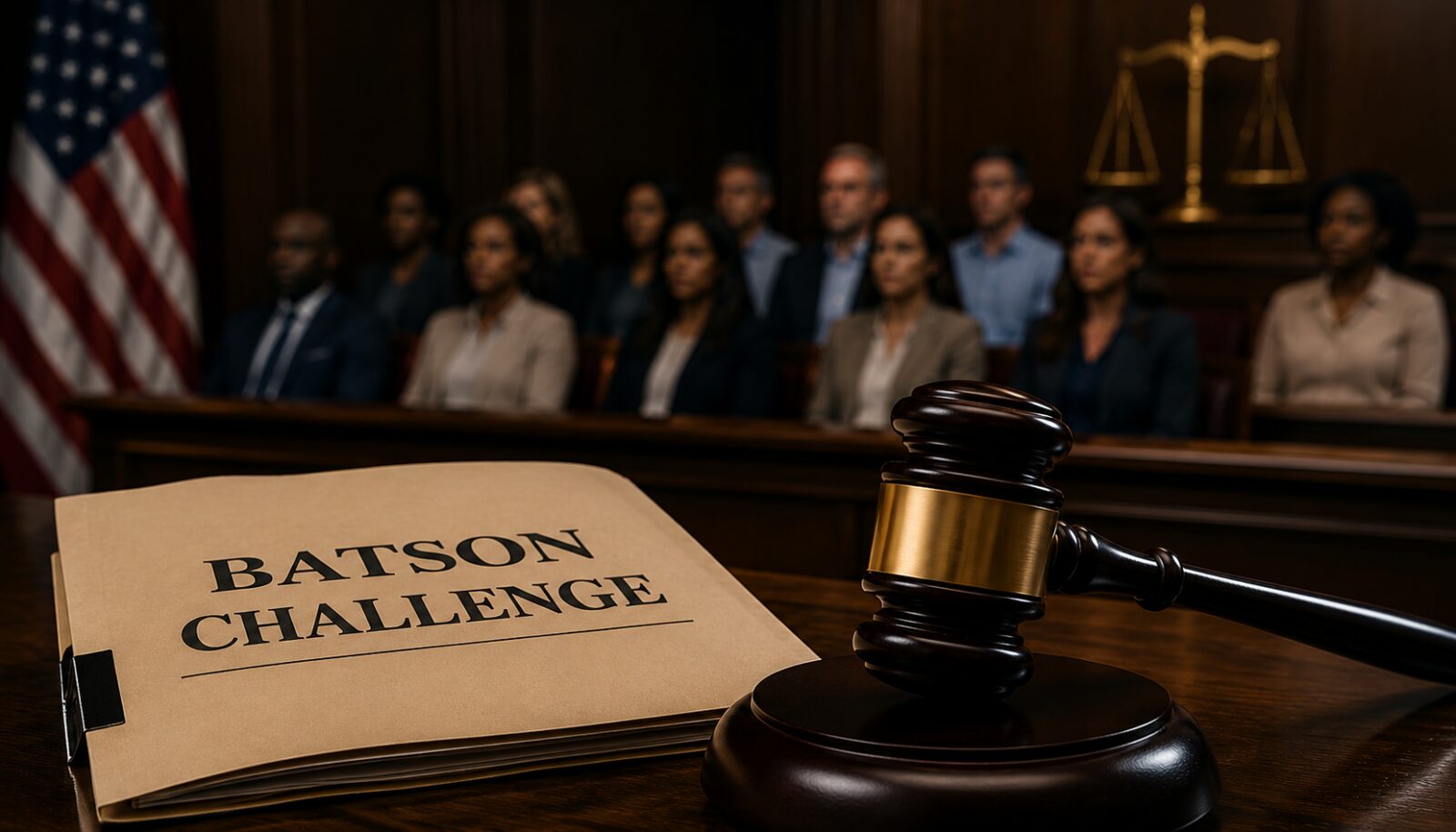
Most criminal cases are decided before a single witness is sworn. They are decided during jury selection, and the rules that are supposed to keep race out of that process have not worked as promised. That is not a slogan. It is what forty years of data show, and it is what the Supreme Court keeps having to say again.
Justice Thurgood Marshall predicted it in his concurrence in the very case that created the rule. He wrote that the decision would not end racial discrimination in jury selection, because a prosecutor with a mind to discriminate could simply offer a reason that sounded neutral, and a trial judge would have little basis to disbelieve it. Marshall’s proposed solution was to abolish peremptory challenges entirely. No court adopted that at the time. One state has since.
What Just Happened at the Supreme Court
On May 28, 2026, the Court decided Pitchford v. Cain, and it is worth being precise about what it did, because the coverage has not been.
The Court did not reverse Terry Pitchford’s conviction or his death sentence. What it reversed was a judgment of the Fifth Circuit, 126 F.4th 422, which had itself reversed a district court’s grant of conditional habeas relief. The vote was five to four, in an opinion by Justice Kavanaugh joined by Chief Justice Roberts and Justices Sotomayor, Kagan, and Jackson, an unusual lineup that says something about how basic the point was. Justice Gorsuch dissented, joined by Justices Thomas, Alito, and Barrett, and his dissent describes the majority’s work accurately: a narrow judgment, holding only that Pitchford did not waive a step three argument. The case is back before the Fifth Circuit. As of this writing nothing public has happened on remand.
The holding is procedural and it is important anyway. The trial court never gave defense counsel a real opportunity to argue the final step of the analysis, and the Court held that a defendant must at least have that opportunity. A great many Batson claims die exactly there, not because the argument was weak but because the record never captured it.
There is context the opinion itself does not contain, and it should be attributed rather than implied. The prosecutor in Pitchford’s case was Doug Evans, the same district attorney whose conduct the Supreme Court addressed in the Curtis Flowers litigation, and the trial judge, Circuit Judge Joseph Loper, presided over the fifth and sixth Flowers trials. Neither name appears anywhere in the slip opinion. Both facts come from the reporting by Mississippi Today and from the APM Reports investigation.
Grenada County is roughly 40 percent Black. The State struck four of the five Black prospective jurors. One Black juror was seated.
What a Batson Challenge Is
A peremptory challenge lets a party remove a prospective juror without giving a reason. Before 1986 that power was effectively unchecked as to race. Under Swain v. Alabama, a defendant had to prove a pattern of discrimination across many cases, which was close to impossible.
Batson v. Kentucky, 476 U.S. 79 (1986), replaced that with a framework focused on the case in front of the judge. The Equal Protection Clause forbids striking a juror because of race, and a defendant can make that showing from his own trial.
The Three Steps
- Step one. The objecting party makes a prima facie showing that a strike was based on race. The bar is low.
- Step two. The striking party offers a race-neutral reason. The bar here is lower still. The reason does not have to be persuasive, or even sensible. It only has to be facially neutral.
- Step three. The judge decides whether the stated reason is the real reason or a pretext. This is where every serious Batson fight is won or lost, and it is the step Pitchford is about.
Step three is comparative work. A lawyer shows that a white juror with the same characteristic was not struck, that the questioning differed by race, that the reason shifted, that the stated concern was never explored on the record. None of that helps unless it is in the record.
Where the Doctrine Now Reaches
Be careful with the scope, because it is commonly overstated. The Supreme Court has extended Batson to ethnicity in Hernandez v. New York and to gender in J.E.B. v. Alabama ex rel. T.B., and has applied the framework in civil cases and to defense strikes. That is the extent of it. The Court has never gone further, and it denied certiorari on religion. A Ninth Circuit decision, SmithKline Beecham Corp. v. Abbott Laboratories, extended the rule to sexual orientation, but that is one circuit, not national law. Lower courts and state legislatures have pushed past the Supreme Court. The Supreme Court has not.
Why the Record Has Been So Bad
The most cited numbers in this area come from the APM Reports investigation In the Dark. The analysis was done by Will Craft and published in 2018, covering trials from 1992 through 2017. Craft found that prosecutors in that jurisdiction struck Black prospective jurors at substantially higher rates than white ones, with a logistic regression producing an odds ratio of roughly 6.67. Two qualifiers matter. It measures one prosecutor’s district, Doug Evans’s, rather than Mississippi as a whole. And the district is called Mississippi’s Fifth Circuit Court District, which is a state judicial district and has nothing to do with the federal Fifth Circuit that decides Texas appeals.
The structural critique is easier to state than the statistics. Austin Sarat, the William Nelson Cromwell Professor of Jurisprudence and Political Science at Amherst College, has written that the ruling failed to curb racial bias in jury selection. Elisabeth Semel of Berkeley Law, who has studied the doctrine for decades, has said Batson has failed the defendants who have been tried since Batson. The Death Penalty Information Center has characterized her assessment as a failing grade; that characterization is theirs, not a quotation from her.
The mechanism is the one Marshall named. Step two accepts almost anything. Step three turns on a credibility finding by the judge who just watched the lawyer make it, and that finding is reviewed for clear error. The doctrine asks a trial judge to call a lawyer who practices in front of him a liar, on a cold record, with deference running the other way.
The Texas Story
The case that defines modern Batson practice is a Dallas County case. Thomas Joe Miller-El was tried for capital murder in 1986, and prosecutors struck ten of the eleven eligible Black prospective jurors. It took nearly twenty years and two trips to the Supreme Court to get relief.
What Miller-El Actually Holds
- Comparative juror analysis. Side-by-side comparison of struck Black jurors and seated white jurors with the same characteristics is the core of a step three showing.
- Disparate questioning, script one. Prosecutors read a graphic description of the death penalty to 53 percent of Black venire members and to 6 percent of white ones.
- Disparate questioning, script two. A manipulative line of questioning about the five-year statutory minimum sentence was put to 94 percent of white panel members and 12.5 percent of Black panel members. The State conceded that this questioning was used to create cause to strike. The Court called the state court’s contrary reading a dismissive and strained interpretation of the petitioner’s evidence of disparate questioning, a phrase that modifies the evidence, not the record generally.
- Statistical disparity. In Miller-El v. Cockrell the Court wrote that happenstance is unlikely to produce this disparity.
- The jury shuffle. Prosecutors used Texas’s jury shuffle procedure, under Article 35.11, which is current law and has never been repealed, in a way the Court found unexplained. Be careful here: the Court made no comparative finding that white members were similarly placed and no shuffle followed. Its reasoning rested on the unexplained shuffles together with the office’s admitted history of using the procedure.
- Office history. The evidence was older and worse than is usually reported. A 1963 circular instructed prosecutors not to take Jews, Negroes, Dagos, Mexicans, or members of any minority race on a jury. A 1968 training document known as the Sparling Manual, titled Jury Selection in a Criminal Case, remained in circulation into the mid-1970s and was available to a prosecutor trying Miller-El’s case.
One more Texas case belongs here, because it shows how long the doctrine can take even when a court gets it right. While Miller-El’s appeal was working its way up, the Court of Criminal Appeals found a Batson violation in Chambers v. State, 784 S.W.2d 29 (Tex. Crim. App. 1989), where one of the same prosecutors had used that identical minimum-sentence line in another case. A Texas court caught the same lawyer running the same play, and Miller-El still spent sixteen more years litigating.
Broadnax: Why the Record Is Everything
If you want a single illustration of the thesis of this post, it is James Broadnax, another Dallas County capital case. Prosecutors struck every Black prospective juror on the panel, along with one Hispanic juror. The trial judge initially denied every challenge, then reseated one of the struck jurors, noting on the record that there were no African-American jurors and that a disproportionate number had been struck. The jury that convicted Broadnax was eleven white jurors and one Black juror. On direct appeal the Court of Criminal Appeals held that no Batson violation had occurred.
Years later, in federal habeas, Broadnax produced a spreadsheet the Dallas County District Attorney’s Office had built before voir dire. It specified the race and gender of every veniremember and bolded the names of the prospective Black jurors. It had never been disclosed, having been withheld as attorney work product, and it surfaced only because the office later changed its policy.
The Fifth Circuit refused to look at it. Because the Batson claim had already been adjudicated on the merits in state court, Cullen v. Pinholster confined federal habeas review to the record the state courts had, and the spreadsheet was not in it. The court added that the document alone is no smoking gun. See Broadnax v. Lumpkin, 987 F.3d 400 (5th Cir. 2021), cert. denied, 142 S. Ct. 859 (2022).
A document that looks like direct evidence of race-conscious jury selection was kept out not because of what it showed but because of when it arrived. The record is not a formality. It is the case.
The Texas Statute and the Remedy Question
Texas codified Batson at Article 35.261 of the Code of Criminal Procedure in 1987. The statute says that if the court finds a peremptory challenge was exercised on the basis of race, it shall dismiss the array and call a new one.
The Court of Criminal Appeals has held that its remedy is not exclusive. In State ex rel. Curry v. Bowman, a district attorney sought mandamus to force a trial judge to dismiss the array after the judge had instead reinstated two wrongly struck veniremembers. The Court denied the mandamus. It observed that the statutory remedy may be unconstitutionally restrictive and held that where a Batson claim is sustained, the court may fashion a remedy in its discretion consistent with Batson and its progeny. Reinstatement was upheld.
So the accurate advice is the opposite of what is often written: ask for the statutory remedy if you want it, but know that the judge may reinstate instead, and that reinstatement is lawful. Argue for the remedy that actually helps your client in the trial you are in.
How Many Strikes Each Side Gets
Article 35.15 sets the numbers, and the capital figure is conditional.
- Capital case in which the State seeks the death penalty: fifteen each. With two or more defendants, eight for each defendant and eight to the State per defendant.
- Non-capital felony, and capital cases where the State does not seek death: ten each. With two or more defendants, six each and six to the State per defendant.
- Misdemeanor tried in district court: five each. In county court or county court at law: three each. With two or more defendants, three each and three to the State per defendant.
- Alternates add one additional challenge for one or two alternates, two for three or four, usable only against alternates.
Building a Record That Survives Appeal
Most Batson claims fail on the record rather than on the merits. The work is front-loaded.
- Before voir dire, get the panel list with any available demographic information, and know the county’s demographics well enough to state them on the record.
- During voir dire, track every question asked of every juror, by whom, and how it was phrased. Disparate questioning is invisible unless someone recorded it.
- At the hearing, make the comparative showing out loud. Name the white juror with the same characteristic who was not struck. Ask the court to have the prosecutor explain the difference.
- Insist on a ruling. Ask the judge to state findings, including on demeanor. Snyder v. Louisiana matters here, but state it precisely: a reviewing court cannot presume the trial judge credited a demeanor-based explanation when the judge made no finding on the record. Snyder does not forbid deference to demeanor, and the violation there was actually found on the second, non-demeanor reason.
- Preserve it. Object before the jury is impaneled, get the ruling on the record, and make sure the reporter has the voir dire. Pitchford exists because the opportunity to argue step three was never given.
What Reform Actually Looks Like
Texas has considered changing this and has not. House Bill 4946 in the 88th Legislature would have rewritten Article 35.261 to cover race, ethnicity, sex, gender identity, sexual orientation, disability, national origin, economic status, and religious affiliation. It reached the General State Calendar on May 11, 2023, and died there. House Bill 580 in the 89th Legislature was essentially the same bill, referred to committee on March 3, 2025, where it died without a hearing. Two sessions, the same bill, no floor vote.
Other states have moved, and one went all the way. Arizona abolished peremptory challenges entirely, in civil and criminal cases, by Supreme Court order effective January 1, 2022, the first state in the country to do what Marshall proposed in 1986. Washington adopted General Rule 37, which replaces the purposeful-discrimination test with an objective observer standard. Connecticut and New Jersey adopted objective-observer rules in January 2023. California’s Code of Civil Procedure section 231.7 has applied to criminal trials since January 1, 2022. Its extension to civil trials, once set for January 1, 2026, was repealed before it ever took effect. The section now reaches civil cases only in three categories: civil rights actions, civil commitment and sexually violent predator proceedings, and damages actions arising from a hate crime.
What This Means If You Are Facing Trial
Jury selection is not a preliminary. It is the part of the trial where the outcome is most often determined, and it is the part clients almost never hear about until it is over. Ask your lawyer how the panel will be tracked, whether comparative juror analysis will be done in real time, and what will be on the record if a strike has to be challenged.
The doctrine has not delivered what the Supreme Court promised in 1986. It is still the law, and in the hands of a lawyer who builds the record, it still works. Pitchford is a reminder that the Court will enforce it, and Broadnax is a reminder of what happens when the record is not there.
If you or a family member is facing a felony or serious misdemeanor trial in Texas, call Deandra Grant Law at (214) 225-7117 to schedule a free consultation, or see our criminal defense practice.
This article is general legal information for educational purposes, not legal advice. Pitchford v. Cain is pending on remand. Verify all citations before relying on them in any filing.
Sources and Further Reading
Each entry below links to the primary source. Links point to free, publicly available versions; still verify every citation in your own research tool before relying on it in a filing.
- Pitchford v. Cain, 608 U.S. ___, No. 24-7351 (May 28, 2026)
- Pitchford v. Cain, 126 F.4th 422 (5th Cir. 2025) (decision below; note the corrected opinion supersedes 124 F.4th 958)
- Batson v. Kentucky, 476 U.S. 79 (1986)
- Swain v. Alabama, 380 U.S. 202 (1965)
- Purkett v. Elem, 514 U.S. 765 (1995)
- Hernandez v. New York, 500 U.S. 352 (1991)
- Edmonson v. Leesville Concrete Co., 500 U.S. 614 (1991)
- Georgia v. McCollum, 505 U.S. 42 (1992)
- J.E.B. v. Alabama ex rel. T.B., 511 U.S. 127 (1994)
- Davis v. Minnesota, 511 U.S. 1115 (1994) (Thomas, J., joined by Scalia, J., dissenting from denial of certiorari) (religion)
- SmithKline Beecham Corp. v. Abbott Labs., 740 F.3d 471 (9th Cir. 2014)
- Miller-El v. Cockrell, 537 U.S. 322 (2003)
- Miller-El v. Dretke, 545 U.S. 231 (2005)
- Chambers v. State, 784 S.W.2d 29 (Tex. Crim. App. 1989)
- Snyder v. Louisiana, 552 U.S. 472 (2008)
- Foster v. Chatman, 578 U.S. 488 (2016)
- Flowers v. Mississippi, 588 U.S. 284 (2019)
- Broadnax v. Lumpkin, 987 F.3d 400 (5th Cir. 2021), cert. denied, 142 S. Ct. 859 (2022)
- Broadnax v. State, No. AP-76,207, 2011 WL 6225399 (Tex. Crim. App. Dec. 14, 2011) (not designated for publication)
- State ex rel. Curry v. Bowman, 885 S.W.2d 421 (Tex. Crim. App. 1993)
- Cullen v. Pinholster, 563 U.S. 170 (2011)
- Tex. Code Crim. Proc. arts. 35.11, 35.15, 35.261
- Tex. H.B. 4946, 88th Leg., R.S. (2023); Tex. H.B. 580, 89th Leg., R.S. (2025)
- Ariz. Sup. Ct. Order No. R-21-0020 (eff. Jan. 1, 2022)
- Wash. Gen. R. 37 (eff. Apr. 24, 2018)
- Cal. Civ. Proc. Code sec. 231.7 (as amended by S.B. 645, Stats. 2025, ch. 656, eff. Jan. 1, 2026)
- Conn. Practice Book sec. 5-12(b) (eff. Jan. 1, 2023)
- N.J. Ct. R. 1:8-3A (eff. Jan. 1, 2023)
- APM Reports, In the Dark, analysis by Will Craft (2018)
- Austin Sarat, UPI Voices (May 8, 2026)
- Death Penalty Information Center (Apr. 30, 2026)
- Mississippi Today (Mar. 12 and May 28, 2026) (Evans and Judge Loper)
Which county your case is filed in changes how it is charged, who prosecutes it, and which court hears it.
Deandra M. Grant, JD, GC, MS, ACS-CHAL Forensic Lawyer-Scientist
She holds a Master of Science in Pharmaceutical Science and a Graduate Certificate in Forensic Toxicology, both from the University of Florida. She is the author of The Texas DWI Manual and has defended Texas DWI cases since 1994.
Facing Criminal Charges in Texas?
The sooner a defense lawyer is involved, the more can be done to protect your record and your freedom. Talk to us today.
Request a Free Case Evaluation
Tell us what happened. We'll respond as soon as possible.