
Showing the Jury Without Taking the Stand

The State plays a jail video where your speech sounds slurred. You want the jury to hear how you actually sound while speaking. Or the surveillance footage shows a robber with bare hands, and you have tattoos across both of yours. In each case there is something about your body the jury should see or hear, and the question is whether showing them costs you your right to remain silent.
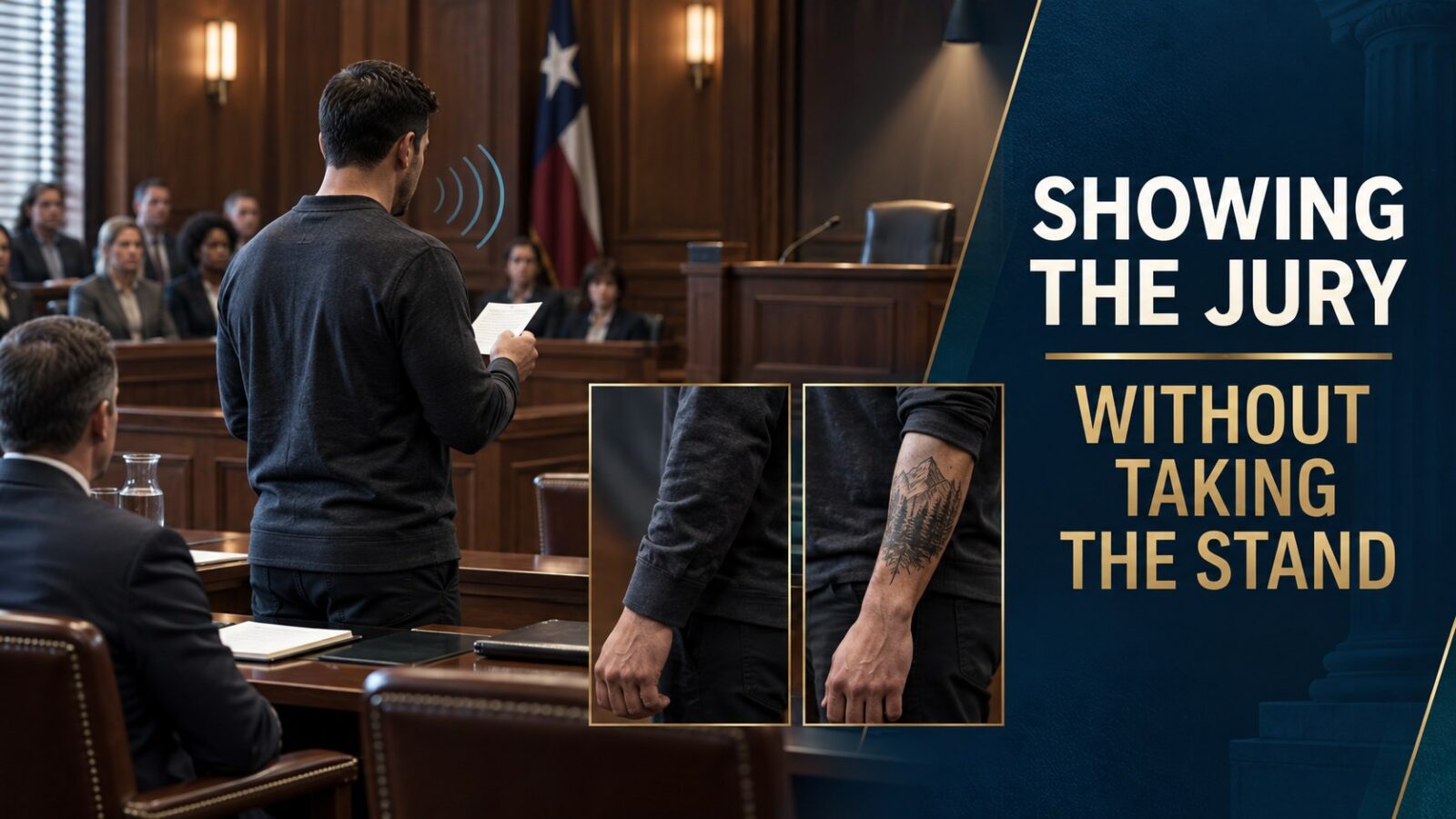
It does not. That is settled in Texas, and it was settled in a DWI case.
The Distinction the Whole Issue Turns On
The Fifth Amendment protects you from being compelled to be a witness against yourself. But it does not protect every piece of incriminating evidence that comes from your body. It protects testimonial communication, which means something that explicitly or implicitly relates a factual assertion or discloses information.
The Supreme Court drew that line in a DWI case. Schmerber v. California, 384 U.S. 757, 765 (1966), held that taking a blood sample from a man arrested for drunk driving, over his objection, did not violate the privilege, because the evidence was neither his testimony nor evidence relating to some communicative act. The definition the later cases quote comes from Doe v. United States, 487 U.S. 201, 210 (1988): to be testimonial, a communication must itself, explicitly or implicitly, relate a factual assertion or disclose information. That is why the State can take your blood, your fingerprints, your handwriting, and your voice without running into the privilege. In United States v. Wade, 388 U.S. 218, 222-23 (1967), the Supreme Court held that making a suspect speak words the robber had used was not compulsion to make a testimonial statement, because he was required to use his voice as an identifying physical characteristic, not to speak his guilt. In United States v. Dionisio, 410 U.S. 1, 7 (1973), the Court said voice recordings taken to measure the physical properties of a voice, rather than for the content of what was said, fall outside the privilege. Pennsylvania v. Muniz, 496 U.S. 582, 592 (1990), put it that requiring a suspect to reveal the physical manner in which he articulates words does not, without more, compel a testimonial response.
Prosecutors have relied on that rule for decades. The interesting question is what happens when the defendant wants to use it.
Sauce for the Goose
The federal answer came in a bank robbery case. In United States v. Bay, 762 F.2d 1314 (9th Cir. 1985), defense counsel asked to show the jury the tattoos on the backs of Bay’s hands. The trial court said that would be testimony. The Ninth Circuit disagreed and did so in a sentence worth remembering: this is one case in which it is proper to apply the sauce for the goose is sauce for the gander maxim. If the government can compel a defendant to display a physical characteristic without triggering the privilege, the defendant can display it voluntarily without surrendering the privilege.
Bay also supplies the most useful phrase in this area, and it is worth using precisely. Courtroom geography, the court said, which apparently prevented the jury from seeing Bay’s hands, should not determine whether Bay had to take the stand to present potentially exculpatory physical evidence. Note what that sentence is about. It is not a test for what makes evidence testimonial. It is about compulsion: the accident of where a defendant sits, and what the jury can or cannot make out from there, should not be what forces him onto the witness stand. The classification point is the separate one, that a tattoo does not become testimony because the defense rather than the government offers it.
Williams v. State: A Texas DWI Case
In 1999 a Hood County officer stopped Theodore Williams on suspicion of driving while intoxicated. At the jail, his speech and demeanor were videotaped, and at trial the State put the video in front of the jury to show that his speech was slurred.
After the State rested, Williams asked to rebut it in the most direct way available. He wanted to give the jury an exemplar of his normal speech by reading five neutral paragraphs from the court’s charge, the language stating the accusation and defining terms. He asked to do it without waiving his privilege, so that the State could not cross-examine him. The trial court refused. The jury convicted him of felony DWI. The Fort Worth Court of Appeals affirmed, reasoning under Rule 403 that letting a defendant avoid cross-examination while tendering a voice exemplar risked unfair prejudice to the State and risked misleading the jury.
Justice Dauphinot dissented below with the sentence that frames the whole issue: the evidence does not morph into testimonial evidence just because it is introduced by the defendant instead of the State.
The Court of Criminal Appeals agreed with her. In Williams v. State, 116 S.W.3d 788 (Tex. Crim. App. 2003), Judge Keasler, writing for a seven-judge majority, held that a voice exemplar is not testimonial, whether it is offered by the State or by the defendant, and that a defendant who offers one does not waive his Fifth Amendment rights and is not subject to cross-examination. Presiding Judge Keller dissented, on preservation rather than on the merits.
On preservation, the State had a real argument, because Williams never actually gave the exemplar. The court distinguished Luce v. United States and Jackson v. State, where defendants who declined to testify could not complain about rulings on impeachment, reasoning that those cases involved testimony while this one involved physical evidence, so the State had no right to cross-examine at all. It also mattered that there was no uncertainty about what would have been offered, because Williams had made a bill of exceptions at the close of punishment evidence, a recording of himself reading five paragraphs from the court’s charge.
Two parts of the reasoning are worth having at hand. First, the court rejected the Rule 403 route directly: Rule 403 is an evidentiary rule, and whether evidence survives it does not resolve the greater constitutional question of whether the evidence is testimonial. A trial court cannot use a balancing test to convert non-testimonial evidence into testimony. Second, on probativeness and prejudice, the court said those judgments must be made case by case, and it cannot be said that in every case the absence of cross-examination makes the evidence more prejudicial than probative.
The Court of Appeals Wrote the Next Case
There is an unsettling detail in the 2002 Fort Worth opinion. Explaining why cross-examination ought to follow such a display, the majority imagined a sexual assault case in which the victim testified her attacker had no tattoos on his arms. Picture the defendant rolling up his sleeves for the jury, the court said, whereupon a prosecutor might be expected to want to cross-examine him about when the tattoos were made, where they were made, the name of the artist, and so on.
Justice Dauphinot answered that in dissent, and her answer is the better law: a prosecutor might be expected to want to cross-examine the defendant in every criminal trial, but that desire does not outweigh a defendant’s right to refuse to testify. Hold that thought.
What Happened on Remand
Winning the principle is not the same as winning the case, and Williams is the proof. On remand the Fort Worth court decided Williams v. State, 145 S.W.3d 737 (Tex. App. Fort Worth 2004, no pet.) (op. on remand), and went further than the voice. Williams was missing his upper teeth and several lower teeth, what the 2002 opinion called the partially toothless condition of his mouth, and that was his explanation for how he sounded. The court held he should have been allowed to let the jury see inside his mouth as well. The prosecutor had told the jury that even with the worst speech impediment in the world, nobody sounds like that unless they have had too much alcohol, and then: his speech says it all. The court reversed and remanded for a new trial.
Then finish the story, because it is the honest version and it makes the point harder rather than softer. Williams was tried again, convicted of felony DWI again, and sentenced to twenty years again. The Fort Worth court affirmed, Justice Dauphinot writing. Williams v. State, 184 S.W.3d 352 (Tex. App. Fort Worth 2006). He won the constitutional question and he won a new trial. He did not win the case. The exemplar is a tool, not a verdict.
The Same Error, Twenty-Three Years Later
On September 3, 2026, the Ninth Circuit reversed Eduardo Valencia’s convictions for Hobbs Act robbery and a related firearm count. Valencia has tattoos across the backs of both hands. The surveillance video of the robbery showed a robber whose hand, where a glove came off, did not clearly show tattoos. His lawyer wanted him to hold up his hands for the jury so the defense could argue he was not the person in the video.
The district court ruled that displaying his hands would be testimonial and that he would have to take the stand and submit to cross-examination. Here is where this case diverges from Williams, and why it is the more frightening of the two. Valencia took the stand. He testified about his tattoos. The government cross-examined him. Then, after court, it moved to reopen its case for newly discovered evidence, recalled the investigating agent, and put in a Facebook photograph posted June 11, 2020 showing him without finger tattoos. The reopening is the part to sit with: taking the stand did not just expose him to cross, it handed the government a second bite at its case in chief. That is the Fort Worth hypothetical from 2002, performed by a federal prosecutor twenty-four years later, with the outcome the Texas court had treated as an argument in favor of allowing the cross-examination.
The Ninth Circuit had already answered this in Bay, and said so. Be precise about what the government did and did not give up on appeal. It insisted there was no error and, in the alternative, that any error was harmless. What it conceded was narrow: that displaying the hands alone was not testimonial. Its harmlessness argument was that the jury could see Valencia’s hands anyway while he sat at counsel table. The Ninth Circuit was not persuaded, holding that this missed the point and that the fundamental error was forcing him to take the stand in order to display an identifying physical characteristic. The convictions were reversed and the case remanded for a new trial.
The detail that makes this more than an ordinary mistake is that the district judge was warned, and warned by the prosecution. The government itself put Bay in front of the court, saying the defendant could just show the jury his hands and that it could not question him about it. The judge answered that he was willing to roll the dice. The Ninth Circuit picked up the metaphor, holding that Bay was and is controlling law and that the district court’s decision not to apply it, at the expense of Valencia’s Fifth Amendment right not to testify, was error, snake eyes, by any measure.
Set the two cases side by side. Williams never gave the exemplar, because the judge had conditioned it on his taking the stand, and he preserved the issue anyway, because the Court of Criminal Appeals held that the usual rule requiring a defendant to actually testify did not apply where the evidence at issue was physical rather than testimonial, and where a bill of exceptions made clear exactly what would have been offered. Valencia accepted the court’s premise, testified, and handed the government a cross-examination and an impeachment exhibit it would never otherwise have had. Both won on appeal. Only one of them had to testify to get there.
Is Error Harmless?
Here is what a practicing lawyer most needs to know, and it is not encouraging. Williams wins the constitutional point in the Texas cases that have cited it since 2003. The defendant usually loses the appeal anyway, on harm.
Harmon v. State, 167 S.W.3d 610 (Tex. App. Houston [14th Dist.] 2005, pet. ref’d), is the clearest example. Note precisely what the error was: the court held it was error to refuse to allow the defendant to stand and walk in front of the jury without being subject to cross-examination. The problem was the condition, not a flat refusal.
It then held the error harmless under Rule 44.2(a), the stricter constitutional standard, and it gave five reasons rather than one. The complainant identified him unequivocally in court and in a photo lineup. Still frames from the ATM surveillance video were in evidence. The jury saw his height when he entered the courtroom at the beginning of each day of trial. The jury saw his hair and eyes while he sat at the defense table. And counsel was able to argue the point in closing.
Among those reasons is the one the Ninth Circuit rejected in Valencia: what the jury could see at the defense table. The government made the same argument about Valencia’s hands, and the court answered that it missed the point, because the fundamental error was forcing him onto the stand to display a physical characteristic. Be fair about the weight. In Harmon that reasoning was one of five grounds supported by an unequivocal identification and video stills, not the whole of the harm analysis. The comparison is still worth making, and it is more persuasive stated accurately than stretched.
So, expect to win the objection and to face a harm fight on appeal, and build the record with that in mind. Make clear what the jury could not observe passively: how a voice sounds when speaking at length rather than sitting silently, how a person walks, what the inside of a mouth looks like. Passive visibility at counsel table is not a substitute for a demonstration, and the record should say why in this case.
What Counts and What Does Not
The line is between the physical characteristics of the evidence and the content of a communication.
- Generally not testimonial: the sound and articulation of your voice, tattoos, height and build, the appearance of your hands, the inside of your mouth, the way you stand and walk, handwriting characteristics, blood and breath, fingerprints, trying on an item of clothing.
- Testimonial: anything that asserts a fact or discloses information. Narrating what happened, explaining when you got a tattoo, answering why you were slurring. The moment the demonstration becomes an explanation, the privilege is in play.
That boundary is exactly where Valencia lost ground at trial. Holding up his hands was a display. Testifying about when the tattoos were done was an assertion, and that assertion is what the Facebook photograph was used to attack.
One more honest limit, because this rule is not a one-way street. The same physical-characteristic principle that lets your client show the jury his hands lets the State show the jury his ink. In Woodward v. State, 170 S.W.3d 726, 729-30 (Tex. App. Waco 2005, pet. ref’d), the court held a defendant’s tattoo was properly admitted at punishment over a Rule 403 objection, and the Amarillo court cited it for that point as recently as March 2026. Know that before you build a strategy around what the body can be made to show.
Why This Matters in a DWI Case
Williams is a DWI case, and the situation that produced it is ordinary. Most Texas DWI prosecutions rest substantially on video. The State plays the roadside and the jail recording and asks the jury to hear slurred speech, watch unsteady balance, and draw a conclusion.
Sometimes the answer is that the person sounds and moves that way sober. A regional accent, a speech impediment, a neurological condition, an old injury, dentures, exhaustion, nerves, or simply the acoustics of a patrol car microphone can all produce what an officer calls slurred speech. Williams means a defendant can put the comparison in front of the jury directly, without surrendering the right to silence, and without a prosecutor getting to ask about anything else.
The same logic reaches the physical tests. If the State’s theory is that swaying or stumbling proves intoxication, a defendant’s ordinary gait or balance is a physical characteristic too, and our page on field sobriety testing covers how much those tests actually establish. The point is general: where the State’s evidence invites an inference from how your body looks or sounds, your body is available to answer it.
Practical Notes
- Keep the demonstration clean. Williams read neutral paragraphs from the court’s charge. Nothing he read asserted a fact about the case. Choose material that cannot be characterized as a statement.
- Make a record. Williams made a bill of exceptions with a recording, which is part of why the appellate court could evaluate the issue at all. If the request is refused, get the proposed demonstration into the record.
- Do not accept the invitation to testify. Valencia shows the cost. Once a defendant takes the stand to do what he had a right to do silently, the cross-examination and the impeachment evidence that follow are real and are not undone by the fact that the ruling was wrong.
- Expect a Rule 403 objection and answer it with Williams. A balancing rule does not decide the constitutional question of whether evidence is testimonial.
- Watch the boundary. The display is protected. The explanation is not.
Twenty-three years after Williams, a federal district court made the same mistake, and it cost a defendant a trial. The principle is not complicated, but it has to be raised, and it has to be raised in the right form. For more on building a defense around the State’s own evidence, see our pages on DWI defenses and tests and evidence.
If you are facing a DWI or criminal charge in Texas and the State’s case rests on video or identification evidence, call Deandra Grant Law at (214) 225-7117 for a free, confidential consultation.
Deandra Grant holds a Master of Science in Pharmaceutical Science, a Graduate Certificate in Forensic Toxicology, and the ACS-CHAL Forensic Lawyer-Scientist designation. She is the author of the Texas DWI Manual.
This article is general legal information for educational purposes, not legal advice. Verify all citations before relying on them in any filing.
Sources and Further Reading
- Williams v. State, 116 S.W.3d 788 (Tex. Crim. App. 2003), opinion.
- United States v. Valencia, No. 24-3820 (9th Cir. Sept. 3, 2026), opinion.
- United States v. Bay, 762 F.2d 1314 (9th Cir. 1985), opinion.
- Williams v. State, 145 S.W.3d 737 (Tex. App. Fort Worth 2004) (on remand), opinion.
- Williams v. State, 74 S.W.3d 902 (Tex. App. Fort Worth 2002), opinion.
- Williams v. State, 184 S.W.3d 352 (Tex. App. Fort Worth 2006) (affirming reconviction on retrial), opinion.
- Harmon v. State, 167 S.W.3d 610 (Tex. App. Houston [14th Dist.] 2005), opinion.
- Woodward v. State, 170 S.W.3d 726, 729-30 (Tex. App. Waco 2005, pet. ref’d) (tattoo properly admitted at punishment over a Rule 403 objection), opinion.
- United States v. Wade, 388 U.S. 218 (1967), opinion.
- United States v. Dionisio, 410 U.S. 1 (1973), opinion.
- Pennsylvania v. Muniz, 496 U.S. 582 (1990), opinion.
- Doe v. United States, 487 U.S. 201 (1988), opinion.
- Schmerber v. California, 384 U.S. 757 (1966), opinion.
Which county your case is filed in changes how it is charged, who prosecutes it, and which court hears it.
Deandra M. Grant, JD, GC, MS, ACS-CHAL Forensic Lawyer-Scientist
She holds a Master of Science in Pharmaceutical Science and a Graduate Certificate in Forensic Toxicology, both from the University of Florida. She is the author of The Texas DWI Manual and has defended Texas DWI cases since 1994.
Facing Criminal Charges in Texas?
The sooner a defense lawyer is involved, the more can be done to protect your record and your freedom. Talk to us today.
Request a Free Case Evaluation
Tell us what happened. We'll respond as soon as possible.