
How Can Video Evidence Be Enhanced or Authenticated for Use in Court?

Surveillance video that appears too dark, too blurry, or too small to be useful may actually contain valuable evidence for the defense. Conversely, video that the prosecution presents as clear and compelling may have been manipulated, taken out of context, or processed in ways that altered its meaning. In both situations, forensic video analysis can change the trajectory of a criminal case.
What Is Forensic Video Enhancement?
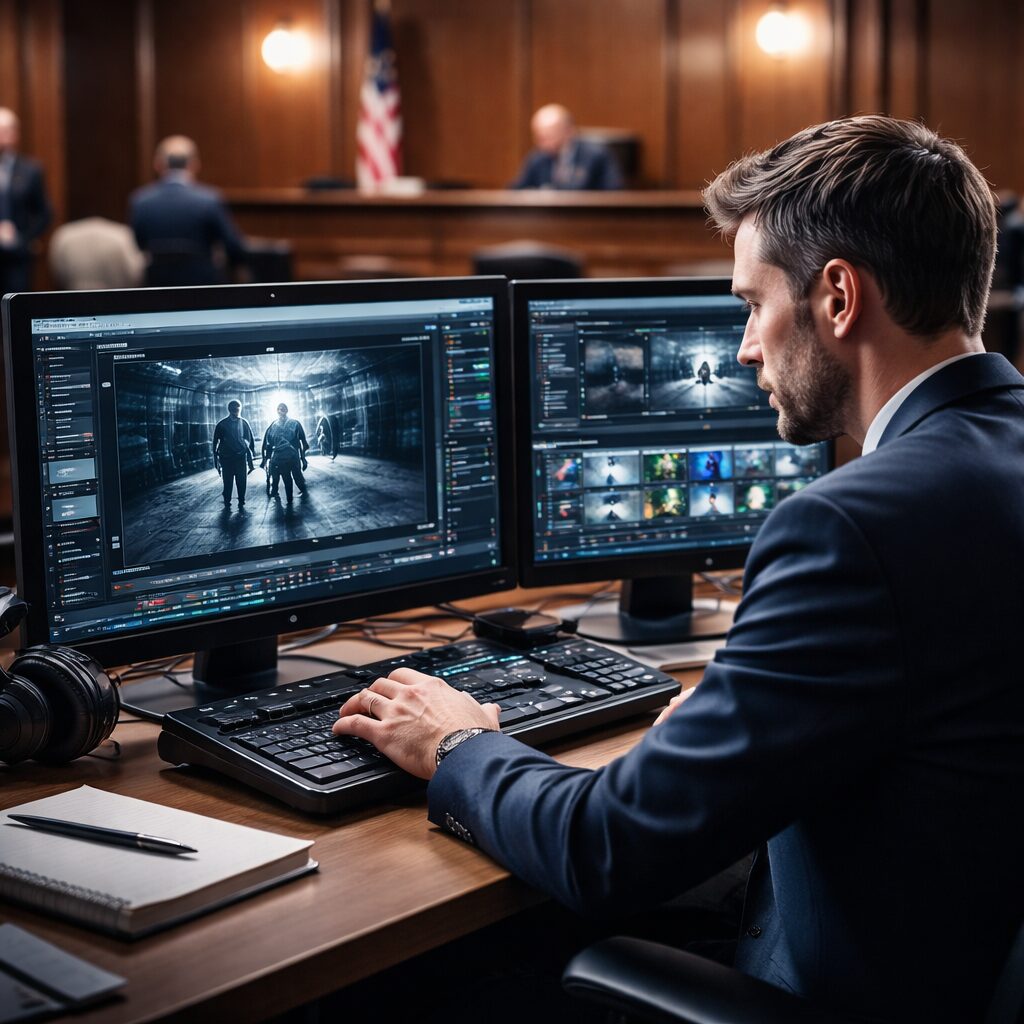
Forensic video enhancement is the scientific process of improving the visual quality of video recordings to make them more useful as evidence. Unlike the dramatic “enhance” scenes from television, forensic enhancement operates within the constraints of the data actually contained in the recording. It cannot create detail that does not exist in the original footage, but it can reveal detail that is present but difficult to see.
Enhancement techniques include:
- Super resolution and image sharpening — combining data from multiple frames to produce a higher-resolution image than any single frame provides
- Light level correction — adjusting exposure and contrast to reveal detail in dark or overexposed footage
- Color correction — adjusting color balance to provide accurate representation of colors, which can be critical for identifying clothing, vehicles, and other objects
- Lens correction — compensating for distortion introduced by wide-angle or fish-eye lenses commonly used in surveillance cameras
- Motion tracking — following specific objects or individuals through a video sequence
- Photogrammetry — measuring distances, heights, and spatial relationships from video footage
All enhancement must be performed using non-destructive methods where the original footage is preserved unaltered, and all enhancement is applied to a working copy with full documentation of the process.
Video Authentication: Proving the Video Is Real
Authentication is the process of determining whether a video recording is an accurate, unaltered representation of what was actually recorded. This is increasingly important in an era when sophisticated editing tools are widely available and AI-generated video is becoming more realistic.
Authentication analysis examines:
- Whether the video file’s metadata is consistent with the recording device’s native format
- Whether the video has been recompressed, which may indicate editing
- Whether pixel patterns are consistent throughout the video or show signs of compositing
- Whether the audio track is synchronized with the video and shows signs of editing
- Whether the video’s noise characteristics are consistent throughout, or show anomalies that indicate manipulation
How Video Forensics Helps the Defense
Revealing Exculpatory Detail
Surveillance footage that appears unclear at first viewing may contain details that support the defense. Enhancement can reveal facial features, license plate numbers, timestamps, and actions that establish the defendant’s innocence or contradict the prosecution’s narrative.
Challenging Prosecution Video
When the prosecution presents video evidence, Doug evaluates how the video was collected, processed, and presented. Was the original footage preserved? Has it been edited or cropped? Are the enhancement techniques used by the prosecution scientifically sound, or have they introduced artifacts or distortions?
Establishing Timeline
Video from multiple sources can be synchronized and analyzed to create a comprehensive timeline of events. This can establish where the defendant was at specific times and contradict the prosecution’s theory of the case.
Talk to a Defense Team That Understands Digital Evidence
At Deandra Grant Law, Attorney Douglas Huff is our Partner and Criminal Division Chief — a senior trial attorney who has completed advanced training in digital forensics with Garrett Discovery, one of the nation’s leading digital forensics firms. Doug doesn’t just read the prosecution’s forensic reports. He has the training to understand the tools, challenge the methods, and expose the weaknesses in digital evidence.
If you are facing criminal charges involving digital evidence of any kind, contact Deandra Grant Law for a free, confidential case review.
Call (214) 225-7117 or schedule an appointment online at texasdwisite.com.
Which county your case is filed in changes how it is charged, who prosecutes it, and which court hears it.
Deandra M. Grant, JD, GC, MS, ACS-CHAL Forensic Lawyer-Scientist
She holds a Master of Science in Pharmaceutical Science and a Graduate Certificate in Forensic Toxicology, both from the University of Florida. She is the author of The Texas DWI Manual and has defended Texas DWI cases since 1994.
Charged With a Crime?
Whatever you're facing, a DWI or any criminal charge, the sooner you have a forensic-trained team on it the more we can do. Tell us what happened and we'll review your options, at no cost and no obligation. Intake answers 24/7, and if your case is one we can take on, we schedule a free consultation with an attorney.
Request a Free Case Evaluation
Tell us what happened. We'll respond as soon as possible.