
Texas Implied Consent Law: What It Means, What It Requires, and Where It Can Be Challenged

Texas implied consent means that, after a lawful DWI arrest, you are deemed to have consented to a breath or blood test. It does not mean police can take a specimen whenever they want. The officer must make a proper request, give the DIC-24 statutory warning, and have a lawful arrest supported by probable cause. You can refuse, but refusal triggers license consequences and can be used as evidence. If the warning was wrong, the arrest was unlawful, or a blood warrant was defective, the test or refusal can be challenged.
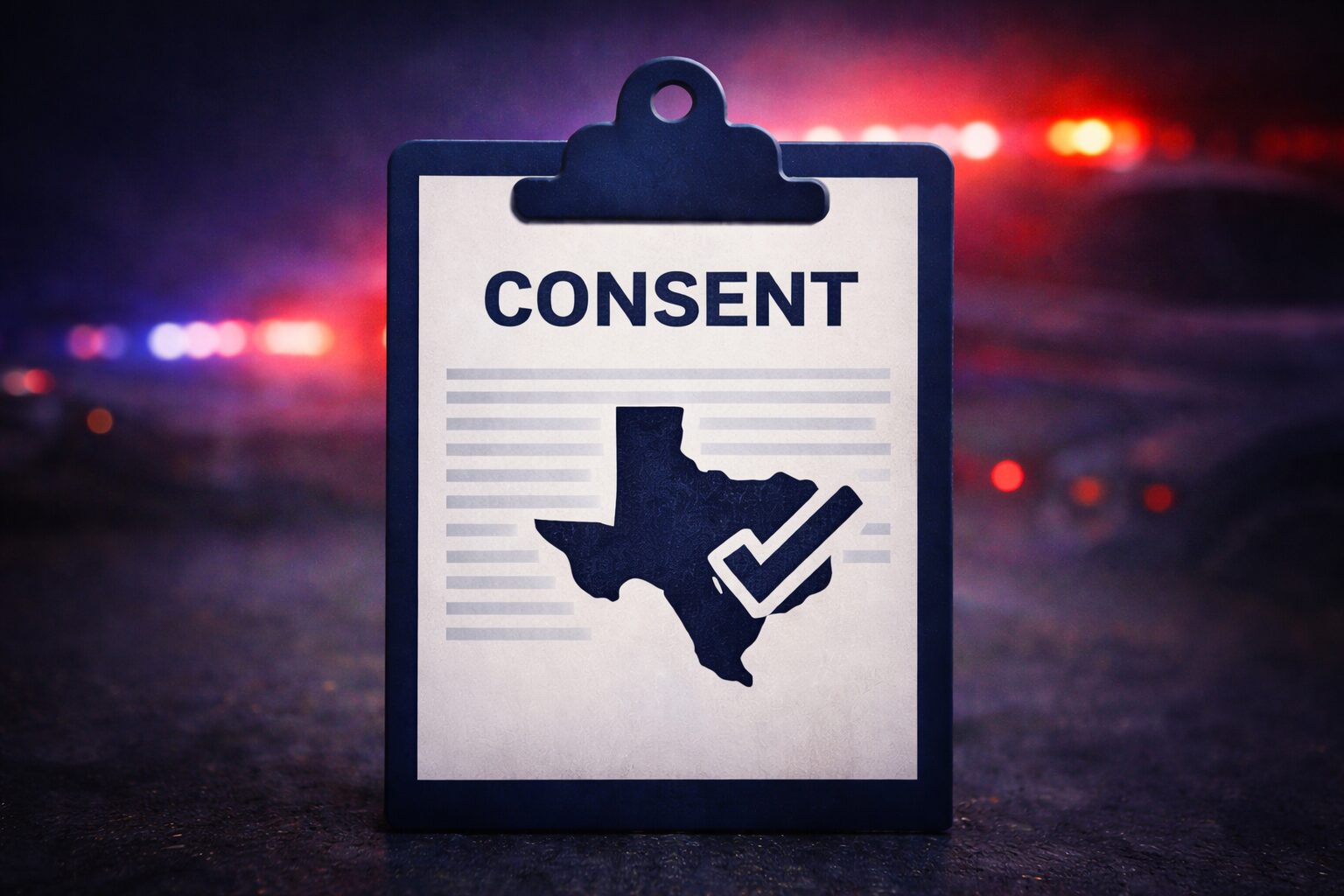
Texas Transportation Code §724.011 provides that any person who operates a motor vehicle in a public place in Texas is deemed to have consented to providing a specimen of breath or blood if lawfully arrested for a DWI offense. This is the implied consent law. Understanding what it actually requires and where its application can be challenged is more useful than a general description of the concept.
What the Implied Consent Law Actually Says
Three things are worth stating precisely at the outset, because they are commonly misunderstood.
First: the consent is implied at the time of arrest, not the time of driving. Implied consent attaches when a person is lawfully arrested for DWI, not when they are initially stopped. A traffic stop alone does not trigger implied consent obligations. The arrest (and the lawfulness of that arrest) is the predicate.
Second: Texas implied consent covers breath or blood only. Urine testing is not an authorized specimen type under Texas’s implied consent statute. The choice between breath and blood testing involves its own set of rules and strategic considerations, but urine is not part of the Texas DWI testing framework.
Third: implied consent does not mean the government can take a specimen without a warrant. A driver can refuse. The legal consequences of refusal are significant, but refusal does not authorize a non-consensual blood draw without a warrant. After refusal, officers must obtain a search warrant to compel a blood specimen unless one of the narrow statutory warrant exceptions applies.
The DIC-24 Warning: A Mandatory Prerequisite
Before requesting a specimen following a DWI arrest, the arresting officer must provide the DIC-24 statutory warning which is an advisement that informs the driver of the consequences of refusing and the consequences of providing a specimen. This is not a courtesy. It is a mandatory statutory requirement under Texas Transportation Code §724.015.
The DIC-24 warning must inform the driver that: refusing to submit to a specimen will result in a driver’s license suspension of not less than 180 days; if the driver has a prior conviction or prior refusal, the suspension period is two years; and evidence of the refusal may be admissible in any subsequent criminal proceeding. The warning must be given in a language the driver understands.
Failure to properly administer the DIC-24 is a complete defense to the ALR suspension for refusal. If the officer did not give the statutory warning, gave it inaccurately, or gave it in a language the driver could not understand, the administrative license suspension cannot stand. This is not a technicality. It is an explicit statutory requirement that the government must satisfy. Reviewing the exact circumstances of the DIC-24 advisement is part of the defense analysis in every refusal case.
Consequences of Refusing: The ALR Suspension
When a driver refuses a breath or blood specimen following a lawful DWI arrest and a proper DIC-24 warning, Texas DPS initiates an Administrative License Revocation (ALR) proceeding. The ALR process is civil and administrative which means it runs entirely separately from the criminal DWI case.
The suspension periods for refusal:
First refusal: 180-day suspension. Compare this to the 90-day suspension for a failed test on a first offense. Refusal produces the longer suspension, not the shorter one.
Second or subsequent refusal, or refusal with prior DWI conviction: Two-year suspension.
Commercial driver’s license holder: A refusal-based ALR suspension triggers a one-year CDL disqualification regardless of whether the driver was operating a commercial vehicle at the time of the DWI arrest.
Whether to Refuse: The Factors That Actually Matter
There is no universal right answer, and the decision has to be made in the seconds between the officer’s request and your response, which is the fundamental problem with it. The considerations that actually drive the analysis are these.
How much time has passed since your last drink. Alcohol concentration rises and falls. Depending on when you stopped drinking relative to when you were stopped, a test taken later may read higher or lower than your level while you were actually driving. This is the retrograde extrapolation issue, and it cuts both ways.
What evidence already exists. If the stop was recorded, you performed poorly on the field sobriety tests, and the report already documents significant signs of impairment, a refusal may not meaningfully change the evidentiary picture. If the stop was weak and the officer’s observations were thin, a refusal denies the State what might have been its strongest evidence.
Your prior history and your license needs. A prior conviction or a prior refusal means a longer suspension. If your license is critical to your employment, that calculation changes.
Medical and physiological factors. Acid reflux, GERD, diabetes, certain respiratory conditions, and occupational chemical exposure can all make a breath result unreliable in ways a blood result would not be. In that situation, declining the breath test may produce more accurate evidence, not less.
The 15-Day Deadline: The Most Urgent Fact After a DWI Arrest
From the date you are served notice of suspension you have 15 days to request an ALR hearing. This is not a suggestion. The notice you were served doubles as a temporary driving permit valid for 41 days, so your license does not stop working the night of the arrest, and that permit runs out on its own schedule whether or not you have requested the hearing. If the hearing request does not reach DPS within 15 days, your license is suspended automatically (for the full statutory period) with no further opportunity to contest it.
When a timely hearing request is received, DPS issues a stay of the suspension, meaning your license remains valid while the case is pending before the State Office of Administrative Hearings (SOAH). The stay can last months. Missing the deadline forfeits both the hearing and the stay.
The 15-day clock runs from the date of notice of suspension, not the date charges are filed, not the date you hire an attorney, not the date you receive paperwork in the mail.
In a blood case that notice usually arrives by mail weeks after the arrest, which is why the deadline works differently when you gave blood. Either way the license case is one of two separate cases the arrest created, and it does not wait for the criminal side.
What Happens at the ALR Hearing
The ALR hearing is conducted by an administrative law judge at the State Office of Administrative Hearings. DPS bears the burden of proving its case for suspension by a preponderance of the evidence. In a refusal case, DPS must establish: the officer had reasonable suspicion to stop the vehicle or probable cause to detain; the officer had probable cause to arrest for DWI; the officer properly administered the DIC-24 warning; and the driver refused to submit to a specimen.
Each element is subject to challenge. If DPS fails to prove any one of them, the suspension must be denied. The hearing is also strategically valuable for the criminal defense: the arresting officer testifies under oath and is cross-examined. That testimony is recorded and can be used in the criminal case for impeachment if the officer’s account later changes.
Challenging the Implied Consent Framework in a Specific Case
The legal questions that arise in implied consent cases are specific, not abstract. The challenges that actually succeed are grounded in the facts of the individual case.
Was the stop lawful?
Implied consent attaches only to a lawful arrest. The lawfulness of the arrest depends in turn on the lawfulness of the stop. An officer who lacked reasonable suspicion to initiate the traffic stop has tainted the chain of events that follows. Under Texas’ Article 38.23 exclusionary rule (which has no good faith exception) evidence obtained following an unlawful stop is suppressible. This includes the chemical test result, the DIC-24 warning, and the refusal itself.
Was the DIC-24 properly administered?
As described above, the statutory warning is a prerequisite to the refusal consequences. Whether it was given, whether it was complete, and whether it was given in a language the driver understood are factual questions examined in every refusal case.
Was probable cause for the arrest sufficient?
The arrest itself must be supported by probable cause to believe the driver was operating a motor vehicle while intoxicated. This may come from officer observations, odors, statements made to the officer and field sobriety tests.
Was the blood draw warrant legally sufficient?
When a driver refuses and law enforcement seeks a blood draw warrant, the warrant affidavit must establish probable cause. A defective affidavit may produce a suppressible blood draw. Under Franks v. Delaware, the defense can challenge the veracity of the affidavit itself.
The Chemical Test Result as Evidence
If a specimen was provided (breath or blood) the result is evidence in the criminal case but is not automatically dispositive. If no specimen was provided and no warrant followed, the State loses the per se theory altogether: there is no number to put in front of a jury, and the case has to be proved on lost normal use from the officer’s observations instead. Breath test results from the Intoxilyzer 9000 are subject to challenge on calibration, the observation period, partition ratio variability, and operator compliance with the approved protocol. Blood test results are subject to challenge on collection procedure, storage conditions, chain of custody, and laboratory methodology.
Deandra Grant holds the ACS-CHAL Forensic Lawyer-Scientist designation along with a Master of Science in Pharmaceutical Science and a Graduate Certificate in Forensic Toxicology. Partner Douglas Huff holds the same ACS-CHAL designation. Chemical test results in DWI cases defended by Deandra Grant Law are evaluated at the analytical chemistry level, not just checked against procedural boxes.
If you were arrested for DWI in Dallas County or North Texas and need to address the ALR deadline or the chemical testing in your case, call (214) 225-7117 for a free, confidential case review. The 15-day ALR deadline runs from the date of service of the notice of suspension.
The other guides in this section.
Before the Lights
The Stop and the Arrest
The Legal Machinery
Which county your case is filed in changes how it is charged, who prosecutes it, and which court hears it.
Deandra M. Grant, JD, GC, MS, ACS-CHAL Forensic Lawyer-Scientist
She holds a Master of Science in Pharmaceutical Science and a Graduate Certificate in Forensic Toxicology, both from the University of Florida. She is the author of The Texas DWI Manual and has defended Texas DWI cases since 1994.
Charged With a DWI in Texas?
Intake answers 24/7, and if your case is one we can take on, we schedule a free consultation with an attorney.
Request a Free Case Evaluation
Tell us what happened. We'll respond as soon as possible.