
How Reliable Is Blood Spatter Analysis?

On television, blood spatter analysis looks like certainty. An expert studies the drops and streaks at a crime scene and announces exactly where the victim stood, how the blow was struck, and who did it. In a Texas courtroom, that same aura of scientific precision can help send a person to prison for decades. The problem is that the confidence is often not matched by the science, and when the two come apart, the consequences fall on the accused.
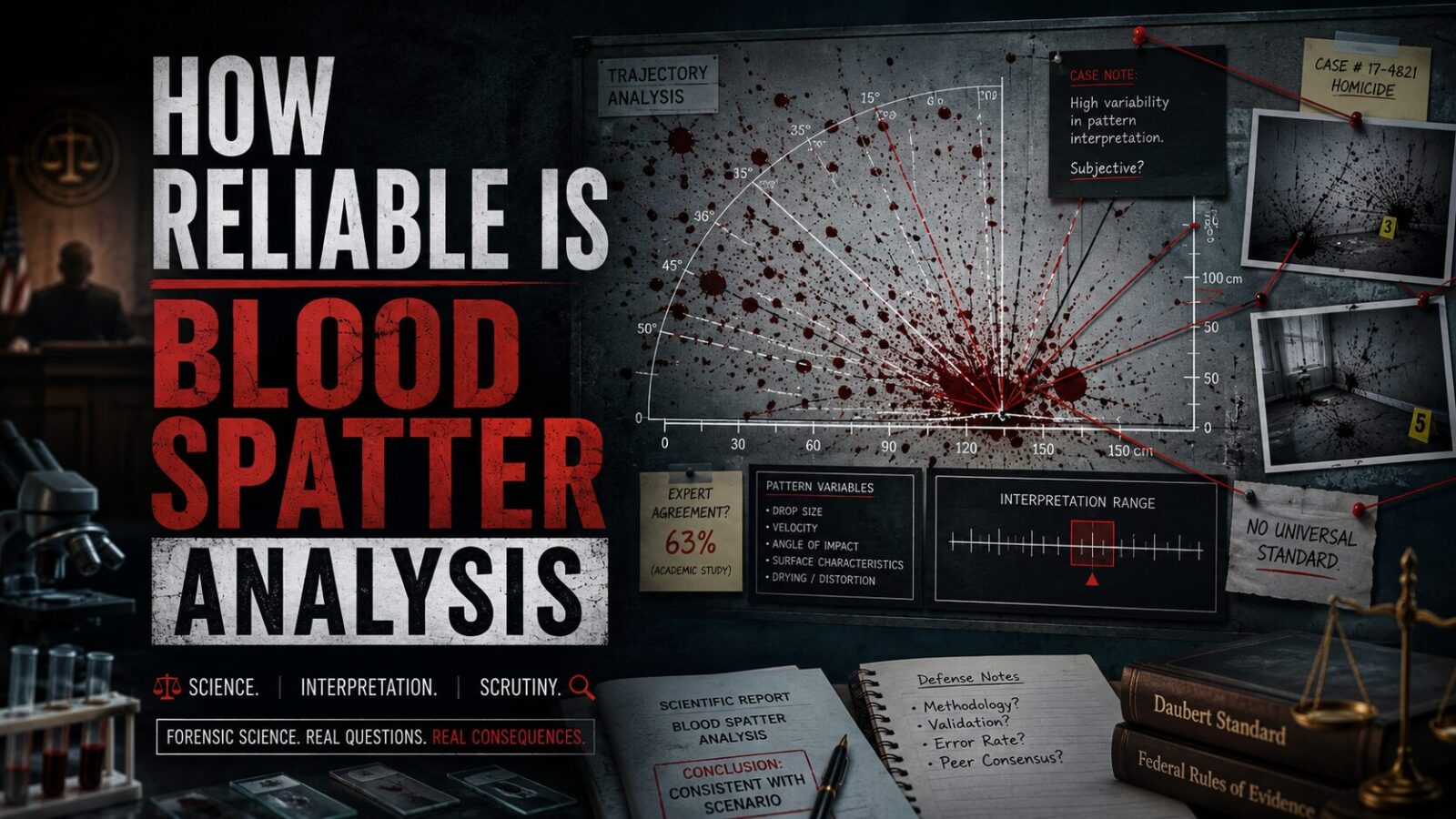
Blood spatter analysis, more formally called bloodstain pattern analysis or BPA, was one of the disciplines singled out for criticism in the landmark 2009 National Academy of Sciences report on forensic science, and the research done since has deepened rather than eased those concerns. This post explains what the discipline claims to do, where it breaks down, what the studies actually show, and how a Texas defense challenges blood-spatter evidence, anchored by the case of a Texas principal who lost more than thirty years to it.
What Blood Spatter Analysis Claims to Do
Bloodstain pattern analysis treats the blood left at a scene as a record that can be read backward to reconstruct a violent event. Analysts sort stains into broad categories: passive stains, which fall or pool under gravity; transfer stains, left when a bloody object touches a surface; and spatter, the small droplets thrown off by force, whether from a blow, a gunshot, or blood flung from a swinging weapon.
From there the discipline gets more ambitious. Because a blood droplet striking a surface at an angle leaves an elongated, roughly elliptical stain, an analyst can use the shape of the stain to estimate the angle at which it landed. By combining the angles of many stains and projecting them backward, an analyst tries to locate the area of origin, the point in space where the blood came from. Layered on top of that geometry are opinions about sequence, movement, the type of force, the position of the people involved, and even which account of events the physical evidence supports. It is that final layer, the narrative reconstruction, that does the heavy lifting in a courtroom and that the science supports least.
Where the Science Breaks Down
The geometry at the core of BPA rests on real physics. The trouble is everything that sits on top of it. A stain’s final shape depends on the surface it hits, the volume and velocity of the droplet, the texture and absorbency of the target, drying, gravity, air resistance, and interference from other droplets and surfaces. Reconstructing a three-dimensional event from two-dimensional stains requires assumption after assumption, and small errors compound quickly. The result is that the uncertainty around a confident-sounding conclusion is often enormous.
Three problems compound the uncertainty:
- It is a subjective judgment, not a measurement. Whether a given pattern is impact spatter, cast-off, or something else is a classification call, and analysts frequently disagree about which is which. The same subjectivity that shows up in other pattern-matching fields, the ones we cover in our post on fingerprint reliability, runs through BPA as well.
- Training varies wildly. There is no single required credential. Some analysts hold advanced science degrees; others have completed a single week-long, forty-hour course and then testify as experts. A conclusion is only as reliable as the person drawing it, and the courtroom rarely makes that distinction visible.
- Context can steer the conclusion. Analysts often work knowing the suspected story of the crime, and an ambiguous pattern can be read to fit that story. That kind of context bias is one of the mechanisms by which honest examiners reach wrong but confident conclusions.
There is also a threshold problem that is easy to overlook: before any pattern can mean anything, someone has to confirm the stain is actually human blood. As the Texas case below shows, that step is sometimes skipped entirely.
What the Research Actually Shows
This is not just a defense-lawyer critique. The 2009 NAS report concluded that the opinions of bloodstain pattern analysis are, in its words, “more subjective than scientific,” warned that the uncertainties are large, and cautioned that extra care is needed in how these analyses are presented to a jury. It noted that reliable BPA demands an understanding of fluid dynamics, physics, and mathematics that many practitioners simply do not have. The report placed blood spatter in the company of other pattern-comparison disciplines whose courtroom confidence has outrun the underlying science, among them firearm and tool-mark identification and microscopic hair comparison.
In 2021, researchers put the discipline to its most rigorous test. In a large black-box study funded by the National Institute of Justice and carried out by Noblis, 75 practicing analysts examined 150 bloodstain patterns presented as 192 images, generating more than 33,000 responses. The findings were sobering. On samples where the true cause was known, 11.2 percent of the conclusions were erroneous, roughly one in nine. Analysts contradicted one another about 7.8 percent of the time. And the errors were not random noise that a second look reliably caught: when an analyst reached a wrong conclusion, a second analyst corroborated that same wrong conclusion between 18 and 34 percent of the time.
In fairness, the study’s authors cautioned that these figures are not precise operational error rates, that real casework gives an analyst more context than a photograph does, and that the group consensus was usually correct. But they also stressed that the magnitude of the disagreement corroborated earlier research and should concern the field. For a defendant, the point is simpler still: a technique on which analysts disagree with each other, and even with themselves, is not the certainty a jury is often led to believe it is.
A Texas Cautionary Tale: The Joe Bryan Case
No case shows the stakes more clearly than that of Joe Bryan. Bryan was a beloved high school principal in Clifton, Texas, when his wife, Mickey, was murdered in their home in 1985. He was attending an education conference in Austin, roughly 120 miles away, and has always maintained that he was asleep in his hotel room. He was convicted of her murder, twice, and spent more than three decades in prison.
The case against him leaned heavily on bloodstain pattern analysis. A police detective named Robert Thorman, who had completed roughly forty hours of BPA training, testified that small flecks on a flashlight found in Bryan’s car trunk days after the murder were back spatter from a close-range shooting, and, with the prosecution, built a narrative that placed that flashlight in the killer’s hand. The flashlight’s connection to the crime was never established. Thorman did no serological testing of his own and assumed the flecks he was interpreting were human blood, and the only typing ever done, back in 1985, put the blood at type O, which matched Mickey Bryan but also roughly half the population, tying the flashlight to no one in particular.
In 2018, the case became the subject of a two-part ProPublica and New York Times Magazine investigation by Pamela Colloff titled “Blood Will Tell,” which questioned both the analysis and the thin training behind it. That year the Texas Forensic Science Commission reviewed the evidence and concluded that the blood-spatter analysis used to convict Bryan was “not accurate or scientifically supported.” At an evidentiary hearing, Thorman himself recanted in a sworn affidavit: “My conclusions were wrong. Some of the techniques and methodology were incorrect. Therefore, some of my testimony was not correct.”
And yet the conviction stood. The judge who heard the new evidence recommended against a new trial, reasoning in part that because Thorman had not specified which of his conclusions were mistaken, the court could not say the testimony had made a difference, and the Texas Court of Criminal Appeals denied relief. Bryan was finally released on parole in 2020, after being denied seven times. He was not exonerated. His case is a hard lesson: even when the state’s own science commission calls the forensic evidence unsupported, the procedural walls around a finished conviction can leave it standing anyway, which is exactly why the time to challenge this evidence is before a jury ever hears it.
Challenging Blood Spatter Evidence in Texas
Texas does not admit expert evidence just because it wears a scientific label. Its criminal courts apply the reliability standard from Kelly v. State, which requires the party offering scientific evidence to show that the underlying theory is valid, that the technique is valid, and that it was properly applied in the case at hand, with the proponent carrying that burden by clear and convincing evidence. Where BPA is offered as experience-based rather than hard science, the related Nenno standard applies, but the core demand is the same: the evidence has to be shown to be reliable, and a defendant can request a hearing to force that showing before trial.
Practical lines of challenge include:
- Attack the qualifications. How many hours of training does the analyst actually have, and in what? A forty-hour course is not a scientific credential.
- Demand the underlying material. The scene photographs, measurements, notes, and the analyst’s calculations are discoverable, and the reconstruction should be reproduced and tested, not taken on faith.
- Question the assumptions. Every area-of-origin estimate rests on assumptions about surface, volume, and trajectory. Each one is a place to introduce reasonable doubt.
- Confirm it is even blood. As the Bryan case shows, analysts sometimes assume a stain is human blood without testing it. Make the State prove the threshold fact.
- Expose context bias. What did the analyst know about the suspected narrative before forming an opinion, and how might that have shaped an ambiguous call?
- Retain an independent expert. The most effective answer to an overstated reconstruction is a qualified analyst who can show the jury how many other explanations the stains allow.
Texas also provides a post-conviction path when this kind of evidence has been discredited. The junk-science writ, Article 11.073 of the Code of Criminal Procedure, lets a convicted person seek relief when the scientific evidence has changed or been contradicted. It is the vehicle Joe Bryan pursued, and the fact that it did not save him is a lesson in how high the bar sits once a conviction is final. The Texas Forensic Science Commission has authority to investigate misuse of forensic disciplines, as it did in the Bryan case, and when a single trusted examiner’s work goes unchecked, the damage can run through hundreds of cases, a pattern we trace in our post on the Missy Woods DNA scandal.
The Bottom Line
Blood spatter analysis is not worthless, and careful, well-qualified analysts can offer genuinely useful observations about a scene. But the discipline has been oversold in American courtrooms for decades, presented as precise measurement when much of it is subjective interpretation, and the research now confirms what the 2009 NAS report warned: analysts are often wrong and often disagree. Like the bite-mark evidence that sent an innocent man to death row, blood spatter can carry more certainty in front of a jury than it can bear under scrutiny. For anyone facing a case built on it, the defense is the same one that runs through this whole series: demand the data, test the assumptions, and make the State prove that its science is actually science.
Deandra Grant is a forensic lawyer-scientist and the first attorney in Texas to earn the ACS-CHAL Forensic Lawyer-Scientist designation. She and Partner Douglas Huff, who also holds that designation, challenge forensic and scientific evidence in criminal cases across Texas. This post is part of the Deandra Grant Law forensic science series. If forensic evidence is central to your case, call (214) 225-7117 for a free, confidential case review.
This post is general legal information for educational purposes, not legal advice. Case citations and study findings should be independently verified against current sources before being relied on in any filing.
Sources and Further Reading
- R. Austin Hicklin et al., “Accuracy and Reproducibility of Conclusions by Forensic Bloodstain Pattern Analysts,” Forensic Science International 325 (2021); National Institute of Justice summary at nij.ojp.gov.
- Pamela Colloff, “Blood Will Tell,” ProPublica and The New York Times Magazine (2018), on the Joe Bryan case, at propublica.org.
- National Research Council, “Strengthening Forensic Science in the United States: A Path Forward” (2009), the NAS report, and our overview of it.
- Kelly v. State, 824 S.W.2d 568 (Tex. Crim. App. 1992); Tex. Code Crim. Proc. Art. 11.073; and the Texas Forensic Science Commission.
- Related posts in this series: the 2009 NAS Report, bite-mark evidence, fingerprint reliability, ballistics and tool-mark matching, cold-case hair analysis, the Texas junk-science writ, and the Missy Woods DNA scandal.
Which county your case is filed in changes how it is charged, who prosecutes it, and which court hears it.
Deandra M. Grant, JD, GC, MS, ACS-CHAL Forensic Lawyer-Scientist
She holds a Master of Science in Pharmaceutical Science and a Graduate Certificate in Forensic Toxicology, both from the University of Florida. She is the author of The Texas DWI Manual and has defended Texas DWI cases since 1994.
Charged With a Crime?
Whatever you're facing, a DWI or any criminal charge, the sooner you have a forensic-trained team on it the more we can do. Tell us what happened and we'll review your options, at no cost and no obligation. Intake answers 24/7, and if your case is one we can take on, we schedule a free consultation with an attorney.
Request a Free Case Evaluation
Tell us what happened. We'll respond as soon as possible.