
Is Gunshot Residue Evidence Reliable?

It depends entirely on what the analyst found and what they claimed it meant. Gunshot residue testing can be done well. It can also produce a result that means almost nothing and is then described to a jury in language that sounds like it means everything. In August 2026 the Connecticut Supreme Court reversed a murder conviction over exactly that problem, and the reasoning travels straight into a Texas courtroom.
What Happened in State v. Sellers
A man was shot and killed in his car in Stamford, Connecticut. Police identified a suspect from surveillance footage near the scene and found, in his home, the jacket and pants he had been wearing. They never found a gun. The state tested the clothing for primer gunshot residue, and an examiner from the state forensic laboratory reported particles “commonly associated with” residue.
Before trial, defense counsel asked for a reliability hearing under State v. Porter, 241 Conn. 57 (1997), Connecticut’s version of the gatekeeping hearing that Daubert requires in federal court. The trial judge refused, reasoning that gunshot residue analysis is not junk science but rather well-trodden ground and an established area of forensic science, so no threshold showing was needed. The examiner testified, her report went to the jury, and the prosecutor argued in closing that multiple particles of lead were found on areas of the defendant’s clothing where you might expect a cloud of gunshot residue to deposit itself. The jury convicted. The sentence was fifty years.
On August 25, 2026, the Connecticut Supreme Court reversed and ordered a new trial. The holding is narrow and important: a trial court cannot decline a reliability hearing solely because it believes the science is well established, when the defense has put forward evidence that standards in the field have moved. That is a failure to exercise discretion, not an exercise of it.
What Gunshot Residue Testing Actually Measures
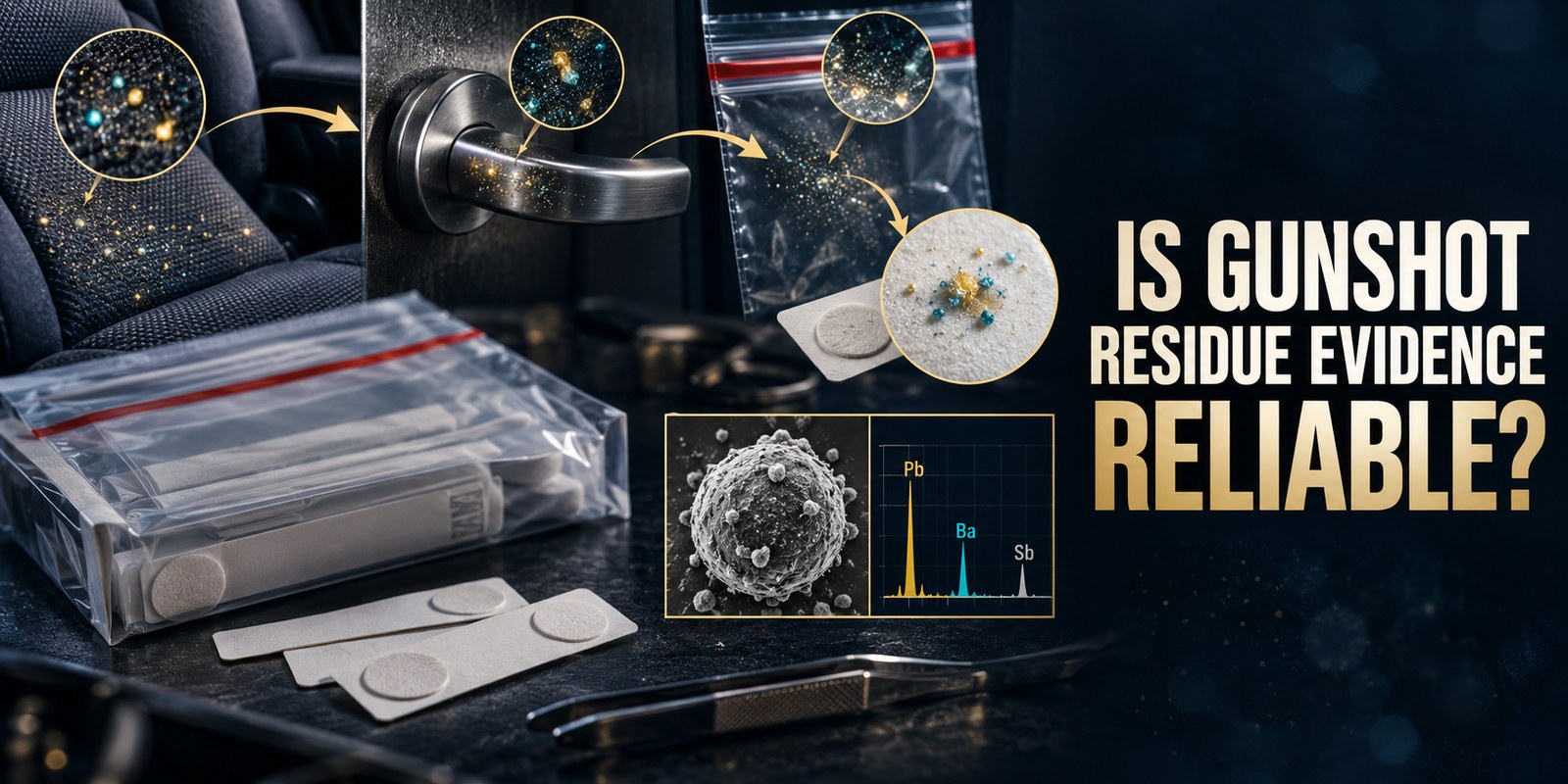
This is where the case becomes useful to anyone facing this evidence. Primer residue analysis looks for three elements together: lead, barium, and antimony. Modern testing uses a scanning electron microscope with X-ray spectrometry, which can identify both the elemental makeup of a particle and its shape.
Results fall into a hierarchy sorted by how specific a particle is to a firearm. At the top are characteristic particles, containing all three elements. Below them are consistent particles. At the bottom are particles merely commonly associated with residue, the weakest category there is. The tiers turn on source specificity rather than a simple element count, and the modern standards account for lead-free primers, where an element such as strontium can carry weight it would not otherwise have. The practical point holds either way: a single-element finding sits at the bottom of the scale.
In this case the analyst found lead only. Two particles on one jacket cuff, and a single particle each on the other cuff and on three areas of the pants. No barium. No antimony. Several other samples came back inconclusive. The strongest thing that could honestly be said about those findings is that lead was present.
And lead is everywhere. The ASTM International standard notes that lead particles alone have compositions commonly found in environmental particles from many sources, including plumbing solder, battery plates, glass, and paint, and that lead persists in soil near highways from decades of leaded fuel. A lead particle on a jacket cuff is not evidence of a gunshot. It is evidence of living in the world.
The Standard the Lab’s Own Field Had Adopted
The most damaging material in the opinion is not an expert’s opinion. It is the published standard. ASTM E3309-21, the guide for reporting this exact analysis, states that no interpretations can be drawn from the identification of particles commonly associated with residue, including lead, barium, or antimony found in isolation in the absence of characteristic and consistent particles, and that such particles should not be reported as potentially having originated from the discharge of a firearm. The standard carves out one narrow exception, for high levels of small spherical lead particles known to come from bullet or pellet debris or from a lead-only primer, supported by a control reference sample. Nothing like that was present here.
In other words, the field’s own reporting standard said the finding in this case should not have been offered as meaning what the prosecutor told the jury it meant.
Then there is the laboratory’s own trajectory, which the court traced in detail. The state lab revised its residue protocols twelve times between 2014 and 2026. A 2019 revision said particles commonly associated with residue have little significance. A January 2024 revision, about six months after this trial ended, instructed that such particles should not be routinely reported. By September 2025 the lab had eliminated the ‘commonly-associated’ category from consideration altogether. The court drew the obvious inference: a discipline revising its protocols twelve times in a decade is not one of the very few principles so firmly established as to have attained the status of scientific law.
Why This Matters in Texas
Texas does not use Daubert in criminal cases. We use Kelly v. State, 824 S.W.2d 568 (Tex. Crim. App. 1992), which requires the State to show by clear and convincing evidence that the underlying theory is valid, that the technique applying it is valid, and that the technique was properly applied on this occasion. That third prong is the one people forget, and it is precisely the prong that a lead-only finding reported as gunshot residue would fail.
Now the part that should encourage a Texas defense lawyer. Connecticut treated pGSR as settled because a trial judge assumed it was. Texas has no such body of authority. No Texas appellate court appears to have held that scanning electron microscopy particle analysis satisfies Kelly. The one Texas decision applying Kelly to something called gunshot residue analysis is Woodward v. State, 170 S.W.3d 726 (Tex. App. Waco 2005, pet. ref’d), and it concerns a different discipline entirely: determining muzzle-to-target distance from patterns on clothing, using a sodium-based test for lead residue and a modified Griess test for nitrites. The Kelly analysis appears at 730 to 731. Read its scope carefully, because the court states it plainly: Woodward challenged only the validity of the underlying scientific theory, and the opinion notes he did not contend on appeal that the State failed to prove the remaining criteria. Technique validity and correct application were never litigated. That is the first Kelly prong and nothing more, and the case is not cited for anything broader.
That means particle analysis in Texas is closer to a question of first impression than to settled ground, and the State should be made to carry the full Kelly showing rather than gesture at familiarity. Bring the current ASTM standards. Bring the laboratory’s own standard operating procedure and its revision history, and the version in force when your sample was analyzed. That is a documentary argument rather than a battle of experts, and it is very hard for a court to wave away.
Texas Has Already Seen This Go Wrong
There is a Texas gunshot residue case, and it is a Court of Criminal Appeals opinion out of Dallas. In Ex parte Miles, 359 S.W.3d 647 (Tex. Crim. App. 2012), an analyst from the Southwestern Institute of Forensic Sciences reported antimony and barium on the right palm only and told the jury the combination was unique to gunshot residue. It was the only physical evidence in the case.
On habeas the same analyst changed her position. She agreed the levels were below the reporting threshold and that under the laboratory’s own standards the result would now be reported as negative. A defense expert, Faye Springer, placed roughly ten percent of the non-shooting population within the same range. The word unique had been carrying enormous weight, and it turned out not to be accurate.
Relief was granted on Brady and actual innocence grounds, not on the residue evidence as an independent claim, and not under Article 11.073, which did not yet exist. Miles is not authority that particle analysis is unreliable. It is something arguably more useful: a documented Texas example, from the Dallas County laboratory, of residue testimony that outran the data, and of an analyst who acknowledged as much once the standards were put in front of her.
There is also a post-conviction route. Article 11.073 of the Code of Criminal Procedure allows relief where relevant scientific evidence was not available at trial or where the science has since changed. A laboratory that formally abandoned a reporting category is close to the paradigm case for that statute. We explain how that writ works in our post on the junk science writ.
What to Ask For
- The classification of every particle found: characteristic, consistent, or commonly associated. If the answer is the third one, the finding has almost no probative value on its own.
- Which elements were actually detected, and which were absent. Lead without barium and antimony is a very different result from all three together.
- The particle morphology. Scanning electron microscopy produces images that let an analyst assess shape, and shape is what distinguishes primer residue from ordinary environmental lead. If the report only lists elements, ask why.
- The laboratory’s standard operating procedure in force on the date of analysis, plus every revision since. The revision history is often the argument.
- The inconclusive samples and the negative results, not just the reported hits.
- Collection timing and conditions. Residue transfers and dissipates, and clothing seized days later from a home raises contamination and transfer questions that no laboratory result can resolve.
The Larger Point
Courts often treat forensic disciplines as settled because they are familiar. Familiarity is not validation, and in this field the standards themselves are still being written. The Organization of Scientific Area Committees for Forensic Science, the federal body that vets forensic standards, maintains a gunshot residue subcommittee and has placed both governing ASTM standards on its registry. A discipline with an active standards subcommittee is one still under construction. We cover the broader critique of unvalidated forensic methods in our post on the 2009 NAS report and its application to firearms and toolmark comparison, though neither that report nor PCAST evaluated gunshot residue specifically. Sellers is a reminder that the question is never whether a discipline has been accepted before. It is whether the specific method, applied to this sample, on this date, produced a result that supports what the State wants to say about it.
It is also worth noting what the Connecticut court said about cross-examination. The defense cross-examined the analyst extensively and got her to concede a dispute in the field. The court held that this did not cure the error, observing that juries give great weight to experts and that cross-examination and opposing experts do not reliably counter expert testimony. The remedy is exclusion, or at minimum a hearing, not a good cross. That is an argument for fighting admissibility early.
If you are facing criminal charges in Texas and forensic evidence is part of the case, call Deandra Grant Law at (214) 225-7117 for a free, confidential consultation.
Deandra Grant holds a Master of Science in Pharmaceutical Science, a Graduate Certificate in Forensic Toxicology, and the ACS-CHAL Forensic Lawyer-Scientist designation. Deandra Grant Law handles forensic evidence challenges in criminal cases across North and Central Texas.
This article is general legal information for educational purposes, not legal advice. State v. Sellers is a Connecticut decision and is not binding in Texas; it is discussed for its reasoning. Verify all citations before relying on them in any filing.
Sources and Further Reading
- State v. Sellers, SC 20986 (Conn. Aug. 25, 2026), opinion.
- State v. Porter, 241 Conn. 57 (1997), opinion.
- State v. Raynor, 337 Conn. 527 (2020), opinion.
- Woodward v. State, 170 S.W.3d 726 (Tex. App. Waco 2005, pet. ref’d) (applying Kelly to gunshot residue distance determination; Kelly analysis at 730 to 731), opinion.
- Crain v. State (Tex. App. Houston [14th Dist.] 2012), citing Woodward with the pet. ref’d designation, opinion.
- Thompson v. State (Tex. App. Amarillo Mar. 14, 2025), same designation, opinion.
- Serol et al., Recent Advances in the Detection of Gunshot Residue, Molecules (2023), article.
- Ex parte Miles, 359 S.W.3d 647 (Tex. Crim. App. 2012), opinion.
- Organization of Scientific Area Committees for Forensic Science, gunshot residue subcommittee and standards registry, nist.gov.
- Kelly v. State, 824 S.W.2d 568 (Tex. Crim. App. 1992), opinion.
- In re Paoli Railroad Yard PCB Litigation, 35 F.3d 717 (3d Cir. 1994), opinion.
- ASTM International standards E1588-25 and E3309-21, governing gunshot residue analysis and reporting by scanning electron microscopy, ASTM.
Which county your case is filed in changes how it is charged, who prosecutes it, and which court hears it.
Deandra M. Grant, JD, GC, MS, ACS-CHAL Forensic Lawyer-Scientist
She holds a Master of Science in Pharmaceutical Science and a Graduate Certificate in Forensic Toxicology, both from the University of Florida. She is the author of The Texas DWI Manual and has defended Texas DWI cases since 1994.
Charged With a Crime?
Whatever you're facing, a DWI or any criminal charge, the sooner you have a forensic-trained team on it the more we can do. Tell us what happened and we'll review your options, at no cost and no obligation. Intake answers 24/7, and if your case is one we can take on, we schedule a free consultation with an attorney.
Request a Free Case Evaluation
Tell us what happened. We'll respond as soon as possible.