When the Hospital Finds Alcohol That Isn’t There

Hospital alcohol tests read a chemical byproduct, not alcohol. In crash victims with shock or liver injury, they can report alcohol that isn’t there.
A 0.266 That Did Not Add Up
Harold lost control of his truck on an icy road and hit a tree. The airbag deployed. He climbed out and wandered off into the snow, and the officer who followed his footprints found him huddled behind a closed car wash, wet, cold, bleeding and seemingly incoherent. They smelled alcohol. No field sobriety tests were given, and an ambulance took him to the hospital.
In the emergency room he seemed to snap out of it. Staff scored him a 15 on the Glasgow Coma Scale, the highest score, meaning the least impairment. An officer read him the statutory warning and asked for a blood specimen. Harold refused, and the officer left.
About half an hour after he arrived, and roughly an hour and a half after the crash, the hospital drew blood for treatment and ran it on an enzymatic analyzer. The result was 0.266, more than three times the legal limit.
Then came the CT scan. Harold had a ruptured bowel. At 6 a.m. the emergency physician met with him to discuss surgery, described him as awake, alert and responsive, and had him sign his own two-page consent. Harold said he remembered drinking three or four beers. He did not remember the crash.
What the records did not show was a lactate level. Nobody ordered one. What they did show was a myoglobin level more than four times the upper end of normal. Myoglobin leaks into the blood from damaged muscle, and the defense’s position was that an injury severe enough to do that would drive lactate up as well. The package insert for the hospital’s test kit said lactate at 100 mg/dL or below would not interfere with the result. Nobody could say Harold’s was below that, because nobody measured it.
At trial, the technician who ran the test conceded that a high lactate level would interfere and produce an elevated ethanol result. The county medical examiner, called by the State to convert the hospital number to a whole blood value of 0.221, testified that gas chromatography is the only forensically reliable method. The defense expert supplied the clinical picture: a genuinely intoxicated patient would not have scored a 15 on the Glasgow scale, and no surgeon lets a patient that intoxicated sign his own consent for emergency surgery when his mother is a phone call away. Working backward from the State’s own number, Harold would have been around 0.18 when he signed.
The jury found him not guilty.
Harold’s case is one of the teaching examples in the blood chapter of the Texas DWI Manual, and it captures the whole problem in one set of facts. The people most likely to get a hospital blood alcohol test after a crash are the people whose blood chemistry is most likely to fool it.
What the Hospital Analyzer Actually Measures
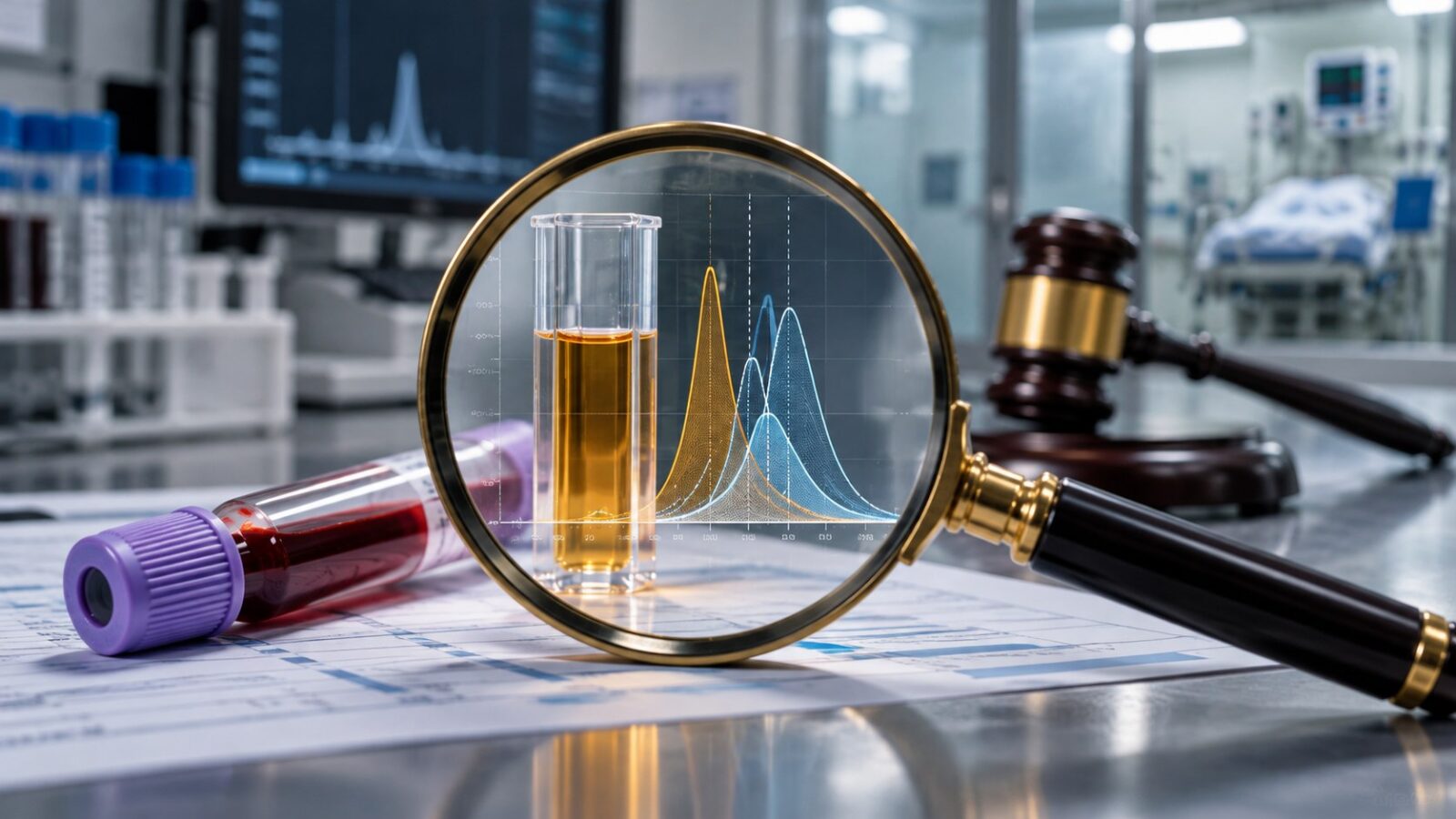
A forensic laboratory measures alcohol by separating it from everything else in the sample and measuring the alcohol molecule itself, using gas chromatography. A hospital analyzer works differently. It adds an enzyme called alcohol dehydrogenase and a helper molecule called NAD+. The enzyme uses the alcohol to turn NAD+ into NADH, and the analyzer measures the NADH by how much ultraviolet light the sample absorbs. More NADH is reported as more alcohol.
The weakness is built into that design. The analyzer cannot tell where the NADH came from, so any other reaction in the tube that turns NAD+ into NADH is reported as alcohol too. The best documented one involves two things that rise together in badly injured patients: lactate, which builds up in the blood during shock and blood loss, and lactate dehydrogenase (LDH), an enzyme that spills out of damaged tissue, especially the liver. Put enough of both in a tube with the analyzer’s excess NAD+, and the tube produces NADH with no alcohol present at all.
A hospital result has a separate problem even when it is accurate, because a hospital tests serum or plasma, not whole blood, and the number has to be converted. That is covered in Legal Blood vs. Hospital Blood. This post is about something more basic: whether there was any alcohol to convert.
The Test the Accrediting Body Ran on Itself
The College of American Pathologists (CAP) accredits most hospital laboratories in the United States and runs the proficiency surveys those laboratories use to check their accuracy. In late 2010, its Toxicology Resource Committee sent 50 volunteer laboratories a sample that contained no alcohol. It was spiked only with salt water, lactate (25 mmol/L) and LDH (5,000 U/L), and each laboratory ran it on its own analyzer as though it were a patient’s serum.
Here is what came back. Hospital labs report alcohol in milligrams per deciliter, so 100 mg/dL is the same as 0.10.
| Platform | Results reported (mg/dL) | Average |
|---|---|---|
| Microgenics Dimension | 105 and 107 | 106.0 |
| Abbott Aeroset | 131, 127, 117, 83, 82, 75 | 102.5 |
| Beckman LX and DxC | 51 to 87 (14 labs) | 73.2 |
| Roche (various) | 16 to 53 | 29.3 |
| Ortho Vitros | 9 to 10.2 | 9.8 |
| Abbott AxSYM | 9 and under 13 | 9.0 |
| Siemens | 0 to 13 | 4.2 |
Source: Frederick & King (2012), reporting the CAP Toxicology Resource Committee study.
One laboratory reported a sample with no alcohol in it at 131 mg/dL, the equivalent of 0.131. Two things stand out. The error is large enough to put a sober person over the legal limit on several platforms. And the platform matters enormously: the identical sample read anywhere from essentially zero to well past 0.10 depending on whose analyzer ran it. The manufacturers in that study accounted for more than 90 percent of the results reported in CAP’s serum alcohol survey, in which almost 3,000 laboratories take part.
Are those lactate and LDH levels realistic? They are high, but they are not hypothetical. In a 2018 emergency department study that the State’s experts like to cite, patients’ lactate ran as high as 24.2 mmol/L, essentially the level in the spiked sample, and LDH ran as high as 8,838 U/L, well above it.
The authors of the CAP report also described a case. A 17-year-old left a graduation party driving a pickup, by all accounts having had nothing to drink, and crashed into a concrete culvert. He arrived at the hospital in shock, and the hospital reported an alcohol level of 90 mg/dL. He died within hours. No autopsy or further toxicology was done, so the number was never checked. The authors pointed out that major trauma, with blood loss on one side and a bruised or torn liver on the other, is exactly the setting where lactate and LDH climb together.
Who Is Most at Risk
The published reports cluster around a recognizable set of patients:
- Major trauma with shock or significant blood loss.
- Liver injury, including a bruised or lacerated liver from a crash.
- Liver disease or acute liver failure, including liver damage from an acetaminophen overdose.
- Severe infection (sepsis) and other conditions that cause lactic acidosis.
- Leukemia and lymphoma, which can raise LDH.
The case reports are striking. In the 1995 study that CAP cites in its own inspection checklist, two infants at a university medical center returned enzymatic alcohol results of 105 and 60 mg/dL, and gas chromatography found no alcohol in either. Follow-up testing on real patient and autopsy samples produced false positives as high as 138 mg/dL against a gas chromatography result below 1, including a living patient with end-stage liver disease reported at 51. The same samples run on a different manufacturer’s assay produced no false positives at all.
In a 2008 report, three patients with liver damage from acetaminophen showed alcohol of roughly 150 mg/dL on one analyzer, with none by gas chromatography and none on a second analyzer. The manufacturer had told the authors that a false result above 80 mg/dL would take LDH over 100,000 U/L. The patients’ LDH ran between about 4,900 and 10,100, and one of them had a normal lactate. The authors concluded that other enzymes besides LDH can produce the same effect. And in 2020, North Carolina’s medical examiner reported two children whose hospital results were 76 and 53 mg/dL, again with no alcohol by gas chromatography. In one, the reported alcohol fell from 76 to 52 to 39 over about twelve hours, a pattern the authors described as inconsistent with normal elimination.
The effect is not a straight line, which is part of what makes it hard to spot. At extremely high LDH the false reaction can finish before the analyzer starts measuring, and the reported result falls back toward zero. So a very high LDH does not guarantee a false positive, and a moderate one does not rule it out.
What the Other Side Will Say
The literature is not one-sided.
- The 1996 response. A coroner’s office argued that the 1995 patients had end-stage liver failure, that the spiked concentrations were unrealistic, and that the average driver, even an injured one, does not match that picture. The same exchange raised a question that remains open: lactated Ringer’s, an IV fluid routinely given to injured patients before blood is drawn. The original authors replied that its effect was not investigated.
- The 2004 trauma study. The same authors later compared one manufacturer’s enzymatic method against gas chromatography in trauma patients and found no false positives.
- The 2018 emergency department study. Every positive enzymatic result in 37 samples was confirmed by gas chromatography. But the samples were run on a Roche analyzer, the platform that produced no false positives in the 1995 study and the lowest interference of the affected platforms in the CAP study. And the patients’ admission diagnoses included sepsis, cancer and heart attack, but no trauma.
- The 2009 state lab analysis. Responding to a challenge based on liver trauma, a Connecticut crime lab looked at the patient’s own chemistry, found a normal anion gap and only modest liver enzyme elevation, and concluded the interference was negligible on those facts.
The common thread is that the analyzer is the variable, not the patient alone. A clean result on one platform says nothing about another: the patients who produced false positives on one analyzer in the 2008 report tested clean on a second one. And the 2009 Connecticut analysis is a good model of the right way to answer the question, which is to look at this patient’s chemistry on this analyzer. That is exactly what the defense should be allowed to do.
Why This Matters in Texas
Hospital records usually reach a Texas courtroom through a records custodian, and the alcohol number arrives looking like any other lab value. But a blood alcohol result offered to prove intoxication is scientific evidence. Under Kelly v. State, the State has to show the judge, by clear and convincing evidence and outside the jury’s presence, that the underlying theory is valid, that the technique applying it is valid, and that the technique was properly applied on the occasion in question.
The enzymatic method in general is rarely the fight. The third question is. Was this result, on this analyzer, from this patient’s blood, reliable? A crash victim in shock with a lacerated liver is precisely the occasion that the accrediting body, the published case reports and often the manufacturer’s own insert flag as a problem. In one of our cases, a hospital result was excluded on that third question after the person who drew the blood admitted swabbing the site with isopropyl alcohol against hospital policy and the kit maker’s instructions, and the jury acquitted. That case summary is here.
How the State gets hospital records in the first place, and when it needs a warrant to test hospital blood itself, is covered in Legal Blood vs. Hospital Blood.
What to Ask For
If a hospital alcohol result is part of the case, these are the records that decide whether it means anything:
- The analyzer and the reagent. Not just “enzymatic.” The manufacturer, the model and the specific assay. As the CAP study shows, that answer can move the risk from negligible to severe.
- The package insert for that assay. Any manufacturer warning about interference will be there, if it is anywhere. Treatment varies; the 2020 report found that the instructions for two named assays mentioned false positives only minimally.
- The full chart. Lactate, LDH, liver enzymes (AST and ALT), bicarbonate, electrolytes, measured and calculated osmolality, myoglobin, every IV fluid given before the draw, and the nursing and physician notes describing the patient.
- The laboratory’s own interference studies. A CAP-accredited lab that tests for legal alcohol must have evaluated its method for ethanol specificity and must have a written procedure for potential interference (item CHM.37000 in the 2016 checklist). CAP revises its checklists yearly, so get the edition the lab was inspected under for the date in question, then compare what the lab actually tested against the levels in the CAP study. Accreditation certifies a system, not a particular result.
- Confirmation. Was the result ever confirmed by gas chromatography? Is any of the specimen left? Hospitals keep clinical samples only briefly, so ask early.
- How the draw site was cleaned. An alcohol prep pad is a separate problem for an enzymatic test.
Four Red Flags in the Chart
- The anion gap. Lactate raises it. The CAP report’s authors suggest that labs screen every alcohol-positive specimen with it. Lactic acidosis is conventionally a lactate above 5 mmol/L, against a normal level near 1, with an anion gap above 15.
- The osmolal gap. Real alcohol raises the blood’s measured osmolality. In the 2008 patients, plugging the reported alcohol into the calculation produced large negative gaps (minus 23, minus 42 and minus 44). Using the true gas chromatography result instead, the gaps were 18, minus 1 and minus 1. A large negative osmolal gap is a signature of an alcohol number that is not real.
- Protein-free ultrafiltrate. Filtering the proteins out of the sample removes the interfering enzymes. In a 1994 study, every specimen that read positive in serum read zero in the ultrafiltrate. Ask whether anything like that was done.
- Liver enzymes. After its three false positives, the 2008 hospital began checking ALT on every alcohol result above 5 mmol/L (about 23 mg/dL) and sending the sample out for confirmation whenever ALT exceeded 500 U/L. Whether a given hospital has any such policy is discoverable.
The Larger Point
Nobody disputes that the enzymatic test is useful in an emergency room. A doctor deciding whether a confused crash victim is drunk or has a head injury needs a fast answer, and a fast answer that is usually right serves that patient well. The trouble starts when a number produced for that purpose is carried into a courtroom as though it were a forensic measurement. A 2025 review by two clinical chemists put it directly: the method “is not inherently a forensic assay,” and where lactate and LDH exceed the assay’s cutoff, the result should be held until gas chromatography confirms it. In most DWI cases built on hospital blood, that confirmation never happened.
The people most likely to get a hospital alcohol test are the people most likely to be hurt badly enough to fool it. That is not a reason to ignore the number. It is a reason to check it.
If you are facing a DWI, intoxication assault or intoxication manslaughter charge built on a hospital blood result, call Deandra Grant Law at (214) 225-7117 for a free, confidential consultation.
Deandra Grant holds a Master of Science in Pharmaceutical Science, a Graduate Certificate in Forensic Toxicology, and the ACS-CHAL Forensic Lawyer-Scientist designation. Her presentation “Blood Alcohol Content by Enzymatic Assay: A Case Study” was accepted for the technical program of the American Chemical Society’s 2014 national meeting in Dallas, and she is the author of the Texas DWI Manual.
This article is general legal information for educational purposes, not legal advice. Several of the studies discussed were conducted outside Texas and are cited for their science. Verify all citations before relying on them in any filing.
Sources and Further Reading
- Donald L. Frederick & Gregory S. King, Lactate Dehydrogenase Can Cause False-Positive Ethanols, Clinical & Forensic Toxicology News 4 (AACC/CAP, June 2012).
- J.S. Nine et al., Serum-Ethanol Determination: Comparison of Lactate and Lactate Dehydrogenase Interference in Three Enzymatic Assays, 19 J. Analytical Toxicology 192 (1995), article.
- William C. Thompson et al., False-Positive Ethanol in Clinical and Postmortem Sera by Enzymatic Assay: Elimination of Interference by Measuring Alcohol in Protein-Free Ultrafiltrate, 40 Clinical Chemistry 1594 (1994), PubMed.
- Angineh Gharapetian et al., Dehydrogenase Interference with Enzymatic Ethanol Assays: Forgotten but Not Gone, 54 Clinical Chemistry 1251 (2008), article.
- Sandra C. Bishop-Freeman et al., False-Positive Enzymatic Alcohol Results in Perimortem Specimens, 51 Laboratory Medicine 394 (2020), article.
- Charles L. Winek & Wagdy W. Wahba, A Response to “Serum-Ethanol Determination: Comparison of Lactate and Lactate Dehydrogenase Interference in Three Enzymatic Assays,” 20 J. Analytical Toxicology 211 (1996).
- Charles L. Winek et al., Serum Alcohol Concentrations in Trauma Patients Determined by Immunoassay Versus Gas Chromatography, 139 Forensic Science International 1 (2004), article.
- Nicholas Nacca et al., Can Elevated Lactate and LDH Produce a False Positive Enzymatic Ethanol Result in Live Patients Presenting to the Emergency Department?, 56 Clinical Toxicology 189 (2018), article.
- Robert H. Powers & Dorothy E. Dean, Evaluation of Potential Lactate/Lactate Dehydrogenase Interference with an Enzymatic Alcohol Analysis, 33 J. Analytical Toxicology 561 (2009), article.
- Cristiano Ialongo & Alan W. Jones, The Enzymatic Analysis of Alcohol (Ethanol) in Serum and Plasma with the Alcohol Dehydrogenase Reagent, 35 Biochemia Medica 030501 (2025), article.
- College of American Pathologists, Chemistry and Toxicology Checklist, CHM.37000 Ethanol Specificity (Aug. 17, 2016 ed.).
- Kelly v. State, 824 S.W.2d 568 (Tex. Crim. App. 1992), opinion.
- Deandra Grant, Texas DWI Manual, ch. 7, § 7:102 (James Publishing).
Which county your case is filed in changes how it is charged, who prosecutes it, and which court hears it.
Deandra M. Grant, JD, GC, MS, ACS-CHAL Forensic Lawyer-Scientist
She holds a Master of Science in Pharmaceutical Science and a Graduate Certificate in Forensic Toxicology, both from the University of Florida. She is the author of The Texas DWI Manual and has defended Texas DWI cases since 1994.
Charged With a Crime?
Whatever you're facing, a DWI or any criminal charge, the sooner you have a forensic-trained team on it the more we can do. Tell us what happened and we'll review your options, at no cost and no obligation. Intake answers 24/7, and if your case is one we can take on, we schedule a free consultation with an attorney.
Request a Free Case Evaluation
Tell us what happened. We'll respond as soon as possible.