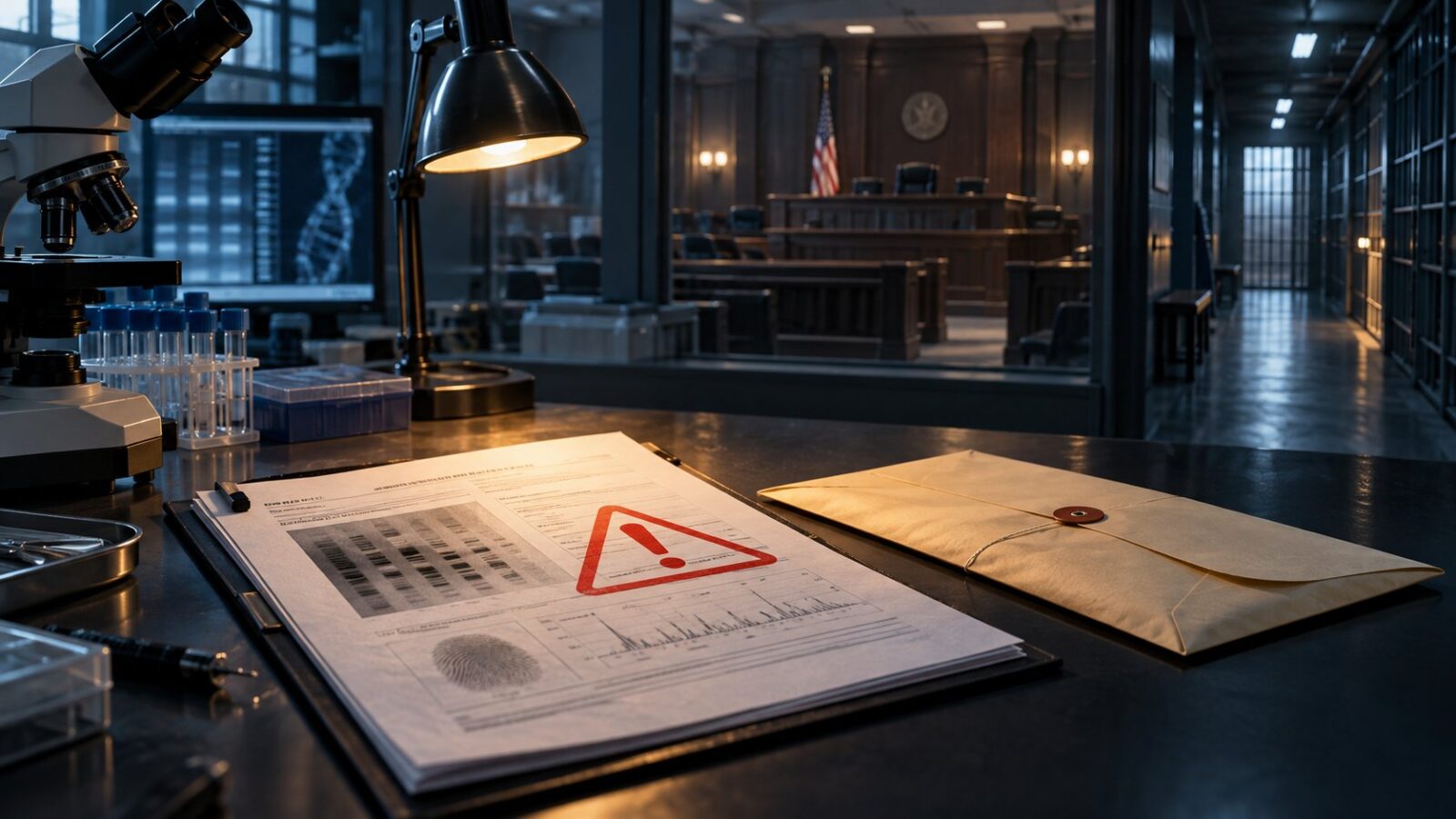
The Crime Lab Was Wrong. Who Tells You?
In early 2024, a firearms supervisor at Virginia’s Western Laboratory in Roanoke took a proficiency test with four items on it. She got one wrong.
That single missed item is the reason that, as VPM News reported in October 2026, the Virginia Department of Forensic Science has now asked prosecutors to review 2,173 of her comparison cases, plus 497 worked by the colleague who verified her conclusions. About 2,670 cases surfaced by one wrong answer.
The scientific argument about whether a bullet can be matched to a single gun is one we have written about separately. This post is about the part that comes after: how a laboratory discovers it has been wrong, what the discovery says about the safeguards, and the question a Texas defendant should be asking, which is who is required to tell you.
What Virginia Says Went Wrong
The department’s own root-cause analysis is the most interesting document in this story because of what it concedes.
DFS first identified “contextual bias” as the cause of a faulty identification. It then expanded the finding to include what it called drift, described as a progressive deviation from standard procedures in both examiners’ criteria for sufficiency of marks for source origin.
Firearms identification rests on an examiner concluding that two marks show sufficient agreement. Critics have argued for years that the standard is circular, because the examiner is the one who decides what counts as sufficient. Virginia’s crime lab has now put in writing that two of its examiners’ sufficiency criteria drifted. That is not a defense expert’s theory. It is the laboratory’s own explanation of its own failure, in the laboratory’s own words.
Director Alka Lohmann said subjective judgment about how much correlation is enough can lead examiners to drift away from their colleagues, especially when they consult only one other person.
The Safeguard Was the Failure Mode
Verification is the safeguard. A second qualified examiner reviews the first examiner’s conclusion, and the agreement of two people is what gives an identification its institutional weight. In Virginia, the verifier’s own work is now under review, 497 cases of it, and the verifier was decertified in January 2026.
So the second opinion did not catch the drift. On the department’s own account, consulting one other person is how the drift developed. A safeguard that consists of one colleague agreeing with another is not an independent check; it is a small closed loop, and a closed loop can move together.
That reframes a routine cross-examination question. “Was your conclusion verified?” invites a yes that sounds like corroboration. The better questions are who verified it, whether that person knew the original conclusion before forming their own, how many of this examiner’s cases that same person has verified, and whether the two of them have ever disagreed.
How Anyone Found Out
Nobody audited these cases. No defendant uncovered anything. The entire 2,670-case review traces to one incorrect answer on a routine four-item proficiency test, which opened a corrective action plan in February 2024. An internal file review the following year found insufficient support for identifications on two bullets in a single case. In April 2025 the Western Lab stopped firearms and toolmark examinations altogether and brought in an outside consultant.
There is also a lawsuit. A former Western Lab scientist filed a federal whistleblower suit in July 2026 alleging she was demoted in retaliation after she changed a finding from an identification to inconclusive. The department says the litigation prevents it from commenting and is seeking dismissal. Nothing in that suit has been proven, and it should be described as an allegation. But it is worth noticing what it alleges: that the person who corrected a result was the one who suffered for it.
The progress figures are also worth stating plainly, because they are small. As of October 5, 2026, DFS had sent 105 case files out for external review and gotten 89 back. At least four had been reworked and results changed in two. That is out of roughly 2,670 but it sure matters if a wrong match is made and an innocent person is charged because of it.
Where This Meets the Science Argument
Our post on firearms and toolmark matching covers the method critique in full: what the discipline actually claims, why “sufficient agreement” is a circular standard, the absence of an established error rate, and the line of federal and state decisions that have narrowed what an examiner may tell a jury. That is the argument about whether the method works.
Virginia is the argument about what happens when it does not, at a laboratory that is accredited, that has a quality management system, and whose director described that system as strong. Both things are true at once, and the second is the one defense lawyers are less ready for.
Who Is Required to Tell You in Texas
Virginia’s process, whatever its shortcomings, is a process. DFS sent case lists to prosecutors and law enforcement and instructed prosecutors to review them, determine outcomes, and notify defense attorneys and defendants in cases that resulted in convictions. One commonwealth’s attorney quoted in the reporting said defense counsel are then responsible for advising their clients, which is where a chain like this tends to go slack. Still, the chain exists.
Texas gets to the same place by a different route, and arguably a stronger one. The notice does not come from the laboratory. It comes from the prosecutor, and it arrives as a continuing legal duty rather than as a request someone is free to set aside.
Start with what the laboratory statute does and does not do. Under Article 38.01 of the Code of Criminal Procedure, a laboratory that conducts forensic analyses must report professional negligence or professional misconduct to the Texas Forensic Science Commission, and the Commission must investigate allegations that would substantially affect the integrity of a laboratory’s results or related testimony. Investigation reports are made public. The only individual notice the statute requires is certified mail to the license holder or the laboratory. Article 38.01 is a regulatory statute. It tells a laboratory to report itself to a commission, and it says nothing about the defendant whose case the work touched.
Two more provisions in that statute are worth knowing. The Commission may not make findings on guilt or innocence in an underlying case. And Commission reports are not admissible in a civil or criminal action, which means the document that tells you your case may be affected is a document you cannot hand to a jury. It is a roadmap, not evidence.
The Duty That Does Not End at Verdict
Article 39.14(h) requires the State to disclose to the defendant any exculpatory, impeachment, or mitigating document, item, or information in its possession, custody, or control that tends to negate guilt or reduce punishment. Subsection (k) adds the part that matters here. If at any time “before, during, or after trial” the State discovers additional material required to be disclosed under subsection (h), it “shall promptly disclose the existence” of that material to the defendant or the court. The duty does not end at verdict, and nothing in the text ends it at the mandate, at the close of an appeal, or at the discharge of a sentence.
The question used to be whose knowledge counts. A laboratory finds a problem; the prosecutor who tried the case has never heard of it. In State v. Heath, 696 S.W.3d 677 (Tex. Crim. App. 2024), the Court of Criminal Appeals held that “the state” in Article 39.14 “means the State of Texas, which includes law enforcement agencies,” and that the article contains no knowledge requirement for the prosecutor. Judge Newell wrote for a six-to-three Court. A Department of Public Safety crime laboratory is part of a law enforcement agency. When that laboratory learns one of its analysts produced unsupported results, the State knows it, whether or not the prosecutor who handled the case has heard a word about it.
A third piece covers the leg between the agency and the prosecutor. Article 2A.209(c), effective January 1, 2025, provides that when a law enforcement agency obtains additional material required to be disclosed under Article 39.14 after filing a case, an agency employee “shall promptly disclose the document, item, or information to the attorney representing the state.” That duty was enacted in 2021 as the Richard Miles Act, Senate Bill 111, and was originally numbered Article 2.1397, which we covered along with Heath in our post on the Michael Morton Act.
Put those together and Texas has a notification chain of its own, and no link in it depends on anyone choosing to be helpful. The laboratory’s knowledge is the State’s knowledge the moment the laboratory has it. The agency owes the prosecutor prompt disclosure. The prosecutor owes the defendant prompt disclosure for as long as the case exists.
In practice that means letters. An event the size of Virginia’s, happening at a Texas laboratory, produces letters from district attorneys’ offices to defense counsel on every affected case. Texas defense lawyers receive them. They are this state’s counterpart to Virginia’s case-list memo, except that what arrives is a disclosure obligation being discharged rather than a request a prosecutor is free to decline.
The precedent for it is more than a decade old. In 2012 the Texas Department of Public Safety’s Houston Regional Crime Laboratory self-disclosed that an analyst, Jonathan Salvador, had used data from one case file to support the reported result in another. He had worked cases in 36 counties, and the Commission’s final report counted 4,944 drug cases from 2006 through 2012. The Harris County District Attorney sent letters to potentially affected defendants and referred them to the Public Defender’s Office. Montgomery County sent notice to the last known address of each potentially affected defendant and defense counsel. Galveston County sent letters and the courts appointed counsel to handle the writs. For the remaining 33 counties, the Commission arranged for the Innocence Project of Texas to contact affected defendants directly.
Heath involved a 911 call held by a police department, not a laboratory quality record, and no Texas court has yet applied subsection (k) to one. The imputation is strongest where the laboratory sits inside a law enforcement agency and weaker where a jurisdiction has deliberately separated the two, as Houston did when the Houston Forensic Science Center was made independent of the police department in 2014. The Salvador letters also went out in 2012, before the Michael Morton Act took effect on January 1, 2014, so they rested on Brady and on the judgment of individual prosecutors rather than on Article 39.14(k). What has changed since is that the practice now has a statute behind it, and Heath has answered the knowledge question that would otherwise have been the State’s best defense.
If one of those letters arrives, treat it as the floor. It will tell you that a case may be affected. It will not tell you the analyst’s proficiency history, what the corrective action file says, who verified the work, or what the bench notes show. Ask for all of it in writing, and ask specifically for the laboratory’s own disclosure to the Commission, which is a different document from the Commission’s report on it.
If no letter arrives, that is not evidence that nothing happened. The Commission’s disclosure docket is public and comes out four times a year, which is why we read it here every quarter in our Forensic Science Commission Dispatch. A disclosure that never generated a letter in your county is still a disclosure, and the request you file does not depend on anyone having written to you first.
Where a result has already been affected by a change in the science or by discredited work, the vehicle is Article 11.073, the junk science writ, which our post on arson convictions and Texas’s junk science writ covers in detail.
What to Ask For
Whether or not a lab has announced a problem, these belong in a forensic discovery request:
- The analyst’s proficiency test history, every result, not a summary, with the testing provider, the dates, and any unsatisfactory finding.
- Corrective action plans and quality incident reports touching this analyst, this discipline, or this laboratory section, by date range.
- The identity of the verifier on your case, that person’s proficiency history, how many of this analyst’s cases that verifier has reviewed, and whether the verification was blind to the original conclusion.
- Any Texas Forensic Science Commission disclosure, complaint, or investigation involving this laboratory or analyst, and the laboratory’s own report to the Commission, which is a different document from the Commission’s.
- Accreditation records, including any finding, suspension, or scope limitation affecting this discipline at this laboratory.
- The underlying data, not the one-page report. Bench notes, photographs, comparison images, and the examiner’s documentation of what marks were relied on.
Our post on how forensic misconduct can unravel a conviction covers what to do once one of those requests turns something up.
The Bottom Line
A state crime laboratory got one proficiency answer wrong and 2,670 cases came loose. The laboratory’s own explanation was that its examiners’ standards for what counts as a match had drifted, and that the second opinion built in to catch that was part of how it happened.
Texas laboratories can drift too. What differs is where the notice comes from. Virginia’s laboratory sent case lists to prosecutors and asked them to tell the defense. In Texas the laboratory reports itself to the Forensic Science Commission, and the obligation to tell you belongs to the prosecutor, as a continuing duty under the Michael Morton Act that does not expire at verdict. An event of Virginia’s size at a Texas laboratory would produce letters from district attorneys’ offices to defense counsel on every affected case.
A letter is a starting point and not an answer. It tells you that a case may be affected. It does not tell you the proficiency history, who verified the work, or what the bench notes show, and the best time to ask for those is before anyone has announced that something is wrong.
If you are facing a Texas case built on firearms, toolmark, or other comparison evidence, our firm can talk with you about the specific facts.
Deandra Grant is the managing partner of Deandra Grant Law, a Texas DWI and criminal defense firm with offices across Dallas-Fort Worth and Central Texas. She holds a master’s degree in pharmaceutical science and a graduate certificate in forensic toxicology, and she and her team challenge forensic evidence throughout the region.
Further Reading
- VPM News on the Virginia Department of Forensic Science review (October 21, 2026).
- Tex. Code Crim. Proc. art. 38.01 (Texas Forensic Science Commission; laboratory reporting of professional negligence or misconduct; public investigation reports; inadmissibility of Commission reports).
- Tex. Code Crim. Proc. art. 39.14 (see subsections (h) and (k), the continuing duty to disclose exculpatory, impeachment, or mitigating material before, during, or after trial) and State v. Heath, 696 S.W.3d 677 (Tex. Crim. App. 2024) (No. PD-0156-22, decided June 12, 2024; Newell, J., for a six-to-three Court) (“the state” includes law enforcement agencies; no prosecutor knowledge requirement).
- Tex. Code Crim. Proc. art. 2A.209 (duties of a law enforcement agency filing a case, including the continuing duty to disclose later-obtained Article 39.14 material to the attorney representing the state), effective January 1, 2025, carrying forward the duty enacted in 2021 as the Richard Miles Act, S.B. 111, 87th Leg., originally numbered art. 2.1397.
- Texas Forensic Science Commission, final report on the Texas DPS Houston Regional Crime Laboratory self-disclosure (April 5, 2013) (the Salvador matter; district attorney notification of affected defendants and defense counsel in Harris, Montgomery and Galveston Counties, with Innocence Project of Texas coordination in the remaining 33).
- Tex. Code Crim. Proc. art. 11.073 (relief based on changed or discredited science).
- Related on this site: firearms and toolmark matching, on whether the method supports what examiners say; Texas’s junk science writ; the Michael Morton Act, the Richard Miles Act and the Heath opinion; our quarterly Forensic Science Commission Dispatch; and how forensic misconduct can unravel a conviction.
This post is an informational synthesis for educational purposes and is not legal advice. The Virginia review is ongoing and no findings described here establish that any particular conviction was wrongly obtained; the whistleblower allegations referenced are unproven and are described as allegations. No Texas court has yet applied Article 39.14(k) to a laboratory quality record, and the scope of that duty in the laboratory setting has not been settled. Anyone facing charges should consult a licensed Texas attorney about the specific facts of their case.
Which county your case is filed in changes how it is charged, who prosecutes it, and which court hears it.
Deandra M. Grant, JD, GC, MS, ACS-CHAL Forensic Lawyer-Scientist
She holds a Master of Science in Pharmaceutical Science and a Graduate Certificate in Forensic Toxicology, both from the University of Florida. She is the author of The Texas DWI Manual and has defended Texas DWI cases since 1994.
Charged With a Crime?
Whatever you're facing, a DWI or any criminal charge, the sooner you have a forensic-trained team on it the more we can do. Tell us what happened and we'll review your options, at no cost and no obligation. Intake answers 24/7, and if your case is one we can take on, we schedule a free consultation with an attorney.
Request a Free Case Evaluation
Tell us what happened. We'll respond as soon as possible.