
What a DNA Match Does Not Tell You

In the first week of October, two Dallas County cases from the 1990s moved forward because of DNA. A jury convicted Steven Augusta Ridge of the 1996 capital murder of fifteen-year-old Tamika Cromer. Two days earlier, Dallas police arrested a man in the 1993 killing of fifty-five-year-old Tommie Davis.
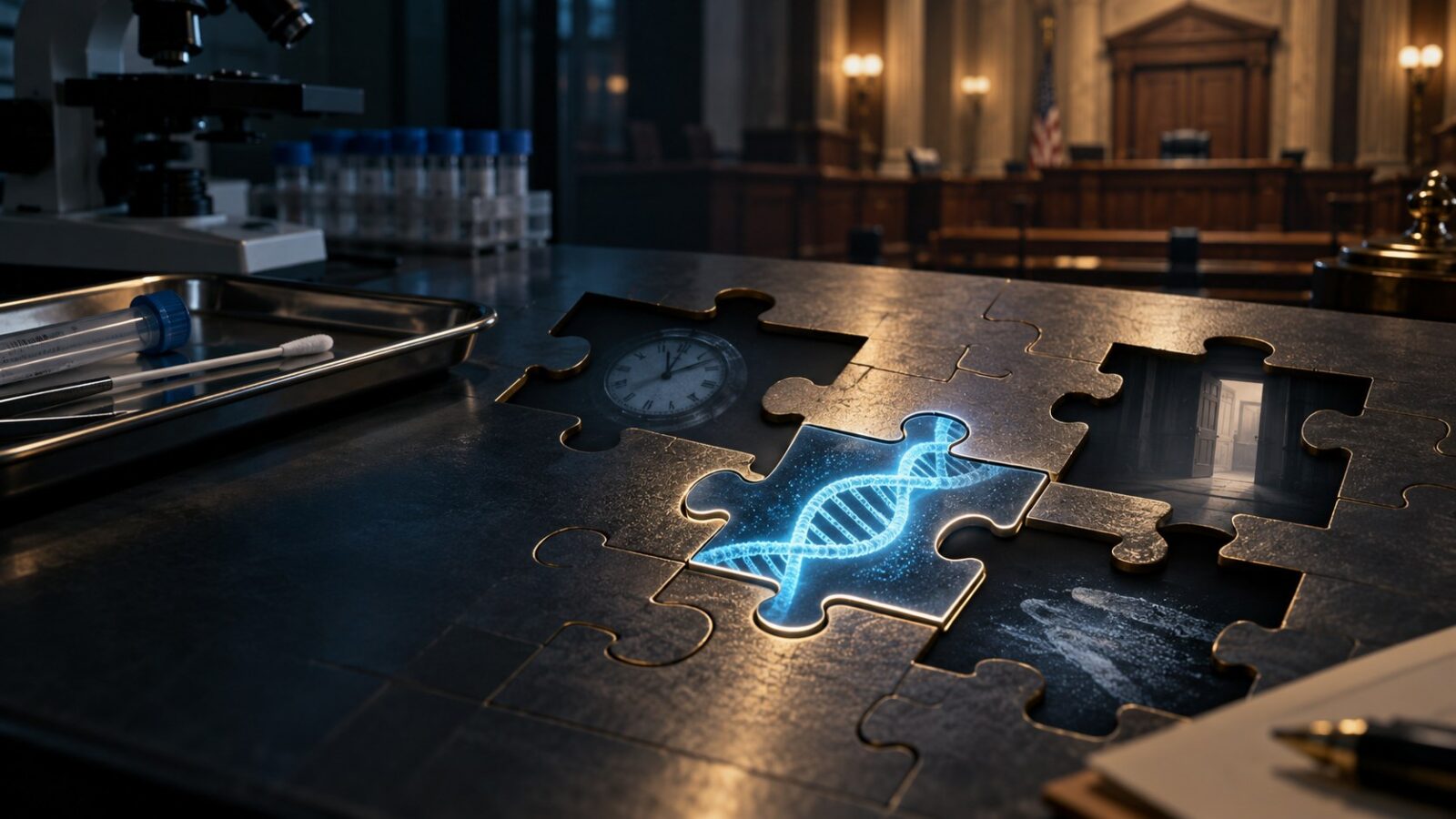
Both are being reported as DNA solving a cold case and, in a rough sense, that is what happened. But the Ridge trial is more interesting than that because the DNA in it was about as strong as DNA gets and the jury still sent out a note saying it could not agree. Understanding why is useful.
The DNA Sample Not Taken
Start with how the Ridge case was built.
Ridge was convicted of sexual assault in Dallas in 1988. KERA reports that he was required to give a DNA sample as a registered sex offender and never did, and describes his profile as one that should have been in the offender database since 1988.
In reality, Texas had no DNA database in 1988. The state one was created by Government Code § 411.142, added by the 74th Legislature and effective September 1, 1995. Cromer was killed in February 1996, about five months after the database opened, and the rape kit taken at her autopsy was preserved. Ten years later the Legislature went back and addressed the specific gap Ridge was sitting in: Government Code § 411.1473, effective in 2005, makes a registered offender’s primary registration authority responsible for taking a specimen and sending it in.
The sample was finally collected in 2023 by a probation officer. It matched the 1996 kit almost immediately.
This is not a story about technology catching up. The technology was there. The kit was preserved and waiting, exactly as Article 38.43 of the Code of Criminal Procedure contemplates, with a retention floor of forty years for biological evidence from a felony with an unapprehended actor. What was missing was one buccal swab from a man the state already knew about, already had a conviction on, and already had a statute specifically directing somebody to swab. Thirty years passed and a fifteen-year-old’s case sat solved in a freezer, waiting for a reference sample that two separate laws required.
Texas has kept widening the net since. Felony arrestee collection expanded in 2019 and again for offenses on or after September 1, 2023, when booking facilities began collecting from all felony arrestees under Government Code § 411.1471. Widening the net is one answer to a collection failure. Whether it is the right one is a policy question. It is worth noting that the failure here was not a gap in who was covered.
One in Ten Trillion
At trial a DNA analyst testified that the match between Ridge and the sperm fraction from Cromer’s kit was a one-in-ten-trillion proposition. What does that mean?
A single-source sample of semen from a rape kit is the most favorable material a DNA laboratory ever handles. There is one contributor, the template is abundant, and the interpretation is not close. This is not the contested territory of mixed samples and low-template work, where probabilistic genotyping software and the assumptions behind a likelihood ratio are genuinely arguable.
What the figure describes is how rarely that profile would appear in the population. It is a statement about identity and nothing else. It does not say when the material was deposited. It does not say how. It does not say what happened before or after, or by whom. A number that tells you whose biological material it is tells you nothing about the events that put it there.
The Defense That Nearly Worked
Cromer was last seen by her aunt on Sunday, February 25, 1996. Her body was found burned on Thursday, February 29, near the Trinity River. Defense counsel worked that four-day gap: if days are unaccounted for, biological material recovered at autopsy does not by itself establish who was present at the killing. She raised another suspect: an ex-boyfriend who had reportedly threatened Cromer. She pressed on how long sperm persists after deposit.
The jury of seven men and five women got the case Thursday afternoon. By Friday evening it had sent a note reading, “We have not been able to come to a unanimous conclusion,” along with notes about a dispute over the timeline and requests for more testimony. Judge Nancy Mulder sent them home for the weekend. Before Monday, the lawyers were discussing a fifteen-year plea in case the deadlock held. Monday the jury convicted and Ridge received life. For a capital felony that is parole eligibility only after forty calendar years, without good conduct time.
On facts including a one-in-ten-trillion match, a Dallas County jury spent two days unable to agree and the State was weighing fifteen years. Not because the DNA was doubtful, but because the DNA was being asked to carry a narrative it could not carry on its own.
The Persistence Question
The medical examiner testified that sperm breaks down within hours. The underlying science is a decline rather than a cutoff. In the largest published dataset of its kind, according to PubMed, Casey and colleagues at Forensic Science Ireland examined roughly 5,581 swabs from about 1,450 sexual assault cases and found the proportion of sperm recovered from the vagina and anus declines significantly after 48 hours from intercourse. Detectability falls off over time; it does not switch off at an hour.
If recoverable sperm implies deposit close in time, then the material ties its donor to the period around the death rather than to some earlier encounter during the missing days. The persistence question that the defense raised is the same question that narrows the defense’s own timeline theory. You do not always control where an expert’s answer lands, and counsel has to know in advance which way the curve runs before opening the subject in front of a jury.
That body of research is built on living complainants examined in a clinical setting. This was a post-mortem kit from a body recovered four days later and burned. Decomposition, fire, and the post-mortem interval are not variables the time-since-intercourse literature was constructed to handle.
The Second Case and What a CODIS Hit Is
The Davis arrest shows the same principle from the other end. Dallas police announced on October 3 that they had arrested Gary Len Ross, 56, for the May 18, 1993, killing of Tommie Davis in her home on Haskell Avenue. Detective Andrea Isom reinvestigated, found that blood collected from a wall during the original investigation did not belong to Davis, developed a profile from it, and entered it into CODIS. The hit came back to an alias Ross had been living under. Police say the investigation is ongoing.
The profile establishes whose blood was on a wall but not when or how it got there. Ross has been charged and nothing has been proven. Everything in the preceding paragraph is an allegation.
What to Actually Do with a Cold Case DNA File
If you are looking at a Texas case built on old biological evidence, the work is mostly not in the laboratory report.
- Get the collection history of the reference sample. When was it taken, by whom, under which statutory authority, and why not earlier. In Ridge’s case that history spans thirty-five years and two statutes.
- Get the storage record for the evidence itself. Where the kit or the swab lived, through how many facility moves, at what temperature, with what inventory entries. Article 38.43 sets the retention duty; the records showing it was met are a separate thing to ask for.
- Separate identity from events. Write down what the match establishes and what the State still has to prove without it. In a decades-old case that second list is usually long and usually thin.
- Work the gap. Unaccounted-for time between a last sighting and a discovery is where alternate explanations live, and it is the part of an old file that was least thoroughly investigated at the time.
- Know the persistence literature before you raise it. It is a curve, not a rule, it was built on living complainants, and it can point at your client.
The Bottom Line
The Ridge case is being told as a story about DNA solving a murder. It is at least as much a story about a buccal swab that two Texas statutes required and nobody took for eighteen years, while the evidence that would have matched it sat preserved the entire time.
Presented with evidence that identified one person out of ten trillion, twelve Dallas County jurors told a judge they could not agree, and the State was contemplating fifteen years. A match is a fact about identity. The case around it still has to be proven, and in these old files it often is not as settled as the press conference sounds. Our post on a cold case solved with forty-five-year-old hair covers the related question of how investigators get to a name in the first place.
If you are facing a Texas case that turns on old biological evidence, our firm can talk with you about the specific facts.
Deandra Grant is the managing partner of Deandra Grant Law, a Texas DWI and criminal defense firm with offices across Dallas-Fort Worth and Central Texas. She holds a master’s degree in pharmaceutical science and a graduate certificate in forensic toxicology, and she and her team challenge forensic evidence throughout the region.
Further Reading
- KERA News on the Ridge verdict, and CBS News Texas on the arrest in the Davis case.
- Tex. Gov’t Code § 411.142 (DNA database, added 1995, effective September 1, 1995); § 411.1473 (DNA records of certain registered sex offenders, effective 2005); and § 411.1471 (specimens from felony arrestees).
- Texas DPS, Statewide CODIS DNA Database Program Overview (the 2019 and 2023 expansions of arrestee collection).
- Tex. Code Crim. Proc. art. 38.43 (preservation of evidence containing biological material) and Tex. Gov’t Code § 508.145 (parole eligibility after forty calendar years on a capital life sentence).
- Casey, Domijan, MacNeill, Rizet, O’Connell & Ryan, “The Persistence of Sperm and the Development of Time Since Intercourse (TSI) Guidelines in Sexual Assault Cases at Forensic Science Ireland,” 62 Journal of Forensic Sciences 585 (2017). doi:10.1111/1556-4029.13325. Located through PubMed.
- Related on this site: probabilistic DNA software, on where match statistics genuinely are arguable, and a cold case solved with forty-five-year-old hair.
This post is an informational synthesis for educational purposes and is not legal advice. Gary Len Ross has been charged and not convicted, and the allegations described here are unproven. Details reflect reporting and statutes available in October 2026. Anyone facing charges should consult a licensed Texas attorney about the specific facts of their case.
Which county your case is filed in changes how it is charged, who prosecutes it, and which court hears it.
Deandra M. Grant, JD, GC, MS, ACS-CHAL Forensic Lawyer-Scientist
She holds a Master of Science in Pharmaceutical Science and a Graduate Certificate in Forensic Toxicology, both from the University of Florida. She is the author of The Texas DWI Manual and has defended Texas DWI cases since 1994.
Charged With a Crime?
Whatever you're facing, a DWI or any criminal charge, the sooner you have a forensic-trained team on it the more we can do. Tell us what happened and we'll review your options, at no cost and no obligation. Intake answers 24/7, and if your case is one we can take on, we schedule a free consultation with an attorney.
Request a Free Case Evaluation
Tell us what happened. We'll respond as soon as possible.