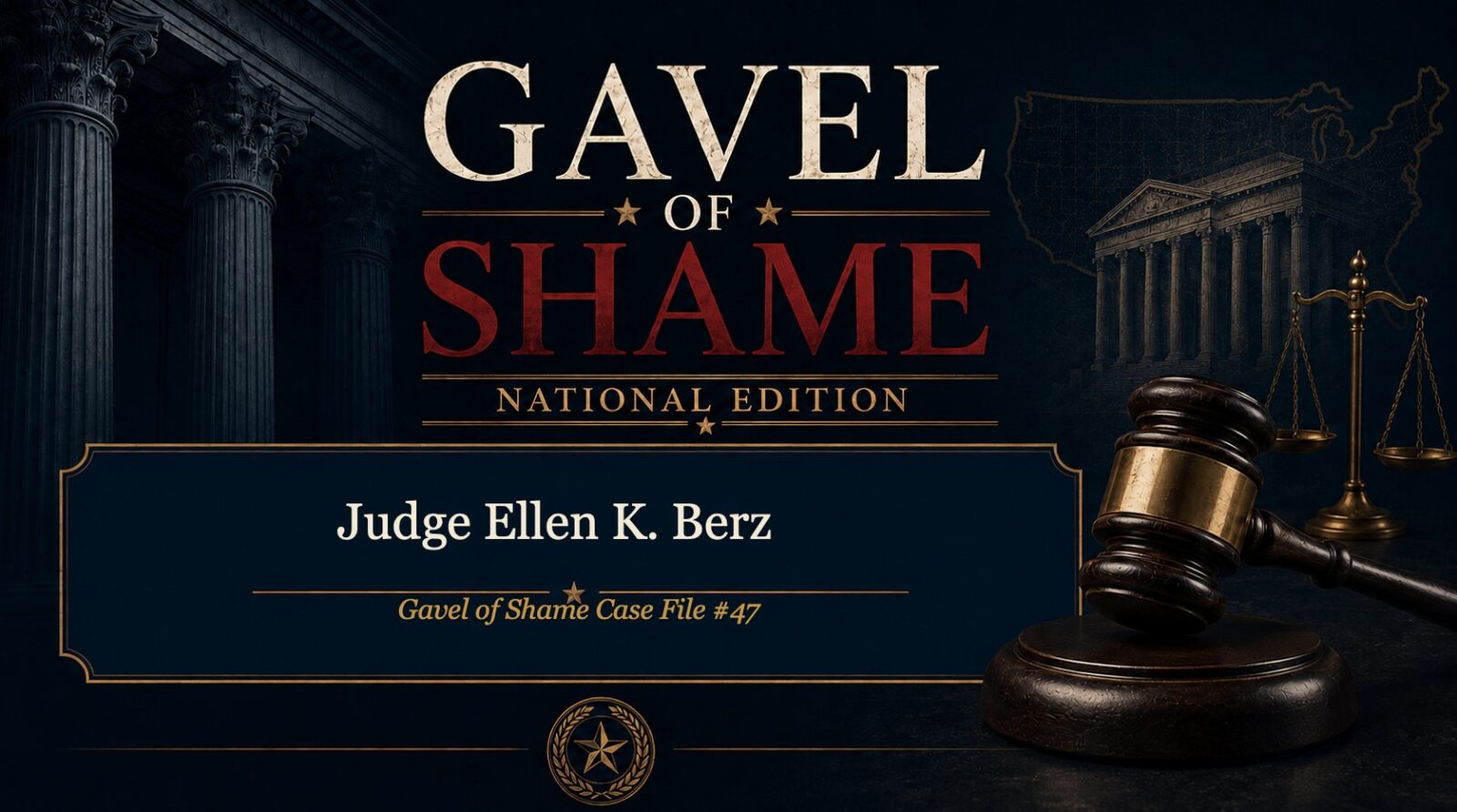
Judge Berz Suspended for Trying to Arrest a Man
On May 27, 2025, the Wisconsin Supreme Court suspended Dane County Circuit Judge Ellen Berz without pay for seven days, finding she committed judicial misconduct in two separate incidents. In the more serious one, when a defendant failed to appear because he was hospitalized, Berz tried to send her bailiff to arrest him, and when that failed, got in her own car with the defendant’s attorney and started driving toward the hospital herself before turning back. In the other, she told a defendant seeking a trial continuance that if he was later convicted, “this Court will not forget that.” Below: both incidents, and where Berz’s career stands now.
| CASE FILE AT A GLANCE | |
| Judge | Ellen K. Berz |
| Court | Dane County Circuit Court |
| County | Dane County, Wisconsin (Madison) |
| Case Number | No. 2024AP2038-J, reported at 2025 WI 17 |
| Sanction | Seven-day suspension without pay, beginning June 26, 2025 |
| Decided | May 27, 2025, Supreme Court of Wisconsin (per curiam) |
| On the Bench Since | 2012 (reelected unopposed in 2024) |
A Defendant in the Hospital and a Judge Who Went to Get Him
On December 13, 2021, a jury trial was set to begin in Judge Berz’s Dane County courtroom. The defendant, Noah Hodges, did not appear. His attorney told the court he was in a hospital emergency room in Sun Prairie. Rather than issue a bench warrant or reschedule, Berz had a staff member track down Hodges’s exact location, then directed her bailiff, whose job is courtroom security, to leave the courthouse and arrest him. When told the bailiff had no authority to do that, Berz announced to the courtroom that she would retrieve Hodges from the hospital herself, adding that if anything happened to her along the way, “they would hear about it on the news.”
Berz then drove from the courthouse in her own car with Hodges’s own defense attorney in the passenger seat, instructing the attorney not to tell Hodges they were coming. No prosecutor was present for any of this. The attorney told Berz partway there that the trip was a bad idea because a judge is supposed to be a neutral decision-maker. When the attorney said they should turn around, Berz did, heading back to the courthouse before reaching the hospital. Once back on the bench, she recalled the case and stated for the record, “The bailiffs have refused to arrest the defendant, to leave the courthouse in order to do so, so I’m ordering a body-only warrant.” Hodges later pleaded guilty to a repeat drunk-driving offense.
“This Court Will Not Forget That”
The second incident was older and, the Supreme Court found, less serious, but still improper. During a May 2019 hearing in a child sexual assault case, defendant Richard Harrison asked, not for the first time, to push back his trial date. Berz granted the request but told him bluntly that she believed it was probably “a ruse,” and warned that if he was later convicted, “this Court will not forget that.” When Harrison replied that her sarcasm was clear, Berz continued arguing with him directly from the bench, telling him to “play the game with other people” and to go talk to fellow inmates about it, until his own attorney cut in.
The Discipline Ladder (Wisconsin)
Wisconsin’s Judicial Commission investigates complaints and can file formal charges with the Supreme Court. A three-judge Judicial Conduct Panel, drawn from the Court of Appeals, then hears the case and recommends discipline, which the Supreme Court reviews and finalizes; the available sanctions run from reprimand and censure up through suspension and removal. Suspension is genuinely rare: through 2025, only 16 public disciplinary cases had ended in suspension and three in removal, out of decades of complaints. Berz’s seven days is one of the sixteen.
Why a Suspension and Not Just a Reprimand
Berz did not contest the facts. She stipulated to both incidents, accepted that she had violated the Code of Judicial Conduct, and jointly proposed the seven-day suspension herself as part of a settlement with the Judicial Commission. The Supreme Court agreed that a suspension, not merely a public reprimand, was warranted, distinguishing two prior Wisconsin cases involving intemperate courtroom remarks that had drawn only a reprimand: the Court found Berz’s conduct in the Hodges matter went well beyond bad language, calling it an abandonment of her role as a neutral judge that placed defense counsel in an impossible position. The Court also credited Berz for accepting responsibility, showing remorse, and having no prior discipline in her twelve years on the bench, which is part of why the sanction stopped at a week’s suspension rather than something longer.
A Capital Times analysis published after the Commission’s complaint became public found that Dane County attorneys had filed requests to remove Berz from their cases hundreds of times since 2020, far more than for any other judge in the county, though that pattern was not itself part of the Commission’s charges against her.
The Rules She Broke
| Rule | What It Requires |
| SCR 60.02, Wisconsin Code of Judicial Ethics | A judge shall personally observe high standards of conduct so that the integrity and independence of the judiciary will be preserved. |
| SCR 60.03(1) | A judge shall respect and comply with the law and act at all times in a manner that promotes public confidence in the integrity and impartiality of the judiciary. |
| SCR 60.04(1)(d) | A judge shall be patient, dignified, and courteous to litigants, lawyers, staff, and others dealt with in an official capacity. |
| SCR 60.04(1)(e) | A judge shall perform judicial duties without bias or prejudice. |
How It Played in the Press
Wisconsin Public Radio covered the suspension in depth when it issued, including comment from a Marquette University law professor on how rare judicial suspensions are in Wisconsin. The story noted that the Wisconsin Supreme Court had separately suspended a Milwaukee County judge, Hannah Dugan, earlier the same year over an unrelated pending criminal matter, a reminder that judicial suspensions, while uncommon, were very much in the news in Wisconsin in 2025. That matter has since run its course: Dugan was convicted of felony obstruction in December 2025, resigned from the bench in January 2026, was sentenced in July 2026 to a $5,000 fine with no prison time, and has an appeal pending in the Seventh Circuit. Case File No. 58 covers it.
Where Is She Now?
Berz’s seven-day suspension without pay ran from June 26, 2025. She was reelected to a new six-year term in 2024, running unopposed, and continues to serve as a Dane County Circuit Court judge. Nothing further has issued against her. The Judicial Commission’s annual report for calendar year 2025 records the seven-day suspension as the disposition and no later proceeding, and no new complaint or sanction had surfaced as of October 2026.
Facing the System in Texas?Judges are bound by rules too, and there are systems (conduct commissions and appeals) built to hold them to it, in Wisconsin and in Texas alike. Deandra Grant Law handles federal and state criminal defense in Texas. Call (214) 225-7117 • texasdwisite.com |
Sources
PRIMARY SOURCE
- Supreme Court of Wisconsin, In re Judicial Disciplinary Proceedings Against the Honorable Ellen K. Berz, 2025 WI 17, No. 2024AP2038-J, decided May 27, 2025 (per curiam), official court copy. wicourts.gov
NEWS COVERAGE
- Wisconsin Public Radio: Wisconsin Supreme Court suspends Dane County judge over ‘intemperate’ behavior. wpr.org
- Capital Times: Attorneys don’t want Dane County Judge Ellen Berz to hear their cases. captimes.com
REFERENCE
- Wisconsin Judicial Commission: 2025 Annual Report, Appendix A (results of public disciplinary cases, 1978 to 2025) and Section VII.C (the Berz suspension). wicourts.gov
This post summarizes public judicial-discipline records and news reporting for general informational purposes and was last reviewed in October 2026. It is not legal advice.
Which county your case is filed in changes how it is charged, who prosecutes it, and which court hears it.
Deandra M. Grant, JD, GC, MS, ACS-CHAL Forensic Lawyer-Scientist
She holds a Master of Science in Pharmaceutical Science and a Graduate Certificate in Forensic Toxicology, both from the University of Florida. She is the author of The Texas DWI Manual and has defended Texas DWI cases since 1994.
Charged With a Crime?
Whatever you're facing, a DWI or any criminal charge, the sooner you have a forensic-trained team on it the more we can do. Tell us what happened and we'll review your options, at no cost and no obligation. Intake answers 24/7, and if your case is one we can take on, we schedule a free consultation with an attorney.
Request a Free Case Evaluation
Tell us what happened. We'll respond as soon as possible.