
A Firing Squad at Fort Hood

Nidal Hasan, the Army psychiatrist who killed 13 people at Fort Hood on November 5, 2009, is scheduled to be executed by firing squad at Fort Hood on December 3, 2026, after the President approved the sentence in early October 2026 under 10 U.S.C. § 857(a)(3). It would be the first U.S. military execution since 1961. A court-martial death sentence runs on a different track from a Texas capital case at every stage: an Article 32 investigation and a convening authority’s referral instead of a grand jury, twelve members who must be unanimous on both guilt and death, aggravating factors prescribed by the President and upheld in Loving v. United States, three layers of appellate review, and a presidential signature at the end. Direct review ended when the Supreme Court denied certiorari in March 2025. The only judicial route left is federal habeas under 28 U.S.C. § 2241, which Burns v. Wilson limits to whether the military courts gave the claims full and fair consideration, and Hasan, who represented himself and has signaled for thirteen years that he does not intend to fight, may never file one. The firing squad is on the Supreme Court’s own list of accepted methods under Wilkerson, Baze, Glossip and Bucklew. Whether the execution happens on December 3 is more likely to turn on operational questions than on law.
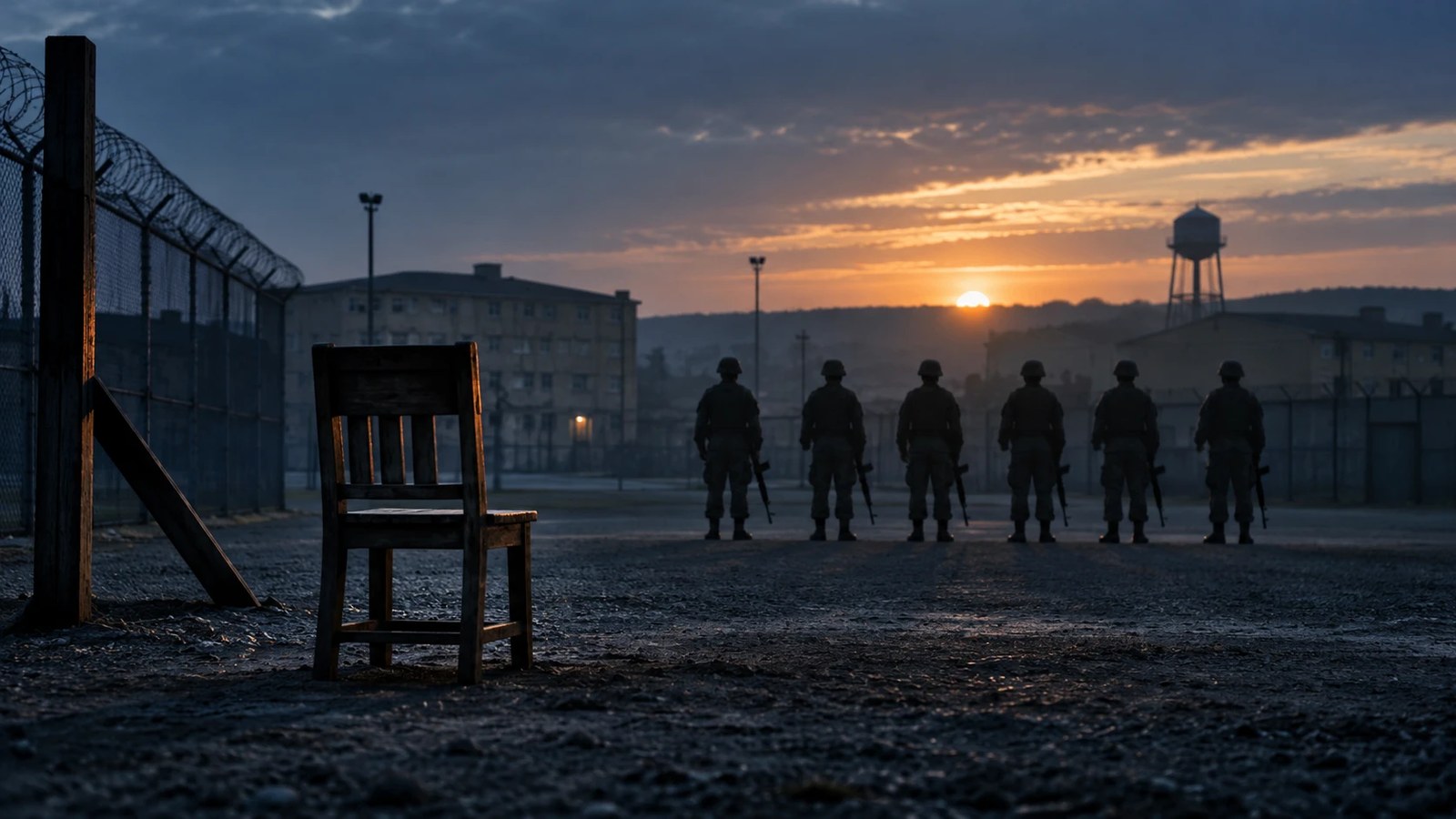
Texas executes more people than any other state. It has done it the same way for forty years, in the same building in Huntsville, under a statute that permits exactly one method.
On December 3, 2026, if the current schedule holds, a man is scheduled to be executed by firing squad at Fort Hood. No Texas judge signed that order. No Texas statute authorizes that method. The Texas Department of Criminal Justice has no role in it. It is a federal military execution happening on Texas soil, and it would be the first military execution in the United States since 1961.
The case is a hard one to look at and an unusually clear window into a system most lawyers never touch. Here is how a court-martial death sentence actually gets carried out, how that differs from the process a few hours south in Huntsville, and what is realistically left.
What Was Approved
Nidal Hasan, then an Army major and a psychiatrist, killed 13 people and wounded more than 30 at Fort Hood on November 5, 2009. A court-martial convicted him in August 2013 on 13 counts of premeditated murder and sentenced him to death.
In early October 2026, the President approved the execution, on the recommendation of the Secretary of Defense, and specified a firing squad. The Army Secretary sets the time and place. An internal email reported by CBS News Texas put the date at December 3, 2026, at Fort Hood, the place where the shooting happened. Hasan has been held at the United States Disciplinary Barracks at Fort Leavenworth, Kansas, which holds the small military death row: four men, counting him. He is paralyzed from the waist down from wounds he received when officers stopped the attack.
Why the President Has to Sign
A military death sentence cannot be carried out until the President personally approves it. That is not custom or courtesy. It is a statute.
Article 71 of the Uniform Code of Military Justice was repealed by the Military Justice Act of 2016, effective January 1, 2019. The requirement is now in Article 57, 10 U.S.C. § 857(a)(3): “If the sentence of the court-martial extends to death, that part of the sentence providing for death may not be executed until approved by the President.”
The same subsection gives the President broad power over what happens next. He “may commute, remit, or suspend the sentence, or any part thereof, as the President sees fit,” with one carve-out that matters here: the part of the sentence providing for death may not be suspended. The President can wipe it out or reduce it. He cannot press pause on it.
The President’s role in military capital cases is broader than the signature at the end. In Loving v. United States, 517 U.S. 748 (1996), the Supreme Court upheld a scheme in which Congress left it to the President to prescribe the aggravating factors that make a military murder death-eligible at all. Capital punishment in the armed forces is, by design, run through the Commander in Chief in a way that has no civilian equivalent.
A Court-Martial Is Not a Texas Capital Trial
The two systems reach the same sentence by genuinely different routes, and the differences are not cosmetic.
- Charging. A Texas capital case starts with a grand jury indictment. A court-martial starts with an investigation under Article 32 and a referral by a convening authority, who is a commander, not a prosecutor and not a judge.
- The panel. Texas seats a jury of twelve. A capital court-martial seats members, and 10 U.S.C. § 825a requires twelve of them in a capital case, a requirement Congress added relatively recently.
- The vote. Both systems require unanimity, and the military version is unusually explicit. 10 U.S.C. § 852 conditions a death sentence on both a unanimous finding of guilt of an offense expressly made punishable by death and a unanimous determination that the sentence include death.
- The sentencing question. A Texas jury answers the statutory special issues under Article 37.071 of the Code of Criminal Procedure. A military panel works from aggravating factors the President prescribed, which is the structure Loving approved.
- The appeal. A Texas death sentence goes on direct appeal straight to the Court of Criminal Appeals. A military death sentence goes to the service Court of Criminal Appeals, then to the Court of Appeals for the Armed Forces, and only then to the Supreme Court on certiorari.
Hasan’s case ran that full course. The Army Court of Criminal Appeals affirmed in 2020. The Court of Appeals for the Armed Forces affirmed in 2023. The Supreme Court denied review in March 2025. Direct appeal is over.
Why the Method Changed
The firing squad surprised a lot of people, including people who had read the regulation. The version of Army Regulation 190-55 published in 2006 was explicit that lethal injection was the method, and it directed the Secretary of the Army to provide the Provost Marshal General with “the approved manner (lethal injection), location, and date of the execution.”
That language is no longer there. According to reporting on the Hasan order, a 2019 revision to the regulation removed lethal injection, leaving the manner of execution to the Secretary of the Army’s designation. So no rule had to be broken or waived to get to a firing squad. The rule that would have blocked it was taken out seven years ago, quietly, while nobody was being executed.
The more interesting point is that a constitutional challenge to the method would be very hard, and for a reason that cuts against intuition.
The Supreme Court upheld execution by firing squad in Wilkerson v. Utah, 99 U.S. 130 (1879), and has never retreated from it. More recently, in Bucklew v. Precythe, 587 U.S. 119 (2019), the Court said that Baze v. Rees and Glossip v. Gross do not suggest “that traditionally accepted methods of execution, such as hanging, the firing squad, electrocution, and lethal injection, are necessarily rendered unconstitutional as soon as an arguably more humane method like lethal injection becomes available.” The firing squad is on the Court’s own list of accepted methods.
And under Baze, Glossip and Bucklew, a prisoner challenging a method generally has to identify a feasible, readily implemented alternative that would significantly reduce a substantial risk of severe pain. For two decades, the alternative capital litigators have most often proposed is the firing squad. A prisoner being shot cannot easily argue there is a gentler option available, because the gentler option was the one the lawyers were asking for. Whatever one thinks of that doctrine, it closes this particular door.
What Is Actually Left
Direct review is finished, so the only remaining judicial route is collateral: a habeas corpus petition in a civilian federal district court. Military prisoners file under 28 U.S.C. § 2241. That route exists, and the commentary saying it could add years is not wrong. But the standard is far more deferential than the one that applies to a Texas state prisoner.
The governing case is Burns v. Wilson, 346 U.S. 137 (1953), itself a military capital case. The Supreme Court held that civilian courts do have habeas jurisdiction over military prisoners, and then sharply limited what they may do with it: “when a military decision has dealt fully and fairly with an allegation raised in that application, it is not open to a federal civil court to grant the writ simply to re-evaluate the evidence.”
Hasan’s claims went through a service appellate court and the Court of Appeals for the Armed Forces, both of which wrote opinions, and the Supreme Court declined review. A civilian district judge asked to revisit those claims starts from the position that the military courts already gave them full and fair consideration. The Court reinforced the same instinct toward non-interference in Schlesinger v. Councilman, 420 U.S. 738 (1975). A federal habeas petition here is not the robust second look that phrase suggests to someone used to state capital litigation.
The Complication No Court Can Solve
There is a reason to doubt any petition gets filed at all.
Hasan represented himself at his court-martial. During trial his standby counsel asked the military judge to let them withdraw, telling the court they could not ethically continue. Lieutenant Colonel Kris Poppe put it this way: “It becomes clear his goal is to remove impediments or obstacles to the death penalty and is working toward a death penalty.” The judge refused to release them and ordered them to keep assisting.
Capital lawyers call this the volunteer problem, and it is the one thing in a death penalty case that procedure cannot route around. Every remaining protection in the system is a right the condemned person has to invoke. Habeas is not automatic. If a defendant wants the sentence carried out, the machinery that might slow it down largely does not start.
Two Death Penalty Systems
This is where the Texas angle turns out to be sharper than a coincidence of geography.
Fort Hood sits inside Texas, the most active death penalty jurisdiction in the country. Under Article 43.14 of the Texas Code of Criminal Procedure, a Texas execution is carried out by “intravenous injection of a substance or substances in a lethal quantity sufficient to cause death,” administered under the supervision of the director of the correctional institutions division of the Texas Department of Criminal Justice. Lethal injection is the only method Texas authorizes. There is no firing squad provision in Texas law.
So on December 3, two execution systems will be operating inside the same state, and they share almost nothing. Different sovereign. Different charging process. Different court. Different appellate ladder. Different habeas standard. Different method. Different chamber, three hours apart. One of them has carried out hundreds of executions. The other has not carried out one since 1961, when Private John Bennett was hanged.
Will It Happen on December 3?
Nobody should state that confidently in either direction.
The legal obstacles are thinner than the commentary suggests. Direct review is complete. The method is one the Supreme Court has blessed since 1879 and listed approvingly as recently as 2019. The regulation that specified lethal injection was amended years ago. Federal habeas for a military prisoner is real but deferential, and the defendant has spent thirteen years signaling that he does not intend to fight.
Against that, this system has not executed anyone in sixty-five years. Institutions that have not done something in six decades tend to discover problems when they try: who fires, who certifies death, who is permitted to witness, what happens to the body, how a prisoner who cannot stand or walk is positioned. Those are not constitutional questions. They are operational ones, and operational questions have delayed executions before.
The Bottom Line
A military death sentence is a rare thing and a slow one. It requires unanimity twice over, survives three layers of appellate review, and then sits until a President signs it. Seventeen years will have passed between the Fort Hood shooting and the date now on the calendar.
None of that makes the system more careful than the civilian one. It makes it different, and in the part that matters most after a conviction becomes final, it is less generous: the civilian court asked to take a second look at a military conviction is told to defer unless the military courts failed to consider the claim at all. That is worth understanding on its own terms, and it is worth understanding alongside what we know about how often capital convictions in this country have turned out to be wrong.
Deandra Grant is the managing partner of Deandra Grant Law, a Texas DWI and criminal defense firm with offices across Dallas-Fort Worth and Central Texas. She and her team defend serious felony and capital-exposure cases throughout the region.
Further Reading
- 10 U.S.C. § 857(a)(3) (UCMJ art. 57) (presidential approval of a death sentence; power to commute or remit but not to suspend); 10 U.S.C. § 871 (UCMJ art. 71, repealed effective Jan. 1, 2019).
- 10 U.S.C. § 825a (twelve members in a capital case) and 10 U.S.C. § 852 (unanimity for a capital conviction and for a death sentence).
- Loving v. United States, 517 U.S. 748 (1996) (presidential prescription of aggravating factors in military capital cases).
- Burns v. Wilson, 346 U.S. 137 (1953) (civilian habeas review of military convictions; full and fair consideration standard), and Schlesinger v. Councilman, 420 U.S. 738 (1975).
- Wilkerson v. Utah, 99 U.S. 130 (1879); Baze v. Rees, 553 U.S. 35 (2008); Glossip v. Gross, 576 U.S. 863 (2015); and Bucklew v. Precythe, 587 U.S. 119 (2019) (method-of-execution challenges and the alternative-method requirement).
- Tex. Code Crim. Proc. art. 43.14 (lethal injection as the sole Texas method) and art. 37.071 (capital sentencing special issues).
- Army Regulation 190-55 (version published January 17, 2006, specifying lethal injection; superseded by a later revision that removed the method designation).
- KERA News and CBS News Texas on the approval and the scheduled date; Al Jazeera on the appellate history.
This post is an informational synthesis for educational purposes and is not legal advice. It describes a pending case and a scheduled execution as of October 2026; dates, filings and the operative version of military regulations can change quickly and should be confirmed before anyone relies on them. Anyone facing charges should consult a licensed attorney about the specific facts of their case.
Which county your case is filed in changes how it is charged, who prosecutes it, and which court hears it.
Deandra M. Grant, JD, GC, MS, ACS-CHAL Forensic Lawyer-Scientist
She holds a Master of Science in Pharmaceutical Science and a Graduate Certificate in Forensic Toxicology, both from the University of Florida. She is the author of The Texas DWI Manual and has defended Texas DWI cases since 1994.
Charged With a Crime?
Whatever you're facing, a DWI or any criminal charge, the sooner you have a forensic-trained team on it the more we can do. Tell us what happened and we'll review your options, at no cost and no obligation. Intake answers 24/7, and if your case is one we can take on, we schedule a free consultation with an attorney.
Request a Free Case Evaluation
Tell us what happened. We'll respond as soon as possible.