A Century of Forensic Rulings Now Searchable
Duke Law’s new Forensic Expert Evidence Database lets anyone see how courts across all fifty states have admitted or rejected firearms, fingerprint, and shoeprint testimony over the last hundred years. Here is what it holds, how to use it, and what it means if forensic evidence is part of a Texas case.
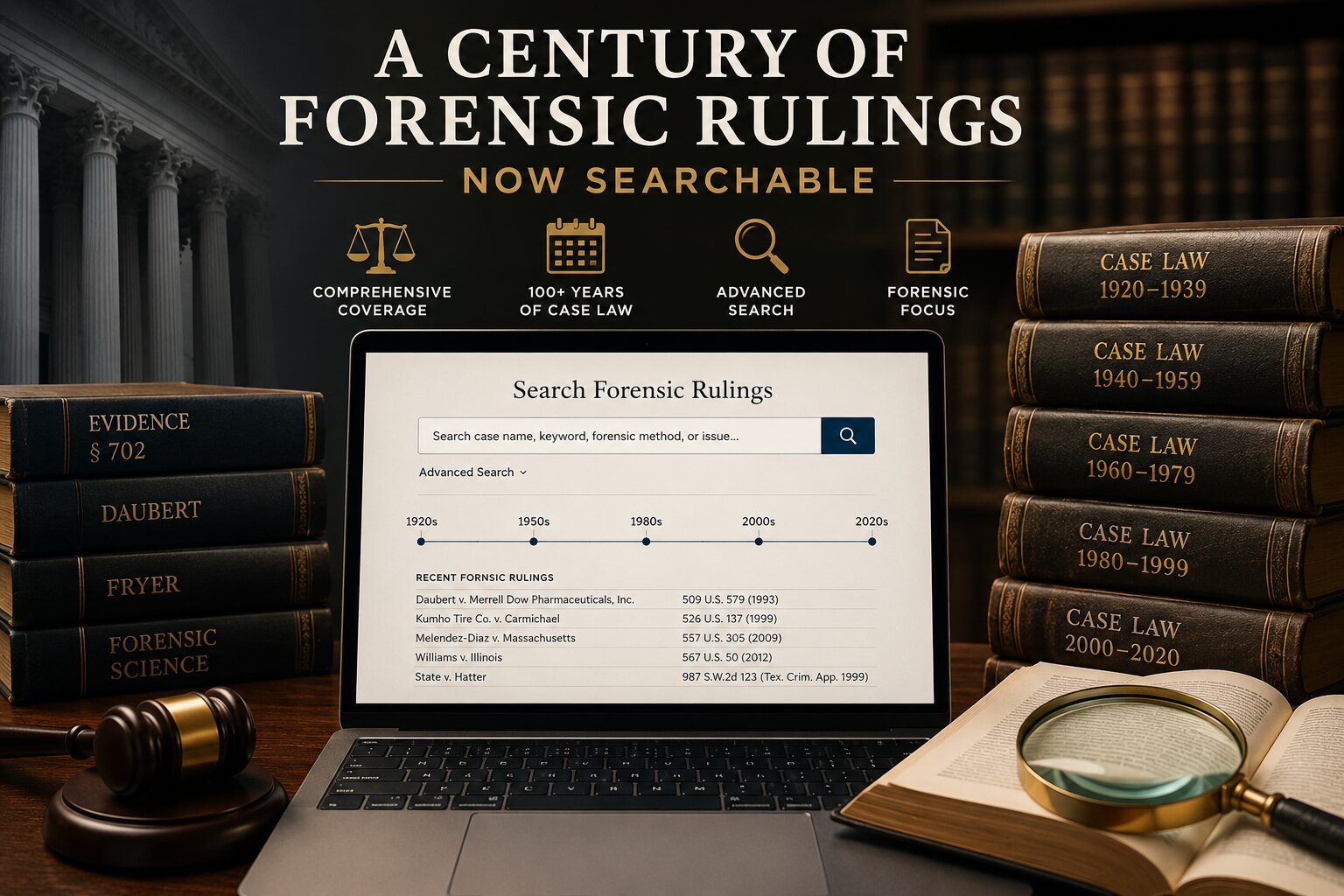
For most of the last century, finding out whether a court would let a jury hear a firearms “match” or a fingerprint “identification” took a specialist, a paid legal-research subscription, and a lot of time. Now anyone can look it up. The Wilson Center for Science and Justice at Duke Law has launched a free, public Forensic Expert Evidence Database. It is a searchable record of how courts have treated forensic expert testimony, reaching back more than a hundred years. For defendants, families, and lawyers alike, it is a rare window into how a category of evidence that can decide a case has actually fared when judges scrutinized it.
What’s In It
The database collects reported court decisions (mostly from appellate courts) on the admissibility of expert testimony in three pattern-matching disciplines: firearms and toolmark analysis, fingerprint comparison, and shoeprint analysis. It draws on rulings from all fifty states and the federal system, gathered from more than a century of caselaw. The project was built over several years by Duke law students under Professor Brandon Garrett, the forensic-science scholar behind Autopsy of a Crime Lab, with support from the Center for Statistics and Applications in Forensic Science. Each entry does more than list a case name. It summarizes what the court decided, which reliability standard the court applied (the federal Daubert test, the older Frye “general acceptance” rule, a state standard, and so on) and what the outcome was: admitted, limited, or excluded.
Why It Matters
The value is not just convenience. Put a century of these rulings in one place and a pattern becomes visible that no single case can show. For decades, firearms, fingerprint, and shoeprint testimony was admitted almost automatically, on the strength of habit and courtroom familiarity. More recently (pushed by the 2009 National Academy of Sciences report, the 2016 PCAST report, and a wave of appellate decisions) courts have grown willing to question these methods, and in some places to limit what an examiner may tell a jury. The Maryland high court, for example, barred firearms examiners from telling jurors that a specific gun fired a specific bullet. A searchable database makes that shift legible to everyone, not just the handful of experts who lived through it. It turns “trust me, this is standard” into something a defendant can actually check.
How to Use It
The database is built to be filtered. You can narrow the rulings by state, by year, by the type of court, by the forensic discipline, by the reliability standard the court applied, and by the outcome. A few practical ways that helps:
- See how your own state’s courts have handled a discipline: for a Texas case, filter to Texas and read how its courts have treated firearms or fingerprint testimony.
- Find the rulings that pushed back: filter to decisions that limited or excluded testimony, and you can see the exact language courts used to rein in overstated “match” claims.
- Learn which standard governs where: the entries show whether a court applied Daubert, Frye, or a state rule, which tells you what the reliability fight in that jurisdiction actually looks like.
- Track the trend over time: sort by year and watch how the treatment of a discipline changed across decades.
You can explore it directly at the Wilson Center’s site.
The Texas Lens
A word of translation for Texas cases. The database flags which reliability standard each court used, and Texas is its own animal: in Texas criminal court, novel or contested scientific evidence is screened under the Kelly standard, not the federal Daubert test that governs in federal court. When you read a Texas entry, you are reading how our courts applied the three-part reliability test in Kelly. And if a Texas conviction rested on forensic evidence that has since been undermined, the tool that matters is Article 11.073 of the Code of Criminal Procedure, Texas’s “junk science” writ, which lets a person seek relief when the science behind a conviction has changed or collapsed.
Know the Limits of the Tool
A resource this good is worth using carefully. Three limits are worth keeping in mind. First, it covers three disciplines (firearms, fingerprint, and shoeprint) not the whole forensic universe; for discredited methods like bite-mark comparison or old-school arson analysis, see our piece on the Jimmie Duncan case. Second, it catalogs admissibility rulings, meaning whether a court let the evidence in which is not the same as a verdict on whether the underlying science is sound. A method can be widely admitted and still be shaky, which is much of the point. Third, because it draws on reported decisions, it leans toward appellate rulings; many trial-court decisions never generate a written opinion and so never appear. It is a powerful map of the legal terrain, not a substitute for a lawyer who can read both the caselaw and the science under it. Reading a favorable ruling from another state does not mean it controls a Texas case.
The Bottom Line
Transparency tends to help the accused, because the reliability of forensic evidence has too often been taken on faith. A free, searchable century of rulings on firearms, fingerprint, and shoeprint testimony is a real step toward letting defendants and their lawyers see the pattern for themselves and it lands at a moment when courts are finally asking harder questions about pattern-matching evidence. Used alongside a lawyer who understands the science, it is a genuinely useful place to start.
Is Forensic Evidence Part of Your Texas Case?
Firearms, fingerprint, shoeprint, DNA, and breath or blood testing all reach the courtroom faster than the law that governs them. Whether the goal is to challenge that evidence at trial or to revisit a conviction that relied on it, Deandra Grant Law brings genuine forensic training to the science behind the case.
Call (214) 225-7117 • texasdwisite.com
Sources & Further Reading
- Forensic Expert Evidence Database, Wilson Center for Science and Justice, Duke Law — the searchable database itself. forensic-case-databases.law.duke.edu
- Wilson Center for Science and Justice at Duke Law, “New Database Documents a Century of Court Decisions on Forensic Expert Evidence Testimony” (Feb. 2026) — the launch announcement. law.duke.edu
- Forensic Resources (North Carolina Office of Indigent Defense Services) — a companion library of forensic-discipline research and caselaw. org
- National Academy of Sciences, “Strengthening Forensic Science in the United States” (2009); PCAST, “Forensic Science in Criminal Courts” (2016)
- Code Crim. Proc. Art. 11.073 — Texas’s “junk science” writ; and Kelly v. State, 824 S.W.2d 568 (Tex. Crim. App. 1992)
- Related, from our blog: firearms and toolmark “ballistics matching” under scrutiny; and how bite-mark “science” sent Jimmie Duncan to death row. com
Deandra M. Grant, JD, GC, MS, ACS-CHAL Forensic Lawyer-Scientist
She holds a Master of Science in Pharmaceutical Science and a Graduate Certificate in Forensic Toxicology, both from the University of Florida. She is the author of The Texas DWI Manual and has defended Texas DWI cases since 1994.
Charged With a Crime?
Whatever you're facing, a DWI or any criminal charge, the sooner you have a forensic-trained team on it the more we can do. Tell us what happened and we'll review your options, at no cost and no obligation. We're available 24/7 across all six Texas offices.
Request a Free Case Evaluation
Tell us what happened. We'll respond as soon as possible.