
What the Body Camera Did Not Record

In most Texas DWI cases the body camera video is treated as the referee. The officer says one thing, the defendant remembers another, and everyone turns to the recording to settle it. Clients assume it will exonerate them. Prosecutors assume it will help them convict. Jurors assume it shows what happened.
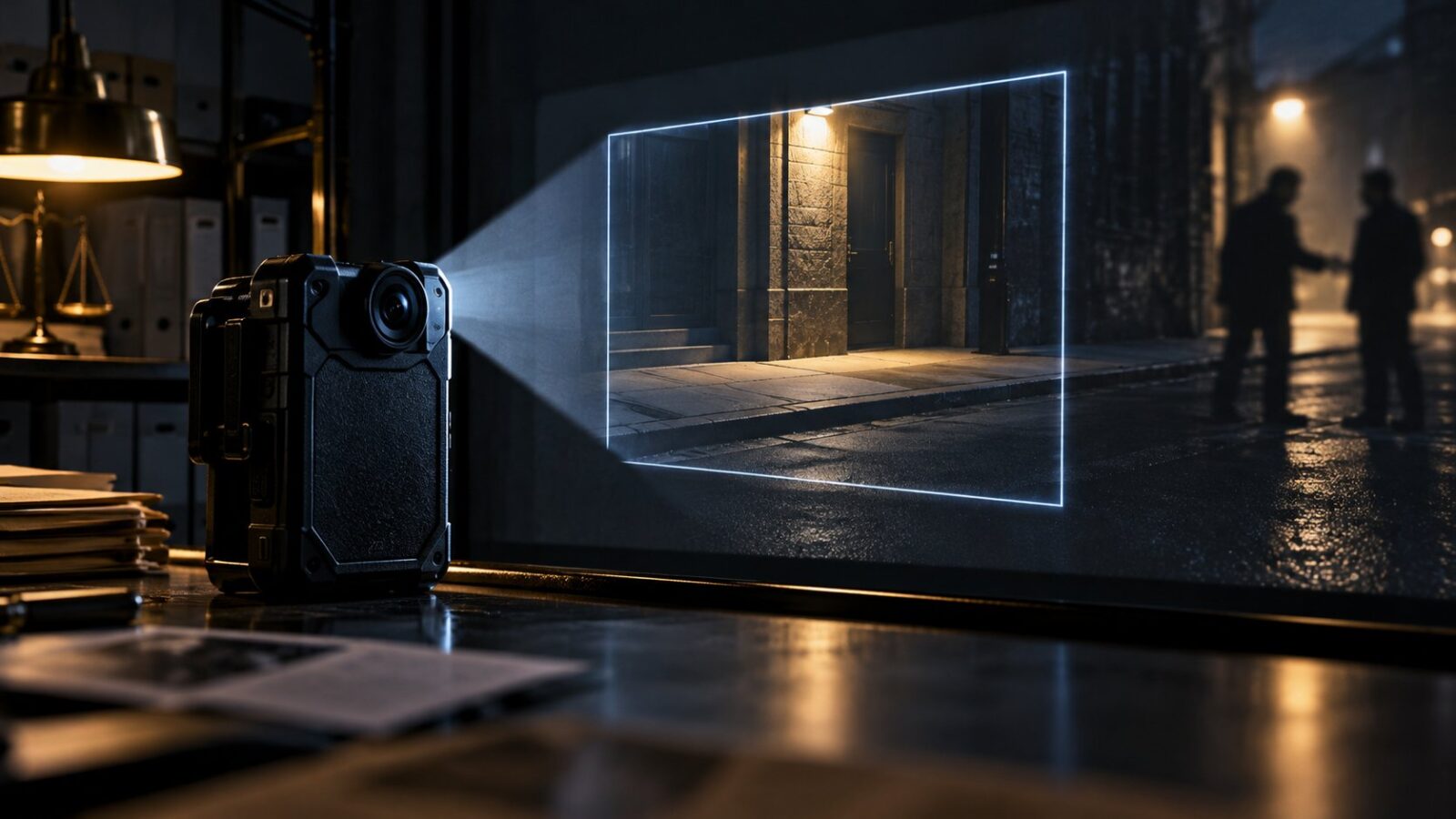
It shows what entered a lens. A recent piece in Forensic Magazine by Larry Danaher, a former police captain, puts the principle well: accuracy inside the frame is not the same as completeness outside it. The research he points to is worth knowing, and it applies to a roadside sobriety test even more directly than to the use-of-force cases it was written about.
A Chest Camera Is Not the Officer’s Eyes
Start with the physical fact that most people never think about. A body-worn camera is usually mounted on the chest. It points where the torso points. The officer’s observations are made with his eyes, and his eyes move independently of his chest.
Somebody measured the difference. In a 2024 study published in Police Practice and Research, Murray and colleagues put eye-tracking glasses and a chest-mounted camera on 44 active-duty officers running a scripted use-of-force scenario, then compared what the officers looked at against what the camera caught. Officers fixated on 80.5 percent of the critical incidents. The body camera captured 66.2 percent. On the two events that mattered most, the suspect retrieving a weapon and firing it, the officers’ eyes caught 74 and 80 percent while the camera caught 48 and 45.
Two things about that study make it more useful than it first appears. The authors reported that the scenario was deliberately designed so the critical incidents could fall within the camera’s field of view, which means 66.2 percent is a generous number rather than a worst case. And one of the co-authors is William Lewinski of the Force Science Institute, a research organization closely associated with law enforcement. This is not an advocacy finding from the defense bar. It is a police-aligned research group reporting that the camera missed a third of what mattered.
The authors’ own conclusion: viewers may reach different conclusions about an officer’s behavior from the body camera footage than from the officer’s point of view. The gyroscope data told the same story. There was far more head movement than body movement, so the camera’s view simply did not track where the officers were looking.
The Test the Camera Cannot Record
Now apply that to a DWI stop.
The horizontal gaze nystagmus test is the first of the three standardized field sobriety tests and usually the most heavily weighted by officers. Under the NHTSA manual, the officer holds a stimulus approximately twelve to fifteen inches in front of the subject’s nose, slightly above eye level, and watches the eyes for an involuntary jerking.
Consider what a chest-mounted camera, standing at conversational distance on a dark roadside, can resolve of a small involuntary movement in a person’s eyes. The answer is nothing. The most important observation in many DWI cases is, as a matter of optics, not on the video. What the jury sees is a man looking at a pen. What the officer testifies to is something the recording cannot confirm or contradict.
The absence of nystagmus on the video is not evidence there was none. But it does mean the single piece of evidence the State treats as the objective record is silent on the officer’s most important conclusion.
Here is the useful inversion. The video is nearly worthless for the observation and excellent for the administration. The same NHTSA manual requires the stimulus to move at a speed taking approximately two seconds to bring the eye from center to side, at least two complete passes, and a hold at maximum deviation for a minimum of four seconds. Those are timing requirements, and timing is exactly what a video can establish. Count the passes. Time the holds with the timecode. An officer who rushed the test produced clues that the manual says the procedure is not validated to produce, and the video that cannot show you his eyes can show you that.
What the Camera Does Badly on the Other Two Tests
The walk-and-turn and the one-leg stand are scored on the feet, and the feet are where the camera is weakest.
- Field of view and angle. A chest camera at an angle, often with the officer’s own arm or flashlight in frame, frequently cannot resolve whether a heel touched a toe or a foot came off a line that may not be painted on the road at all.
- Lighting and exposure. Roadside stops happen at night in headlights and strobes. Automatic exposure preserves one part of the image by losing another, and the part it loses is usually the dark pavement where the scoring happens.
- Wide-angle distortion. These lenses are wide by design. The study above used a 133-degree field of view. Wide angles distort apparent distance and the geometry near the edges of frame, which is where a person taking nine heel-to-toe steps ends up.
- Frame timing. Variable frame timing complicates any calculation that depends on elapsed time, and these are timed tests scored on a count. That goes to precision at the margin rather than to the method: a timecode will still establish whether a hold lasted four seconds or two, and whether the officer made two passes or one. Treat it as a limit on how fine a measurement you claim, not as a reason to skip the measurement.
Audio and the Slurred Speech Problem
Audio deserves its own paragraph because slurred speech is in nearly every DWI report and almost nobody challenges the recording of it.
Microphones on a moving scene contend with wind, passing traffic, sirens, and overlapping voices, and automatic gain control continuously adjusts levels in ways that can flatten, distort, or suppress what was said. The Forensic Magazine piece makes a distinction: separate what the microphone recorded, what the officer could actually hear standing there, and what the officer perceived. Those are three different things, and a report that says “slurred speech” collapses them into one.
If there is both an in-car microphone and a body-worn one, get both. They are different distances from the speaker, with different gain behavior, and they will not sound the same.
Slow Motion Changes What Jurors Conclude
Caruso, Burns and Converse published “Slow Motion Increases Perceived Intent” in the Proceedings of the National Academy of Sciences in 2016. Across four experiments with 1,610 participants, using real surveillance footage from a murder and broadcast replays from professional football, viewing an action in slow motion rather than at regular speed caused viewers to perceive it as more intentional. The mechanism was that slow motion made participants feel the actor had more time to act, and the authors found this held even when viewers knew how much clock time had actually elapsed.
In four further experiments with 2,737 participants, showing viewers both the regular-speed and the slow-motion version mitigated the bias but did not eliminate it. The usual fix does not fully work.
A DWI case is not about intent, so do not overclaim the holding. What transfers is the underlying effect: slowed and repeated playback changes how a viewer reads a physical movement, and a three-second stumble examined frame by frame for a jury is not the three-second stumble a person standing on the shoulder saw. Watch the video at normal speed with audio before you form a theory, insist the jury see it that way first, and object when the State’s presentation is built on slowed or looped excerpts.
What This Means in Both Directions
A post like this one can slide into telling defense lawyers to distrust video, which would be bad advice. In most Texas DWI cases the video is the best evidence the defense has. It routinely shows a person walking normally, speaking clearly, and following instructions, while the report describes someone else entirely. That contrast wins cases, and it wins them precisely because juries credit video.
What to Ask For
- The original file. What arrives through a district attorney’s download portal is frequently a re-encoded, further compressed derivative. Lossy compression discards information even when ordinary playback looks fine, and the detail it discards is the fine detail you need.
- Hash values and the processing record. SWGDE’s best practices for forensic video analysis call for hashing original and working files and documenting processing so another examiner can reproduce the result. Ask for what the State’s analyst did, in a form you could repeat.
- Every camera, not the one they chose. Body-worn, in-car, any second officer on scene, and any nearby business or residential camera. Each captures a partial view, and device clocks are often slightly wrong, so ask how they were synchronized.
- The activation and buffering record. Ask when the camera was activated, whether the system retains a pre-activation buffer, whether that buffer was preserved, and whether the recording was interrupted at any point.
Our post on how video evidence is enhanced and authenticated covers the forensic side of that work, and our post on deepfake-era evidence covers authentication under Rule 901 when the question is whether a recording is genuine at all. This post assumes it is.
The Bottom Line
A camera records what entered the lens. It does not record everything that entered the event.
None of that makes the video unreliable. It makes it evidence rather than a verdict, and the difference is a question any lawyer can put to a witness: not whether the camera was working, but whether what you say you saw is something this camera, mounted there, pointed that way, in that light, was capable of recording.
If you are facing a Texas DWI built on body camera video, our firm can talk with you about the specific facts.
Deandra Grant is the managing partner of Deandra Grant Law, a Texas DWI and criminal defense firm with offices across Dallas-Fort Worth and Central Texas. She holds a master’s degree in pharmaceutical science and a graduate certificate in forensic toxicology, was the first attorney in Texas to earn the Forensic Sobriety Assessment Certification, and is the author of the Texas DWI Manual.
Further Reading
- Larry Danaher, “Video Evidence is Powerful, but Incomplete,” Forensic Magazine (October 19, 2026).
- Murray, Lewinski, Allen, Sandri Heidner, Albin & Horn, “The eyes have it! Functional field of view differences between visual search behavior and body-worn camera during a use of force response in active-duty police officers,” Police Practice and Research 25(4):490 (2024). doi:10.1080/15614263.2024.2328664; open-access copy.
- Caruso, Burns & Converse, “Slow Motion Increases Perceived Intent,” Proceedings of the National Academy of Sciences 113(33):9250 (2016). doi:10.1073/pnas.1603865113. Located through PubMed.
- SWGDE, Best Practices for Digital Forensic Video Analysis, 18-V-001 v2.0 (December 10, 2025).
- NHTSA, DWI Detection and Standardized Field Sobriety Testing (hosted copy), for the horizontal gaze nystagmus administration and timing requirements.
- Related on this site: how video evidence is enhanced and authenticated and deepfake-era evidence and Rule 901.
This post is an informational synthesis for educational purposes and is not legal advice. The studies described here were conducted in use-of-force and general-perception settings rather than on roadside sobriety testing, and they are cited for the underlying effects rather than as findings about DWI cases. Anyone facing charges should consult a licensed Texas attorney about the specific facts of their case.
Which county your case is filed in changes how it is charged, who prosecutes it, and which court hears it.
Deandra M. Grant, JD, GC, MS, ACS-CHAL Forensic Lawyer-Scientist
She holds a Master of Science in Pharmaceutical Science and a Graduate Certificate in Forensic Toxicology, both from the University of Florida. She is the author of The Texas DWI Manual and has defended Texas DWI cases since 1994.
Charged With a Crime?
Whatever you're facing, a DWI or any criminal charge, the sooner you have a forensic-trained team on it the more we can do. Tell us what happened and we'll review your options, at no cost and no obligation. Intake answers 24/7, and if your case is one we can take on, we schedule a free consultation with an attorney.
Request a Free Case Evaluation
Tell us what happened. We'll respond as soon as possible.