
Facial Recognition: When the Algorithm Is Wrong

A man is shot to death on a Cleveland street. Police have no witness, no DNA, no gunshot residue, no phone data placing anyone at the scene. What they have is a piece of surveillance video and a software tool. They feed the video into Clearview AI’s facial recognition system, it returns a name, and within days officers are inside that man’s apartment with a search warrant, pulling out a gun. There is just one problem: the warrant never told the judge that a computer picked the suspect. And when the defense found out, the whole case started to come apart.
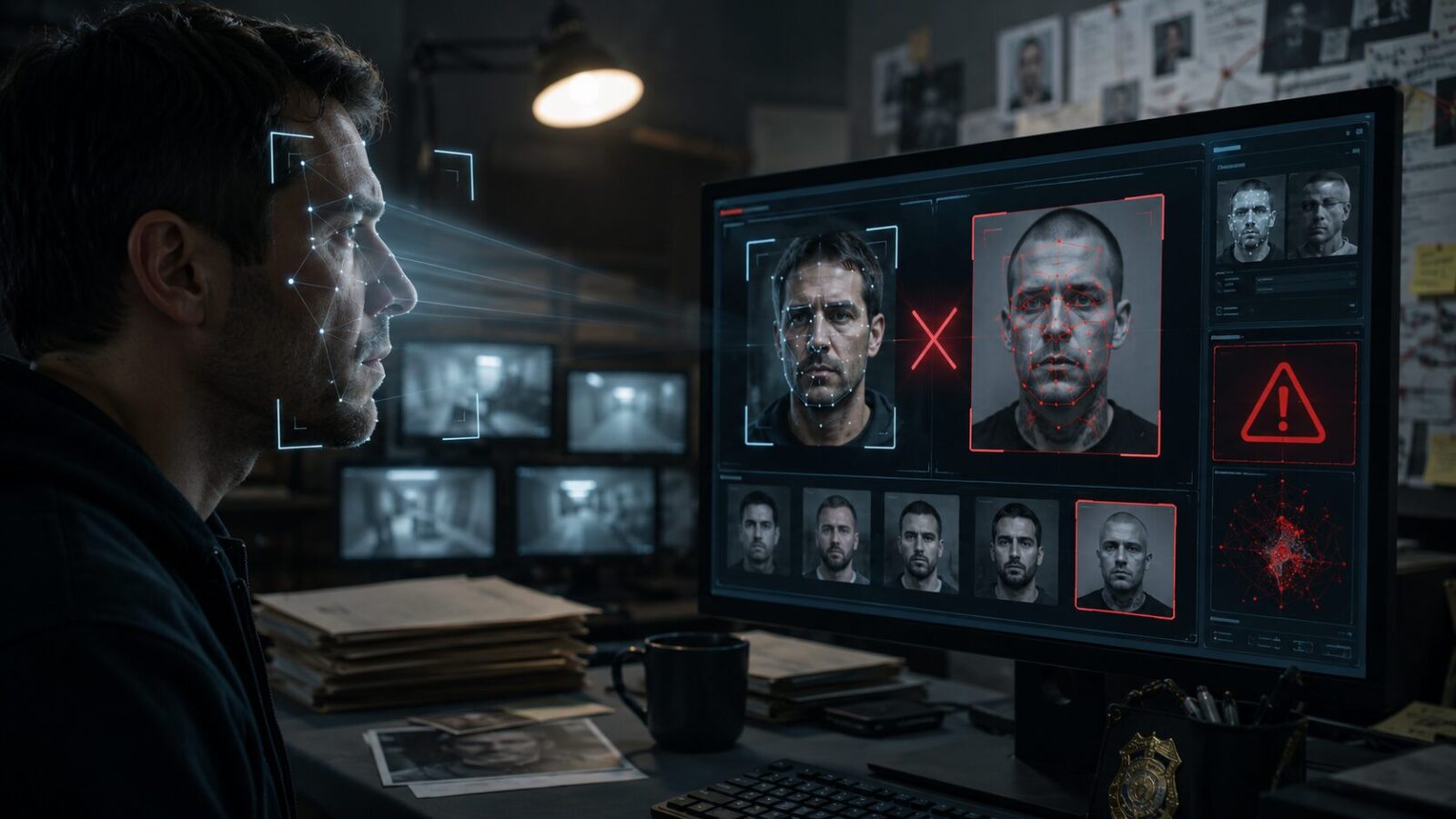
That is not a hypothetical. It is the real arc of an Ohio murder prosecution that has become a national flashpoint and it captures, in one story, why a facial-recognition “match” is an investigative lead, not proof, and why the rules about disclosing that lead can decide a case. Here is what happened, why the technology is weaker than it looks, and what rights a Texas defendant has when police run their face through an algorithm.
What Happened in Cleveland
In the case of State v. Tolbert, Cleveland police investigating a February 2024 killing ran surveillance footage through Clearview AI by way of a regional fusion center. The software returned the name of Qeyeon Tolbert. Officers had not identified him any other way. They then obtained a warrant to search his apartment but the affidavit presented the lead as an “identification” and left out that it came from facial recognition. The search turned up a firearm, and Tolbert was charged with murder.
His defense moved to suppress, arguing the affidavit was misleading and that a facial-recognition hit is closer to an anonymous tip than to a real identification. It’s not nearly enough, standing alone, to establish probable cause. In January 2025 the trial judge agreed and threw out the evidence, and prosecutors conceded that without it they likely could not convict. It did not end there. On appeal, in September 2025, Ohio’s Eighth District reversed and sent the case back, faulting the trial court for not making specific findings about whether the affidavit’s misleading statements were made knowingly or recklessly and whether what remained would still support probable cause. On remand, in January 2026, the trial court made those findings and again quashed the warrant. The case remains active, but the through-line is unmistakable: when the algorithm was pulled out of the affidavit, there was no case left.
One detail matters more than any other: When the defense asked for a hearing on whether the facial-recognition evidence was even scientifically admissible, the State sidestepped it by conceding it did not intend to offer the facial-recognition match as evidence at trial at all. That concession is the whole point. Even the government treats a face match as a way to find a suspect and not as proof of guilt to put before a jury.
Why a Face Match Is a Lead, Not Proof
Facial recognition does not work the way television suggests. It is probabilistic, not deterministic. Feed it a grainy still and it does not announce “this is your man”; it returns a ranked list of candidate faces from a database, each with a similarity score. A human then eyeballs the candidates and decides which one to pursue. Clearview’s own materials caution that its results are investigative leads, not positive identifications. This is also a disclaimer the vendor itself puts in writing.
The error is not evenly distributed. Federal testing by the National Institute of Standards and Technology has found that many facial-recognition algorithms return significantly more false matches for women and for people with darker skin, with some of the highest false-positive rates falling on Black and Asian faces. Layer on “automation bias” (the human tendency to trust what the computer says) and you have a recipe for confident mistakes. The consequences are documented: by 2024 there were at least seven publicly known wrongful arrests in the United States tied to facial recognition, nearly all of them Black Americans, including Robert Williams, arrested in front of his family in Detroit in 2020 over a match that was simply wrong.
Readers of this series will recognize the theme from our piece on courtroom AI in the forensic lab: a tool that is genuinely useful for generating leads gets quietly upgraded, somewhere between the lab and the courtroom, into something that sounds like certainty. With facial recognition, the upgrade often happens in the one place no one is looking: the search-warrant affidavit.
Where the Law Bites: Disclosure and Suppression
Because facial recognition usually operates as an investigative lead rather than trial evidence, the fight over it rarely looks like a classic reliability hearing. It happens in two other places.
Your right to know it was used
You cannot challenge what you do not know about. The central abuse in the Cleveland case was concealment by dressing a facial-recognition hit up as an ordinary “identification.” Other courts are now building an affirmative right to that information. In New Jersey, an appellate court in State v. Arteaga (2023) recognized a defendant’s right to discovery about how facial recognition was used, and in June 2026 the New Jersey Supreme Court in State v. Miles held that prosecutors must turn over non-proprietary information about the technology and how investigators used it while leaving the vendor’s source code for cases where a defendant can show a particularized need. The direction of travel is toward more disclosure, not less.
Suppression when a lead is disguised as proof
A facial-recognition match, by itself, is not probable cause any more than an anonymous tip is. When police build a warrant on that match and hide its source, they run headlong into Franks v. Delaware, the rule that a warrant affidavit containing a knowing or reckless false statement (or a material omission) can be invalidated and if the misleading piece is what supplied probable cause, the evidence from the search is suppressed. That is precisely the mechanism that gutted the Cleveland prosecution.
How This Plays Out in Texas
Texas has not yet passed a comprehensive statute governing police use of facial recognition, even though Texas law enforcement uses the technology. But a Texas defendant is far from empty-handed. In fact, on both the disclosure and the suppression side, Texas law is unusually favorable.
On disclosure, the Michael Morton Act (Article 39.14 of the Code of Criminal Procedure) is one of the broadest criminal-discovery statutes in the country. On a timely request, the State must produce essentially all material (which Texas courts read to mean relevant) evidence in its possession, custody, or control, as soon as practicable. The Court of Criminal Appeals confirmed the breadth of that reading in Watkins v. State, 619 S.W.3d 265 (Tex. Crim. App. 2021), holding that evidence is “material” under the amended statute if it bears a logical connection to a fact of consequence—a relevance standard, not the stricter, outcome-determinative test that governs Brady. Crucially, “the State” includes law enforcement, so the obligation reaches the police department and the fusion center that ran the facial-recognition search, even if the prosecutor never personally saw it. Paired with the constitutional duty under Brady v. Maryland to disclose favorable evidence, that gives a Texas defendant a strong statutory lever to force the question: was facial recognition used here, which system, and how?
On suppression, Franks applies in Texas courts (see, e.g., Massey v. State, 933 S.W.2d 141 (Tex. Crim. App. 1996), and Renteria v. State, 206 S.W.3d 689 (Tex. Crim. App. 2006)) and the remedy is reinforced by Article 38.23, Texas’s statutory exclusionary rule which is broader than its federal counterpart and, unlike federal law, carries only a narrow good-faith exception limited to reliance on a warrant issued on probable cause. The Court of Criminal Appeals construed that statutory good-faith exception in McClintock v. State, 541 S.W.3d 63 (Tex. Crim. App. 2017), which reads Article 38.23(b) narrowly. A warrant built on a concealed or bare facial-recognition match is exactly the kind of thing that narrow exception may not save. Put together, Texas gives defendants both a wide net to find the algorithm and a strong tool to exclude what it tainted.
If Facial Recognition May Have Touched Your Case
This is general education, not advice about any particular case, but if a “match” is anywhere near the State’s theory, these are the questions worth pressing:
- Ask, in writing. In a Morton Act request, ask directly whether any facial-recognition or algorithmic-identification tool was used at any stage, which vendor and system, and how the result was handled.
- Read the warrant affidavit like a hawk. Was the facial-recognition source disclosed to the magistrate, or repackaged as an “identification”? Omissions can be a Franks problem, not just outright falsehoods.
- Treat the match like an anonymous tip. Demand the independent corroboration that actually establishes probable cause and test whether it exists without the algorithm.
- Get the candidate list and the human review. Facial recognition returns multiple candidates; ask what the examiner saw, what they knew about the suspect first, and how they chose.
- Ask whether the State will offer it at trial. Usually they won’t and that refusal is itself an admission that the match is a lead, not proof.
The Bottom Line
Facial recognition can be a legitimate way to generate a lead. It is not a witness, and it is not a fingerprint left at the scene. The danger comes when a probabilistic guess is laundered into a confident “identification” and slipped past a judge. That is exactly what a growing line of courts, from Cleveland to New Jersey, has started to punish. In Texas, the tools to expose that move are already on the books: broad discovery under the Michael Morton Act, the disclosure duty of Brady, the warrant protections of Franks, and the exclusionary force of Article 38.23. The lesson of this series holds once more: the label on the evidence is only as good as the method and the honesty behind it, and you are entitled to see both.
Deandra Grant earned the ACS-CHAL Forensic Lawyer-Scientist designation. She holds an M.S. in Pharmaceutical Science and a Graduate Certificate in Forensic Toxicology, and she has spent three decades challenging the science behind the State’s evidence. This post is part of the Deandra Grant Law forensic science series.
Further Reading
- The Record (Recorded Future News) — Prosecutors say they can’t obtain a murder conviction after judge throws out facial recognition evidence
- Ohio Eighth District Court of Appeals — State v. Tolbert, 2025-Ohio-4469 (opinion)
- ACLU of Ohio — State v. Tolbert (case page and amicus brief)
- New Jersey Monitor — Top court orders disclosures in NJ police use of facial recognition (State v. Miles)
- NIST — Face Recognition Vendor Test, Part 3: Demographic Effects
- Texas Code of Criminal Procedure Art. 39.14 (Michael Morton Act)
- Texas Court of Criminal Appeals — Watkins v. State, 619 S.W.3d 265 (Tex. Crim. App. 2021) (materiality standard under Art. 39.14)
- Texas Court of Criminal Appeals — McClintock v. State, 541 S.W.3d 63 (Tex. Crim. App. 2017) (Art. 38.23(b) good-faith exception)
- Texas Court of Criminal Appeals — Massey v. State, 933 S.W.2d 141 (Tex. Crim. App. 1996), and Renteria v. State, 206 S.W.3d 689 (Tex. Crim. App. 2006) (Franks applied in Texas)
This post is an informational synthesis for educational purposes and is not legal advice. State v. Tolbert (Cuyahoga C.P. No. CR-24-689572-A; 2025-Ohio-4469) remains an active case; its status and all case citations should be independently verified against the official record before use in any filing.
Which county your case is filed in changes how it is charged, who prosecutes it, and which court hears it.
Deandra M. Grant, JD, GC, MS, ACS-CHAL Forensic Lawyer-Scientist
She holds a Master of Science in Pharmaceutical Science and a Graduate Certificate in Forensic Toxicology, both from the University of Florida. She is the author of The Texas DWI Manual and has defended Texas DWI cases since 1994.
Charged With a Crime?
Whatever you're facing, a DWI or any criminal charge, the sooner you have a forensic-trained team on it the more we can do. Tell us what happened and we'll review your options, at no cost and no obligation. Intake answers 24/7, and if your case is one we can take on, we schedule a free consultation with an attorney.
Request a Free Case Evaluation
Tell us what happened. We'll respond as soon as possible.