
AI in the Forensic Lab
“AI in the crime lab” has become a headline phrase, and like most headline phrases it hides more than it reveals. When people say it they are usually talking about one of two very different things.
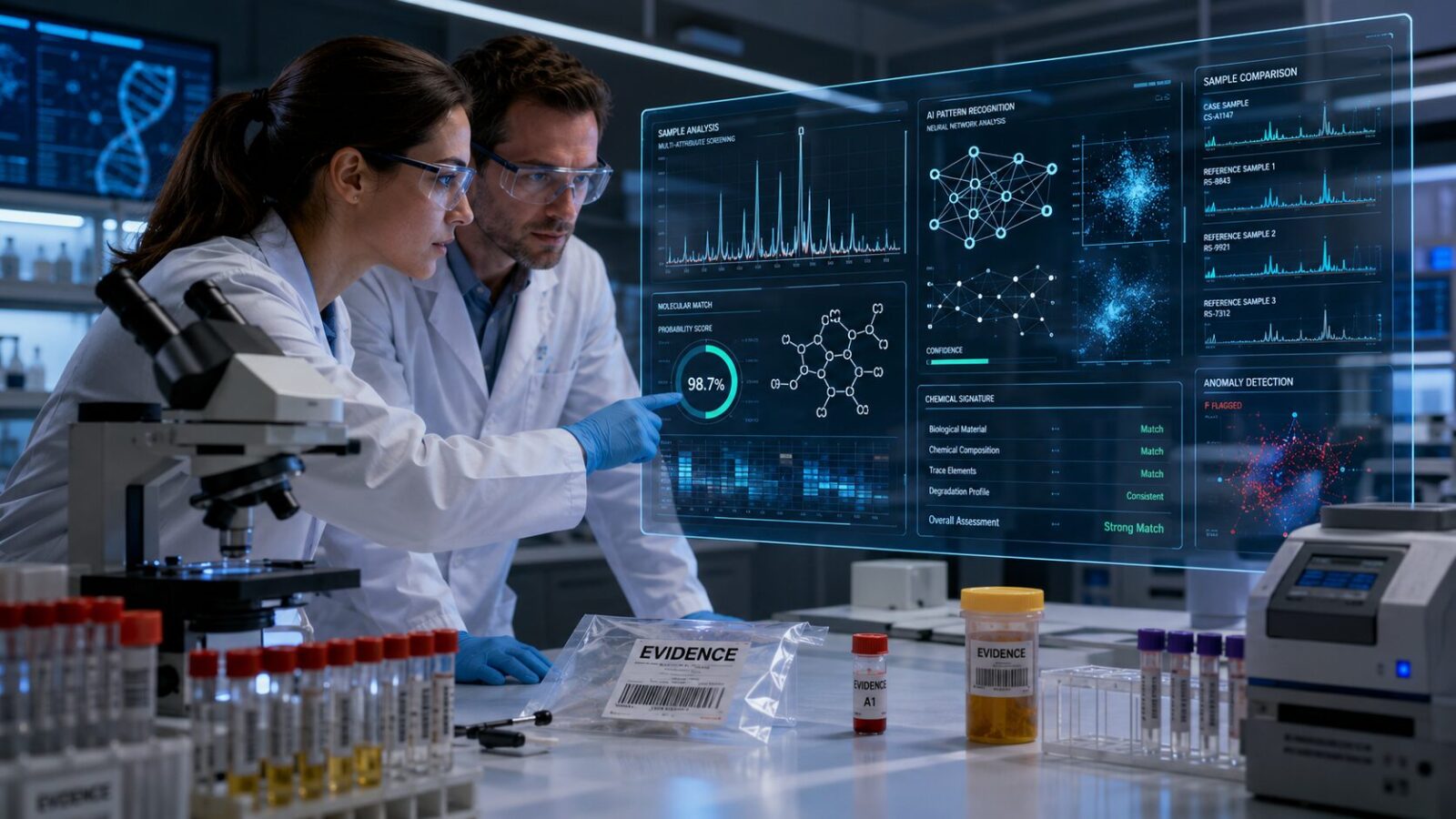
The first is established statistical and algorithmic software that has been producing courtroom evidence for more than a decade. Probabilistic genotyping, the software that interprets complex DNA mixtures, is the marquee example. It is partly a black box, and in a growing number of cases its output is not merely an input to the evidence. It is the evidence.
The second is the newer machine learning and deep learning wave everyone pictures when they hear “AI.” That wave is real, but for now it lives mostly upstream, in investigative triage, screening, and comparison assist, and it has not yet become the load-bearing basis for many convictions.
The practical story, then, is not that crime labs have been automated. It is that a small number of algorithmic tools have quietly become dispositive in individual cases, while the transparency, standards, and disclosure infrastructure around them lags well behind. That gap is where the legal questions live.
And here is the part most coverage misses. This is not a DNA story. It is a software story, and DWI defense got there first. The fight over what a machine decided and who was allowed to check it has been running in breath test litigation since 2008. The same fight is now live in DNA, and it is arriving in toxicology.
How Forensic Labs Actually Use AI
Ordered roughly by courtroom maturity, the picture looks like this.
DNA mixture interpretation
Probabilistic genotyping software such as STRmix and TrueAllele, from Cybergenetics, takes a complex DNA mixture and produces a likelihood ratio. The FBI Laboratory completed its own internal validation of STRmix and has published on validating later versions under SWGDAM guidelines, so this is not fringe software. The algorithm’s output is itself the evidence a jury hears, which is a categorically different thing from an examiner using a tool to help form an opinion.
STRmix’s developers maintain a public miscode log that now lists thirteen entries; the best known was discovered by Queensland Health in December 2014 and is generally reported as having affected about sixty Australian cases. Separately, New York City’s older Forensic Statistical Tool drew a defense expert’s declaration in United States v. Johnson, No. 15 Cr. 565 (S.D.N.Y.), in which Nathaniel Adams of Forensic Bioinformatics reported an undisclosed function that dropped data from the likelihood ratio calculation. The city’s Office of Chief Medical Examiner disputed that characterization. Judge Valerie Caproni unsealed the source code in October 2017, and the lab retired the tool that year after using it in roughly 1,350 cases. No court or regulator ever made a formal finding of defective code.
This post is the overview. Two others go much deeper on the DNA side, and you should read them if that is your case: Probabilistic Genotyping: What Texas Defense Lawyers Must Know and Can the Algorithm Convict You? TrueAllele DNA Defense. A third, Can DNA Results be Hacked?, covers the vulnerability disclosed in genetic analyzer software in the summer of 2026, which is a reminder that the files feeding these programs are ordinary digital files.
Two Texas data points
Texas has seen this from both directions.
In June 2018, Judge David Wahlberg of Travis County excluded DNA evidence from four items in the prosecution of Meechaiel Criner for the murder of University of Texas student Haruka Weiser. Two of those items had been analyzed with STRmix. The DPS analyst acknowledged she had not followed the laboratory’s own multistep standard operating procedure when she changed her conclusion after running the samples through the software. That is a textbook prong three problem, decided in a Texas courtroom under Texas rules. It is also worth knowing that Criner was convicted the following month anyway.
Now the harder data point. In Barrow v. State, No. 01-24-00624-CR (Tex. App.—Houston [1st Dist.] Apr. 2, 2026), a capital murder defendant raised an as-applied reliability challenge to STRmix results. The court never reached the merits, resolving the issue on harmless error because identity was independently proven. That is the practical trap: an as-applied software challenge gets swallowed by harmless error review unless the DNA is the case. Preserve the record accordingly, and make the record on why the software result is load-bearing.
Latent prints
AFIS and ABIS systems use algorithms to return candidate lists, and newer deep learning models score similarity. A human examiner still makes the final call, but the algorithm decides what gets compared in the first place, which quietly shapes the outcome. The separate question of whether the human comparison itself is as reliable as advertised is covered in Is a Fingerprint Match Really “a Match”?.
Firearms and toolmarks
NIBIN and IBIS correlate cartridge case and bullet images. Newer research layers 3D imaging and machine learning on top to generate objective similarity scores, with the explicit goal of replacing subjective “match” testimony with something measurable. On the underlying discipline, see Ballistics Matching: The Science Isn’t as Certain as TV.
Facial recognition
This one is used heavily as an investigative lead rather than as trial evidence. Facial recognition can drive an arrest without ever surfacing in discovery. As of April 2026 the ACLU counted at least fourteen publicly documented wrongful arrests in the United States traceable to it, and the real number is almost certainly higher, because departments routinely record a facial recognition hit in a warrant affidavit as a tip from a credible source. Facial Recognition: When the Algorithm Is Wrong takes that apart in detail.
Digital and multimedia forensics
Machine learning now handles image and video classification, contraband detection, deepfake detection, and phone extraction triage. Extraction tools increasingly add AI categorization on top of the raw data pull, which means a categorization decision can shape what an examiner ever looks at.
Emerging and research stage
Bloodstain pattern analysis, forensic document and handwriting examination, forensic anthropology, toxicology, and wildlife forensics all have active AI research but little courtroom footprint yet. Watch whole genome work: in People v. Heuermann, 2025 NY Slip Op 25203 (Sup. Ct. Suffolk County Sept. 3, 2025), a New York court admitted whole genome sequencing of rootless hairs together with IBDGem probabilistic genotyping over defense source code and validation objections. That is the frontier past STR-based software.
Today AI is mostly a triage, screening, and comparison assist layer, with DNA probabilistic genotyping as the standout exception where the algorithm’s output is the evidence.
The standards are catching up slowly
There is movement, but there is still no published, overarching standard governing AI in forensic science. NIST’s Organization of Scientific Area Committees, the principal standards coordinating body for the field, treats AI as a set of research and development needs scattered across individual disciplines. There is no AI task group, no AI coordination document, and no AI standard on the OSAC Registry, including in the batch that took effect September 1, 2026.
One thing is in motion and worth tracking by name: ASTM work item WK96121, a proposed practice for establishing governance for the use of artificial intelligence systems in forensic science disciplines. It was announced in September 2025 and remains in development. It is not published and it is not on the Registry, so today it proves the point rather than answering it.
The NIST AI Risk Management Framework, AI 100-1, released in January 2023, is not forensics specific but is increasingly cited as the backbone labs should map their AI tools onto. Note that it is itself under revision, so a laboratory that says it has mapped onto the framework has mapped onto a moving target. ISO/IEC 17025 accreditation supplies the existing hook through its method validation and information management provisions, which require laboratory software to be validated before use.
The principal working group for digital evidence, SWGDE, has exactly one AI document: an overview of artificial intelligence trends in video analysis, published in January 2021, which expressly says it is not guidance and takes no position for or against AI use. Five years on, that is still the state of play. When a witness tells you the field has standards for this, ask which one.
The most cited critique remains the 2016 PCAST report, which set the foundational validity bar. On probabilistic genotyping its finding was narrower than it is usually quoted. PCAST wrote that published evidence supported foundational validity, with some programs, for mixtures of three individuals in which the minor contributor makes up at least twenty percent of the intact DNA and the total DNA exceeds the method’s minimum. It also wrote that the validated range was likely to grow and it issued an addendum in January 2017.
The gap to watch: standards for validating a tool exist. Standards for the transparency, disclosure, auditability, and bias testing of AI specifically are still embryonic.
How would you even know it was used?
Answer: often you would not unless you go looking.
- Read the bench notes and the case file, not just the report. A lab will happily report a likelihood ratio of 540 million to one without foregrounding that software produced it. The software name, version, parameters, and the assumed number of contributors live in the underlying documentation, not the summary.
- Ask directly in discovery. Demand the software name and version, internal and developmental validation studies, parameter settings and any analyst judgment calls, run logs, and the underlying data so a defense expert can re-run the analysis independently.
- Watch for investigative lead laundering. Facial recognition and similar AI leads can generate a suspect and then never appear in the file. Ask specifically whether any algorithmic or AI tool was used at any stage of the investigation, not just in the bench work.
- Check for version and validation mismatches. Was the specific version used validated by this laboratory, for this type of sample, at this complexity?
- Treat unreplicated numbers with caution. Different programs can diverge sharply on identical data. A comparison of STRmix and EuroForMix across more than four hundred NIST mixtures found differences of more than three orders of magnitude in over fourteen percent of them, and a 2023 low-template case study in the Journal of Forensic Sciences reported a STRmix likelihood ratio of 24 against a TrueAllele result in the millions on the same sample. A single unreplicated likelihood ratio deserves scrutiny, not deference.
Texas now has a mechanism that did not exist a few years ago. Texas CLR Connect, the statewide crime laboratory records portal authorized by SB 991 and codified at Sections 411.161 through 411.164 of the Government Code, gives defense counsel direct access to crime lab records on the same footing as prosecutors, across roughly forty accredited laboratories, rather than routing every request through the State. What it will and will not do is covered in Texas CLR Connect and Crime Lab Discovery in 2026.
The source code fight
Increasingly, AI is embedded in the instrument and software pipeline rather than bolted on, which makes it easy to overlook, and which is exactly why access to the code matters.
State v. Pickett, 466 N.J. Super. 270, 246 A.3d 279 (App. Div. 2021), was the watershed. Be precise about what it did: the court reversed and remanded, holding that if the State chooses to use an expert who relies on novel probabilistic genotyping software, the defendant is entitled to access to the source code under an appropriate protective order. It did not itself order the code produced. It rejected the trade-secret shield in memorable terms, writing that hiding the source code is not the answer and the solution is producing it under a protective order, and it rejected the State’s proposal to confine review to a device at the prosecutor’s office. Vendors resist hard. Cybergenetics’ Mark Perlin argued in that litigation that TrueAllele’s roughly 170,000 lines of code would take about eight and a half years to review. That is an argument which doubles as an admission of how much unreviewed logic sits inside a single expert’s testimony.
United States v. Ortiz, 736 F. Supp. 3d 895 (S.D. Cal. 2024), exposed validation limits in stark terms. The laboratory had validated STRmix to five contributors. The analyst set the number of contributors at five while conceding he could not say for certain it was not a six-person mixture, which conveniently forced the sample into the validated range. After a defense expert testified that peak counts at several loci indicated at least six, the court excluded the STRmix evidence and with it a likelihood ratio of roughly 542 million to one.
In United States v. Lopez, No. 3:20-cr-95 (D. Conn. Apr. 15, 2025), the defendant pressed the same number-of-contributors question, pointing to the state laboratory’s own protocol saying STRmix should not be used when a sample is believed to have more than four contributors. He mostly lost. The DNA evidence came in. What he won was narrow: the government was barred from arguing the results would remain valid at five contributors, and from introducing newer laboratory tools that postdated the analysis.
Then came the turn. In United States v. Anderson, No. 25-1223 (3d Cir. Mar. 26, 2026), a precedential decision, the Third Circuit affirmed the denial of a motion to exclude TrueAllele results and refused to order source code disclosure. The court wrote that “Daubert is not a criminal discovery device” and that “courts have long relied upon other mechanisms to ensure fairness in prosecutions,” and it declined to authorize what it called a fishing expedition through the source code under the auspices of Daubert. The case reached the court on a conditional guilty plea, so there was no trial record.
Read Anderson narrowly: The court was deciding whether a reliability challenge compels source code disclosure, and it said no. It did not hold that the code is never discoverable. It noted that a district court in United States v. Ellis, No. 19-cr-369 (W.D. Pa.), had allowed defense review of the same source code under a protective order, and that the ruling was never reviewed because the case ended in a plea. So the route that remains open is ordinary criminal discovery, not the admissibility hearing.
A similar result arrived from Oklahoma on a different theory. In Napoleon v. State, 2025 OK CR 25 (Okla. Crim. App. Dec. 18, 2025), the court analyzed source code as a Brady suppression question and found nothing suppressed, because the program at issue, Sorenson Forensics’ BulletProof, is built on the open source EuroForMix algorithms and the code had been freely downloadable for more than two years before trial. That is a useful reminder that the answer changes with the product.
So the pattern is not, as it is often described, a slow trend toward more access. The vendor invokes trade secret plus complexity, the defense invokes confrontation and due process, and after Anderson the reliability hearing is a narrower road than it was. The work has moved to ordinary discovery, to protective orders, and to prong three.
Reliability gatekeeping
AI strains every reliability standard there is. A model’s output cannot always be explained, training data bias may be undisclosed, and there is no meaningful consensus about a tool only the vendor fully understands.
In a Texas criminal case, the standard is Kelly. Reliability gatekeeping under Rule 702 runs through Kelly v. State, 824 S.W.2d 568 (Tex. Crim. App. 1992), and through its tailored application to fields outside the hard sciences in Nenno v. State, 970 S.W.2d 549 (Tex. Crim. App. 1998), overruled on other grounds by State v. Terrazas, 4 S.W.3d 720 (Tex. Crim. App. 1999). Kelly also asked whether the Frye general acceptance test was still part of Texas law and answered that it is not, so general acceptance is a factor in Texas, not a gate.
The vehicle is a motion to suppress or a motion in limine to exclude the expert testimony, with an objection under Rules 702 through 705, and a hearing outside the presence of the jury. The State carries the burden, and Kelly requires it to prove all three criteria to the trial court before the evidence comes in.
The Kelly framework asks whether the underlying scientific theory is valid, whether the technique applying it is valid, and whether the technique was properly applied on the occasion in question. That last prong maps almost perfectly onto the AI problem. It does not matter that STRmix is generally validated if it was never validated for this sample, at this contributor count, in this version, by this laboratory. And as Barrow shows, prong three is also where the harmless error trap waits, so build the record on why the software result carried the case.
Do not let the State soften the standard by relabeling the field either. Nenno declined to draw a rigid line between hard science, soft science, and nonscientific testimony, and Rhomer v. State, 569 S.W.3d 664 (Tex. Crim. App. 2019), sorts by the character of the particular opinion offered rather than by a label on the discipline. The sentence to have ready is from Coble v. State, 330 S.W.3d 253, 274 (Tex. Crim. App. 2010): soft science does not mean soft standards.
There is real activity on amending the Federal Rules of Evidence for AI, but nothing has been adopted. Proposed Rule 707, on machine-generated evidence, was published for public comment from August 2025 through February 2026. On May 7, 2026, the Advisory Committee on Evidence Rules declined to advance it, revised it, and set it for further study. The companion deepfake proposal, a new Rule 901(c), was never published at all, and the committee concluded that an amendment is not warranted for now, relying in part on a Federal Judicial Center survey in which only fifteen judges reported having dealt with deepfake issues. The Standing Committee took both up as information items in June 2026 and took no action. There is no Judicial Conference approval, no transmittal to Congress, and no effective date. Anyone telling you Rule 707 has been adopted is reading a headline from June 2025 that described approval to publish for comment.
This is not new: breath, blood, and now toxicology
If the problem of opaque software deciding guilt sounds familiar, that is because DWI defense has been fighting it for years, long before probabilistic genotyping existed. The newest AI is extending the same problem into forensic toxicology.
Breath alcohol, the original source code fight
Breath test instruments are embedded computers. Firmware converts a raw infrared or fuel cell signal into a number, and the algorithms in between make consequential judgment calls: slope and breath flow detectors deciding when a sample is valid, minimum breath volume thresholds, radio frequency interference detection, and rules for averaging and rounding. None of that appears on the printed breath test slip the jury sees. How that plays out on the instrument Texas actually uses is in The Intoxilyzer 9000: How Texas Breath Testing Works.
State v. Chun, 194 N.J. 54, 943 A.2d 114 (2008), is the landmark. The New Jersey Supreme Court appointed a special master, retired Presiding Judge Michael Patrick King, to conduct an extensive review of the Draeger Alcotest 7110 MKIII-C, and then held the instrument generally scientifically reliable subject to a list of conditions. Note what that means. Chun is authority for looking inside the machine. It is not authority for the proposition that the machine failed.
In Chun the special master recommended either a breath temperature sensor or an across-the-board 6.58 percent reduction to account for elevated breath temperature. The court rejected both, calling the temperature effect theoretical at best and the sensor an unreasonable maintenance burden. If you intend to argue breath temperature, know that the underlying research is Fox and Hayward’s 1989 study reporting a rise of 8.62 percent per degree Celsius, that the figures in the 5.5 to 6.8 percent range come from the Chun record itself, and that the Chun court declined to act on any of them.
Massachusetts produced two separate stories. Commonwealth v. Camblin is an Alcotest 7110 case, the same instrument as Chun. Camblin I, 471 Mass. 639 (2015), established the defendant’s right to a reliability hearing on breath test source code, and that holding is genuinely useful. In Camblin II, 478 Mass. 469 (2017) the court found that despite minor flaws in the source code the instrument provided a reliable measure, and characterized the risk of a falsely high reading from those flaws as on the order of a million to one.
The Alcotest 9510 litigation is a different case, Commonwealth v. Ananias. A single justice of the Supreme Judicial Court authorized dynamic testing of the source code in June 2016, after the trial court had confined review to reading the code statically. Judge Robert Brennan issued his decision in February 2017 and found the code reliable. The exclusion that followed had nothing to do with the software. It rested on the Office of Alcohol Testing’s calibration methodology and its discovery conduct.
Breath tests were presumptively excluded by stipulation, not held unreliable by a court. The February 2017 decision reached devices calibrated between June 2012 and September 14, 2014. A January 2019 stipulation extended presumptive exclusion to June 1, 2011 through April 18, 2019, covering roughly 27,000 defendants, and included the Office of Alcohol Testing’s admission that it intentionally withheld 432 failed calibration worksheets. Later independent review of the 9510 in Washington State, by security consultant Falcon Momot and software engineer Robert Walker, documented a different set of problems: a temperature correction that may be insufficient, with the state police having chosen not to install the breath temperature sensor at all; a flawed adjustment for fuel cell decay; and an ambient temperature range check that was disabled in the state’s configuration, allowing the instrument to report a result while operating outside its specified conditions.
New Jersey has a 9510 sequel that ended without an answer, which matters. The state supreme court granted direct certification, appointed a special master, and stayed DWI prosecutions resting on 9510 results. On December 19, 2025 it lifted the stay and dismissed the appeal because the lead defendant withdrew her challenge, leaving no party in interest. The court never ruled the 9510 scientifically reliable and issued no Chun-style framework for it. Case-by-case challenges remain open. Separately, State v. Cassidy, 235 N.J. 482 (2018), held 20,667 Alcotest results inadmissible after a sergeant skipped a required calibration step, which remains the largest single calibration failure on the books.
There is no Texas appellate decision (yet) addressing source code access for a breath or blood testing instrument. Do not cite out-of-state instrument decisions as though they bind a Texas court. Cite them for what the review found.
Blood alcohol and where the number actually comes from
The standard for blood alcohol is headspace gas chromatography with flame ionization detection, typically run on dual columns of differing selectivity so that retention times can be compared. The reliability question is subtle. The instrument software, Agilent ChemStation or OpenLab and similar packages, uses an automatic peak integration algorithm to decide where each chromatographic peak starts and stops and to compute its area. That area is what becomes the reported result. Shift the baseline slightly and the number moves. The instrument itself is explained in Understanding the GC-FID in DWI Blood Testing.
Analysts can accept the algorithm’s integration or manually redraw it, which injects subjectivity that can push a result over a per se limit. The audit trail records manual re-integration only if the laboratory turned the audit trail on. Agilent’s own documentation treats the method and results audit trails as features the user enables, and states that it is the user’s responsibility to ensure they are on. So there are two questions, not one. Was the peak re-integrated, and was the system configured to be able to tell you? Ask for the electronic raw chromatographic data, the audit trail, and the configuration showing when audit logging was enabled. It is the direct analogue of demanding the electropherograms in a DNA case.
Drug analysis and toxicology, where genuine AI is arriving
Confirmatory identification in a toxicology laboratory relies on mass spectrometry, and the standard treats two workflows differently. Under ANSI/ASB Standard 098, full scan low resolution mass spectrometry, which in practice means GC-MS with electron ionization, may be confirmed either by ion ratios within tolerance or by a library search scoring above a predefined match factor demonstrated through validation. That is where spectral libraries and match factor algorithms live. Targeted LC-MS/MS confirmation is different: it requires ion ratios matched against a reference material, not a library match factor. The standard sets no numeric threshold and names no specific library, which means the threshold your laboratory used is a validation question with a discoverable answer.
The genuinely new frontier is deep learning for novel psychoactive substances. When a compound is not in any library, models can predict spectra from candidate structures and match them. PS2MS, published in Analytical Chemistry in 2024, does exactly this for electron ionization spectra, using one model to predict spectra from structures and another to predict fingerprints from a spectrum, and it was validated against cathinone derivatives in real evidence specimens. A separate 2023 paper in the same journal does the analogous work for tandem mass spectrometry. The risk is obvious: a black-box model identifying a drug that was never matched to a reference standard, then offered as though it were a confirmed identification. Keep presumptive color and reagent field tests in a separate box. Those are a well-known reliability problem, but not an AI one, and the difference between a screen and a confirmation is covered in The Difference Between Screening Tests and Confirmatory Tests in Drug Cases.
What to ask for
Name the software, demand the raw data, and check whether the version and validation actually fit the sample in front of you.
- DNA: software name and version; internal and developmental validation studies, including the maximum number of contributors validated at this laboratory; parameter settings and analyst judgment calls, especially the assumed number of contributors; run logs; and the underlying STR data and electropherograms.
- Breath: instrument make, model, and firmware version; any prior source code review findings for that instrument; calibration and certification records; and the specific error, slope, and radio frequency interference settings in the configuration actually deployed.
- Blood: the electronic raw chromatographic data, not just the printout; the audit trail showing automatic versus manual integration, plus proof that audit logging was enabled; the laboratory’s integration standard operating procedure; and calibration and control data.
- Drugs: the instrument and library used; the match factor threshold and search parameters, and the validation study that set them; whether the compound was confirmed against a reference standard; and whether any predictive or machine learning identification tool was used at any stage.
The bottom line
“AI in the forensic lab” is not one thing. Sort the load-bearing tools, probabilistic genotyping above all, from the upstream assists. Understand which standards supposedly govern them and where those standards run out.
Then pick the right road. After Anderson, the reliability hearing may be a narrower route to the code than it looked two years ago, and ordinary criminal discovery, Article 39.14, and Texas CLR Connect are wider than they were. And whichever road you take, build the record on prong three and on why the software result carried the case, because Barrow is the reminder that a court will reach for harmless error if you leave it the room.
That gap between what the software decided and what anyone was ever allowed to check has been winning breath and blood cases for years. It is now available in DNA and toxicology cases too, for the lawyers willing to look.
Deandra Grant earned the ACS-CHAL Forensic Lawyer-Scientist designation. She holds an M.S. in Pharmaceutical Science and a Graduate Certificate in Forensic Toxicology, and she has spent three decades taking apart the science behind the State’s evidence. This post is part of the Deandra Grant Law forensic science series.
Further reading
- State v. Pickett, 466 N.J. Super. 270, 246 A.3d 279 (App. Div. 2021), the leading decision on defense access to forensic software source code. law.justia.com
- United States v. Anderson, No. 25-1223 (3d Cir. Mar. 26, 2026) (precedential), declining to order source code disclosure under Rule 702. ca3.uscourts.gov
- United States v. Ortiz, 736 F. Supp. 3d 895 (S.D. Cal. 2024), excluding STRmix results over the number-of-contributors assumption. caselaw.findlaw.com
- United States v. Lopez, No. 3:20-cr-95 (D. Conn. Apr. 15, 2025), limiting but admitting STRmix results. govinfo.gov
- Napoleon v. State, 2025 OK CR 25 (Okla. Crim. App. Dec. 18, 2025), treating source code access as a Brady question. law.justia.com
- State v. Chun, 194 N.J. 54, 943 A.2d 114 (2008), the special master review of the Alcotest 7110. courtlistener.com
- Commonwealth v. Camblin, 471 Mass. 639 (2015) and 478 Mass. 469 (2017), the right to a source code reliability hearing and what happened after it. courtlistener.com
- Commonwealth v. Ananias, memorandum of decision (Mass. Dist. Ct. Feb. 16, 2017), on the Alcotest 9510 source code and the Office of Alcohol Testing. mass.gov
- State v. Cassidy, 235 N.J. 482 (2018), excluding 20,667 breath test results. nj.gov
- Kelly v. State, 824 S.W.2d 568 (Tex. Crim. App. 1992), the Texas reliability framework. law.justia.com
- Mata v. State, 46 S.W.3d 902 (Tex. Crim. App. 2001), on breath test science in Texas. law.justia.com
- President’s Council of Advisors on Science and Technology, Forensic Science in Criminal Courts (2016), the foundational validity report. obamawhitehouse.archives.gov
- NIST AI Risk Management Framework, AI 100-1. nist.gov
- ASTM WK96121, proposed practice for AI governance in forensic science disciplines, tracked by OSAC. nist.gov
- SWGDE 20-V-001, Overview: Artificial Intelligence Trends in Video Analysis (2021). swgde.org
- ANSI/ASB Standard 098, Standard for Mass Spectral Analysis in Forensic Toxicology (2023). aafs.org
- Advisory Committee on Evidence Rules, agenda book and report, May 2026, on proposed Rule 707 and Rule 901(c). uscourts.gov
- STRmix miscode summary, maintained by the developers. strmix.com
- ProPublica, on the unsealing of the New York Forensic Statistical Tool source code. propublica.org
- American Civil Liberties Union, on wrongful arrests tied to facial recognition. aclu.org
- Texas CLR Connect discovery portal, Texas Forensic Science Commission. txcourts.gov
This post is an informational synthesis for educational purposes and is not legal advice. Case citations should be independently verified against the official record before use in any filing.
Which county your case is filed in changes how it is charged, who prosecutes it, and which court hears it.
Deandra M. Grant, JD, GC, MS, ACS-CHAL Forensic Lawyer-Scientist
She holds a Master of Science in Pharmaceutical Science and a Graduate Certificate in Forensic Toxicology, both from the University of Florida. She is the author of The Texas DWI Manual and has defended Texas DWI cases since 1994.
Charged With a Crime?
Whatever you're facing, a DWI or any criminal charge, the sooner you have a forensic-trained team on it the more we can do. Tell us what happened and we'll review your options, at no cost and no obligation. Intake answers 24/7, and if your case is one we can take on, we schedule a free consultation with an attorney.
Request a Free Case Evaluation
Tell us what happened. We'll respond as soon as possible.