
The Intoxilyzer 9000: How Texas’s Breath Testing Instrument Works, What It Misses, and How to Challenge It

The Intoxilyzer 9000 is Texas’s approved evidential breath-testing machine. It uses infrared light to estimate alcohol in a breath sample and reports a number in grams per 210 liters of breath. The machine can be useful, but it is not self-proving. It depends on proper observation, clean air blanks, reference checks, two samples within tolerance, maintenance, and assumptions about the person being tested. Texas also does not use every data feature the instrument can generate. A valid-looking ticket is only the summary. The defense has to inspect the records behind it.
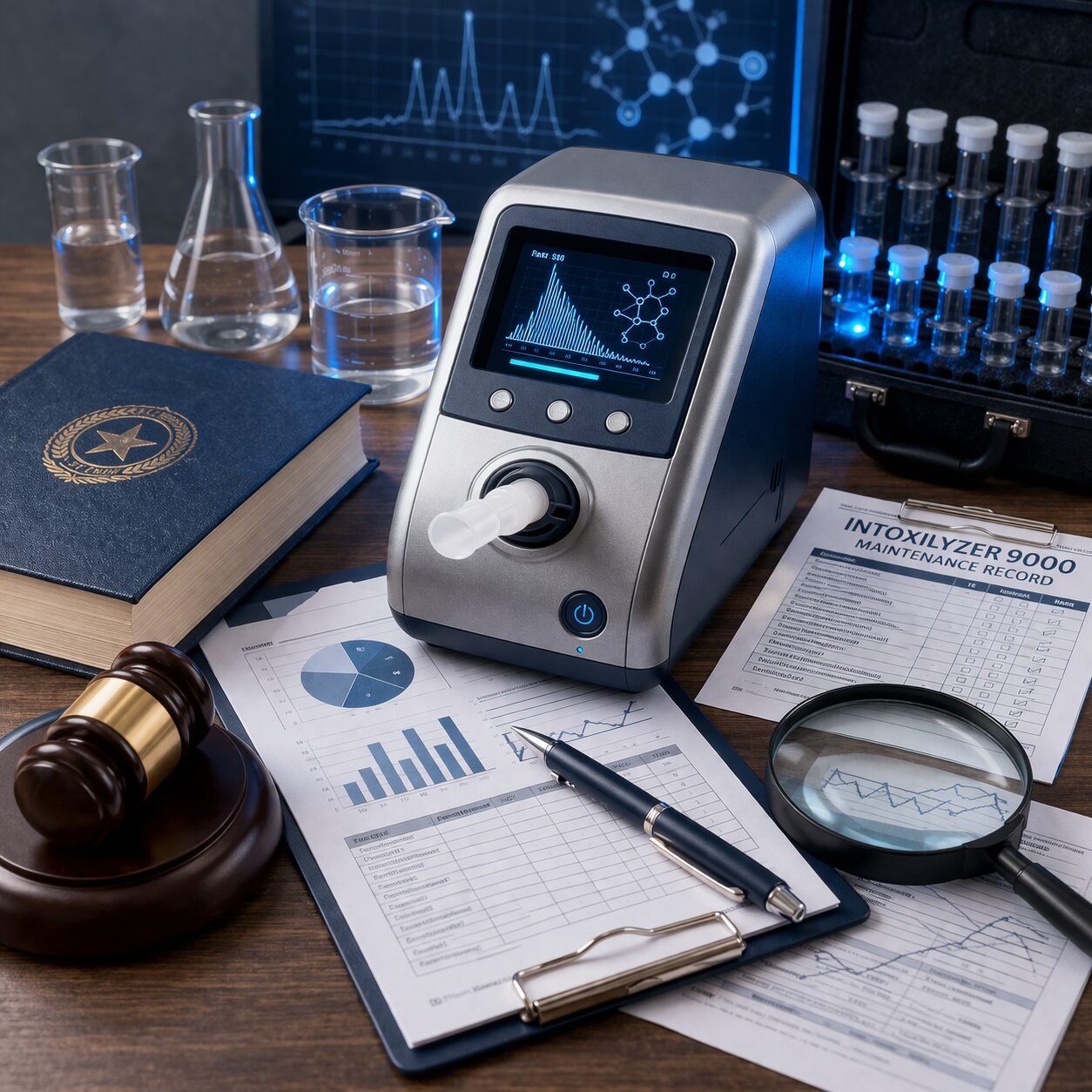
If you submitted to a breath test during a DWI arrest in Texas, the instrument that generated your result was the Intoxilyzer 9000, manufactured by CMI, Inc. of Owensboro, Kentucky. Texas adopted the Intoxilyzer 9000 around 2015, replacing the older Intoxilyzer 5000 EN. It is the sole approved evidential breath testing instrument for the Texas Breath Alcohol Testing Program, administered by the Texas Department of Public Safety (DPS) Office of the Scientific Director.
Prosecutors present the Intoxilyzer 9000 result as a definitive measurement of your blood alcohol concentration. The reality is more complicated. The Intoxilyzer 9000 is a sophisticated infrared spectrometer, but it has documented limitations, features that Texas has chosen not to use, and maintenance gaps that raise serious questions about the reliability of any given result.
I am a trained operator and maintenance technician on breath testing instruments, and I teach forensic chromatography and drug analysis at Axion Analytical Labs. What follows is about this machine specifically.
The broader question of how accurate breath testing is, along with the partition ratio and mouth alcohol science that applies to any breath instrument anywhere, is covered on How Accurate Is the Breathalyzer in Texas. This page is narrower: what this instrument does, what it is capable of doing that Texas has switched off, and where the Texas program falls short of what the hardware allows.
How the Intoxilyzer 9000 Works
The 9000 is an infrared spectrometer operating under the Lambert-Beer Law, which holds that absorption is proportional to the number of absorbing molecules in the sample path. The measurement principle, the two-sample sequence, and what the reported unit means are all set out on the accuracy page. What is worth laying out here is the hardware, and the numbers a technical supervisor has to defend.
The Optical Bench
Inside the Intoxilyzer 9000 is an optical bench containing a heated sample chamber, a pulsed infrared light source at one end, and a pyroelectric detector at the other end. When a subject blows into the instrument, breath passes through the heated sample chamber. The infrared light source emits IR energy at multiple wavelengths through the chamber. The detector at the other end measures how much energy arrives, i.e. the difference between what was emitted and what was received represents the energy absorbed by ethanol (and potentially other substances) in the sample.
The Numbers the Test Has to Hit
The order of operations is on the accuracy page. The acceptance criteria are what matter here, because every one of them is a number somebody has to stand behind on the witness stand:
- Every air blank must read 0.000. Four of them run during a single test, before and after each sample. Whether a reported 0.000 is a true zero is a separate question, and it is taken up at the bottom of this page.
- The reference standard must fall between 0.070 and 0.090 g/210L. This is the known solution the instrument analyzes mid-test to prove it is reading correctly. A result outside that window invalidates the test.
- The two subject samples must not differ by more than 0.020 g/210L. What that tolerance actually permits is below.
Results are reported in grams of alcohol per 210 liters of breath, as required by Texas Penal Code §49.01(1)(A).
The Problems with the Intoxilyzer 9000
Two of the largest problems with any breath instrument are not peculiar to this one, and each has a page of its own. The fixed 2100:1 partition ratio the 9000 applies to turn breath into a blood figure is covered on Partition Ratio Variability. Mouth alcohol, where it comes from, and why the observation period exists are covered on Mouth Alcohol and the Breath Test. What follows is what is wrong with this machine, and with the way Texas runs it.
1. Slope Detection, and Whether It Works
The observation period is the procedural guard against mouth alcohol. Slope detection is the mechanical one, and it is the only part of that safeguard living inside the instrument.
The Intoxilyzer 9000 includes a slope detection algorithm designed to identify mouth alcohol by monitoring the shape of the breath alcohol curve as the subject blows. Mouth alcohol typically produces a rapidly declining curve rather than the plateau expected from deep lung air. In the 9000, this is accomplished by pulsing the infrared source at 10 cycles per second, generating a breath sample reading every 100 milliseconds across each of its four filtered points. Whether this approach is adequate is an open question. At least one independent hands-on evaluation found that Michigan’s outgoing DataMaster DMT actually outperformed the 9000 on slope detection. Patrick T. Barone and Michael J. Boyle, writing in the Michigan State Appellate Defender Office’s Criminal Defense Newsletter, noted that testing showed “the DMT performed better than the 9000 regarding slope detection; or Residual Alcohol Detection System (RADS).” (Introducing the Intoxilyzer 9000 — Michigan’s New Breath Test Instrument, SADO Criminal Defense Newsletter, April 2023, citing Semenoff, An Independent Review of the Intoxilyzer 9000, Pt. 2, Counterpoint: The Journal of Science and the Law, Vol. 2, Issue 2, Article 4 (2017).)
If that evaluation holds up, the consequence is narrow but real. On at least one independent hands-on review, the instrument Texas selected was worse at catching mouth alcohol than the machine it was measured against. That is a question a technical supervisor can be asked under oath, and it is answerable from the literature rather than from speculation.
2. Interference the Instrument May Not Catch
The Intoxilyzer 9000’s use of multiple IR wavelengths is designed to identify interferents. When the instrument detects an absorption pattern inconsistent with pure ethanol, it is supposed to flag the test. However:
- Chemical interferents. Acetone from diabetes or ketosis, and solvents including isopropanol, methanol, and toluene, all absorb infrared energy at overlapping wavelengths and may not be fully compensated for. Which compounds do this, and which medical conditions and occupations produce them, are covered on Medical Conditions That Cause False Breath Tests.
- Radio frequency interference (RFI): Cell phones and police radios emit electromagnetic radiation that can potentially affect electronic instrumentation. The Intoxilyzer 9000 includes RFI detection, but its effectiveness in all real-world conditions has been questioned.
- Ambient ethanol. A separate problem from the interferents above, because the compound reaching the sample really is ethanol and no multi-wavelength check will ever flag it as anything else. Controlled research on ethanol vapor exposure is on A Horse Vet Blew a 0.087 Without Drinking.
3. Features Texas Has Chosen Not to Use
This is one of the most significant issues with the Texas implementation. The Intoxilyzer 9000 is capable of producing histograms which are graphical representations of the subject’s breath flow, volume, and duration during each blow. A histogram would allow the operator, the laboratory, and the defense to verify that the subject provided a proper deep lung sample and to detect anomalies like mouth alcohol spikes.
Texas DPS has chosen not to activate the histogram function. This means that critical data about the quality of the breath sample is generated by the instrument but not made available to anyone — not the operator, not the prosecutor, not the defense, not the jury. The instrument has the capability to provide this transparency, and the state has deliberately chosen not to use it.
Attorneys in Colorado and Georgia work from exactly that curve to spot anomalies in a blow. Texas breath test slips leave it off. The data is generated either way.
4. Maintenance and Calibration Gaps
Prior to 2020, DPS required monthly on-site inspections of every Intoxilyzer 9000 in Texas by a Technical Supervisor. During COVID-19, these inspections were suspended. This means that instruments that were previously checked monthly for calibration accuracy, reference system integrity, and environmental conditions have gone extended periods without independent verification.
Additionally, the Intoxilyzer 9000 is not warranted by the manufacturer to be accurate or reliable for human testing. The manufacturer’s warranty covers the instrument’s ability to analyze a reference sample solution but not its accuracy when measuring a human breath sample under real-world conditions. This distinction is rarely disclosed to juries.
5. The 0.020 Agreement Requirement
A 0.020 range sitting on a 0.08 threshold is a 25 percent margin, which is a great deal of room for an instrument whose output decides whether someone goes to jail. What that tolerance permits in practice, including two samples that straddle the legal limit and still count as agreement, is covered on How Accurate Is the Breathalyzer in Texas.
Three More Things Texas Practice Hides About the 9000
Each of these is documented in breath-test litigation practice, and none of them appears on the test slip the State hands over.
- Texas uses a 15-minute observation period where Colorado and Georgia use 20. The same instrument, a shorter guard against residual mouth alcohol. The observation window exists to let contamination dissipate, and Texas chose the shorter one.
- There is no true zero detector. The filter wheel design means the instrument cannot verify a genuine zero; readings under 0.007 are masked and reported as 0.000, and after the first sample the air blank cycle itself can measure up to 0.007 in the chamber.
- Expert testing has produced inflated readings with no contamination flag. Controlled testing has documented falsely elevated results that the instrument did not flag, which is the entire problem with treating the printed number as self-verifying.
Other Breath Testing Instruments
While the Intoxilyzer 9000 is the approved instrument in Texas, other states use different devices. The DataMaster DMT, used in several states, operates on a similar infrared spectrometry principle but with different hardware and software implementations. The Dräger Alcotest, widely used in New Jersey and other jurisdictions, combines infrared spectrometry with electrochemical fuel cell technology for dual-detection. Understanding the differences between instruments is relevant for defense attorneys handling cases that cross state lines or involve federal DWI on military installations or federal property.
How to Challenge Intoxilyzer 9000 Results
- Demand maintenance and calibration records for the specific instrument used in your case, including all records since the last in-person Technical Supervisor inspection
- Request the operator’s certification and training records to verify they were qualified to administer the test
- Obtain the complete test record including all air blanks, reference standard results, and both subject samples
- Ask why the histogram function was not activated — the instrument can produce this data, and the state’s refusal to use it deprives the defense of information about sample quality
- Review video of the testing to verify the 15-minute observation period was properly conducted and documented
- Investigate medical conditions including GERD, diabetes, ketogenic diet, and any condition producing acetone or other volatile organic compounds
- Challenge the partition ratio assumption through expert testimony on individual variability
- Challenge the manufacturer’s warranty — the instrument is not warranted for human breath testing accuracy
At Deandra Grant Law, Deandra Grant is a trained operator and maintenance technician on breath testing instruments. She teaches the science of forensic analytical instruments at Axion Analytical Labs and understands the Intoxilyzer 9000 at the component level. When we challenge your breath test result, we are not guessing at what might have gone wrong. We know the instrument, its capabilities, its limitations, and the specific ways the Texas implementation falls short of what the science requires. Call (214) 225-7117 or visit texasdwisite.com.
The other guides in this section.
The Breath Test
The Blood Test
The Roadside Tests
Drug Cases
The Science of the Number
The science on this page is the raw material. The moves that turn it into a suppressed result, an excluded expert or a dismissal live in Defenses.
Which county your case is filed in changes how it is charged, who prosecutes it, and which court hears it.
Deandra M. Grant, JD, GC, MS, ACS-CHAL Forensic Lawyer-Scientist
She holds a Master of Science in Pharmaceutical Science and a Graduate Certificate in Forensic Toxicology, both from the University of Florida. She is the author of The Texas DWI Manual and has defended Texas DWI cases since 1994.
Charged With a DWI in Texas?
Intake answers 24/7, and if your case is one we can take on, we schedule a free consultation with an attorney.
Request a Free Case Evaluation
Tell us what happened. We'll respond as soon as possible.