
Retrograde Extrapolation in Texas DWI

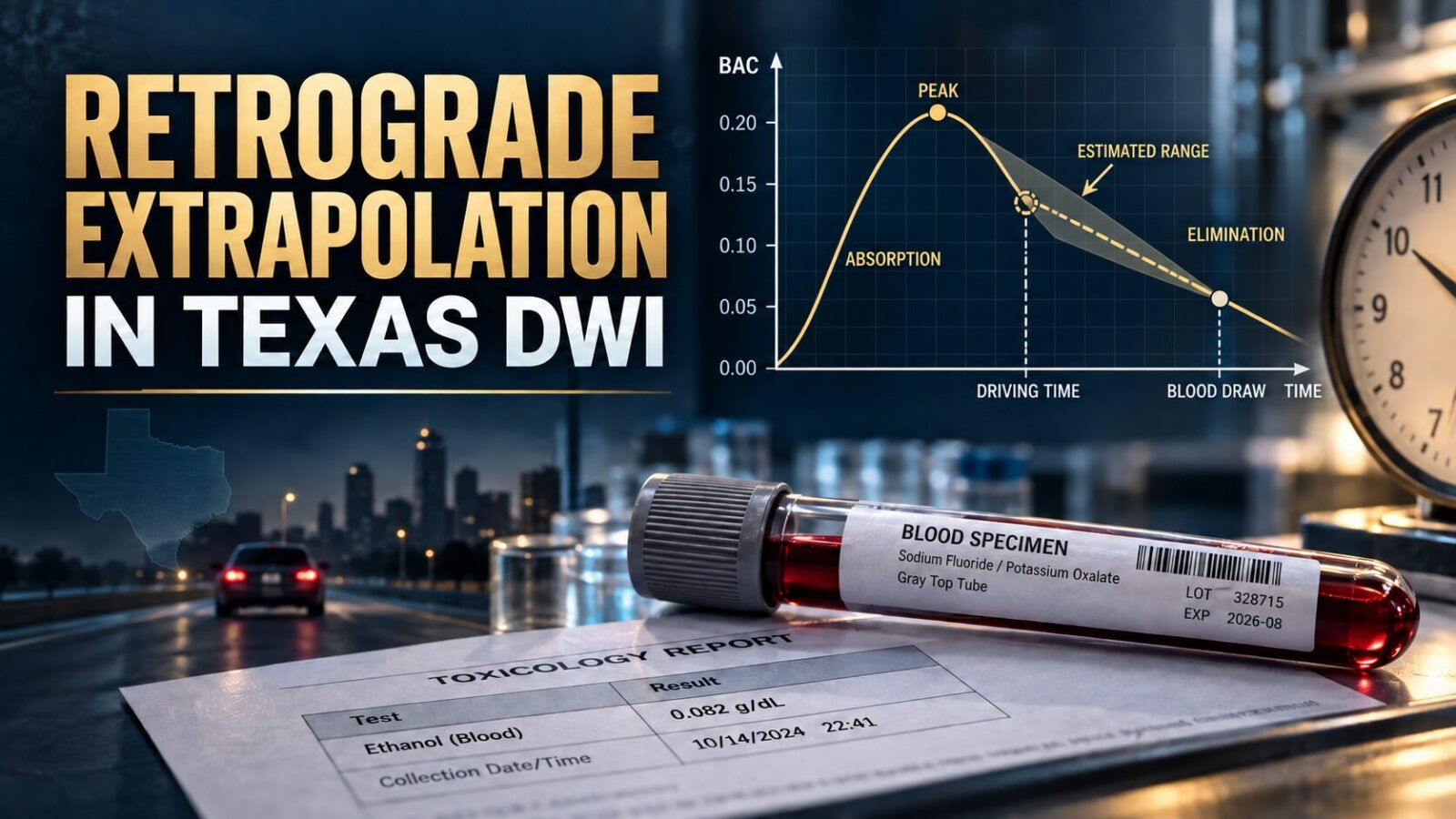
You were stopped at 11:00 p.m. Your blood was drawn at 12:15 a.m. The laboratory reports a blood alcohol concentration of 0.09. But the State does not have to prove what your concentration was at 12:15. It has to prove what it was while you were driving, and to bridge that gap it will call a witness to work backward. That calculation is called retrograde extrapolation, and whether it holds up depends almost entirely on facts that are usually unknown.
What the Calculation Actually Is
Back-extrapolation from a measured result needs exactly three inputs: the concentration that was measured, an elimination rate, and the time between driving and the draw. The expert multiplies the rate by the interval and adds the product to the measured result. An hour and fifteen minutes at an assumed 0.015 per hour adds roughly 0.019, which turns a 0.09 into about 0.109.
Everything that follows is about those three inputs, and one of them is not like the others. The measured concentration is a laboratory number with its own uncertainty, which we cover in our post on blood alcohol concentration. The interval is usually documented. The elimination rate is a value nobody measured on the person sitting at counsel table.
The Problem That Matters Most
Retrograde extrapolation assumes the person had finished absorbing alcohol before driving. If absorption was still underway, the concentration was rising, not falling, and running the clock backward with an elimination rate does not merely produce a number that is somewhat off. It produces a number that is wrong in the wrong direction. The true driving concentration would have been lower than the measured one, not higher.
A single measurement cannot tell you which side of the curve the person was on. You know where they were at the moment of the draw. You do not know whether they were ascending toward a peak, sitting at one, or descending from it, and you cannot derive the slope of an elimination phase from one point. Two results a known interval apart give you a direction. One result gives you a dot.
The Elimination Rate, Argued Correctly
This is where defense arguments most often go wrong, so be careful with it. Experts commonly use 0.015 g/dL per hour. The instinct is to attack that figure as too low. Resist it. In the back-extrapolation equation the rate carries a positive sign, so arguing for a higher rate raises your client’s estimated driving concentration. You would be doing the State’s work.
It is also worth knowing that 0.015 already sits at the favorable end of the range for the population that gets arrested. Jones and Andersson, studying more than a thousand apprehended drivers, reported a mean near 0.019, and Jones’s own tiering places people who drank to above 120 mg percent in the 0.016 to 0.025 band. If you persuade a judge that the State’s rate is unrealistically low, the honest consequence is a larger addition to your client’s number, not a smaller one.
The standard is on your side here, and explicitly. Section 5.4.4 of BPR 122 provides that the calculation shall be performed using a range of elimination rates, and section 5.4.4.1 sets the minimum range at 0.010 to 0.025 g/dL per hour. Section 5.4.5 adds that a rate calculated from two or more test results shall not be used in place of a range. The foreword is blunter still: the science does not support providing a single value, and an estimated range is what should be given. An expert who walks in with one number and no interval is not following the standard.
The same document requires a range for the volume of distribution, calls the use of a single fixed value inappropriate given population variability, requires that the impact of potentially unabsorbed alcohol be addressed, and states that when the drinking history is unknown it is not reasonable to assume the subject was post absorptive. That last provision is worth memorizing, because the drinking history is unknown in a great many cases.
The defensible attack is on width, not center. The point is not that the rate should be some other single value. It is that no single value can be defended for an individual who was never studied, that the plausible range across individuals is wide enough to swallow the difference between conviction and acquittal, and that an expert who reports a point estimate without an interval is concealing that. Ask what the rate was for this person. Nobody knows. That answer, not a competing number, is the one that matters.
Michaelis-Menten, the Right Way Around
You will sometimes read that alcohol elimination departs from linearity at high concentrations because the liver enzyme becomes saturated. That has the causal arrow backward, and an expert will say so on cross.
Alcohol elimination follows Michaelis-Menten kinetics. Saturation of alcohol dehydrogenase is precisely why elimination appears zero-order, meaning linear, in the first place. The Km for the enzyme is on the order of 0.001 to 0.01 g/dL, which means the enzyme is already saturated at any concentration an ordinary drinker reaches. At saturation the enzyme works at a constant maximum rate, and the curve is a straight line. Linearity does not fail at the top of the curve. It fails at the bottom, as concentrations fall low enough for the enzyme to desaturate and the decline to become curved.
Jones states this directly in WIREs Forensic Science in 2019, and Maskell and de Korompay surveyed seven empirical studies and placed the transition at or below 0.020 g/dL. Every serious position in that literature puts the departure from linearity at low concentrations.
Getting this right is not pedantry, because the correct version is the stronger weapon. The field has written the limit into its own consensus standard. ANSI/ASB Best Practice Recommendation 122, Best Practice Recommendation for Performing Alcohol Calculations in Forensic Toxicology, approved in 2024, states at section 4.1.4.3 that at concentrations below 0.020 g/dL the elimination rate may not be linear because zero order kinetics may no longer apply. It then turns that into a rule. Section 5.4.3 provides that retrograde extrapolation calculations shall not be performed on alcohol concentrations below 0.020 g/dL. That is not a defense expert’s opinion. It is a prohibition in the standard the State’s own analyst is supposed to be following. Section 5.1.3 adds another: extrapolation shall not be performed on urine alcohol results, even ones converted to a whole blood equivalent.
The Individual Nobody Studied
The population averages in these calculations come from studies of people who are not your client, and the standard says so itself. BPR 122 states that due to the high variability within the population, the use of a single fixed volume of distribution is inappropriate, and it sets an elimination range of 0.010 to 0.025 g/dL per hour precisely because that range is what encompasses the majority of the population regardless of age, sex, ethnicity, and drinking experience. Read that clause carefully. It is not an invitation to argue that some category of person metabolizes differently. It is the opposite: the range is wide because individuals vary, and the variation is handled by using the range rather than by profiling the individual. A.W. Jones, the authority the State’s expert is most likely to cite, has written that ethnic differences in elimination are small compared with other factors and that the overlap between groups is such that the differences lack forensic significance. The honest argument is not about who your client is. It is that no single value was ever measured on this person, and the standard forbids pretending otherwise.
Bariatric Surgery Changes the Curve
This is the most concrete version of the problem, and it is common enough that it should be a standard client question. Hagedorn and colleagues, publishing in Surgery for Obesity and Related Diseases in 2007, gave gastric bypass patients and controls a standardized amount of red wine. The bypass patients reached an average peak of about 0.08 against 0.05 in controls, and took about 108 minutes to return to zero against 72. They did not report feeling any more impaired, which is its own hazard.
The sharper study is Klockhoff, Naslund and Jones in the British Journal of Clinical Pharmacology in 2002. Twelve women who had undergone gastric bypass at least three years earlier and twelve matched controls each drank roughly two small glasses of wine in five minutes on an empty stomach, with blood drawn every ten minutes. Median time to peak was 10 minutes in the bypass group against 30 in controls. At ten minutes the bypass group averaged about 0.071 against 0.017. Peak averaged about 0.074 against 0.058. By thirty minutes the two groups were indistinguishable, because the bypass women were already falling while the controls were still climbing. The rate of decline was essentially identical in both groups.
Read that last pair of findings together, because it is the whole argument. Surgery does not change the elimination rate. It changes when the peak happens. Someone who peaks at ten minutes and is descending by thirty is on a completely different part of the curve at the roadside than the model assumes, and an extrapolation built on a normal absorption profile will place them in the wrong phase entirely.
Jones himself wrote, in that paper, that in back-calculations of this kind the factors influencing the rate and extent of absorption matter, specifically including an abnormal gut after gastric bypass or other surgery. That is the State’s own authority instructing the reader to account for it.
Ask the right question, though. Sleeve gastrectomy, not Roux-en-Y bypass, is now the most common bariatric operation in the United States, and the studies published since Hagedorn report the same altered handling after a sleeve. A client who had a sleeve in 2021 and has never heard the word bypass will answer no to the wrong question. Ask which operation and when. Ask, too, about gut surgery that has nothing to do with weight loss, because the same rapid absorption is expected after gastric resection or gastrectomy, so a client who lost part of his stomach to an ulcer or to cancer belongs in this conversation.
GLP-1 Medications Cut the Other Way
A large number of people are now taking semaglutide and related drugs, marketed as Ozempic, Wegovy, and Mounjaro among others, for weight loss or diabetes. These medications slow gastric emptying. That is part of how they work, and it means alcohol leaves the stomach and reaches the small intestine more slowly than the standard absorption model assumes.
The practical consequence is the mirror image of the surgical one. Delayed emptying means a later and flatter peak, which raises the possibility that a person was still absorbing at the time of driving and that their concentration was lower behind the wheel than at the draw. It is a question worth asking every client now, and it is not on any intake form.
A Different Calculation, and a Different Attack
Keep two calculations separate, because conflating them is a common error. Back-extrapolation from a measured result uses the three inputs described above. The r factor, the Widmark distribution value of roughly 0.68 for men and 0.55 for women, does not appear in it at all.
The r factor belongs to the forward calculation, the one that converts a reported number of drinks into an estimated concentration. That is a different piece of testimony, and it is often weaker. It depends on a population average for body water distributed across an individual, on an accurate count of drinks, on accurate pour sizes, and on an accurate timeline, and it typically rests on what someone told an officer on the side of a road. When the State’s witness moves from drinks to a number, that is where the distribution assumptions live and where they should be challenged.
What Texas Courts Actually Held
Mata v. State, 46 S.W.3d 902 (Tex. Crim. App. 2001), is the controlling case, and it is routinely described inaccurately as a checklist of six things an expert must know. The opinion does not say that.
Mata sets out a three-factor inquiry. A court evaluating reliability should consider the length of time between the offense and the test or tests; the number of tests and the interval between them; and whether, and to what extent, individual characteristics of the defendant were known to the expert. Within that third factor the court listed characteristics that might include, but are not limited to, weight and gender, typical drinking pattern and tolerance, how much the person drank that night, what they drank, the duration of the drinking, the time of the last drink, and what they ate before, during, or after.
The court then said something a defense brief must not omit: not every single personal fact about the defendant has to be known, because otherwise no valid extrapolation could occur without the defendant’s cooperation. Quoting the list without that sentence is the kind of abridgment opposing counsel will enjoy pointing out.
The most useful passage in Mata is the one that tells you which cases are winnable. Where the State has more than one test, each a reasonable length of time apart, with the first conducted a reasonable time from the offense, an expert could potentially produce a reliable estimate with limited personal information. By contrast, a single test conducted some time after the offense could support a reliable extrapolation only if the expert knew many personal characteristics of the defendant. Most DWI cases are single-test cases. That sentence is written for them.
The tighter only-if language people attribute to Mata is actually in Kirsch v. State, 306 S.W.3d 738 (Tex. Crim. App. 2010), which noted that even proponents of the technique have used it only where certain facts are known: the length of the drinking spree, the time of the last drink, and the person’s weight.
Two Cases Worth Knowing
In Veliz v. State, 474 S.W.3d 354 (Tex. App. Houston [14th Dist.] 2015, pet. ref’d), a DWI conviction was reversed over improperly admitted retrograde testimony, in a case where the analyst had not heard of Mata. In Meza v. State, 497 S.W.3d 574 (Tex. App. 2016), the court rendered an acquittal where the State’s own expert conceded the extrapolation could not be done. Those are the two ends of the practical spectrum, and both are worth reading before a hearing.
The Part Most Posts Leave Out
Excluding the extrapolation does not exclude the blood test. Texas courts have been explicit that a BAC result remains relevant and admissible even without retrograde testimony, because it is evidence the jury may consider alongside the other proof of intoxication. Kirsch, Stewart v. State, 129 S.W.3d 93 (Tex. Crim. App. 2004), and Lampkin v. State, 470 S.W.3d 876 (Tex. App. Texarkana 2015, pet. ref’d) all point the same direction.
That matters for expectations and for credibility. Winning a Mata challenge removes the State’s bridge from the laboratory number back to the wheel. It does not remove the number. Saying so plainly is what makes the rest of the argument believable, and it is also why the cross-examination should be aimed at what the result can and cannot establish rather than at whether the jury will hear it.
What This Means in Practice
- Find out how many tests there were and when. A single test well after driving is the weakest posture for the State under Mata, and the strongest for you.
- Ask the expert what individual characteristics of your client were actually known, and get the list on the record before the opinion is offered.
- If the result is below 0.020 g/dL, cite BPR 122 section 5.4.3 directly. The field’s own standard forbids the calculation. If the sample is urine, section 5.1.3 forbids it too.
- If the expert gave a single number rather than a range, cite sections 5.4.4 and 5.4.4.1. The standard requires a range and sets a minimum of 0.010 to 0.025 g/dL per hour.
- If the drinking history is unknown, cite section 5.4.6.2. The standard says it is not reasonable to assume the subject was post absorptive.
- Attack the rate as an unknowable range, not as a wrong number. A point estimate without an interval is the vulnerability.
- Separate the back-calculation from any forward calculation built on reported drinks, and aim the distribution and drink-count arguments at the second one.
- Expect the blood result to stay in evidence, and plan the defense around what it proves rather than around suppressing it.
Retrograde extrapolation can be reliable in a given case. Mata says so. The question is never whether the technique exists, but whether this expert, with these facts, on this record, could do what was claimed. For more on challenging the underlying result, see our pages on blood testing and DWI defenses.
If you are facing a DWI in Texas and the State is relying on a blood or breath result, call Deandra Grant Law at (214) 225-7117 for a free, confidential case review.
Deandra Grant holds a Master of Science in Pharmaceutical Science with coursework in pharmacokinetics, a Graduate Certificate in Forensic Toxicology, and the ACS-CHAL Forensic Lawyer-Scientist designation. She is the author of the Texas DWI Manual.
This article is general legal information for educational purposes, not legal advice. Verify all citations before relying on them in any filing.
Sources and Further Reading
- Mata v. State, 46 S.W.3d 902 (Tex. Crim. App. 2001), opinion.
- Kirsch v. State, 306 S.W.3d 738 (Tex. Crim. App. 2010), opinion.
- Veliz v. State, 474 S.W.3d 354 (Tex. App. Houston [14th Dist.] 2015, pet. ref’d), opinion.
- Meza v. State, 497 S.W.3d 574 (Tex. App. 2016), opinion.
- Stewart v. State, 129 S.W.3d 93 (Tex. Crim. App. 2004), opinion.
- Lampkin v. State, 470 S.W.3d 876 (Tex. App. Texarkana 2015, pet. ref’d), opinion.
- ANSI/ASB Best Practice Recommendation 122, Best Practice Recommendation for Performing Alcohol Calculations in Forensic Toxicology (1st ed. 2024), aafs.org.
- Klockhoff, H., Naslund, I. & Jones, A.W., Faster Absorption of Ethanol and Higher Peak Concentration in Women After Gastric Bypass Surgery, 54 Br. J. Clin. Pharmacol. 587 (2002), doi.
- Hagedorn, J.C. et al., Does gastric bypass alter alcohol metabolism?, 3 Surgery for Obesity and Related Diseases 543 (2007), doi.
- Grover, R., Fortune, B.E. & Tow, C.Y., The Impact of Alcohol on Patients After Bariatric Surgery, 23 Clinical Liver Disease e0139 (2024), doi.
- A.W. Jones, Alcohol, its absorption, distribution, metabolism, and excretion in the body and pharmacokinetic calculations, WIREs Forensic Science 2019;1(5):e1340, doi.
The other guides in this section.
The Breath Test
The Blood Test
The Roadside Tests
Drug Cases
The Science of the Number
The science on this page is the raw material. The moves that turn it into a suppressed result, an excluded expert or a dismissal live in Defenses.
Which county your case is filed in changes how it is charged, who prosecutes it, and which court hears it.
Deandra M. Grant, JD, GC, MS, ACS-CHAL Forensic Lawyer-Scientist
She holds a Master of Science in Pharmaceutical Science and a Graduate Certificate in Forensic Toxicology, both from the University of Florida. She is the author of The Texas DWI Manual and has defended Texas DWI cases since 1994.
Charged With a DWI in Texas?
Intake answers 24/7, and if your case is one we can take on, we schedule a free consultation with an attorney.
Request a Free Case Evaluation
Tell us what happened. We'll respond as soon as possible.