
What Is In Vitro Fermentation — And Can It Produce a False BAC Result?

In vitro fermentation means alcohol is produced inside the blood tube after the draw. It can happen when microorganisms, such as yeast or bacteria, metabolize glucose in the sample and create ethanol. The risk increases if the tube lacks enough preservative, is stored warm, sits too long before testing, or contains blood from a person with elevated glucose. If fermentation occurs, the lab may measure alcohol that was not in the person’s bloodstream while driving. The defense looks for tube problems, storage gaps, chromatogram clues, and differences between the two collected samples.
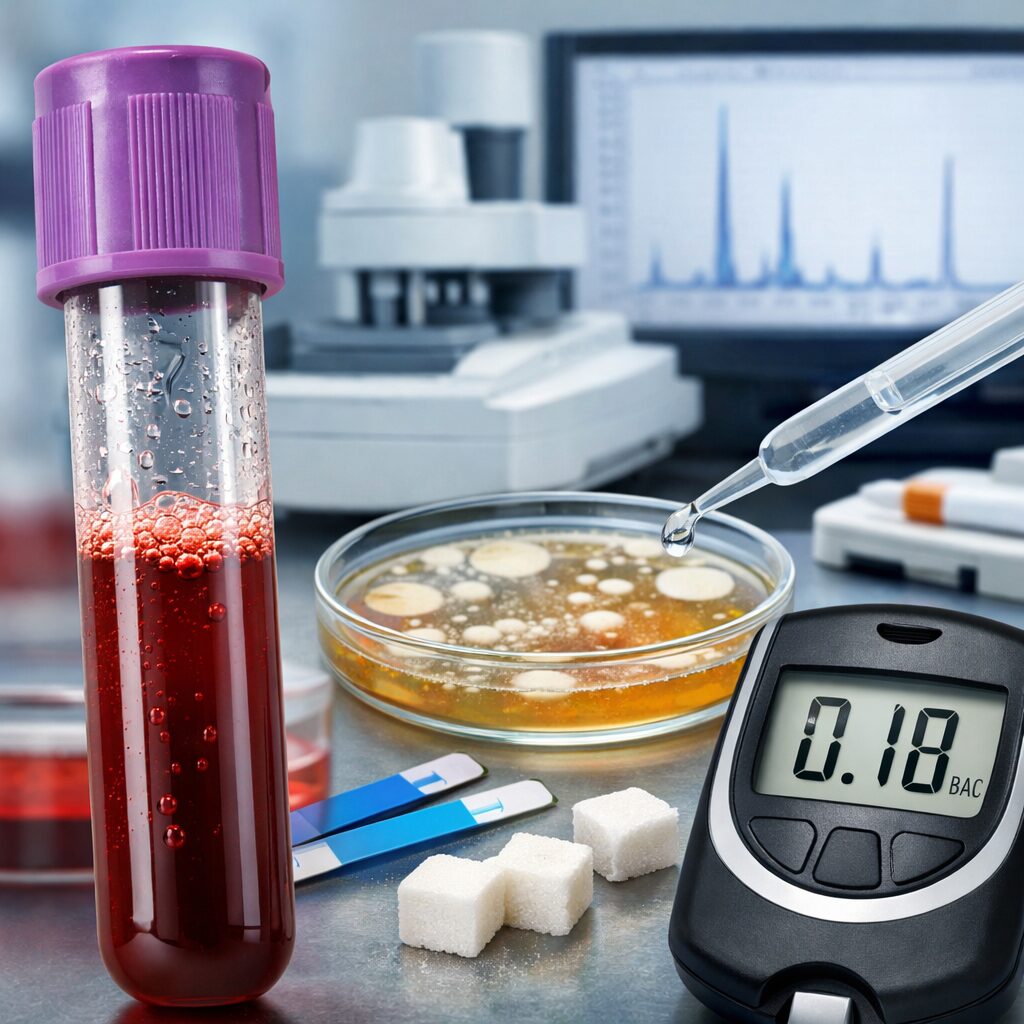
One of the most significant and least understood challenges to blood test accuracy in DWI cases is in vitro fermentation. This is the process by which microorganisms inside the blood collection tube produce alcohol after the blood was drawn, artificially inflating the BAC result. When in vitro fermentation occurs, the laboratory is not measuring the alcohol that was in your bloodstream at the time of the draw. It is measuring that alcohol PLUS alcohol that was manufactured inside the tube. This is one failure point among many in a blood case, and the rest of the sequence from the needle to the report is on Can a DWI Blood Test Be Wrong?
How In Vitro Fermentation Happens
The human body harbors vast populations of microorganisms, including bacteria and yeasts. One of the most common is Candida albicans, a yeast that is present on the skin and in the gastrointestinal tract of most people. When blood is drawn and placed in a collection tube, some of these microorganisms may enter the tube with the blood.
If the conditions inside the tube allow it, these microorganisms, particularly Candida albicans, can metabolize the glucose naturally present in the blood and produce ethanol as a byproduct. This is the same fermentation process that produces alcohol in beer and wine, except that it happens inside a blood sample tube. Be precise about where the mechanism was demonstrated, because the State will be. The controlled work most often cited, Yajima and colleagues on ethanol production by Candida albicans, was performed on postmortem blood, and found that the effect depends heavily on glucose level and dilution. The companion study on ethanol formation in samples containing fluoride ions likewise involved autopsy specimens, in a case where a diabetic decedent’s postmortem blood alcohol rose between analyses. Those papers establish that the biochemistry is real. They do not establish that it routinely happens in a properly preserved antemortem tube, and a defense that claims otherwise will be corrected.
Conditions That Promote In Vitro Fermentation
- Insufficient sodium fluoride. Blood collection tubes for DWI testing are supposed to contain sodium fluoride, a preservative that inhibits microbial growth and enzyme activity. If the tube contains an insufficient amount of sodium fluoride, or if the blood volume is larger than the tube was designed for (diluting the preservative), microbial activity may not be fully suppressed.
- Elevated storage temperature. Microorganisms are more active at higher temperatures. If the blood sample is stored at room temperature or in a warm environment (such as the trunk of a patrol car in Texas summer heat) rather than being refrigerated promptly, fermentation is more likely to occur.
- Delay between collection and analysis. The longer the sample sits before being analyzed, the more time microorganisms have to produce ethanol. Delays of days or weeks between collection and laboratory analysis increase the risk of fermentation.
- Elevated blood glucose. Individuals with diabetes or pre-diabetes often have elevated blood glucose levels, which provides more substrate (food) for the microorganisms to ferment into ethanol. Diabetic individuals are particularly vulnerable to false BAC elevations from in vitro fermentation.
- Improper blood draw technique. If the phlebotomist does not follow proper aseptic technique, additional microorganisms from the skin surface may be introduced into the sample.
How Much Alcohol Can In Vitro Fermentation Produce?
There is no reliable figure for how much alcohol fermentation adds to an antemortem tube, and any number offered should be traced to its source before it is used. The large increases reported in the literature come almost entirely from postmortem or grossly contaminated specimens, where conditions are far more permissive than in a preserved gray-top tube. What can be said is narrower and still useful: where fermentation does occur, the amount is a function of available glucose, temperature, and elapsed time, and in a case sitting near a statutory threshold it does not take much. The thresholds that matter in Texas are 0.08 and 0.15, the latter being what raises a first DWI to a Class A misdemeanor under Penal Code 49.04(d).
What the Consensus Standard Actually Requires
The clinical standards body that governs blood alcohol collection addressed this directly, and its guidance is more useful to the defense than most of the forensic literature. NCCLS document T/DM6-A, Blood Alcohol Testing in the Clinical Laboratory, approved in 1997 under a subcommittee chaired by Kurt Dubowski, sets out what preservation is actually good for.
Start with the concentrations. The standard provides that potassium oxalate at 5 mg/mL and sodium fluoride at 1.5 mg/mL are an appropriate combination for storage of initially sterile blood specimens at 5 degrees Celsius for up to 48 hours. Specimens that will be transported or mailed unrefrigerated, or stored longer than 48 hours, should carry sodium fluoride at 10 mg/mL, which is nearly seven times the lower figure.
Hold that against how a Texas DWI sample is actually handled. The gray-top tube in a standard kit is formulated at roughly the lower concentration. The sample is frequently transported unrefrigerated, and it commonly sits for weeks or months before analysis rather than 48 hours. On the standard’s own terms, the preservative in the tube was specified for a set of conditions that the case did not meet.
Then there is the sentence that answers the usual objection. The standard states that changes produced by contaminating microorganisms can affect alcohol concentrations in blood specimens even in the presence of preservatives, and cites Blume and Lakatua for the finding that organisms isolated from contaminated specimens produced ethanol when inoculated into bank blood, with Candida albicans particularly active, producing significant quantities of alcohol even in the presence of sodium fluoride. That work was done on banked human blood, not autopsy material, which is precisely the gap in the postmortem literature discussed above.
Give the other side its due, because the standard does. It also cites Winek and Paul for the finding that blood drawn from living people under sterile conditions can sit as long as 14 days without significant change in alcohol content, refrigerated or not, preserved or not. The standard’s own response is the useful part: it observes that a phlebotomist cannot know with certainty, even using aseptic technique, that no microorganism entered the specimen, and concludes that preservatives and refrigeration are therefore advisable as additional safeguards. Every one of those findings carries the qualifier initially sterile. Nobody can establish that a given tube was.
The standard is also specific about the draw itself, and the detail is mechanical enough to be checkable. The disinfectant must not contain alcohol or other volatile organic substances, with aqueous benzalkonium chloride or aqueous povidone-iodine named as the usual choices. Sterile dry sponges should cover the site. And where an evacuated tube is used, the tube should be removed from the needle holder before the needle is withdrawn from the arm, because work by Dubowski and Essary showed specimens can be significantly contaminated when an alcohol-containing sponge covers the site while the needle is still attached to the vacuum tube. Finally, the closed tube should be gently inverted several times immediately after collection so the fluoride actually dissolves. A tube that was never inverted has preservative sitting at the bottom rather than distributed through the blood.
The strongest authority in this area runs against the defense, and it belongs on this page rather than in an opponent’s cross-examination. In Lack of Fermentation in Antemortem Blood Samples Stored Unstoppered in Various Locations, published in the Journal of Forensic Sciences in 2023, the authors state that decades of research into the stability of ethanol in antemortem forensic blood have consistently shown that any analytically significant change is a decrease, and that blood which starts out negative for ethanol stays negative in storage. They also make the point that matters most: for fermentation to occur at all, there has to be a plausible route by which the organism entered the tube.
That is the correct framing, and it defines the argument rather than defeating it. This is not a general proposition that blood samples ferment. It is a challenge built on the specific conditions of a specific tube: a documented preservative deficiency, a documented storage failure, an elevated glucose level, a long delay, or a break in aseptic technique that supplies the route of entry. Absent one of those, the argument should not be made. With one of them documented, the literature the State relies on does not answer it, because those studies describe properly preserved samples. Two papers make the same point from the other direction: Jones and colleagues found that storage at 4 degrees Celsius or the addition of 1 percent sodium fluoride prevents ethanol formation in specimens inoculated with Candida albicans, and Lough and Fehn reached a similar conclusion on preservative efficacy. Preservation and refrigeration work. The defense arises when they fail.
How to Detect In Vitro Fermentation
In vitro fermentation can be detected through several analytical indicators:
- Presence of other fermentation byproducts. Microbial fermentation produces not only ethanol but also other compounds such as n-propanol, n-butanol, and acetaldehyde. Recent work indicates acetaldehyde is considerably more sensitive than n-propanol as a marker of microbial production, with one analysis suggesting suspicion is warranted above roughly 0.014 g/dL. If the chromatogram shows peaks for these compounds alongside ethanol, it suggests fermentation occurred in the tube.
- Direct markers of actual drinking. Ethyl glucuronide and ethyl sulfate are metabolites the body produces only when a person has actually consumed alcohol. Microbial fermentation in a tube does not create them. Where the question is whether the ethanol was drunk or manufactured after the draw, testing for those two compounds answers it directly rather than by inference.
- Elevated ethanol in the second sample. The Texas blood kit officers carry holds two tubes, so in most cases a second specimen exists even though no statute requires one. If that second tube, analyzed later, shows a higher BAC than the first, the difference is consistent with ongoing fermentation in the sample.
- Clotting or discoloration. Visual inspection of the sample may reveal clotting (which can indicate the anticoagulant failed) or discoloration (which can indicate microbial growth).
- Glucose depletion. If the glucose level in the sample is abnormally low compared to what would be expected for the patient, it suggests glucose was consumed by microbial fermentation.
Why Most Attorneys Miss This
In vitro fermentation is not something you learn in law school or at a CLE seminar. It requires understanding of microbiology, fermentation biochemistry, and the specific conditions under which blood samples are collected and stored in DWI cases. Our ACS-CHAL training covers this topic in depth and it can be an effective challenge available in blood test DWI cases.
Establishing it takes the underlying analytical data rather than the one-page report, because the fermentation byproducts that prove the case are visible on the chromatogram and nowhere else. What that data looks like and how it is read is on Understanding the GC-FID.
The other guides in this section.
The Breath Test
The Blood Test
The Roadside Tests
Drug Cases
The Science of the Number
The science on this page is the raw material. The moves that turn it into a suppressed result, an excluded expert or a dismissal live in Defenses.
Which county your case is filed in changes how it is charged, who prosecutes it, and which court hears it.
Deandra M. Grant, JD, GC, MS, ACS-CHAL Forensic Lawyer-Scientist
She holds a Master of Science in Pharmaceutical Science and a Graduate Certificate in Forensic Toxicology, both from the University of Florida. She is the author of The Texas DWI Manual and has defended Texas DWI cases since 1994.
Charged With a DWI in Texas?
Intake answers 24/7, and if your case is one we can take on, we schedule a free consultation with an attorney.
Request a Free Case Evaluation
Tell us what happened. We'll respond as soon as possible.