
Drug Recognition Experts: What They’re Trained to Do, What They Actually Can Do, and Where the Science Falls Short

A Drug Recognition Expert is trained to follow a 12-step evaluation and give an opinion about which drug category may be causing impairment. That opinion is not a chemical measurement. It is pattern matching based on observations, vital signs, eye exams, divided-attention tests, and toxicology confirmation. The problem is that many medical conditions, medications, fatigue, and mixed-drug situations can look like drug impairment. A positive test may show presence, not impairment. DRE evidence can matter, but it has limits and should be checked against the science, the toxicology, and the video.
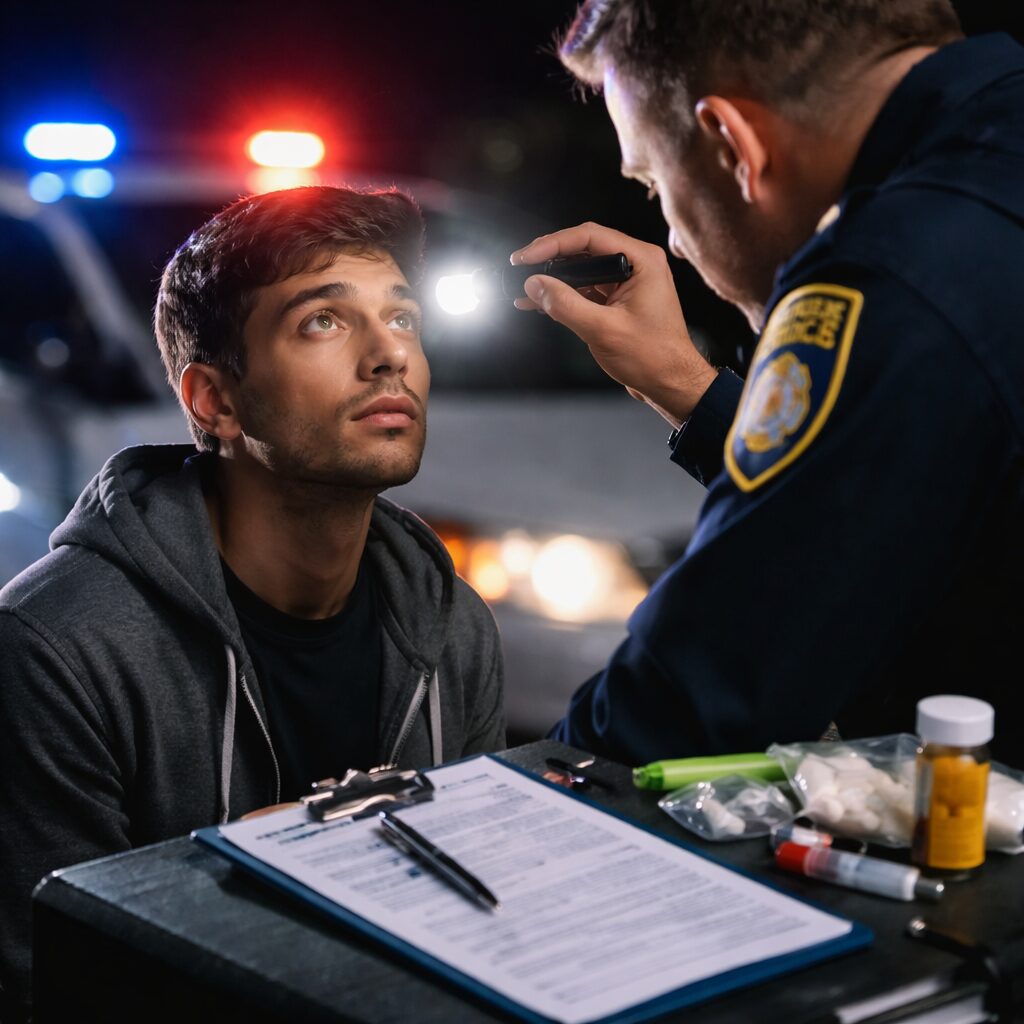
When a police officer suspects a driver is impaired by drugs rather than alcohol, a specialized officer called a Drug Recognition Expert (DRE) may be called to the scene or the station to conduct a Drug Influence Evaluation (DIE). The DRE follows a 12-step protocol and, at its conclusion, renders an “opinion” about which category of drug is causing the observed impairment. That opinion is then presented in court as expert testimony.
The DRE program is administered by the International Association of Chiefs of Police (IACP) through NHTSA’s Drug Evaluation and Classification (DEC) program. It is used in all 50 states. And for many drug DWI cases, the DRE’s opinion is the most important piece of evidence the prosecution has.
It carries that weight for a structural reason. Texas has no per se limit for any drug, so there is no number that decides the case the way 0.08 does in an alcohol case. What the State has to prove instead, and how a drug case is charged, is on The Legal BAC Limit and Driving Under the Influence of Drugs.
I have studied the DRE program from multiple angles. What follows is what the science actually shows.
The 12-Step Drug Evaluation Process
The DRE protocol consists of 12 sequential steps:
- Step 1: Breath alcohol test — to determine whether alcohol alone explains the observed impairment
- Step 2: Interview of the arresting officer
- Step 3: Preliminary examination (pulse, general appearance, speech, questions about medical conditions)
- Step 4: Eye examinations (HGN, VGN, lack of convergence, pupil size)
- Step 5: Divided attention psychophysical tests (the SFSTs: walk-and-turn, one-leg stand, Romberg Modified, Finger-to-Nose)
- Step 6: Vital signs (blood pressure, pulse, body temperature)
- Step 7: Dark room examinations (pupil size under different lighting conditions)
- Step 8: Examination for muscle tone
- Step 9: Examination for injection sites
- Step 10: Suspect’s statements and other observations
- Step 11: DRE’s opinion (drug category identification)
- Step 12: Toxicological examination (blood or urine sample sent to lab for confirmation)
Based on the accumulated observations from Steps 1–10, the DRE compares the signs and symptoms against a matrix of expected effects for seven drug categories and renders an opinion at Step 11.
The Seven Drug Categories
| Category | Examples |
| CNS Depressants | Alcohol, benzodiazepines, barbiturates, GHB |
| CNS Stimulants | Cocaine, methamphetamine, amphetamine |
| Hallucinogens | LSD, psilocybin, MDMA |
| Dissociative Anesthetics | PCP, ketamine, dextromethorphan |
| Narcotic Analgesics | Heroin, fentanyl, oxycodone, morphine |
| Inhalants | Toluene, nitrous oxide, gasoline vapors |
| Cannabis | Marijuana, THC, hashish |
The DRE must place the suspected drug into one or more of these categories. The system does not allow for “I don’t know” or “the signs are inconsistent.” The DRE must categorize or declare no impairment.
What the Research Actually Shows About Accuracy
The Walden Study (2005)
The most rigorous independent assessment of DRE accuracy is the 2005 Walden study at Texas A&M University. Troy Duane Walden analyzed 324 enforcement drug influence evaluations drawn from the DRE tracking system and compared DRE predictions against toxicology results.
The findings by drug category:
| Drug Category | DRE Accuracy |
| Cannabis | 64.9% |
| CNS Depressants | 60.5% |
| Narcotic Analgesics | 51.6% |
| PCP | 46.6% |
| CNS Stimulants | 32% |
| Inhalants | 14.2% |
| Hallucinogens | 12% |
The DRE tracking system reports an overall success rate of approximately 85%. The Walden study submitted a more representative median accuracy of 53.2% which is barely better than a coin flip.
The discrepancy exists because the DRE tracking system uses a broader definition of “success” that counts partial matches and multi-category predictions more generously than a strict one-to-one comparison against toxicology results.
The LAPD “173 Study” (1986)
This early study is frequently cited by prosecutors as demonstrating DRE effectiveness. Its full citation is:
But the Compton study has a fatal methodological flaw rooted in selection bias. The entire 173-subject sample was drawn from people already arrested by non-DRE officers on suspicion of drug-impaired driving and not from a representative sample of drivers on the road. Because the sample was pre-selected for suspected drug impairment, 94% had drugs in their system before the DREs ever evaluated them. The DREs then opined that every single subject had drugs present, rendering zero “no impairment” findings. With no true negatives in the dataset, it is mathematically impossible to calculate a false positive rate. A test that predicts “yes drugs” 100% of the time will appear to be 94% accurate when 94% of subjects actually had drugs, but this is an artifact of sample design, not diagnostic validity.
This methodological critique was formalized in a peer-reviewed analysis:
The Laboratory Validation Studies
The field studies above ask whether a DRE named the right drug category. The laboratory studies ask the harder question: what happens when the researchers know exactly who was dosed and who was not. Three of them are worth having at hand, because each one produced false positives on subjects who had taken nothing at all.
- The Johns Hopkins laboratory study (1985). Forty-six percent of subjects who had actually been dosed with a drug passed the DRE. Twenty-five percent of subjects who had been given nothing failed it. The subjects were not chronic users and the doses were well above therapeutic levels, which should have made the calls easier rather than harder.
- The Arizona validation study (1994). A review of 500 DRE assessment sheets found that 42 percent of the people who failed the DRE exam, meaning the DRE concluded they were under the influence of a drug, had no drug present in their urine. The study was never peer reviewed and never published, which is worth establishing on cross before its numbers are relied on.
- The Heishman laboratory validation (1996). Forty-one percent of subjects given a placebo were found impaired by the DRE. Of 36 subjects dosed with cocaine, the DREs identified 31 of them as unimpaired by a stimulant.
Read alongside Walden, these results describe a procedure that produces false positives at a meaningful rate and performs worst on several of the categories it is most often used to call. None of that makes DRE evidence automatically inadmissible. It is the reason the evidence belongs in a Rule 702 hearing rather than being accepted at face value.
The Fundamental Scientific Problems
- Pattern matching, not measurement: The DRE protocol is a pattern-matching exercise, not a quantitative measurement. The DRE observes signs and symptoms and matches them against expected patterns for each drug category. But many medical conditions, medications, fatigue, stress, and neurological disorders produce signs that overlap with the DRE drug matrix. Diabetes, inner ear disorders, anxiety, PTSD, sleep deprivation, and dozens of common medications can mimic the signs of drug impairment.
- Polypharmacy blind spot: The seven-category system was designed for single-drug impairment. When a person has consumed multiple substances, which is increasingly common, the signs and symptoms may not match any single category cleanly. The DRE must still categorize, even when the presentation is inconsistent.
- Confirmation bias: By the time a DRE is called, the arresting officer has already formed an opinion that the driver is impaired. The DRE knows this. The evaluation is conducted on a person who has already been arrested. The DRE is looking for signs consistent with drug impairment and not conducting a blind assessment of an unknown subject.
- No dose-response validation: The DRE protocol does not establish the degree of impairment. It attempts to identify a drug category, not to quantify impairment. A person with a therapeutic blood concentration of a prescribed medication may show identical DRE signs to a person with an impairing concentration of the same drug. Why a concentration and an impairment are different facts is on The Tolerance Problem.
- Urine confirmation is inadequate: Many DRE evaluations are confirmed by urine toxicology, which detects metabolites that may have been present for days or weeks. A positive urine result does not establish that the drug was active at the time of driving.
How to Challenge DRE Testimony
- Demand the DRE’s training records, rolling log, and recertification history
- Obtain the complete DRE evaluation form and compare each step to the protocol requirements
- Cross-examine on the Walden study’s 53.2% median accuracy
- Identify medical conditions and medications that could explain the observed signs
- Challenge urine confirmation as evidence of impairment vs. evidence of prior use
- Highlight the absence of any validated dose-response relationship between DRE signs and actual impairment
- Point out that the DRE protocol was built on the SFST foundation which was never validated for drug impairment
- Challenge the foundational validation studies using Kane (2013), which demonstrates that the Compton (LAPD 173) study’s methodology cannot support the accuracy claims prosecutors routinely make
About the Author
Deandra Grant is the Managing Partner of Deandra Grant Law and has been defending DWI cases in Texas for more than 30 years. She holds a Master’s Degree in Pharmaceutical Science (Forensic Science Concentration) from the University of Florida College of Pharmacy and a Graduate Certificate in Forensic Toxicology from UF’s College of Veterinary Medicine. She is an ACS-CHAL Forensic Lawyer-Scientist who teaches the ACS forensic chromatography and drug analysis courses at Axion Analytical Labs in Chicago and administers and grades the ACS-CHAL proficiency examination. She serves on the faculty of the Robert F. Borkenstein Drug Course at Indiana University Bloomington and chairs the DUI Defense Lawyers Association’s national Board Certification program. She is a certified SFST Instructor and was the first Texas attorney to pass the Forensic Sobriety Assessment Certification exam. She is a member of the American Academy of Forensic Sciences, the American Chemical Society, the Society of Toxicology, and the International Association of Forensic Toxicology Consultants. She is the author of 18+ law books including The Texas DWI Manual (James Publishing, updated annually).
If you are facing a DWI charge in Texas and your case involves DRE evidence, contact Deandra Grant Law at (214) 225-7117 or visit texasdwisite.com for a free, confidential case review.
The other guides in this section.
The Breath Test
The Blood Test
The Roadside Tests
Drug Cases
The Science of the Number
The science on this page is the raw material. The moves that turn it into a suppressed result, an excluded expert or a dismissal live in Defenses.
Which county your case is filed in changes how it is charged, who prosecutes it, and which court hears it.
Deandra M. Grant, JD, GC, MS, ACS-CHAL Forensic Lawyer-Scientist
She holds a Master of Science in Pharmaceutical Science and a Graduate Certificate in Forensic Toxicology, both from the University of Florida. She is the author of The Texas DWI Manual and has defended Texas DWI cases since 1994.
Charged With a DWI in Texas?
Intake answers 24/7, and if your case is one we can take on, we schedule a free consultation with an attorney.
Request a Free Case Evaluation
Tell us what happened. We'll respond as soon as possible.