
A Vet Blew a 0.087 Without Drinking a Drop

A breath test can show alcohol even when the person did not drink. In the horse-veterinarian study, sober participants tested positive after working around ethanol used during equine ultrasounds. The likely source was ethanol vapor in the air, not drinking. That matters in DWI cases because breath machines assume the alcohol they detect came from deep-lung air tied to blood alcohol. They cannot always tell the difference between true breath alcohol and contamination from the mouth, airway, or environment. If exposure explains the number, the printout does not prove intoxication.
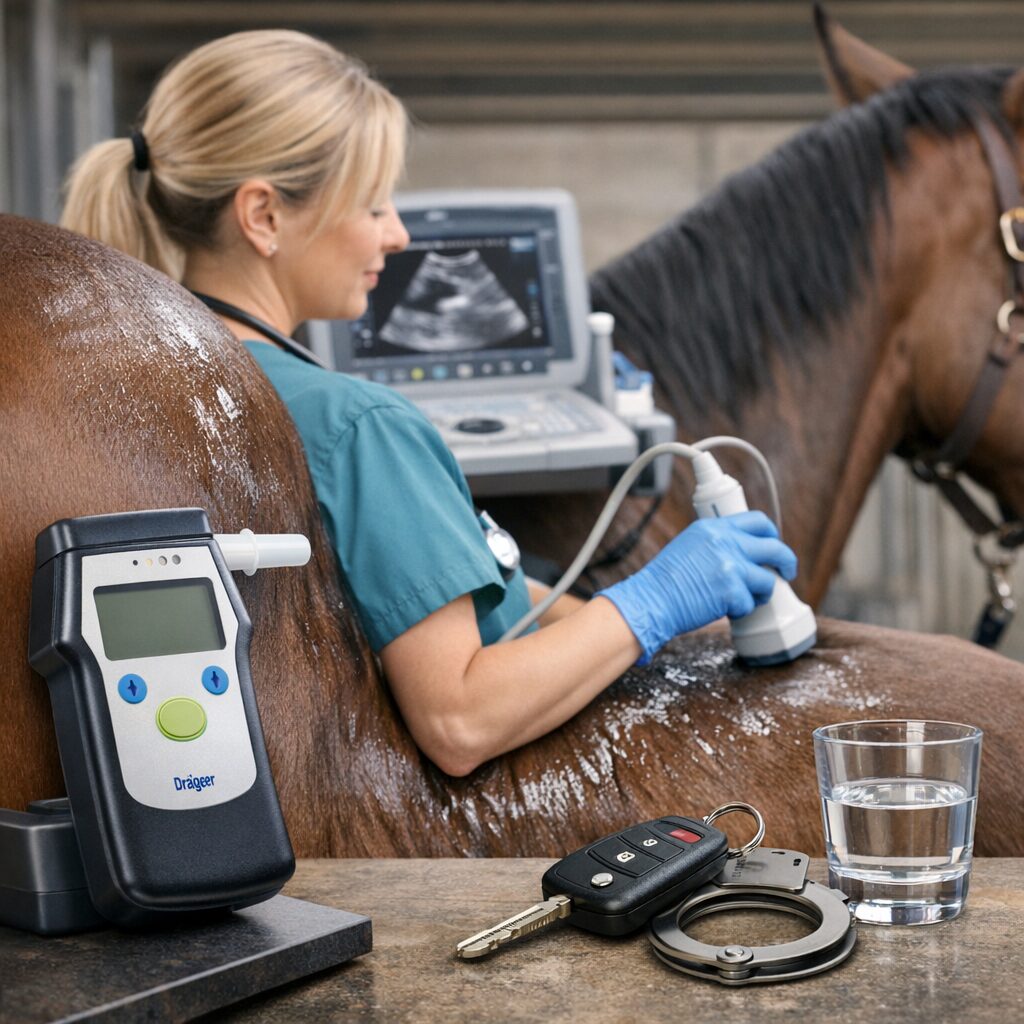
A peer-reviewed study published in Veterinary Sciences examined what happens when a person performs an abdominal ultrasound on a horse using ethanol as a coupling agent, a standard, routine procedure in equine medicine. The subjects were six veterinary students, ages 22 to 26, and all thirty-six examinations were performed on a single animal, a 20-year-old Standardbred mare. None of them drank any alcohol. They poured or sprayed ethanol solution onto the horse’s skin to create contact between the ultrasound probe and the body, the same way they do it every day in every equine practice in the world.
Then they blew into an evidential-grade infrared breath alcohol analyzer which is the same type of instrument used by law enforcement to arrest people for DWI.
The results should concern anyone who has ever been asked to provide a breath sample during a traffic stop.
The Numbers
The study enrolled six veterinary students who each performed six ultrasound examinations on a horse, for a total of 36 sessions. Immediately after each procedure, the operator blew into a Dräger Alcotest 7110 which is a widely used evidential breathalyzer approved in both Europe and Australia.
83% of the time, the breath test was positive. Every single participant tested positive in at least four of their six sessions without consuming any alcohol.
The highest reading recorded was 0.087% which is above the legal limit in every state in the United States, including Texas. That reading came from a person who had not had a drink in at least 24 hours. They were sober. They had been examining a horse.
Among the key findings:
- 30% of the readings at time zero were above 0.050%, the per se limit in Utah and in many other countries. Be careful with that number: 0.050% sits below the 0.08 per se limit in the other 49 states and the District of Columbia, so a reading at that level is not itself over the limit in Texas
- 53% were in the “positive but below the legal limit” range (0.019%–0.050%)
- Positive results persisted for up to 60 minutes after the procedure ended
- When more than 1 liter of ethanol was used (common in extended colic exams), 100% of participants tested positive, with a median reading of 0.023% still registering at 30 minutes post-procedure
- Results above the legal driving limit persisted for up to 35 minutes in some cases
The medians matter as much as the maximums, and any competent State expert will lead with them. The median time to a negative reading was 7.5 minutes, and the median time spent above 0.050% was zero. The figures above are the tail of the distribution, not the middle of it. Saying so first is what lets the rest of the argument survive cross-examination.
The study’s authors concluded that equine veterinarians who attend colic emergencies (which can happen at any hour of the day or night) can test positive on a breath alcohol test for up to an hour after the procedure, and recommended waiting at least 35 minutes before driving.
How Does This Happen?
The veterinarians were not drinking. They were not absorbing alcohol through their skin because they wore nitrile gloves throughout the procedures. They were inhaling ethanol vapor while working in close proximity to a large surface area saturated with 90% ethanol solution.
Breath alcohol testing works on a fundamental assumption: that the alcohol detected in the breath sample came from the subject’s blood, crossed from the bloodstream into the lungs through the alveolar membrane, and was exhaled in a proportion that correlates with blood alcohol concentration. The standard blood-to-breath ratio used by most instruments (including the ones used in Texas DWI enforcement) is 2100:1, meaning the instrument assumes that 2,100 milliliters of breath contain the same amount of alcohol as 1 milliliter of blood. One caution before borrowing the study’s figures: the Alcotest 7110 used in the study was configured to a 2000:1 ratio, the European convention. Texas instruments use 2100:1. The readings do not transfer to a Texas case one for one, and it is the mechanism rather than the specific number that carries over.
But that assumption fails when the alcohol in the breath did not come from the blood. If alcohol is present in the mouth, the throat, the esophagus, or the upper airways (i.e. from any source other than alveolar air) the instrument cannot tell the difference. It reads the alcohol, applies the 2100:1 ratio, and reports a number that looks like a blood alcohol concentration but is not.
This is called mouth alcohol contamination and it is one of the most well-documented sources of false positive breath test results in forensic science. Prior research had established that hand sanitizer vapors and alcohol-based mouthwashes can produce positive breath tests for 5–10 minutes. Law enforcement protocols address this through a 15-minute observation period before testing, designed to let any residual mouth alcohol dissipate.
The equine ultrasound study demonstrated that 15 minutes is not always enough. When the ethanol exposure is prolonged and the quantity is large, positive results persisted for 30, 45, and in one case 60 minutes. And the study’s authors suspect that at least some of the readings reflected actual pulmonary absorption of ethanol vapor meaning the alcohol entered the bloodstream through the lungs, not the stomach, producing a genuine (though involuntary) blood alcohol level.
Why This Matters for DWI Defense
Nobody is going to get arrested for performing an ultrasound on a horse. But the science in this study has direct implications for DWI defense, because the mechanism that produced these false positives (mouth alcohol contamination from environmental ethanol exposure) is the same mechanism that can produce false positives in a traffic stop.
The 15-Minute Observation Period Is Not Foolproof
Here is where Texas practitioners should read the actual rule rather than the version that circulates in DWI commentary, because the Texas rule is weaker than most people describe it, and that is the argument. Texas Administrative Code Title 37, Section 19.3(a)(1) provides that an operator shall remain in the continuous presence of the subject at least 15 minutes immediately before the test and should exercise reasonable care to ensure that the subject does not place any substances in the mouth. The same provision then says, in terms, that direct observation is not necessary to ensure the accuracy of the test result. That is the whole requirement.
Notice what is not in it. Other states write the prohibition out: Michigan and Wyoming bar smoking, regurgitating, or placing anything in the mouth, and Florida requires the operator to reasonably ensure the subject has not regurgitated for twenty minutes. Texas has no such list. It has presence, a reasonable-care standard, and an express statement that nobody has to be watching. The purpose is still to let residual mouth alcohol dissipate so the sample reflects alveolar air. The point is that Texas builds in less assurance that it happened, and the productive attack is on the reasonable-care prong and on the video, not on a deprivation rule Texas never adopted.
The equine study shows that 15 minutes is insufficient when the ethanol exposure is significant. Veterinarians who used more than 1 liter of ethanol during the procedure were still testing positive at 30 minutes. Some were still positive at 60 minutes. If environmental ethanol exposure can defeat the 15-minute observation period in a controlled study, the defense must ask: was the 15-minute observation period sufficient in this case? Was the defendant exposed to any environmental ethanol source (occupational, medical, or incidental) that could have contaminated the breath sample?
The Instrument Cannot Distinguish Source
The Dräger Alcotest 7110 used in the equine study is an evidential-grade instrument with both electrochemical and infrared sensors. It is sophisticated. It is accurate. And it cannot tell the difference between alcohol that crossed the alveolar membrane from the bloodstream and alcohol that was inhaled, ingested as residue, or present in the upper airways from any other source.
The Intoxilyzer 9000, which is the instrument used in Texas DWI enforcement, has the same fundamental limitation. It measures the concentration of ethanol in the breath sample. It applies a fixed ratio. It reports a number. If the alcohol in the sample came from a source other than the defendant’s blood, the number is wrong and the instrument will not flag it.
Occupational and Environmental Ethanol Exposure Is More Common Than You Think
The equine veterinarian scenario is vivid, but it is not the only context in which occupational or environmental ethanol exposure can produce false breath test results. Consider:
- Healthcare workers who use alcohol-based hand sanitizer dozens of times per shift
- Industrial workers exposed to ethanol-based solvents, degreasers, or cleaning agents
- Painters and auto body technicians working with ethanol-containing coatings and finishes
- Workers in breweries, distilleries, and wineries who inhale ethanol vapor throughout the workday
- People who use alcohol-based asthma inhalers or nebulizers
- People who used alcohol-based mouthwash within the hour before the traffic stop
In each of these scenarios, the breath test instrument will report a number. It will look like a blood alcohol concentration. It may be above 0.08. And it may have nothing to do with how much the person actually drank.
GERD, Acid Reflux and the Mouth Alcohol Problem
The mouth alcohol problem extends beyond environmental exposure, but it is worth being disciplined about how far. An acute belch or regurgitation in the moments before a test can carry stomach alcohol into the mouth and inflate a reading, and that is precisely what the fifteen minutes is for. The broader claim, that chronic gastroesophageal reflux disease by itself produces falsely high evidential breath results, has mixed findings in the scientific literature. Kechagias and colleagues studied patients with severe reflux, provoked it with abdominal compression, and reported that falsely elevating an evidential breath test this way was highly improbable. Booker and Renfroe went further, calling reflux an essentially irrelevant source of potential error in forensic breath testing, and noted pointedly that the GERD defense has been aggressively promoted through internet advertisements. A prosecution expert will have those papers. Read all of Booker and Renfroe before conceding it, though. Of the fifteen subjects they dosed, three produced breath readings as high as 0.105 during the absorptive phase, and the authors attributed that to gastric alcohol passing the lower esophageal sphincter rather than to any belch or regurgitation. The headline conclusion runs against the defense. That finding does not, and it sits inside the paper the State will hand the jury. A prosecution expert will have these papers, so a defense filing should not rest on the diagnosis alone.
A personal note on that citation. Dr. Booker was a dear friend of mine, and he testified as a defense expert in many of my trials over the years. He has since passed away. It says something about him that the study bearing his name reaches a conclusion the defense bar would rather it did not, and reports the contrary findings anyway. That is what a forensic scientist is supposed to do, and it is why the paper is worth citing honestly rather than selectively.
The literature has not stood still, though, and the newest entry proposes a mechanism the older studies never tested. In a 2026 case report in the Medico-Legal Journal, Aaron Olson described two Minnesota driving-while-impaired cases involving men with documented GERD and chronic cough, each of whom admitted to two beers. Both produced breath alcohol expirograms with a negative-going slope, which is the signature of mouth alcohol rather than deep-lung air. In the first case, video of the observation period captured more than 37 distinct coughing or throat-clearing events, including a coughing fit within seconds of the sample. That first test aborted as deficient for failing to reach a level slope, and a second sequence returned 0.14. In the second case, the subject coughed three times on video and the reported value was 0.11.
The proposed mechanism is microaspiration: small volumes of gastric contents reaching the larynx and upper airway without any visible regurgitation. That distinction matters, because an observation period built around watching for a belch will miss it entirely, and because microaspiration is itself a recognized trigger for the coughing and throat clearing that end up on the video.
Be equally disciplined about what that paper is. It is two cases, not a study. The author states plainly that microaspiration and upper-airway ethanol were never directly measured, that other sources of residual mouth alcohol cannot be excluded, that the magnitude and duration of any effect remain unknown, and that the cases are hypothesis-generating. He also discloses that he testifies in forensic toxicology cases. Offered as proof that a reading was false, it will not survive cross-examination. Offered for what it actually supports, it is useful, and its own recommendation is the practical one: look at the video as part of a thorough case review, particularly where the medical history includes an aerodigestive disorder.
So the defensible position on reflux has three parts rather than one. A diagnosis by itself proves nothing. A documented belch or regurgitation during the fifteen minutes, shown on video, is a reason to question the sample. (NOTE: In Texas it should lead to exclusion of the test result). And the expirogram is the piece most often ignored: the instrument records the shape of the breath, not just the final number, and a negative-going slope is objective evidence of mouth alcohol whatever mechanism put it there. That is a records request, not a theory.
The equine study adds to a growing body of forensic science literature demonstrating that breath alcohol testing is not the simple, infallible measurement that prosecutors present it to be. The instrument produces a number. The question is whether that number accurately reflects the defendant’s blood alcohol concentration at the time of driving and the answer depends on factors that the instrument itself cannot evaluate.
The Defense Takeaway
A breath test result is a piece of evidence. It is not proof. It is a number generated by a machine that operates on assumptions about the source of the alcohol, about the blood-to-breath ratio, about the absence of interfering substances, and about the adequacy of the observation period. When any of those assumptions is wrong, the number is wrong, and the defenses that turn that into a result are the next question.
The equine veterinarian study is a powerful illustration of this principle because the scenario is so clean: six sober people, controlled conditions, an evidential-grade instrument, and results that would have put every one of them over the legal limit. No drinking. No impairment. Just ethanol vapor and a machine that cannot tell where the alcohol came from.
In every DWI case we handle, we evaluate the breath test result not as a conclusion but as a data point that must be interrogated: Was the observation period adequate? Was there any source of mouth alcohol contamination? Does the defendant have GERD or another condition that could introduce alcohol vapor into the breath sample? Was the instrument properly calibrated and maintained? Was the operator properly trained and certified? Did the instrument’s internal quality checks pass?
Deandra Grant’s Master’s Degree in Pharmaceutical Science, ACS-CHAL Forensic Lawyer-Scientist designation, and training at Axion Analytical Labs give her the scientific credentials to challenge breath test results at the scientific level, not just the number on the printout, but the science behind how that number was generated and whether it can be trusted. When a breath test result is the centerpiece of a DWI prosecution, the defense must be equipped to ask the questions the instrument cannot answer.
If you have been arrested for DWI in Texas based on a breath test result, call (214) 225-7117 or visit texasdwisite.com. The number on the printout may not be what the prosecution says it is.
The other guides in this section.
The Breath Test
The Blood Test
The Roadside Tests
Drug Cases
The Science of the Number
The science on this page is the raw material. The moves that turn it into a suppressed result, an excluded expert or a dismissal live in Defenses.
Which county your case is filed in changes how it is charged, who prosecutes it, and which court hears it.
Deandra M. Grant, JD, GC, MS, ACS-CHAL Forensic Lawyer-Scientist
She holds a Master of Science in Pharmaceutical Science and a Graduate Certificate in Forensic Toxicology, both from the University of Florida. She is the author of The Texas DWI Manual and has defended Texas DWI cases since 1994.
Charged With a DWI in Texas?
Intake answers 24/7, and if your case is one we can take on, we schedule a free consultation with an attorney.
Request a Free Case Evaluation
Tell us what happened. We'll respond as soon as possible.