
The Tolerance Problem: Blood Drug Levels vs Impairment

The prosecution’s theory in every drug DWI case rests on a simple equation: the defendant had drugs in their system, therefore the defendant was impaired. The relationship between blood alcohol concentration and impairment is well-established and reasonably consistent across individuals. But for virtually every other substance (cannabis, benzodiazepines, opioids, amphetamines, antidepressants, sleep medications) this reasoning is scientifically wrong.The reason it is wrong has a name: tolerance. And understanding tolerance at the pharmacological level is one of the most powerful defense tools in drug DWI cases.
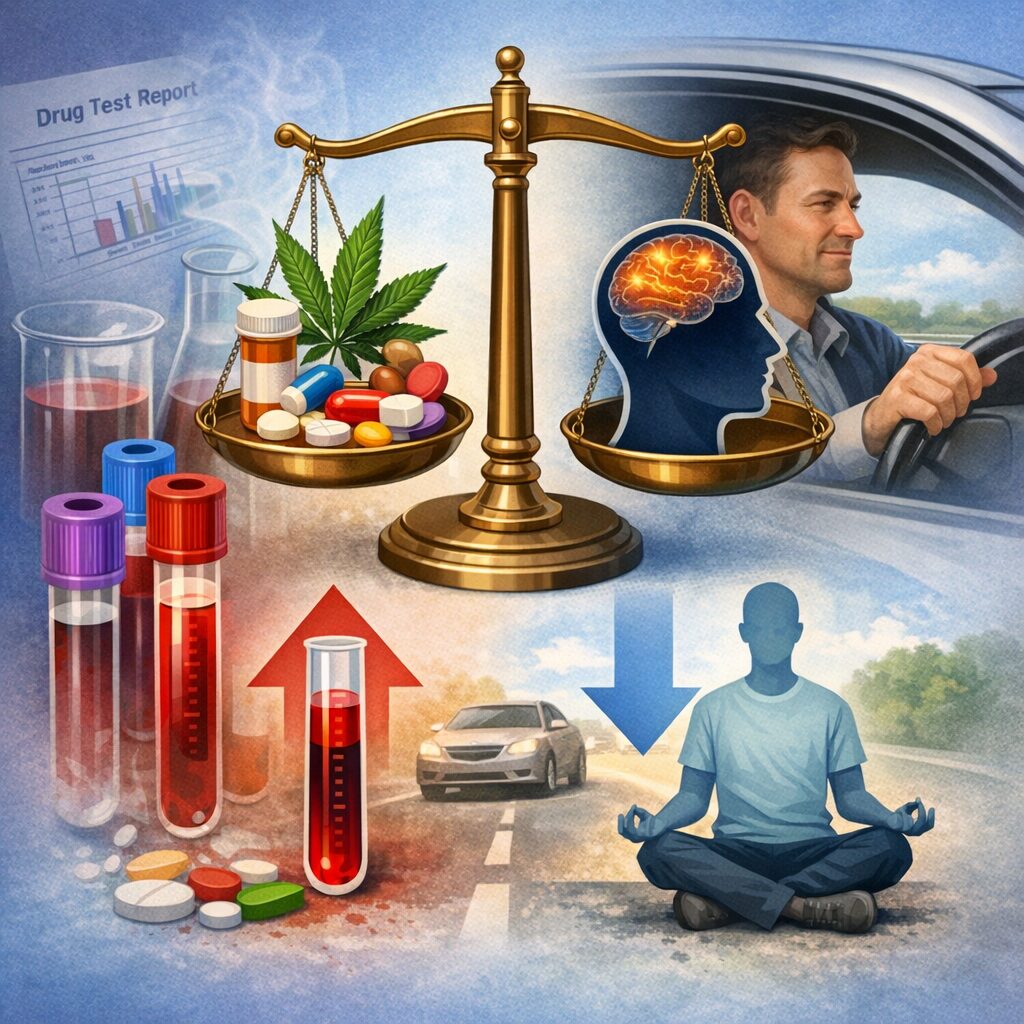
What Is Tolerance?
In pharmacology, tolerance refers to the body’s progressive adaptation to repeated drug exposure, resulting in a diminished response to the same dose over time. A drug that produces significant impairment on first exposure may produce little or no impairment after weeks or months of regular use even though the blood concentration is the same or even higher.
There are three main types of tolerance, each operating through a different biological mechanism:
1. Pharmacodynamic Tolerance
This is the most important type for defense purposes. Pharmacodynamic tolerance occurs when the brain’s receptors adapt to the chronic presence of a drug. With repeated exposure, receptors may downregulate (decrease in number), desensitize (become less responsive), or trigger compensatory changes in neural circuits. The result: the same drug concentration at the receptor site produces a smaller effect.
Cannabis is the clearest example. Chronic cannabis users develop significant tolerance to the psychoactive effects of THC through downregulation of CB1 cannabinoid receptors in the brain. Studies have shown that chronic users can function normally (i.e. performing cognitive and psychomotor tasks within normal limits) at THC blood concentrations that would significantly impair a naive user. This is why per se THC limits are scientifically indefensible: the same blood concentration means entirely different things in different people.
2. Pharmacokinetic (Metabolic) Tolerance
Pharmacokinetic tolerance occurs when the body becomes more efficient at metabolizing and eliminating a drug with repeated exposure. This happens through enzyme induction which is the upregulation of the cytochrome P450 enzyme systems in the liver that metabolize drugs. With chronic exposure, the liver produces more of the relevant enzymes, which metabolize the drug faster, resulting in lower peak concentrations and shorter duration of effect from the same dose.
Alcohol is the classic example: chronic heavy drinkers induce CYP2E1, which increases the rate of ethanol metabolism. This is why chronic drinkers can consume quantities that would incapacitate a non-drinker and appear relatively functional. Their livers are processing the alcohol faster.
3. Acute Tolerance (The Mellanby Effect)
Acute tolerance occurs within a single episode of drug exposure. For alcohol it is called the Mellanby effect, after Edward Mellanby’s 1919 report to the Medical Research Committee, and the real picture is more complicated than the phrase usually suggests. It is worth stating carefully, because the version repeated in most driving-while-intoxicated literature is only half right.
The effect is well established for how intoxicated a person feels. In a systematic review of the literature, subjects rated themselves less intoxicated on the descending limb of the blood alcohol curve than at the same concentration on the ascending limb in twelve of the thirteen trials that produced statistically significant results, by a weighted average of twenty-nine percent. They were also markedly more willing to drive.
The objective evidence does not follow the subjective evidence. That same review found that the skills driving actually requires ran the other way: performance on driving simulators and on tests of inhibitory control was generally worse on the descending limb at the same blood alcohol concentration.
So the defensible statement is not that a person is more impaired on the way up. It is that the relationship between a blood alcohol number and a person’s actual behavior is not fixed across the curve, and that a driver on the descending limb feels less intoxicated, and is more willing to get behind the wheel, than the number alone would predict. Both halves of that matter in a DWI case, and both bear on the reliability of retrograde extrapolation.
Drug-Specific Tolerance in DWI Cases
Cannabis
Chronic cannabis users develop substantial pharmacodynamic tolerance. Peer-reviewed research has demonstrated that regular users can maintain normal driving performance in simulator studies at THC blood concentrations that impair occasional users. The National Institute of Justice reported in 2021 that THC levels in biofluid were not reliable indicators of marijuana intoxication, and that the standardized field sobriety tests commonly used to detect drug impairment were not effective at detecting cannabis intoxication. In that research the one leg stand, the walk and turn, and the modified Romberg balance test were not sensitive to cannabis intoxication for any of the study participants.
One caution, because it is the honest way to state the finding and because the prosecution will read the same source. The disconnect runs in both directions. The researchers also observed significantly decreased cognitive and psychomotor functioning in some participants whose blood, urine, and oral fluid contained only low levels of THC. The point is not that a high number means an unimpaired driver, or that a low number means an impaired one. The point is that the number and the behavior are not reliably linked at all, which is precisely why a concentration cannot carry a prosecution on its own.
Benzodiazepines
Patients prescribed benzodiazepines for anxiety, insomnia, or seizure disorders develop significant tolerance to the sedating and psychomotor-impairing effects within weeks of regular use. A chronic benzodiazepine patient with a therapeutic blood concentration may show no impairment, while a naive user at the same concentration may be severely impaired. DRE evaluations frequently flag benzodiazepine-positive individuals as “CNS depressant” impaired without any consideration of whether the person is a chronic therapeutic user.
Opioids
Chronic pain patients on stable opioid regimens (oxycodone, morphine, fentanyl patches, buprenorphine) develop tolerance to the sedating and psychomotor-impairing effects. In one study, chronic pain patients on stable opioid regimens drove their own automobiles through a predetermined community route including residential and highway conditions, and then through a five-station obstacle course, and showed no significant differences from healthy volunteer controls. Their average dose was the equivalent of 118 milligrams of morphine a day. A 2018 systematic review reached the same conclusion, finding no significant impact of regular therapeutic opioid agonists on driving-related psychomotor skills.
State the limits of that literature yourself rather than waiting for the prosecutor to state them. The systematic review found only three studies that met its inclusion criteria out of more than 3,800 records screened, and one of those studies reported that more intense pain significantly worsened driving performance. Pain itself is a variable here, and the evidence base is thin. What the research does not support is the assumption that a blood opioid concentration in a chronic pain patient carries the same impairment significance as the same concentration in an opioid-naive person.
Amphetamines and Stimulants
Patients prescribed amphetamine-based medications (Adderall, Vyvanse) for ADHD develop tolerance to the stimulant’s side effects while maintaining therapeutic benefit. These patients may have detectable amphetamine in their blood at all times while being completely functional. Charging a stable ADHD patient with drug DWI based on a positive amphetamine result ignores the pharmacology of therapeutic use.
Why Per Se Drug Limits Are Scientifically Indefensible
Some jurisdictions have enacted or proposed per se limits for drugs in blood, meaning a specific concentration above which a person is presumed impaired, regardless of observed behavior. For alcohol, the 0.08 per se limit has a reasonable scientific basis (though it is still an imperfect proxy for individual impairment). For other drugs, per se limits have no comparable scientific foundation.
The fundamental problem is that unlike alcohol, the relationship between blood drug concentration and behavioral impairment is not consistent, not linear, and not predictable from a single measurement. Tolerance, individual pharmacokinetic variability, polypharmacy, the timing of the measurement relative to the drug’s absorption and elimination curve, and the specific pharmacological profile of the drug all affect the relationship between concentration and effect. A single number cannot capture this complexity.
Defense Strategy: Using Tolerance in Your Case
- Establish your client’s medication and use history. A documented history of chronic, stable use (whether therapeutic or recreational) provides the foundation for a tolerance defense.
- Obtain medical records and prescription history. Pharmacy records, prescriber notes, and dosing histories establish the chronicity and stability of drug use.
- Retain a pharmacologist or toxicologist. An expert who can explain tolerance mechanisms to the jury in plain language is essential. The science is counterintuitive but jurors need to understand why a positive drug test does not automatically mean impairment.
- Challenge the DRE’s failure to account for tolerance. DRE evaluations do not include any assessment of the subject’s drug use history or tolerance status. This is a fundamental gap that should be highlighted on cross-examination.
- Challenge per se arguments. If the prosecution argues that any detectable level equals impairment, demand the scientific literature supporting that position for the specific drug at issue. For most drugs, that literature does not exist.
References
Byas-Smith MG, Chapman SL, Reed B, Cotsonis G. The effect of opioids on driving and psychomotor performance in patients with chronic pain. Clinical Journal of Pain 21(4):345-352 (2005).
Ferreira DH, Boland JW, Phillips JL, Lam L, Currow DC. The impact of therapeutic opioid agonists on driving-related psychomotor skills assessed by a driving simulator or an on-road driving task: a systematic review. Palliative Medicine 32(4):786-803 (2018).
Holland MG, Ferner RE. A systematic review of the evidence for acute tolerance to alcohol: the “Mellanby effect.” Clinical Toxicology 55(6):545-556 (2017).
Mellanby E. Alcohol: Its Absorption into and Disappearance from the Blood under Different Conditions. Medical Research Committee, Special Report Series No. 31. London (1919).
National Institute of Justice. Field Sobriety Tests and THC Levels Unreliable Indicators of Marijuana Intoxication. April 5, 2021, reporting research by RTI International under award 2016-DN-BX-0193.
At Deandra Grant Law, the tolerance defense draws directly on Deandra Grant’s Master’s Degree in Pharmaceutical Science. Pharmacodynamics (the study of how drugs interact with biological systems to produce their effects, including tolerance) is core curriculum in pharmaceutical science education. When we argue that a blood drug concentration does not equal impairment, we are applying graduate-level pharmacology, not legal argument. Call (214) 225-7117 or visit texasdwisite.com.
The other guides in this section.
The Breath Test
The Blood Test
The Roadside Tests
Drug Cases
The Science of the Number
The science on this page is the raw material. The moves that turn it into a suppressed result, an excluded expert or a dismissal live in Defenses.
Which county your case is filed in changes how it is charged, who prosecutes it, and which court hears it.
Deandra M. Grant, JD, GC, MS, ACS-CHAL Forensic Lawyer-Scientist
She holds a Master of Science in Pharmaceutical Science and a Graduate Certificate in Forensic Toxicology, both from the University of Florida. She is the author of The Texas DWI Manual and has defended Texas DWI cases since 1994.
Charged With a DWI in Texas?
Intake answers 24/7, and if your case is one we can take on, we schedule a free consultation with an attorney.
Request a Free Case Evaluation
Tell us what happened. We'll respond as soon as possible.