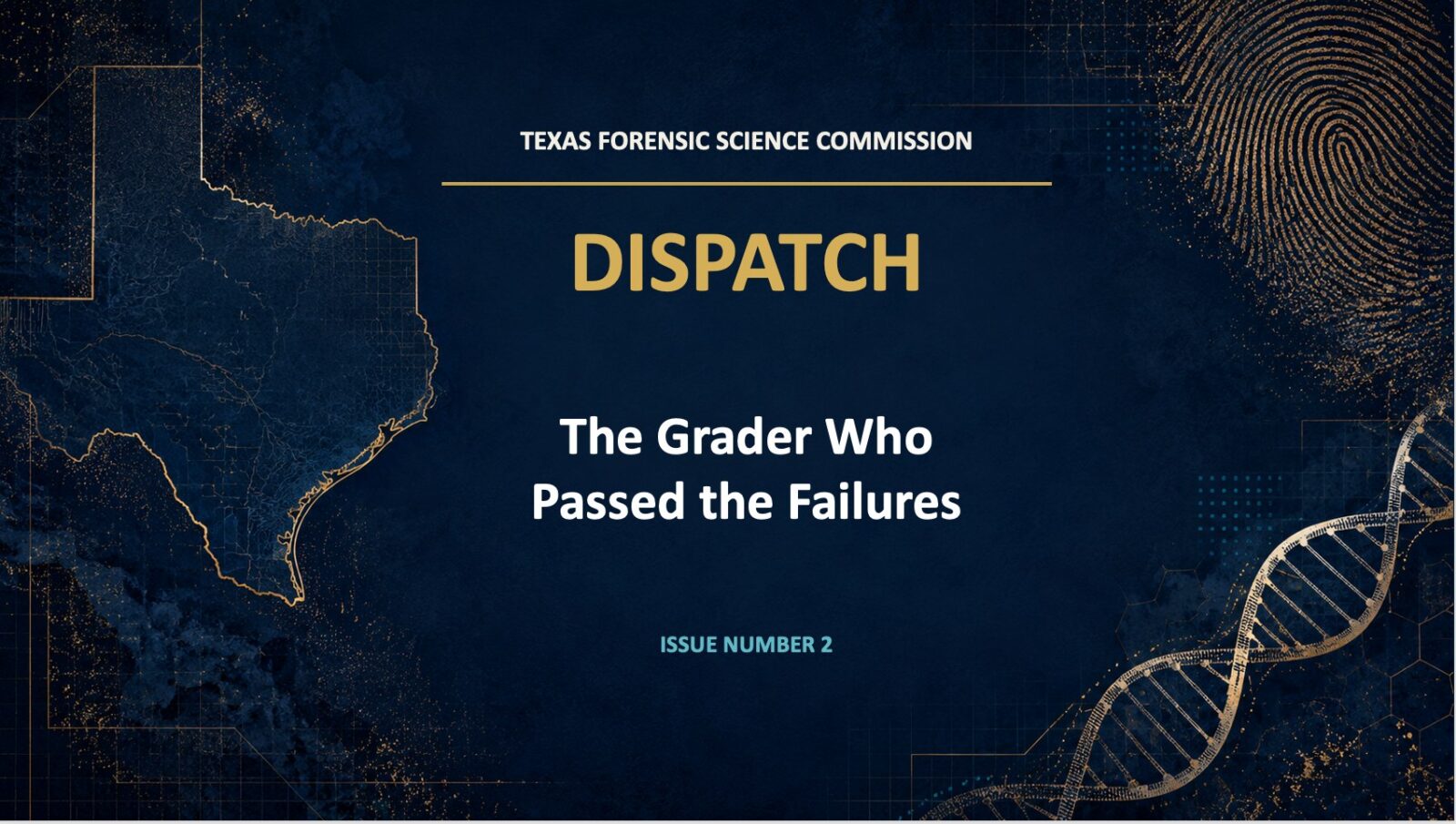
TFSC Update: The Grader Who Passed the Failures
A former Texas Forensic Science Commission employee passed seven analysts who failed the licensing exam. What that means for a case built on their work.
Seven Licenses the Exam Did Not Earn
The Texas Forensic Science Commission licenses the analysts who test evidence in criminal cases. To hold that license, an analyst has to pass the Commission’s exam. At the Commission’s July 31, 2026 quarterly meeting, General Counsel Garcia reported that a former Commission employee had handed out passing grades to seven people who did not pass.
A former employee issued a passing grade for seven test takers who did not meet the 70-point threshold. Passing the General Forensic Analyst Licensing Exam, the version the Commission calls GFALE II, requires a score of at least 70 plus minimums in each domain category. Seven people were told they had cleared a bar they had not cleared, and were licensed on that footing.
This is not a new story that broke this fall. It is a July story that only became public this fall. The minutes of the July 31 meeting were adopted at the Commission’s October 23, 2026 meeting and posted afterward, which is the first time the account appeared in the agency’s own record.
Who the Seven Are
Three of the seven hold licenses in a mandatory discipline. The minutes note that one of those three was not performing criminal casework, which leaves two who were. The other four hold licenses in voluntary categories.
A mandatory discipline is one the licensing requirement reaches by statute, so a mandatory licensee is a person whose work the law says cannot be done without a license. A voluntary licensee, under 37 TAC 651.222, works in a category the requirement does not reach and seeks the credential anyway. The two mandatory licensees doing criminal casework are the ones whose files a defense lawyer would want to find.
Here is what the record does not contain. No names. No laboratories. No disciplines beyond the mandatory and voluntary labels. No date for when the grades were issued or when staff caught them, so no way to measure the window. And no statement, one way or the other, about whether either of those two analysts signed a report or testified while holding a license the exam did not support. The Commission did not say they did. It also did not say they did not.
Why the Exam Is Not a Formality
Article 38.01, Section 4-a(b) of the Code of Criminal Procedure is short and absolute. A person may not act or offer to act as a forensic analyst unless the person holds a forensic analyst license. Section 4-a(d)(1) then directs the Commission to set the qualifications for that license by rule, and names an examination required or recognized by the Commission as one of them.
Under 37 TAC 651.207(h)(1), an applicant for a forensic analyst license must pass the General Forensic Analyst Licensing Exam administered by the Commission, may sit for it no more than three times, and has to make a written request for special dispensation to go past three.
Education and coursework can be waived under Rule 651.207(g), and at this same July meeting the Commission made that waiver easier to reach for firearms and toolmarks examiners by cutting the work experience it takes to qualify for one from five years to three. The exam cannot be waived, and the rule caps how many times you are allowed to fail it.
The 70-point threshold and the domain minimums do not appear in Rule 651.207 at all. The rule requires a passing grade without saying what passing means. The numbers come from the Commission’s own administration of the exam, which is how the minutes describe them. A standard that lives in practice rather than in text is harder to audit, which is close to the root cause the Commission identified for itself.
What This Does Not Do
Article 38.35(d) is the provision that ties forensic analysis to admissibility, and it keys off laboratory accreditation, not individual licensure. If the laboratory was accredited when it did the work, the statute is satisfied on its own terms, whatever happened with one analyst’s exam grade. There is no subsection anywhere that makes an analyst’s licensing defect a ground for exclusion.
What it actually is: material on qualification and credibility.
- Qualification under Rule 702, which is the State’s burden to establish for the witness it offers.
- The third prong of Kelly v. State, 824 S.W.2d 568 (Tex. Crim. App. 1992), which asks whether the technique was properly applied on the occasion in question by the person who applied it.
- Impeachment, because an analyst who testifies to a credential has opened the door to how that credential was obtained.
- A Michael Morton Act request under Article 39.14 for the licensing file, which is how you find out whether any of this touches your case rather than guessing.
A standing caveat for DWI practice. Article 38.35(a)(4) carves breath testing under Transportation Code Chapter 724 out of the definition of forensic analysis, so breath test operators and technical supervisors are not Commission licensees and this matter does not reach them. Blood alcohol testing is a different story, because it is an accredited discipline and its analysts are licensed.
Set It Next to the Commission’s Other Licensing Case This Year
In Self-Disclosure 25.66, published April 24, 2026, the Commission found professional misconduct by a forensic biology analyst at the Southwestern Institute of Forensic Sciences in Dallas. Kenneth Balagot altered a hard copy electropherogram submitted for technical review in order to conceal a contamination event in a known reference sample, in a case then set for trial. The Commission suspended his license and resolved that if he seeks reactivation or renewal it will refuse until May 31, 2031. The laboratory reviewed 208 of his cases and notified the Dallas County District Attorney’s Office.
Same agency, same year, same credential, two very different responses. An analyst who falsified a record lost his license for five years. When the Commission’s own grading issued licenses after a failing grade the response was a round of retakes and a better spreadsheet.
The seven licensees did nothing wrong. They sat for an exam and were told the result. But the credential came out identical in both situations: a license on the wall with a record behind it that does not hold up. In the Balagot matter the Commission treated that gap as serious enough to suspend a license for half a decade. In its own house it treated the same gap as an administrative fix with no vote taken.
No Second Reviewer, Again
The Commission’s root cause analysis found the errors came in part from a time intensive, manual grading process. There was no second reviewer. Staff built an automated, Excel-based formula, and every exam grade now gets a second review at one of three levels of rigor keyed to the score in Blackboard. The final corrective action will be released after the last three licensees retake.
Defense lawyers who read this docket every quarter will recognize the finding, because it is the same one the Commission keeps making about everybody else.
- In Complaint 25.77, the investigative panel reported that the 1999 Houston firearms file held conclusions with no photographs and no detailed analytical notes, which made review of the analyst’s work impossible.
- In Self-Disclosure 26.19, the Commission accepted a disclosure for staff investigation because a Dallas analyst failed to notify the technical leader of a reagent blank contamination and failed to document it on the form that triggers an investigation.
- In Self-Disclosure 25.66, the concealment worked for a while precisely because nobody was checking the paper copy against the underlying data. The Commission’s corrective recommendation was to compare the two and document the comparison.
Three casework matters and one licensing matter, all turning on the same thing. A single person produced a record, nobody verified it, and the error surfaced later by accident. The work may well have been fine in every one of these. The point is that for a while nobody could tell.
If a Licensed Analyst Worked Your Case
- Ask about the license directly. When did the analyst sit for the licensing exam, what does the license history show, and has the Commission notified them that their grade was reviewed. Those are three questions with short answers.
- Ask the Commission. Seven is a small number and the agency has the list. A public information request is the route, and nothing in the minutes suggests the identities were treated as confidential.
- Use Article 39.14 to request the licensing file, the exam date, and any Commission correspondence about the grade review.
- This is qualification and weight, not exclusion.
- Watch December 1, 2026. That is the deadline for the last three licensees to retake, and the Commission said its final corrective action follows.
What Happens Next
Three voluntary licensees have to sit for the exam by December 1, 2026. The three mandatory licensees and one voluntary licensee have already retaken it and passed, which answers the competence question for them and leaves the credential question for the window before the retake.
The Commission proposed amendments to 37 TAC 651.219 to make clear that a license holder must communicate honestly and fully with all parties, including the Commission itself. That was proposed rather than adopted, so it was still in the rulemaking pipeline at the end of the quarter. And seven domain-based working groups are rewriting the analyst and technician licensing exams, with staff expecting the new exam to be complete within the year. The exam at the center of this story is being replaced.
For scale: 1,392 total licenses, with 115 new ones issued so far this year. Seven bad grades is a small fraction of that. It is also seven licenses whose one measured qualification wasn’t met.
The minutes of the October 23, 2026, meeting have not been posted. They are expected to be adopted at the Commission’s January 29, 2027 meeting, and we will update this post if they add anything on the grading audit or name the final corrective action.
Sources
- Texas Forensic Science Commission, July 31, 2026 quarterly meeting minutes, item 6c (licensing exam grading audit), item 6f (Section 651.207 amendments), item 6g (proposed Section 651.219 amendments), posted after the October 23, 2026 meeting.
- Tex. Code Crim. Proc. art. 38.01, Sec. 4-a(b) (license required to act as a forensic analyst); Sec. 4-a(d)(1) (Commission shall establish qualifications by rule, including an examination required or recognized by the Commission).
- Tex. Code Crim. Proc. art. 38.35(d) (admissibility keyed to laboratory accreditation); art. 38.35(a)(4) (definition of forensic analysis; excludes breath tests under Transportation Code Chapter 724); art. 39.14 (Michael Morton Act).
- 37 Tex. Admin. Code Sec. 651.207(h)(1) (must pass the General Forensic Analyst Licensing Exam; no more than three attempts; special dispensation by written request); Sec. 651.216 (disciplinary action); Sec. 651.219 (Code of Professional Responsibility); Sec. 651.222 (voluntary licensing).
- Kelly v. State, 824 S.W.2d 568 (Tex. Crim. App. 1992) (the Texas scientific reliability standard).
- Texas Forensic Science Commission, final investigative report in Self-Disclosure No. 25.66 (Southwestern Institute of Forensic Sciences, forensic biology/DNA, published April 24, 2026) (professional misconduct; license suspended; renewal refused until May 31, 2031).
Related on this site: our quarterly Forensic Science Commission Dispatch; analyst misconduct and what it does to a case; quality control and control samples; and impeaching a forensic analyst.
Deandra Grant holds a Master of Science in Pharmaceutical Science, a Graduate Certificate in Forensic Toxicology, and the ACS-CHAL Forensic Lawyer-Scientist designation. Deandra Grant Law handles DWI and criminal defense across North and Central Texas.
This post is an informational synthesis for educational purposes and is not legal advice. The Commission has not found professional negligence or professional misconduct by any of the seven licensees, and nothing here is offered as a finding about any analyst. The grading error was attributed to a former Commission employee who is not named in the minutes. Verify all citations before relying on them in any filing. Anyone facing charges should consult a licensed Texas attorney about the specific facts of their case.
Which county your case is filed in changes how it is charged, who prosecutes it, and which court hears it.
Deandra M. Grant, JD, GC, MS, ACS-CHAL Forensic Lawyer-Scientist
She holds a Master of Science in Pharmaceutical Science and a Graduate Certificate in Forensic Toxicology, both from the University of Florida. She is the author of The Texas DWI Manual and has defended Texas DWI cases since 1994.
Charged With a Crime?
Whatever you're facing, a DWI or any criminal charge, the sooner you have a forensic-trained team on it the more we can do. Tell us what happened and we'll review your options, at no cost and no obligation. Intake answers 24/7, and if your case is one we can take on, we schedule a free consultation with an attorney.
Request a Free Case Evaluation
Tell us what happened. We'll respond as soon as possible.