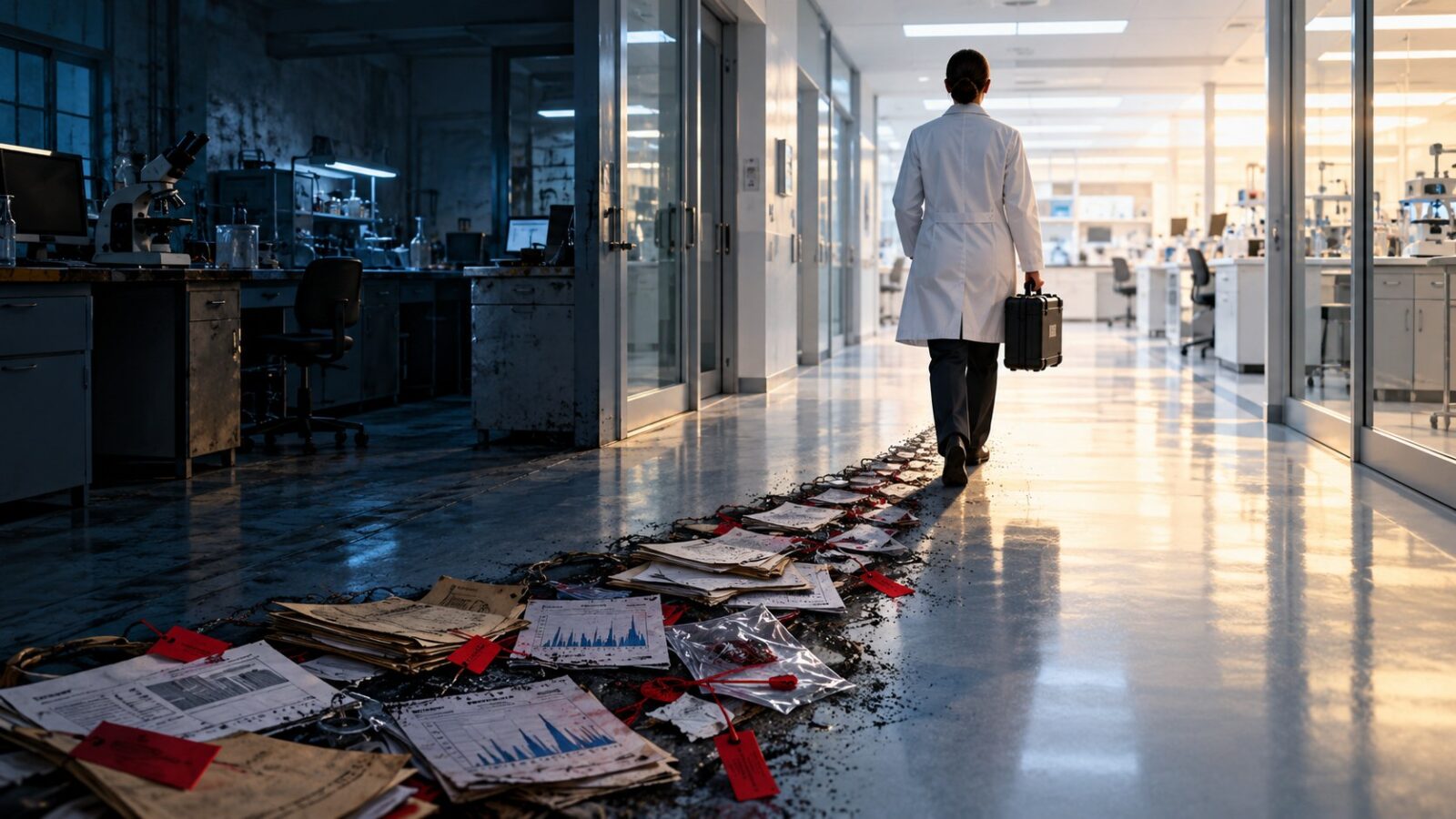
What Follows an Analyst to the Next Lab
Between March 2021 and July 2022, a DNA analyst at the Texas Department of Public Safety’s Waco Regional Crime Laboratory reported work hours that differed from the laboratory’s sign-in sheets and key card records by 279 hours. She was also paid for 96 hours of requested overtime. On one day she claimed nine hours and worked six and a half.
Colleagues raised it on June 27, 2022. It went to DPS headquarters and the Office of Inspector General the following month. She resigned effective August 10, 2022, and on September 21, 2022 the OIG sustained the timekeeping allegation. Othram, a private forensic genomics company, contacted her about a position on August 16, 2022, six days after her resignation took effect, and she started there on October 11, 2022. She left Othram on June 29, 2025 and started the next day at the Southwestern Institute of Forensic Sciences, Dallas County’s government forensic laboratory, which signed her off for independent casework in March 2026.
Neither of those employers was told. The Texas Forensic Science Commission found out in late March 2026, when a DPS Waco staff member alerted it that she was training at SWIFS.
The Commission’s final report in Self-Disclosure No. 26.18 is worth reading for a reason that has nothing to do with whether this particular analyst did good work. It is worth reading because of what it reveals about how impeachment material moves, and does not move, through the Texas forensic system.
What the Commission Found, and What It Did Not
The analyst is Amy Stewart, formerly Amy Powell, and the Commission’s public licensee record carries the name, the license number and the current status. The Commission’s first conclusion was that the timekeeping findings fell outside its misconduct jurisdiction. In the report’s words, “the OIG’s sustained findings of improper time reporting do not fall within the definition of ‘professional misconduct,’” because the conduct was separate from forensic analysis and testimony. The definition it was applying is not in the statute. It is the Commission’s own rule, 37 Tex. Admin. Code § 651.302(7), which reaches a deliberate departure from a standard of practice that “would substantially affect the integrity of the results of a forensic analysis.” Timekeeping does not touch a result, so the conclusion follows almost mechanically.
What the Commission did find was a failure to disclose. She did not tell Othram about the sustained OIG findings, and she did not tell SWIFS. On her October 11, 2024 license renewal application she gave “New Job Opportunity” as her reason for leaving DPS, which the Commission found incorrect or incomplete and which she acknowledged in her interview. The Commission found violations of Provisions 16 and 17 of the Texas Code of Professional Responsibility for Forensic Analysts and called the nondisclosure “a violation that compounds the previous poor judgment.” It suspended her forensic analyst license for the remainder of its term, expiring October 29, 2026, and requires her to document completed remedial training in legal disclosure compliance, and training on discussing the report’s issues with stakeholders, before the license is renewed. A disciplinary action may be appealed to the Judicial Branch Certification Commission on a written hearing request received within twenty days of notice.
Two things about that sanction are worth noticing. The suspension runs only to the license’s own expiration date, and the Commission attached no bar on reinstatement. Three months earlier it had suspended a Dallas analyst who altered a printed electropherogram, and added that it would refuse to renew or reactivate his license until 2031. That conduct went to a test result and this did not, which is the Commission’s whole point. But it means the discipline here is the weeks between the order and the expiration, plus a training requirement she can satisfy whenever she decides to apply again.
The report states there were no issues with her casework and that supervisors described her as skilled and hardworking. She did not testify in any case at Othram or at SWIFS. Nothing in the report suggests a single result was wrong.
Two Different Lines
The Commission drew a licensing line. It asked whether the conduct fell inside “forensic analysis,” which is the boundary of its own authority, and concluded that padding a timesheet does not. As a jurisdictional matter that is defensible and probably correct.
A defense lawyer draws a different line, and asks a different question: would a jury weighing this witness’s testimony want to know that a state agency sustained a finding that she misreported 279 hours and accepted pay for 96 hours of overtime she had not worked?
The Commission decides who holds a license. Whether something bears on a witness’s credibility is decided by different people, under different rules, for a different purpose. A ruling that conduct is outside a licensing definition is not a ruling that it is outside a jury’s interest.
Why It Did Not Follow Her
DPS did not bury this. It generated a disclosure form in December 2022, emailed it to her on January 2, 2023, mailed a letter to her Waco address on January 10, 2023, which she says she never received, sent the same form to the affected District and County Attorney’s Offices on January 26, 2023, and provided it to the Commission. By the standards of these things, that is a laboratory doing its job. We have written separately about who has the duty to tell a defendant when a laboratory itself gets something wrong, which runs through the prosecutor rather than the laboratory.
The notice went to the prosecutors who had DPS Waco cases. It was indexed to an agency and a caseload, not to a person. When the person left, the information stayed behind.
The January 2 email went to her work address at Othram. The notice arrived on Othram’s own system. It reached an inbox and not an institution, because nobody at Othram was a party to it and nothing in the system made them one. Othram as an employer was never told. SWIFS was never told. Three and a half years passed before anyone put the two halves together, and what finally did it was not a process. It was a former colleague who decided to say something.
That is the structural problem. Impeachment material attaches to a witness. Disclosure systems attach to agencies. When the witness moves and the agency does not, the obligation does not get waived by anyone; it simply goes quiet, because no one’s filing system is organized by the name of the analyst.
Whose Duty It Is in Texas
The obligation itself is not in doubt. Brady v. Maryland, 373 U.S. 83 (1963), requires disclosure of favorable material evidence, and Giglio v. United States, 405 U.S. 150 (1972), established that impeachment evidence is Brady evidence. Kyles v. Whitley, 514 U.S. 419, 437 (1995), puts on the prosecutor a duty to learn of favorable evidence known to others acting on the government’s behalf. Texas writes it into the statute: Article 39.14(h) names “impeachment” material expressly, and subsection (k) makes the duty continuing, before, during, or after trial, once the state discovers the material. Two limits belong with that sentence. Subsection (h) reaches impeachment material that tends to negate guilt or reduce punishment, which is not quite every credibility fact in existence. And article 39.14 as the Michael Morton Act rewrote it applies only to offenses committed on or after January 1, 2014, so for an older offense the former statute controls and the constitutional duty does the work. We cover that framework in our post on the Holberg case and the statute in our post on the Michael Morton Act.
The harder question is whose knowledge counts once the analyst has moved. In State v. Heath, 696 S.W.3d 677 (Tex. Crim. App. 2024), the Court of Criminal Appeals held that “the state” in Article 39.14 “means the State of Texas, which includes law enforcement agencies,” and that the statute carries no knowledge requirement for the prosecutor. A DPS crime laboratory sits inside a law enforcement agency, so what DPS knew about its own analyst is fairly described as the State’s knowledge. Read the rest of the holding before relying on it. The court replaced prosecutor knowledge with a duty of reasonable diligence rather than strict liability, said the prosecution may not be reasonably capable of producing what law enforcement lost or hid, and pointed to an agency’s completeness certification as something that might show an item was not reasonably capable of disclosure. It was decided six to three, it survived rehearing, and the State Prosecuting Attorney is asking the court to revisit it.
Othram is a private company. SWIFS is a county institute. Heath’s reasoning runs to law enforcement agencies and no Texas court has addressed what a prosecutor must know about an analyst’s prior employer in another part of the state. As far as I can find, no court anywhere has decided it. The Ninth Circuit had the question in front of it in a case where the testifying analyst’s misconduct file sat with a state agency and the prosecution was federal, and it called the imputation issue complex and declined to reach it. The nearest guidance is the prosecution team case law, which asks about control and participation in your case rather than about employment history, and which has put a private contractor inside the team where police drove the work and outside it where the outside entity had nothing to do with the particular case. A former employer holding a personnel file is the clearest example of an agency that is not on the team for your case. This is reason to put the question in a written request rather than wait for a court to answer it.
The Trap on Cross
Getting this material is not the same as using it.
Texas Rule of Evidence 608(b) is close to the opposite of its federal counterpart. It provides that “except for a criminal conviction under Rule 609, a party may not inquire into or offer extrinsic evidence to prove specific instances of the witness’s conduct in order to attack or support the witness’s character for truthfulness.” A sustained timekeeping finding is a specific instance of conduct and it is not a conviction. Offered to show she is the kind of person who shades the truth, it may be barred. Texas is in a small minority here. The federal rule bars extrinsic evidence but lets the court allow the inquiry on cross, and most states follow it. A handful do not, and Alabama’s advisory committee note says in terms that the federal approach is “hereby rejected.” A lawyer reading this outside Texas should check the local rule before assuming the door is shut.
What survives:
- Bias or interest under Rule 613(b). Bias is a separate theory from character, and resigning while an internal investigation is still open is the kind of fact the theory is built for. Be honest with yourself about the authority, though, because no Texas court has blessed this route and the closest case went the other way. A Fort Worth court in 2024 considered an officer whose internal affairs division had sustained findings that she made more than ten statements conflicting with those of other officers, who served a twenty day suspension and then went to work for a different police department. It held that this was “exactly the sort of ‘instance of conduct’ evidence that Rule 608(b) prohibits.” The Confrontation Clause argument there was unpreserved, which is a lesson by itself. Note the mechanics: 613(b)(1) requires you to first tell the witness the circumstances or statements that tend to show the bias or interest, and 613(b)(4) makes extrinsic evidence admissible only if the witness is first examined about the bias and fails to unequivocally admit it. Expect to litigate whether you are offering character or bias, and expect the State to say character.
- A door the State can open. Rule 608(a) governs reputation and opinion evidence, and it makes evidence of truthful character admissible only after the witness’s character for truthfulness has been attacked. Testimony presenting an analyst as scrupulous and rule-following can change what is fair response.
- The disclosure duty is not measured by admissibility. Article 39.14(h) entitles you to impeachment material that tends to negate guilt or reduce punishment, not to admissible impeachment material. You are owed it whether or not you can put it in front of a jury the obvious way, because what it mainly tells you is where to look next.
- What the report is not. Article 38.01 provides that a Commission investigative report “is not prima facie evidence of the information or findings contained in the report” in a later civil or criminal proceeding, and it bars the Commission from making any finding on guilt or innocence. The report is a map, not an exhibit. You still have to prove the underlying facts with witnesses and records.
What to Ask For
None of this is on a laboratory report. Ask in writing:
- Every laboratory or forensic employer this analyst has worked for, in order, with dates, including private vendors.
- Any sustained administrative, internal affairs, or inspector general finding involving this analyst at any employer, and any disclosure form or Brady letter any agency has issued about this analyst to any prosecutor’s office.
- The analyst’s forensic analyst licensing file, renewal applications, and any disciplinary history with the Texas Forensic Science Commission. The Commission publishes its investigative reports, so this is partly a search you can run yourself. This is not theoretical either. A Harris County capital case is being litigated right now over a dismissed Commission complaint about the State’s blood spatter expert that nobody disclosed.
- What the laboratory asked this analyst at hiring about disclosure obligations, and what it did to verify the answers.
- Whether the prosecutor has made any inquiry about this analyst’s history, and of whom.
That fourth item is not hypothetical. After this matter, DPS added a supplemental application question about disclosure obligations under Brady, Giglio and the Michael Morton Act, and the Commission recommended that laboratories strengthen hiring screening for disclosure issues, revised its own application questions, proposed amending the Code of Professional Responsibility to make the Commission itself a party to whom licensees must communicate honestly, and asked the state association of crime laboratory directors to consider a model supplemental application. It also made the recommendation this whole post is about: that laboratories improve how they share information on lateral hires. Those are useful reforms. They are also an admission that, until now, nothing was catching this.
The Bottom Line
At a 2024 criminal trial in Ellis County where this analyst had performed some of the forensic work, DPS Waco management was questioned about her timekeeping. She did not know it had happened.
So somebody found it. Somebody asked. That is how this material surfaces, and as we have written before, laboratory oversight is reactive by design. It answers questions; it does not go looking.
None of this is a Texas problem. In early 2008 a three judge panel in King County, Washington concluded that the manager of the state toxicology laboratory, Ann Marie Gordon, had been, in the panel’s words, a “perpetrator of fraud.” She had certified under penalty of perjury that she examined and tested solutions used in breath alcohol testing when an assistant had done the work. About a hundred criminal cases were dismissed. Within months the San Francisco medical examiner’s office hired her as a supervising forensic toxicologist at $105,000 a year, and its administrator would not say whether the office had known. Prosecutors there say they did not learn of her history until about a year after she was hired, and they began telling defense lawyers only then, after a newspaper reported on problems with prosecution witnesses. She testified for the State that May. A deputy public defender asked her about Washington, she denied wrongdoing, and the jury acquitted in forty minutes.
The reason this keeps happening is that nothing is built to stop it. A police officer fired for misconduct goes into a national decertification index that a hiring agency can search. A forensic analyst goes into nothing. There is no national registry of forensic analyst discipline, public or otherwise. Colorado passed the most ambitious forensic misconduct disclosure law in the country last year, after its own bureau analyst was charged with more than a hundred felonies, and it is organized by laboratory, by the employee’s own casework, and by case. It says nothing about an analyst who changes employers.
An analyst is a witness. What is known about a witness’s credibility is supposed to reach the defense, and in Texas the statute says so in as many words. But the machinery that carries it is built around agencies and caseloads, and an analyst who changes employers steps out of it. So the question is not only what the laboratory in your case knows. It is where your analyst worked before, and what came with her.
If you are facing a Texas case that turns on forensic testimony, our firm can talk with you about the specific facts.
Deandra Grant is the managing partner of Deandra Grant Law, a Texas DWI and criminal defense firm with offices across Dallas-Fort Worth and Central Texas. She holds a master’s degree in pharmaceutical science and a graduate certificate in forensic toxicology, and she and her team challenge forensic evidence throughout the region.
Further Reading
- Texas Forensic Science Commission, final report in Self-Disclosure No. 26.18 (DPS Waco, Forensic Biology/DNA), adopted July 31, 2026, and the Commission’s investigative reports page.
- Brady v. Maryland, 373 U.S. 83 (1963); Giglio v. United States, 405 U.S. 150 (1972); Kyles v. Whitley, 514 U.S. 419 (1995).
- State v. Heath, 696 S.W.3d 677 (Tex. Crim. App. 2024) (“the state” includes law enforcement agencies; no prosecutor knowledge requirement, but a duty of reasonable diligence rather than strict liability; rehearing denied).
- Tex. Code Crim. Proc. art. 39.14 (see subsections (h) and (k)); art. 38.01 (Forensic Science Commission; see Section 4(e), under which an investigative report is not prima facie evidence of its findings, and Section 4-c on disciplinary action and appeal).
- Texas Rules of Evidence (see Rule 608 on character for truthfulness and Rule 613(b) on bias or interest).
- 37 Tex. Admin. Code § 651.219(b) (Code of Professional Responsibility for Forensic Analysts, including provisions 16 and 17); § 651.302(7) (definition of professional misconduct); Texas Forensic Science Commission quarterly meeting minutes, April 24 and July 31, 2026, and its public licensee record.
- Brown v. State, No. 02-23-00066-CR (Tex. App.-Fort Worth Aug. 8, 2024) (mem. op.) (sustained internal affairs findings and a twenty day suspension barred by Rule 608(b)); Hammer v. State, 296 S.W.3d 555 (Tex. Crim. App. 2009) (character impeachment distinguished from bias and motive); United States v. Olsen, 704 F.3d 1172, 1183 (9th Cir.), reh’g en banc denied, 737 F.3d 625 (9th Cir. 2013) (whether a state agency’s knowledge about a testifying analyst is imputed to a federal prosecutor called complex and left undecided).
- “Problems of S.F. toxicologist not disclosed,” San Francisco Chronicle. The Washington state toxicology laboratory manager found to have been a perpetrator of fraud and hired months later by the San Francisco medical examiner’s office.
- Texas Forensic Science Commission, final report in Self-Disclosure No. 25.66 (Southwestern Institute of Forensic Sciences, Forensic Biology/DNA), April 24, 2026. The Dallas electropherogram matter, suspension through the license term plus a refusal to renew or reactivate until May 31, 2031.
- Also related on this site: who tells you when the crime lab was wrong, and the State’s expert with a past in the A.J. Armstrong case, where a dismissed Commission complaint about a blood spatter analyst went undisclosed.
- Related on this site: paid snitches and Brady; the Michael Morton Act; how forensic misconduct can unravel a conviction; and our quarterly Forensic Science Commission Dispatch.
This post is an informational synthesis for educational purposes and is not legal advice. The findings described are the Texas Forensic Science Commission’s own, set out in its adopted report, which states that no issues were identified with the analyst’s casework and that management at each laboratory described her as skilled and hardworking. By statute a Commission investigative report is not prima facie evidence of its findings in a later proceeding, and a disciplinary action may be appealed to the Judicial Branch Certification Commission. Anyone facing charges should consult a licensed Texas attorney about the specific facts of their case.
Which county your case is filed in changes how it is charged, who prosecutes it, and which court hears it.
Deandra M. Grant, JD, GC, MS, ACS-CHAL Forensic Lawyer-Scientist
She holds a Master of Science in Pharmaceutical Science and a Graduate Certificate in Forensic Toxicology, both from the University of Florida. She is the author of The Texas DWI Manual and has defended Texas DWI cases since 1994.
Charged With a Crime?
Whatever you're facing, a DWI or any criminal charge, the sooner you have a forensic-trained team on it the more we can do. Tell us what happened and we'll review your options, at no cost and no obligation. Intake answers 24/7, and if your case is one we can take on, we schedule a free consultation with an attorney.
Request a Free Case Evaluation
Tell us what happened. We'll respond as soon as possible.