
Paid Snitches and Brady: The Holberg Case

The Fifth Circuit’s fractured en banc decision in Brittany Holberg’s case is a lesson in three things that decide cases: the Brady rule requiring the State to disclose favorable evidence, the special danger of paid informant testimony, and how AEDPA can leave even a serious disclosure failure without a remedy.
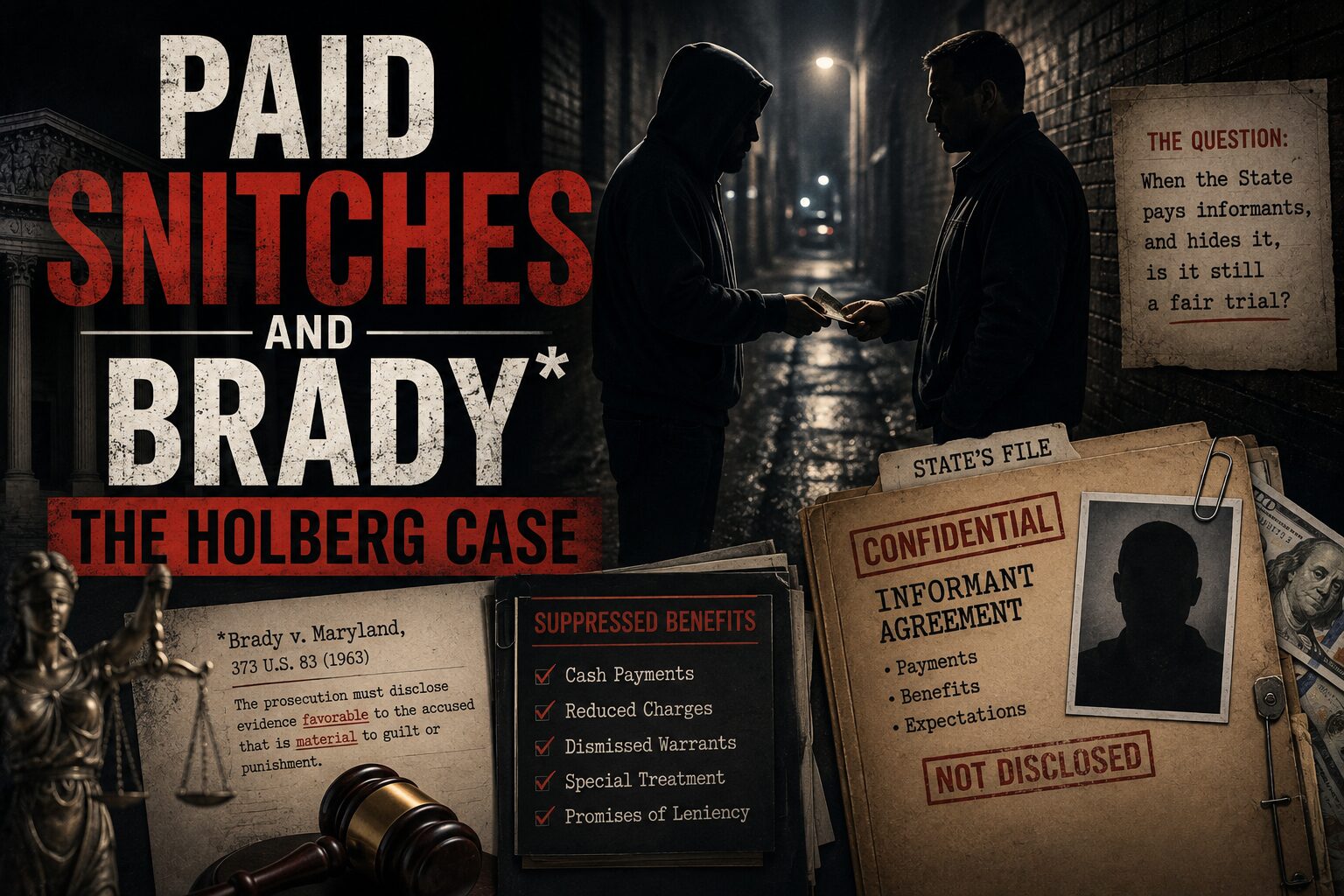
This month, the full U.S. Court of Appeals for the Fifth Circuit did something unusual: it reversed itself. A year earlier, a three-judge panel had thrown out the 1998 Amarillo capital murder conviction and death sentence of Brittany Holberg and ordered a new trial. Sitting en banc, eighteen judges reinstated that conviction and sentence in a badly fractured decision that produced six separate opinions. The question that divided them was not whether Holberg killed A.B. Towery, the 80-year-old man she was convicted of murdering after a trial in which she claimed self-defense. The question was about a secret the prosecution kept.
At trial, a jailhouse witness, Holberg’s cellmate, told the jury that Holberg had bragged about the killing. What the jurors were never told was that the cellmate was a paid police informant, and that several charges against her were dismissed one day after she gave her statement about Holberg. For a Texas audience, the Holberg case is a hard but useful lesson in three things that decide more cases than most people realize: the constitutional rule that requires the State to turn over evidence like this, the special danger of testimony bought from an informant, and the reason even a serious failure to disclose can go without a remedy in federal court.
The Brady Rule: The State Has to Show Its Hand
The foundational rule is more than sixty years old. In Brady v. Maryland, the Supreme Court held that due process requires prosecutors to turn over evidence favorable to the defense that is material to guilt or punishment. It does not matter whether the prosecutor withheld it in bad faith or by simple oversight; suppression of material favorable evidence violates the Constitution either way. The idea is basic to a fair trial: the side that holds the power of the state cannot hide the ball.
A decade later, in Giglio v. United States, the Court made clear that Brady covers not just evidence of innocence but evidence that undercuts a witness’s credibility, including any deal, payment, or benefit a witness received in exchange for testimony. A jury weighing whether to believe a witness is entitled to know if that witness was paid, or was working off her own charges, because those incentives bear directly on whether the testimony can be trusted. A paid informant whose pending charges vanish the day after she talks is the textbook Giglio situation.
The catch is a single word in the rule: material. Favorable evidence must be disclosed, but a conviction is overturned only if the withheld evidence was material, meaning there is a reasonable probability that, had the jury known, the outcome would have been different. How demandingly that word is read is where cases like Holberg are won and lost. The Fifth Circuit’s majority concluded that revealing the informant’s status would not have created a reasonable probability of a different verdict, and it added that Holberg’s own lawyers had known of the informant and chosen not to attack her credibility. The dissent saw it very differently, describing a secret that, in its words, crippled Holberg’s defense over and over again.
Why Bought Testimony Is So Dangerous
The reason the disclosure matters so much is that informant testimony is at once one of the least reliable kinds of evidence the system regularly uses and one of the most persuasive to a jury. An incarcerated witness who is offered leniency, dropped charges, money, or privileges in exchange for testimony has a powerful incentive to say what prosecutors want to hear, and sometimes to invent it. The details can be fed, deliberately or not, and the arrangement is often made quietly, outside the jury’s view.
The data are sobering. As of 2016, false informant testimony was a factor in roughly fifteen percent of the DNA exonerations recorded to that point, and the Center on Wrongful Convictions found that false snitch testimony was the leading cause of wrongful convictions in American capital cases in the modern death-penalty era, a factor in nearly half of the death-row exonerations it studied. In a system where a person’s life can turn on a cellmate’s word, hiding that the cellmate was on the payroll is not a technicality.
How Texas Responded and Why It Came Too Late for Holberg
Texas knows this problem intimately, because it has produced some of the country’s most notorious wrongful convictions and, in response, some of its strongest reforms. Two matter here. The Michael Morton Act, named for a man who spent nearly twenty-five years in prison because a prosecutor hid evidence, broadened the State’s duty to disclose favorable and impeachment evidence and is codified in Article 39.14 of the Code of Criminal Procedure. And in 2017, House Bill 34 went further on informants specifically: Texas now requires prosecutors to disclose a jailhouse informant’s complete criminal history, including charges dismissed or reduced as part of any deal, along with any benefit offered for the testimony and the other cases in which that informant has testified. Texas law also now forbids convicting a person on jailhouse-informant testimony unless it is corroborated by other evidence.
Read that list against the Holberg facts and the point is unavoidable. The very things Texas now requires be disclosed, that a witness is an informant, that her charges were dropped after she cooperated, are precisely what was hidden at Holberg’s 1998 trial. The reforms exist because of cases like hers. But they were not the law when she was tried, and, as the next section explains, even a clear disclosure failure does not guarantee relief once a case reaches federal court.
The Wall in Federal Court: AEDPA Deference
Most people assume that if a serious constitutional error happened at trial, a federal court will eventually fix it. That assumption runs into a 1996 statute, the Antiterrorism and Effective Death Penalty Act, known as AEDPA. When a state prisoner brings a constitutional claim in federal habeas that the state courts already rejected on the merits, AEDPA bars the federal court from granting relief unless the state court’s decision was contrary to, or an unreasonable application of, clearly established Supreme Court law, or rested on an unreasonable finding of fact. The Supreme Court calls this standard doubly deferential.
The practical effect is stark. It is not enough for a federal court to believe the state court got the Brady question wrong. The petitioner must show the state court’s ruling was unreasonable, not merely mistaken. And here the irony bites. When a question is genuinely close, when reasonable judges can disagree about whether withheld evidence was material, that closeness itself can become a reason to deny relief, because a ruling other fair-minded jurists could accept is, by definition, not unreasonable. A decision in which eighteen federal judges fracture into six opinions is, on its face, evidence of exactly that kind of disagreement. That is much of why a disclosure failure that might have won a new trial on direct appeal can lose on federal habeas years later. The question on habeas is not really whether the trial was fair; it is whether the state court that said it was fair was so wrong that no reasonable judge could agree.
What This Means for a Texas Defendant
The Holberg decision is not the final word, and she can still ask the Supreme Court to hear the case. But the lessons for anyone facing a Texas prosecution do not depend on how her case ends.
- Brady and Giglio material. The State must disclose favorable and credibility-damaging evidence, including deals, payments, and benefits given to its witnesses. Demand it specifically and in writing.
- Treat every incentivized witness as a project. If the State relies on an informant or a cooperating witness, their full criminal history, every charge dismissed or reduced, every benefit, and every other case in which they have testified are all discoverable under Texas law and all fair game for impeachment.
- Insist on corroboration. Texas does not allow a conviction to rest on jailhouse-informant testimony alone. Make the State show what independently supports it.
- Raise disclosure failures early and completely. Because of AEDPA, the strength of a Brady claim in state court can determine whether it is even reviewable later in federal court. These issues have to be built and preserved from the start, not saved for appeal.
None of this is abstract. The difference between a hidden deal and a disclosed one can be the difference between a conviction and an acquittal, and, as Holberg shows, between raising a claim while a court can still act on it and raising it after the law has closed the door.
The Bottom Line
A trial is supposed to be a search for the truth conducted with the cards face up. The Brady rule, and its Giglio corollary for bought testimony, exist to keep the State from hiding the cards that matter, and the documented unreliability of informant evidence is exactly why those rules are not optional. Texas has learned this the hard way and written real reforms into its law. Yet the Holberg case is a reminder that a constitutional right is only as strong as the remedy that enforces it, and that in federal habeas the door can close on even a serious wrong. A six-opinion split from one of the most conservative courts in the country is a signal worth reading: on the question of what the State must reveal, and what happens when it does not, the law is far from settled. For any defendant, the response is the one that runs through everything we write. Demand what you are owed, test what the State offers, and build the record early, because you cannot challenge a secret you never learn, and you cannot raise a claim the law will later refuse to hear.
Deandra Grant is the managing partner of Deandra Grant Law, a Texas DWI and criminal defense firm with offices across Dallas-Fort Worth and Central Texas. She and her team defend serious criminal cases and handle post-conviction matters throughout the state.
Further Reading
- Ayden Runnels, “Fifth Circuit reaffirms death row inmate Brittany Holberg’s conviction,” The Texas Tribune (August 14, 2026). texastribune.org
- Innocence Project, “Texas Governor Signs Landmark Comprehensive Legislation to Prevent Wrongful Convictions,” on House Bill 34 and the regulation of jailhouse informants. innocenceproject.org
- Innocence Project, “Informing Injustice: The Disturbing Use of Jailhouse Informants.” innocenceproject.org
- Brady v. Maryland, 373 U.S. 83 (1963); Giglio v. United States, 405 U.S. 150 (1972); and, on federal habeas deference, 28 U.S.C. Section 2254(d) and Harrington v. Richter, 562 U.S. 86 (2011).
- Tex. Code Crim. Proc. Art. 39.14 (Michael Morton Act) and Art. 39.14(h-1) (jailhouse-informant disclosures); Art. 38.075 (corroboration of jailhouse-informant testimony).
This post is an informational synthesis for educational purposes and is not legal advice. It describes an ongoing case and the reporting available as of publication; the underlying conviction stands, and further review is possible. Case citations should be independently verified against the official record before use in any filing.
Which county your case is filed in changes how it is charged, who prosecutes it, and which court hears it.
Deandra M. Grant, JD, GC, MS, ACS-CHAL Forensic Lawyer-Scientist
She holds a Master of Science in Pharmaceutical Science and a Graduate Certificate in Forensic Toxicology, both from the University of Florida. She is the author of The Texas DWI Manual and has defended Texas DWI cases since 1994.
Charged With a Crime?
Whatever you're facing, a DWI or any criminal charge, the sooner you have a forensic-trained team on it the more we can do. Tell us what happened and we'll review your options, at no cost and no obligation. Intake answers 24/7, and if your case is one we can take on, we schedule a free consultation with an attorney.
Request a Free Case Evaluation
Tell us what happened. We'll respond as soon as possible.