
When the State’s Expert Has a Past: The A.J. Armstrong Case

On September 17, 2026, the Texas Court of Criminal Appeals refused to block a hearing on A.J. Armstrong’s motion for new trial, so the 178th District Court in Harris County must now decide whether prosecutors violated Brady by not disclosing a Texas Forensic Science Commission complaint, later dismissed as unfounded, that accused the State’s blood-spatter expert of planting evidence in another case. The ruling does not grant a new trial; Armstrong’s 2023 capital murder conviction stands. Under the Michael Morton Act, Article 39.14(h), the State must disclose impeachment information without regard to materiality, a broader duty than Brady that this hearing will not reach because the claim was framed as Brady alone. The State’s strongest points are that the complaint was likely inadmissible and was publicly available, but Banks v. Dretke rejected “prosecutor may hide, defendant must seek,” and the real question is what the prosecution team, including the expert herself, knew and when. For Texas defense lawyers: plead Brady and Article 39.14(h) separately, ask specifically about every forensic witness’s complaint history, demand the evidence-room record for any item reexamined years later, and file a specific affidavit within the motion-for-new-trial deadlines.
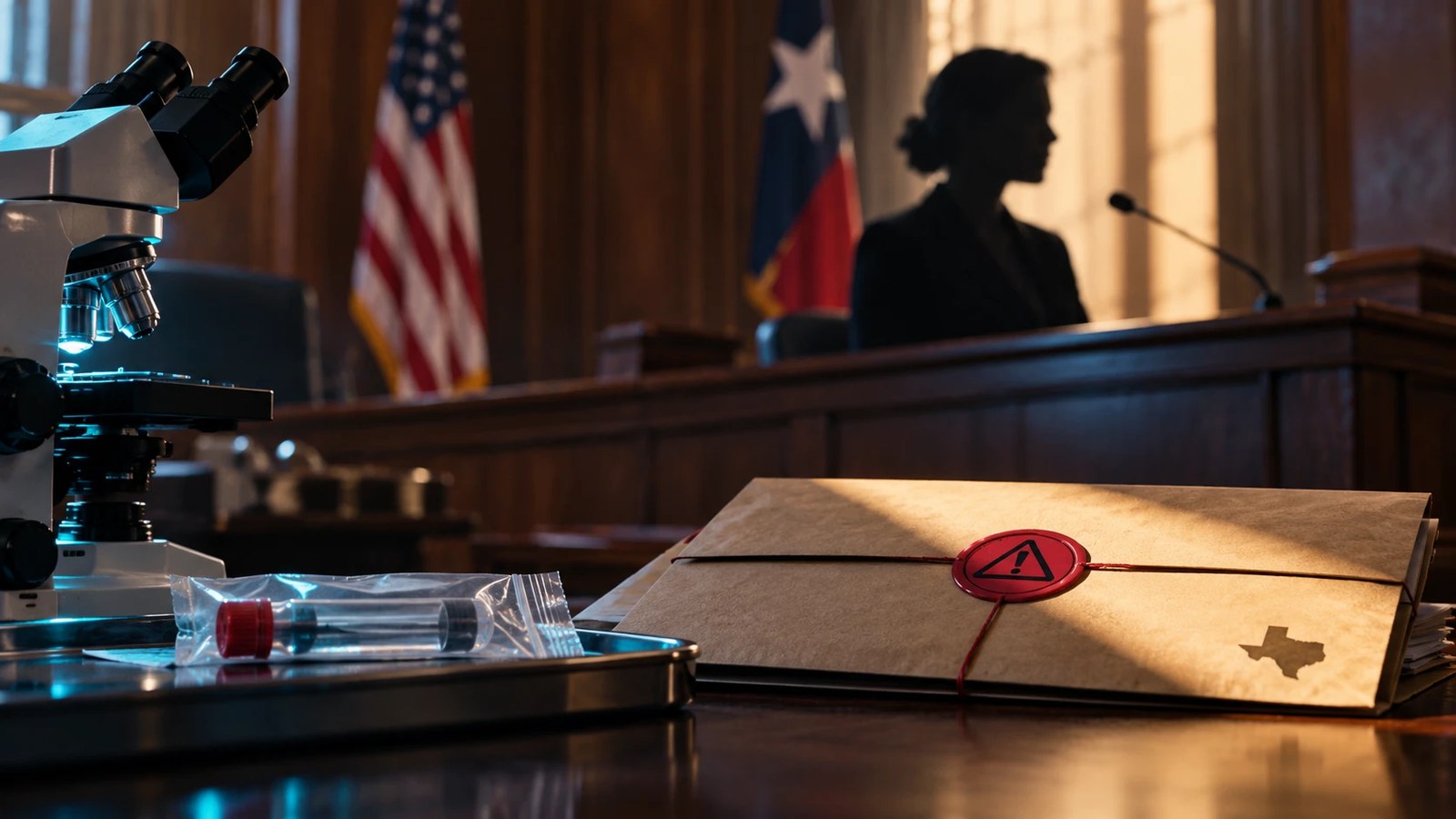
On September 17, 2026, the Texas Court of Criminal Appeals refused the Harris County District Attorney’s Office’s request to block a hearing in the A.J. Armstrong case. The hearing is on Armstrong’s motion for new trial, and the issue is narrow but important: the defense says prosecutors never told it that a complaint had been filed with the Texas Forensic Science Commission accusing one of the State’s key forensic witnesses of planting evidence in an unrelated case. (KPRC; FOX 26)
The complaint was dismissed as unfounded. The witness has never been found to have done anything wrong. And that is exactly what makes this case worth watching, because it forces a question every Texas defense lawyer should be asking about every State expert: what do we get to know about the people who testify against our clients, and who decides whether it matters?
To be clear about where things stand: the ruling does not grant Armstrong a new trial. His capital murder conviction stands. What he has won is the right to a hearing where a judge will decide whether the nondisclosure requires one.
The Case in Brief
On July 29, 2016, Dawn and Antonio Armstrong Sr. were shot to death in their Bellaire home. Their son, A.J., then 16, called 911. His first two trials, in 2019 and 2022, ended with juries unable to reach a verdict. The third, in 2023, ended in a capital murder conviction and a life sentence with parole eligibility after 40 years. (FOX 26)
What changed between the second hung jury and the conviction? A lot of things, as always happens across three trials. But the most dramatic new evidence in the third trial came out of an evidence box.
Two Specks Under a Police Sticker
In 2016, Armstrong’s gray T-shirt, pants and sandals were tested, and no blood was detected on any of them, according to trial testimony from a Houston Forensic Science Center DNA analyst. Officers also testified they saw no blood on him the morning of the killings. (ABC13)
Then, in June 2023, weeks before the third trial, prosecution blood-spatter expert Celestina Rossi went to the Houston Police Department evidence room to examine pillows from the case. While there, she noticed a stain at the edge of a police identification sticker that had been placed on the shirt when it was collected, and the sticker appeared to be peeling. Under it were two small stains. DNA testing tied them to Antonio Armstrong Sr. (KPRC; ABC13)
At trial, Rossi offered a theory for how the blood got there: a mist of exhaled blood from Antonio Sr. that could have settled on his son and been preserved under the sticker. On cross-examination she acknowledged she could not exclude cross-contamination. The defense argued that dried blood flakes had been found throughout the seven-year-old evidence boxes and demonstrated, with red pepper flakes, how particles can detach and migrate during storage. (ABC13; ABC13)
The jury convicted. What the defense did not know when it made those choices is the subject of the current fight.
The Complaint Nobody Mentioned
The complaint was filed with the Texas Forensic Science Commission by Robert Collins, Ph.D., who has no connection to the Armstrong case, and it accused Rossi of planting blood and DNA evidence in a murder case out of a different county. (Fourteenth Court of Appeals amended abatement order) The Commission dismissed it as unfounded. The defense says prosecutors never disclosed it before the 2023 trial. Armstrong’s appellate lawyer, Patrick McCann, put it this way: “That goes to the heart of her integrity. Even if it wasn’t proven, we should have known about it.” (KPRC)
The State’s answers have been consistent. The complaint had nothing to do with Armstrong’s case. An unproven accusation cannot be used to attack a witness’s credibility under Texas law. And the complaint and related materials had been publicly available since 2019, so nothing was suppressed. The defense responds that the complaint “was not available via easy search” and that “the only way anyone could have found it was to know the complaint number assigned to it beforehand.” (KPRC)
How It Got to the Court of Criminal Appeals
Armstrong’s motion for new trial raised six issues. The trial court never ruled on it; it was overruled by operation of law, without a hearing. On November 6, 2025, a three-justice panel of the Fourteenth Court of Appeals held that the trial court abused its discretion by not holding one and abated the appeal.
The State then asked the court to clarify whether the hearing covered all six issues or only the one about Rossi. On November 18, 2025, the court withdrew its first order and issued an amended one limiting the hearing to a single question: “appellant’s alleged Brady violation based on the complaint filed against Officer Rossi.” It ordered the hearing held by January 20, 2026. Armstrong v. State, No. 14-23-00607-CR (Tex. App.—Houston [14th Dist.] Nov. 18, 2025) (per curiam) (amended abatement order) (not designated for publication).
The amended order is more candid than the news coverage about how open the question is. The court wrote that on this record it could not determine whether “(1) a complaint with the Texas Forensic Science Commission such as the one here should be imputed to the State; and (2) if such a complaint can be imputed to the State, whether a Brady violation has occurred based on the vagueness and ambiguity in defense counsel’s affidavit.” It noted that trial counsel’s affidavit said only that he “may” have used a different strategy on admissibility, without saying whether that meant Rossi’s testimony, the blood evidence or both, and did not say when the defense learned of the complaint. It ordered the hearing anyway, because the motion still showed reasonable grounds that Armstrong “could potentially be entitled to relief.”
That is the standard the Court of Criminal Appeals set in Hobbs v. State, 298 S.W.3d 193, 199 (Tex. Crim. App. 2009): a hearing on a motion for new trial is not an absolute right, but a trial judge abuses his discretion by refusing one when the motion and affidavits raise matters not determinable from the record and establish reasonable grounds showing the defendant could potentially be entitled to relief. An undisclosed complaint, who on the State’s side knew about it, and what trial counsel would have done differently had they known, are textbook examples of things that cannot be decided from the trial transcript.
The District Attorney’s Office then went to the Court of Criminal Appeals and asked for a writ of mandamus ordering the Fourteenth Court of Appeals to withdraw its abatement order, and the hearing was put on hold while the court considered it. McCann accused the State of trying to “hide behind this Court rather than simply have a public hearing.” (KPRC)
Notice what the State was fighting about. It was not the complaint. It was the appellate court’s power to send the case back at all. Under Texas Rule of Appellate Procedure 44.4, a court of appeals can abate an appeal and remand only to correct an error the trial court was empowered to correct. On September 17, in a short unsigned order, the Court of Criminal Appeals rejected the State’s position: “Because a reasonable court of appeals could conclude that the supporting affidavit gave rise to reasonable grounds for a hearing on the motion for new trial,” the trial court’s failure to hold that hearing “was an erroneous failure to act that the trial court remained empowered to correct,” and abatement and remand were authorized. The State therefore “has not established a clear and indisputable right to relief.” The court denied leave to file, denied mandamus and lifted its stay. In re State ex rel. Teare, No. WR-97,207-01 (Tex. Crim. App. Sept. 17, 2026) (per curiam) (not designated for publication).
The Court of Criminal Appeals did not say the Fourteenth Court of Appeals got it right. Mandamus requires a clear and indisputable right to relief, and the court held only that a reasonable court of appeals could have ruled the way this one did. The order is also designated not for publication, so it is not precedent. Nobody has yet decided whether the undisclosed complaint entitles Armstrong to anything. That question now goes back to the 178th District Court in Harris County, where the hearing will finally happen.
Hot Take 1: Texas Discovery Is Broader Than Brady. This Hearing Isn’t.
Everything about this case, including the amended order that defines the hearing, has been framed around Brady v. Maryland, the constitutional rule that the prosecution must disclose favorable evidence that is material to guilt or punishment. (We walk through Brady and its companion rule for impeachment evidence, Giglio, in our Holberg post.) Under Brady, the State’s arguments have real force. The Fourteenth Court spelled out the test: the evidence must have been suppressed, favorable and material, and material means “a reasonable probability that, had it been disclosed, the outcome of the trial would have been different.” An accusation the Commission rejected is not obviously the kind of thing that changes a verdict.
But Texas stopped relying on Brady alone in 2014. The Michael Morton Act added Article 39.14(h) to the Code of Criminal Procedure, which requires the State to disclose “any exculpatory, impeachment, or mitigating document, item, or information in the possession, custody, or control of the state that tends to negate the guilt of the defendant or would tend to reduce the punishment.” (Tex. Code Crim. Proc. art. 39.14) The Court of Criminal Appeals has read that language exactly as written. In Watkins v. State, 619 S.W.3d 265, 277 (Tex. Crim. App. 2021), it held that the Legislature “did not limit the applicability of Article 39.14(h) to ‘material’ evidence, so this duty to disclose is much broader than the prosecutor’s duty to disclose as a matter of due process under Brady.”
Note the word “impeachment.” The statute does not say admissible impeachment. It says impeachment information. Whether a dismissed complaint could have been put in front of the jury is one question. Whether it is information that tends to impeach the State’s expert is a different and much easier one. (Our post on the Michael Morton Act and State v. Heath covers how the Act came to be and how courts have enforced it.)
Article 39.14(k) adds the part people forget: if the State discovers such information “at any time before, during, or after trial,” it must promptly disclose it. The duty does not end at the verdict.
Here is why that matters for Armstrong specifically. The hearing the Court of Criminal Appeals just cleared is, by the amended order’s own words, about an “alleged Brady violation.” That means the judge will ask Brady‘s questions, materiality included, not the broader statutory ones. The lesson for every Texas defense lawyer is to plead the two separately. Brady and Article 39.14(h) are different claims with different standards, and a disclosure argument framed only as Brady gives up the one that does not require materiality.
Hot Take 2: The State’s Best Argument Is About Admissibility, Not Disclosure
The prosecution is probably right that the complaint itself would never have come in front of the jury. Texas Rule of Evidence 608(b) generally bars using specific instances of a witness’s conduct to attack her character for truthfulness, and an accusation the Commission found unfounded is even weaker than conduct. A defense lawyer who stood up at trial and asked Rossi about it would likely have drawn a sustained objection.
But that is an answer to a question nobody asked. Disclosure rules exist so the defense can decide how to try the case, not only so it can collect exhibits. Knowing that the State’s expert had been accused of planting evidence could shape which experts the defense hires, how hard it attacks the handling of the shirt, whether it asks for a hearing on the reliability of her opinions before she ever reaches the jury, and what it investigates about the evidence room. Armstrong’s trial lawyer, Rick DeToto, has said publicly that the complaint “would have affected a very important decision in the case.” (KPRC) The affidavit in the record is less definite. The appellate court noted it said only that counsel “may” have used a different strategy on admissibility. One more fact from the State’s own filing fits here: the State says trial counsel withdrew an objection that Rossi was testifying outside her area of expertise. Whether knowing about the complaint would have kept that objection alive is exactly the kind of thing the hearing will have to answer.
Even under the broader Texas statute, a violation is not automatically a new trial. In reviewing an Article 39.14(h) violation raised by a mistrial motion, the Court of Criminal Appeals held in 2025 that the ordinary harmless error standard for non-constitutional error applies (Hallman v. State, No. PD-0332-22 (Tex. Crim. App. July 2, 2025)). The defense still has to show the nondisclosure mattered. The difference is that under Article 39.14(h), the fight is over harm, not over whether the State ever had a duty to hand it over.
Hot Take 3: “It Was Public” Is Not the Same as “You Were Told”
The State’s argument that the complaint sat on a public website since 2019 has intuitive appeal. Defense lawyers should do their own homework, and Texas Forensic Science Commission complaints are public records.
But the United States Supreme Court rejected the broader version of that argument more than twenty years ago. In Banks v. Dretke, 540 U.S. 668, 696 (2004), a Texas case, the Court wrote that a rule “declaring ‘prosecutor may hide, defendant must seek,’ is not tenable in a system constitutionally bound to accord defendants due process.” The statute points the same way: Article 39.14(h) puts the duty on the State to disclose, not on the defense to find.
There is also a practical problem with “it was public.” Being findable is not the same as being found. If the defense is right that the only way to locate this complaint was to already know its number, then “public” meant public to someone who already knew what to look for. The hearing should answer a narrower question that matters more: what did the prosecution team know about its own witness, and when?
That is the imputation question the Fourteenth Court said it could not resolve, and it is the real battleground. Brady reaches what the prosecution knows and what is known to others acting on the State’s behalf in the case, but not everything every state agency has in a file. The Forensic Science Commission is a state body, but it is not part of the prosecution team. The harder question, and one the coverage has not asked, is about Rossi herself. She was working this case for the State. If she knew a complaint had been filed against her, is her knowledge the State’s knowledge? The record will have to say whether she knew, and when.
Hot Take 4: Old Evidence Deserves New Scrutiny
Set the complaint aside and the blood evidence still raises the issue that should worry every defense lawyer who has a case with evidence sitting in a property room. Texas law is not demanding about chain of custody. Absent evidence of tampering or other fraud, problems in the chain of custody go to the weight the jury gives the evidence, not its admissibility. Druery v. State, 225 S.W.3d 491, 503-04 (Tex. Crim. App. 2007). The Court of Criminal Appeals has applied that rule to evidence that sat in storage for more than two years and had already been tested once. Lagrone v. State, 942 S.W.2d 602 (Tex. Crim. App. 1997).
That rule makes sense for a bag of cocaine. It makes much less sense for trace biological evidence, where the question is not whether the item is the same item but whether something was added to it. A shirt that tested negative for blood in 2016, stored for seven years alongside blood-soaked bedding from the same scene, and then found to carry two specks under a sticker that was already peeling, raises a contamination question the chain of custody paperwork cannot answer. The State’s own expert conceded she could not exclude cross-contamination. Armstrong has also filed a civil suit against the City of Houston alleging the blood was planted; that is an allegation, and the city has said it will respond in court. (ABC13)
For the broader reliability problems with bloodstain pattern opinions, including the Joe Bryan case and the 2021 National Institute of Justice error-rate study, see our post on how reliable blood spatter analysis is.
What This Means for a Texas Case
Ask About the Witness, Not Just the Evidence
Discovery requests tend to focus on the evidence: reports, bench notes, photographs. The Armstrong case is a reminder to ask about the people too. For every forensic witness the State plans to call, the Michael Morton Act request should specifically cover:
- Complaints filed with the Texas Forensic Science Commission, and the Commission’s disposition of each, whether or not the complaint was sustained.
- Internal disciplinary files, corrective action reports and quality incident reports involving the analyst.
- Proficiency test failures and any testimony later found inaccurate or overstated.
- Any findings, in any court, that limited or excluded the witness’s testimony.
Then search the Commission’s records yourself anyway. A specific written request does two things: it tells the State exactly what it must look for, and it makes “you could have found it” much harder to argue later.
Demand the Evidence Room Record
For any item that was reexamined long after collection, ask for the property room logs showing every time the container was opened, by whom and why; photographs of the item at collection and at each later examination; the packaging and storage arrangement, including what else was stored with it; and the laboratory’s contamination and cleaning records for the examination. If nobody photographed the shirt the day it was collected, the jury deserves to hear that too.
Know the Motion for New Trial Clock
A motion for new trial must be filed within 30 days after sentence is imposed, and if the court does not rule within 75 days, it is overruled by operation of law (Tex. R. App. P. 21.4, 21.8). Claims that depend on facts outside the trial record need a sworn affidavit setting out those facts specifically, or there will be no hearing at all. Armstrong got a hearing, but the appellate court went out of its way to call the affidavit vague and ambiguous. Say exactly what counsel would have done differently and when the defense first learned of the undisclosed information. A vague affidavit may get you a hearing; it makes the hearing much harder to win. And the Armstrong order illustrates the payoff: when a trial court refuses a hearing on a properly supported motion, that refusal can be treated as an error the court of appeals sends back to be fixed, rather than a door that closed when the 75 days ran.
The Bottom Line
Nobody has found that Celestina Rossi planted anything, in this case or any other. The complaint against her was dismissed. But the Michael Morton Act was written precisely so that the defense, not the prosecution, gets to decide what a piece of impeachment information is worth. The State’s position in Armstrong comes down to three answers: the complaint was never ours, it was public anyway, and it would not have mattered. The first two are fair questions for the hearing. The third, under the Michael Morton Act, is not supposed to be a call the State makes for the defense.
We will update this post after the hearing in the 178th District Court.
If you are facing charges in Texas and the State’s case depends on forensic testimony, the questions about the expert matter as much as the questions about the evidence. Deandra Grant Law defends clients across Dallas, Fort Worth, Allen, Denton, Waco and Rockwall. Call 214-225-7117 for a confidential consultation.
This post discusses a pending post-conviction proceeding based on public reporting. It is for informational purposes only and is not legal advice. Verify all citations before using them in any filing.
Sources
- In re State ex rel. Teare, No. WR-97,207-01 (Tex. Crim. App. Sept. 17, 2026) (per curiam) (not designated for publication)
- Armstrong v. State, No. 14-23-00607-CR (Tex. App.—Houston [14th Dist.] Nov. 18, 2025) (per curiam) (amended abatement order) (not designated for publication)
- FOX 26 Houston, “A.J. Armstrong case: Texas Court of Criminal Appeals rules regarding move for possible 4th trial” (Sept. 17, 2026)
- KPRC, “Texas court clears way for hearing in A.J. Armstrong murder case” (Sept. 17, 2026)
- KPRC, “Dispute over forensic evidence drives latest A.J. Armstrong appeal” (Feb. 2026)
- KPRC, “Court orders new hearing in AJ Armstrong appeal after questions about blood expert” (Nov. 6, 2025)
- ABC13, “Appeals court rules hearing be held on Armstrong’s motion for new trial” (Nov. 2025)
- KPRC, “Blood spatter expert walks jury through how she found new DNA evidence after 7 years” (Aug. 8, 2023)
- ABC13, “DNA expert testifies on Antonio Armstrong Sr.’s blood found on son 7 years after the murders” (Aug. 2023)
- ABC13, “Blood evidence found on HPD visitor’s badge is from Antonio Sr., prosecutors say” (Aug. 2023)
- ABC13, “Double murder suspect claims city of Houston planted blood evidence, lawsuit says” (Aug. 2023)
- Tex. Code Crim. Proc. art. 39.14
- Watkins v. State, 619 S.W.3d 265 (Tex. Crim. App. 2021); Hallman v. State, No. PD-0332-22 (Tex. Crim. App. July 2, 2025); Hobbs v. State, 298 S.W.3d 193 (Tex. Crim. App. 2009); Druery v. State, 225 S.W.3d 491 (Tex. Crim. App. 2007); Lagrone v. State, 942 S.W.2d 602 (Tex. Crim. App. 1997); Banks v. Dretke, 540 U.S. 668 (2004); Tex. R. Evid. 608(b); Tex. R. App. P. 21.4, 21.8.
Which county your case is filed in changes how it is charged, who prosecutes it, and which court hears it.
Deandra M. Grant, JD, GC, MS, ACS-CHAL Forensic Lawyer-Scientist
She holds a Master of Science in Pharmaceutical Science and a Graduate Certificate in Forensic Toxicology, both from the University of Florida. She is the author of The Texas DWI Manual and has defended Texas DWI cases since 1994.
Does the State's Case Rest on a Forensic Witness?
The questions about the expert matter as much as the questions about the evidence, and the time to ask them is before trial. Intake answers 24/7, and if we can take your case, the consultation with an attorney is free.
Request a Free Case Evaluation
Tell us what happened. We'll respond as soon as possible.