
Hemani: SCOTUS Rules Against Stripping Marijuana Users of Their Gun Rights

The Supreme Court ruled marijuana use alone can't strip your Second Amendment gun rights.
| Decision update — June 18, 2026
The Supreme Court issued their ruling in United States v. Hemani, No. 24–1234, and affirmed the Fifth Circuit. The Court held that prosecuting Ali Hemani under 18 U.S.C. §922(g)(3)’s “unlawful user” provision based solely on his regular marijuana use, with no claim that he was intoxicated, addicted, or dangerous violates the Second Amendment. All nine Justices agreed on the result. This post has been rewritten to reflect what the Court actually decided, what it pointedly did not decide, and what it means if you have a federal gun charge in Texas right now. |
NOTE: We previously covered this case as it made its way through the courts in a blog you can find here.
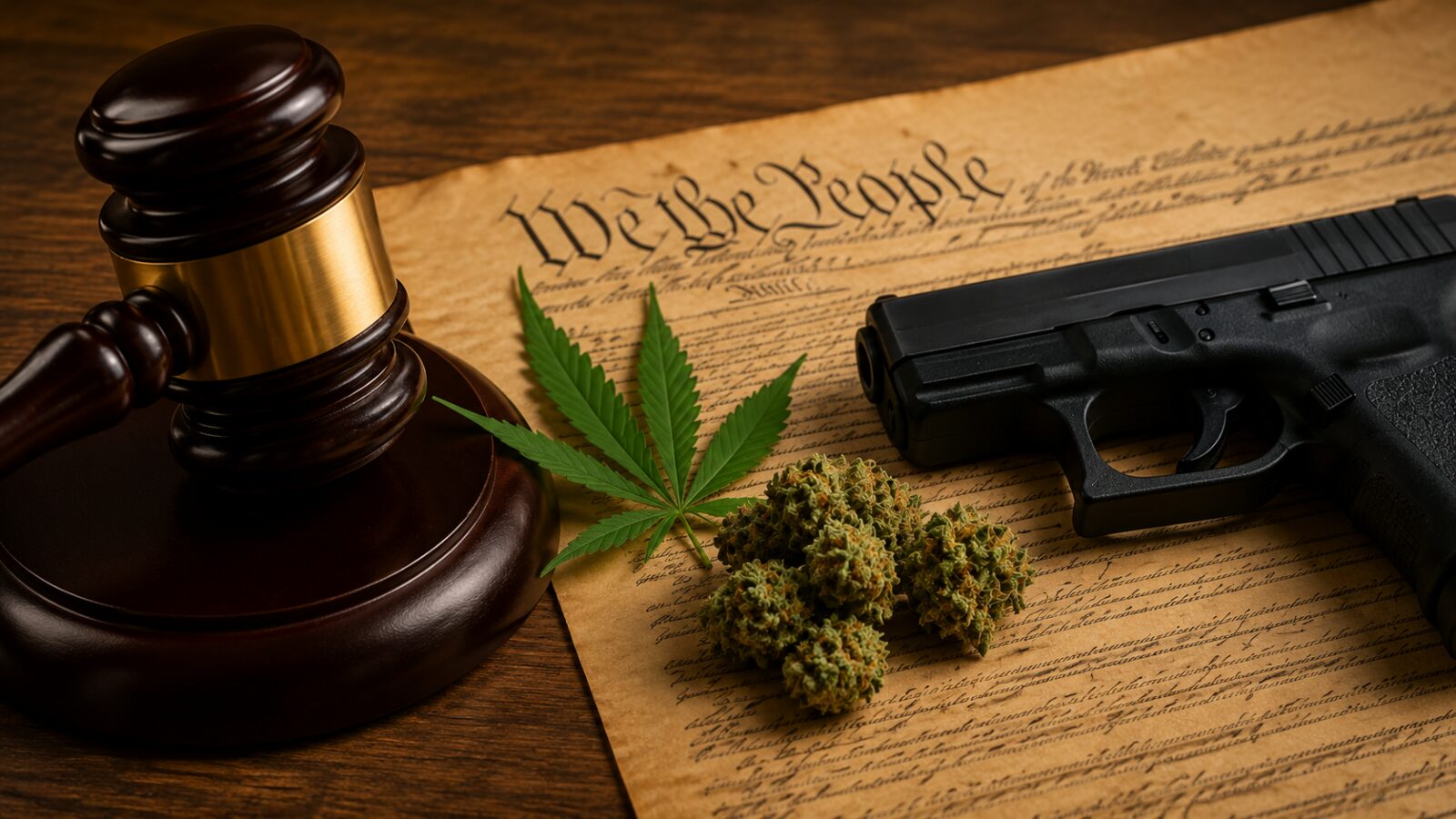
The case started in Texas. In 2022, FBI agents (investigating suspected terrorism ties that never produced a terrorism charge) searched the Hemani family home in the Eastern District of Texas. They found a Glock 19, roughly 60 grams of marijuana, and a small amount of cocaine. Ali Danial Hemani, a Dallas-area dual citizen who was born in Texas and held a steady job, cooperated: he surrendered the gun, pointed agents to the marijuana, and told them he used marijuana about every other day. More than six months later, relying solely on that admission, the government charged him with a single federal felony of possessing a firearm while being an unlawful user of a controlled substance under §922(g)(3), an offense carrying up to 15 years in prison and a lifetime firearms ban.
U.S. District Judge Amos Mazzant in Sherman dismissed the indictment. The Fifth Circuit affirmed. The government took it to the Supreme Court. And today, the Supreme Court affirmed, too, holding that the government cannot strip a regular marijuana user of his Second Amendment rights on those facts alone.
What the Supreme Court Held
Justice Gorsuch wrote for the Court. His opinion was joined by Chief Justice Roberts and Justices Thomas, Sotomayor, Kavanaugh, Barrett, and Jackson which is a striking cross-ideological lineup of seven. Justice Thomas and Justice Jackson each wrote separately while joining in full; Justice Alito, joined by Justice Kagan, agreed only with the result. The bottom line: the judgment was unanimous, 9–0, in Hemani’s favor.
The holding is deliberately narrow. The Court did not strike §922(g)(3) from the books. It held only that, as applied to Ali Hemani, the prosecution could not stand, because the government failed to carry the burden it conceded it had: showing that disarming a regular drug user with no proof of intoxication, incapacitation, or dangerousness fits “the Nation’s historical tradition of firearm regulation.”
How the Court Got There: The “Habitual Drunkard” Analogy Falls Apart
Under the framework from New York State Rifle & Pistol Association v. Bruen (2022) and United States v. Rahimi (2024), once a law burdens conduct the Second Amendment presumptively protects, the government must justify it by pointing to a “relevantly similar” historical tradition. The government conceded the first step, so it carried the burden on the second. Its sole historical analogy was to founding-era laws targeting “habitual drunkards,” which fell into three buckets: vagrancy laws, civil-commitment statutes, and surety (good-behavior bond) laws. The Court found the analogy failed on every metric the government asked it to consider: the “why” and the “how.”
The “why,” part one: different people
A “habitual drunkard” at the founding was not a regular drinker. It was someone so impaired they were “incapable of conducting [their] own affairs,” “mentally incompetent,” or had “lost the power of self-control.” In an era the Court described as a “culture of copious drinking” (the opinion notes John Adams’ cider breakfasts and Washington’s evening madeira), merely using an intoxicant regularly did not qualify. Section 922(g)(3), by contrast, sweeps in anyone who regularly uses any amount of any controlled substance with no showing they are incapacitated or cannot manage their lives.
The “why,” part two: different purpose
The government said the statute exists to protect the public from “unusually dangerous” and violent people. But the historical laws had different aims: vagrancy laws promoted work and suppressed idleness; civil-commitment laws protected drunkards from themselves and their families from financial ruin; and the “good behavior” surety laws guarded the community against moral “scandals,” not violence. The Court pointedly noted that the government did not rely on surety-of-the-peace laws (the violence-prevention tradition the Court credited in Rahimi) because being a habitual drunkard alone did not trigger them.
The “how”: different operation
Each historical law provided process before disarmament: a vagrant could be confined only on conviction; a habitual drunkard got a guardian or commitment only after probate-style proceedings; a surety bond required a hearing before a justice of the peace. Section 922(g)(3) does the opposite. It disarms a person automatically, the moment they become an “unlawful user,” with no pre-deprivation process at all. (A later criminal trial for violating the ban, the Court said, is not process before the disarmament the government calls “temporary.”)
A fourth problem: does the statute even target dangerous people?
Finally, the Court doubted the government’s own premise. Section 922(g)(3) borrows its list of drugs from the Controlled Substances Act which is a public-health statute under which substances are scheduled for reasons that often have nothing to do with violence. And the government’s own conduct undercut its argument: the Justice Department has curtailed marijuana enforcement, most states have legalized marijuana to some degree, and the government recently moved some marijuana products from Schedule I to Schedule III. Quoting then-Judge Barrett’s dissent in Kanter v. Barr, the Court warned that giving the government “broad power to designate any group as dangerous” would let it “quickly swallow” the Second Amendment.
What §18 U.S.C. §922(g)(3) Actually Does
Section 922(g)(3) makes it a federal felony for any person “who is an unlawful user of or addicted to any controlled substance” to possess a firearm or ammunition. It does not require intoxication at the time of possession, or any connection at all between the drug use and the gun. It turns on status, not a moment. Before today, on the government’s reading, that swept in an enormous number of people:
- Marijuana users in Texas. Texas has not legalized recreational marijuana, so under federal law every Texas marijuana user is an “unlawful user.” If they own a gun, the government’s theory made them a federal felon regardless of amount or frequency.
- Marijuana users in legal states. Marijuana remains Schedule I federally even after the partial Schedule III reclassification, so state legalization does not change “unlawful user” status for the rest of the schedule. Users in legal states were swept in too.
- Prescription-drug users. The reach is not limited to street drugs. As the Court illustrated, the government’s reading would equally cover “a husband who regularly takes his wife’s prescription Ambien to sleep” or “a college student who routinely uses a friend’s Adderall to cram for exams.” The drug, the amount, and the effect made no difference which is exactly why the analogy to incapacitated “habitual drunkards” collapsed.
The Concurrences and Why Defense Lawyers Should Read Them
The separate writings matter as much as the holding for anyone litigating federal gun charges and one of them may end up mattering more than the majority opinion itself.
Justice Thomas: a roadmap to challenge §922(g) itself
Justice Thomas joined the majority in full but wrote separately to raise something the Court did not decide: in his view, all of §922(g) (not just the drug-user provision, but the entire statute, including the felon-in-possession ban) likely exceeds Congress’s power under the Commerce Clause. Section 922(g) reaches purely intrastate gun possession. The only thing tying it to interstate commerce is the requirement, drawn from Scarborough v. United States (1977), that the firearm at some point “traveled in interstate commerce.” In Hemani’s own case, the government alleged only that his gun had been shipped in interstate commerce at some time in the past even though he was charged with possessing it in his home in Texas. It never had to prove he bought it out of state or carried it across any line himself.
Thomas argued that this “minimal nexus” cannot bear the constitutional weight courts have placed on it. Mere possession of a gun that once crossed state lines, he wrote, is not “economic activity,” and under United States v. Lopez (1995) and United States v. Morrison (2000), Congress cannot reach noneconomic, local conduct on that theory. He pressed two points that matter for litigants: Scarborough was a statutory holding about what Congress intended, not a ruling that §922(g) is constitutional; and treating the so-called “jurisdictional hook” (the gun-crossed-state-lines element) as sufficient “could very well remove any limit on the commerce power.” He catalogued decades of federal judges who have voiced the same doubt and observed that no party has won a Commerce Clause challenge in the Supreme Court in 26 years.
For the defense bar, the significance is hard to overstate. A sitting Justice expressly invited “the Court, and lower courts, [to] revisit the constitutionality of §922(g)” which includes the entire prohibited-person framework, including §922(g)(1). No court is bound by a lone concurrence, and this argument will lose in the lower courts for now. But it is a printed roadmap. In any federal §922(g) case, counsel should consider preserving a Commerce Clause challenge (raising it in the district court and on appeal even where current circuit law forecloses it) so the client’s case is positioned as a potential vehicle if the Court takes up the invitation. An argument that is not preserved cannot benefit from a doctrinal shift later.
Justices Jackson and Alito
Two more writings round out the decision:
- Justice Jackson (joined by Sotomayor). Jackson joined in full but renewed her view that Bruen itself is unworkable and that courts should return to means-end scrutiny (weighing the burden on Second Amendment rights against the government’s interest) rather than combing through centuries-old statutes. Her concurrence also catalogs the lower-court chaos over §922(g)(1) as Exhibit A for why the historical test fails in practice.
- Justice Alito (joined by Kagan), concurring in the judgment. Alito agreed the government’s analogues were not “relevantly similar,” and would have affirmed on that narrow ground alone (the mismatch between incapacitating habitual drunkenness and Hemani’s mere regular use) without the majority’s broader discussion of the statute’s purpose. He stressed that nothing in the decision casts doubt on §§922(g)(1) and (4). The result is the same; the reasoning is deliberately smaller.
What the Decision Does NOT Do
This is where careful counsel earns their keep, because the carve-outs are as important as the holding. The Court expressly left all of the following open:
- It did not address disarming addicts. The “addicted to” prong of §922(g)(3) was not before the Court, because the government never claimed Hemani was an addict.
- It did not address people who are presently intoxicated while possessing a firearm.
- It did not disturb §922(g)(1), the felon-in-possession ban, or the other prohibited-person categories that come with pre-deprivation process.
- It did not foreclose a §922(g)(3) prosecution supported by individualized proof that a defendant’s drug use makes him dangerous, or proof that a particular drug always renders users dangerous. The government simply disclaimed any such showing here.
- It did not bless future prophylactic laws Congress might pass after finding that users of a specific drug pose a special firearms risk.
In short: this is a decisive win on a specific fact pattern (the sober, regular marijuana user prosecuted on status alone) not a wholesale repeal of the drugs-and-guns ban. Anyone telling a client “the gun ban for drug users is gone” is overreading it.
What This Means Right Now
Pending federal indictments
If you or a family member has a pending federal case with a §922(g)(3) count built on status as a regular user (with no allegation of intoxication, addiction, or dangerousness) Hemani is directly on point and is now binding Supreme Court precedent. That count is vulnerable to a motion to dismiss, which can reshape the charge exposure, the guidelines calculation, and the entire plea posture. Counsel should be moving now. James Lee Bright of Deandra Grant Law handles federal criminal defense in all four Texas federal districts, the Fifth Circuit, and the Supreme Court.
Plea negotiations
The leverage that existed while the case was pending is now realized. A prosecutor whose §922(g)(3) count rests on bare user status is holding a count the Supreme Court just said is unconstitutional on those facts. That changes what a reasonable resolution looks like and defense counsel should say so plainly.
Post-conviction options
For people already convicted under §922(g)(3) and serving sentences or on supervised release, Hemani may open post-conviction relief under 28 U.S.C. §2255. Retroactivity of new constitutional rules is complex and fact-specific, and the decision will not automatically vacate any conviction but for the right case, the argument now exists where it did not before. These are worth evaluating individually and quickly, given filing deadlines.
The Texas-Specific Picture
This was a Texas case from start to finish. It began before Judge Amos Mazzant in the Eastern District of Texas (Sherman) and ran up through the Fifth Circuit, which covers all of Texas, Louisiana, and Mississippi. The Fifth Circuit had already been the epicenter of this fight. It held §922(g)(3) unconstitutional as applied in United States v. Daniels (2023, later returned for reconsideration after Rahimi) and again in United States v. Connelly (2024), which found “no historical justification for disarming a sober citizen not presently under an impairing influence.” Today’s ruling affirms and nationalizes that approach.
Texas carries one of the heaviest federal criminal dockets in the country. The Northern (Dallas/Fort Worth), Southern (Houston/Corpus Christi), Eastern (Sherman/Tyler), and Western (San Antonio/El Paso) Districts all prosecute firearms offenses routinely, and §922(g)(3) counts frequently ride along with drug charges when both a gun and drugs turn up at a scene. For Texas defendants, the interaction is acute: a state marijuana case with a firearm present often draws a parallel federal §922(g)(3) count, and Hemani directly affects whether that federal count survives.
The Broader Post-Bruen Landscape
Hemani is one piece of a larger post-Bruen reckoning. The biggest open question is §922(g)(1), the felon-in-possession ban, where lower courts are split over its application to nonviolent felons. Justice Jackson’s concurrence catalogs the inconsistency. The majority took pains to say nothing today casts doubt on §922(g)(1) or on the prohibited-person categories that involve pre-deprivation process. But two threads are worth watching: how courts apply Hemani’s “why and how” methodology to other prohibited-person categories, and whether Justice Thomas’s Commerce Clause invitation draws a future challenge to §922(g) as a whole. For now, Rahimi sustains the domestic-violence prohibition, and Hemani cuts back the drug-user prohibition on a specific, common fact pattern.
Sources
- United States v. Hemani, No. 24–1234, 608 U.S. ___ (2026) (decided June 18, 2026) — slip opinion
- SCOTUSblog case page: United States v. Hemani (24–1234)
- New York State Rifle & Pistol Association v. Bruen, 597 U.S. 1 (2022)
- United States v. Rahimi, 602 U.S. 680 (2024)
- United States v. Hemani, No. 24–40137 (5th Cir. Jan. 31, 2025)
- United States v. Connelly, 117 F.4th 269 (5th Cir. 2024)
- United States v. Daniels (5th Cir. 2023), vacated and remanded, 144 S. Ct. 2707 (2024)
- 18 U.S.C. §922(g)(3) — firearms prohibition for unlawful users of controlled substances
If you are facing a federal firearms charge under §922(g)(3) in Texas call (214) 225-7117 for a free, confidential case review. James Lee Bright handles federal criminal defense in all four Texas federal districts, the Fifth Circuit, and the United States Supreme Court.
Federal cases out of North Texas are prosecuted in the Northern District, and they move nothing like a state case.
Deandra M. Grant, JD, GC, MS, ACS-CHAL Forensic Lawyer-Scientist
She holds a Master of Science in Pharmaceutical Science and a Graduate Certificate in Forensic Toxicology, both from the University of Florida. She is the author of The Texas DWI Manual and has defended Texas DWI cases since 1994.
Under Federal Investigation or Charged?
In federal cases, the most important decisions often come before an indictment. The sooner you have a defense lawyer, the more can be done. Talk to us today.
Request a Free Case Evaluation
Tell us what happened. We'll respond as soon as possible.