
Afroman, Lemon Pound Cake, and the American Instinct to Root for the Little Guy

In August 2022, Adams County sheriff’s deputies in rural Ohio kicked down Afroman’s front door with guns drawn, tore through his house, cut his security camera wires, seized over $5,000 in cash, and left. They had a warrant for drug trafficking and kidnapping. They found nothing. No arrest. No charges. Just a broken door, a busted driveway gate, and a family that had been terrorized in their own home.
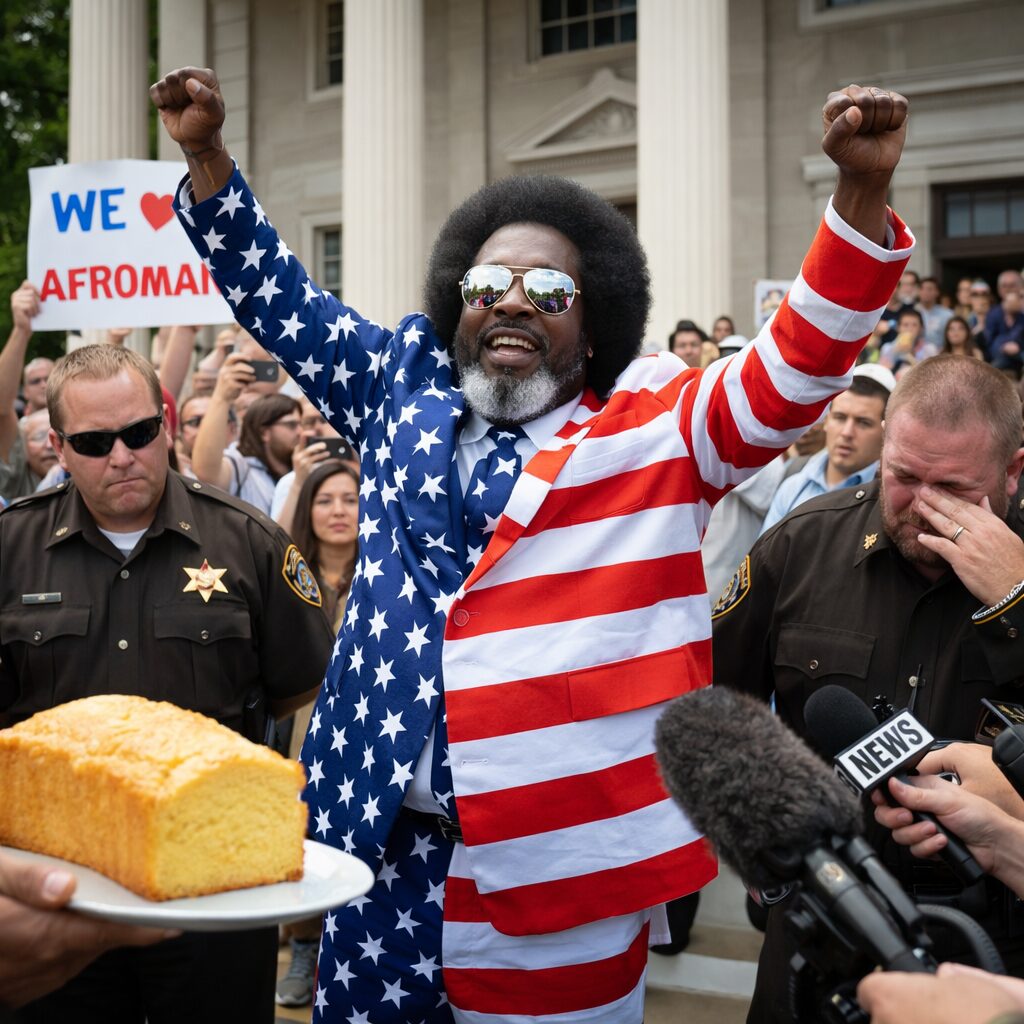
What they didn’t count on was the security cameras they didn’t disable and a man who makes music for a living.
Afroman, whose real name is Joseph Foreman, took the footage and did the most American thing imaginable: he turned it into art. He released music videos. He wrote songs. He named an entire album Lemon Pound Cake after the moment captured on camera when one of the armed deputies stopped mid-raid to eye a lemon pound cake sitting on the kitchen counter. The videos went viral. The deputies became famous in exactly the way they did not want to be famous. And then they did the one thing guaranteed to make it worse.
They sued him.
The Trial That Captivated the Internet
The three-day trial in Adams County this week was everything the deputies should have feared. Afroman took the stand in an American flag suit and matching aviators. His attorney, David Osborne, compared his lyrics to N.W.A’s “F**k tha Police” and Cardi B’s “WAP” (which he pronounced “Carly B” and “Megan Three Stallion” — a moment that immediately went viral on its own). A deputy broke down crying on the stand. Another testified that strangers had been sending him pound cakes at work. The whole thing played out on social media in real time, turning a rural Ohio courtroom into the most-watched legal proceeding in the country.
After less than a day of deliberations, the jury returned a complete defense verdict. All 13 claims including defamation, invasion of privacy, false light were rejected. Afroman walked out of the courthouse and said the words that captured the moment perfectly: “I didn’t win. America won.”
Why the Whole Country Was Rooting for Afroman
In a country that seems to agree on almost nothing, the Afroman trial united people across every demographic, political affiliation, and ideological line. Commentators from the left, the right, and everywhere in between were all saying the same thing: this man had every right to do what he did, and the deputies had no business suing him for it.
Why? Because the story hits a nerve that runs deeper than politics. It touches something foundational in the American character and that is the instinct to root for the little guy who has been stepped on by the government and refuses to stay down.
Here is a man whose home was invaded by armed agents of the state. They broke his door. They scared his children. They took his money. They found nothing. They charged him with nothing. And then, when he had the audacity to talk about it, to make fun of it and to turn his worst day into his best album, they hauled him into court and demanded $3.9 million for hurting their feelings.
That story resonates because every American, regardless of where they fall on the political spectrum, can see themselves in it. It doesn’t matter whether you’re a Second Amendment conservative who worries about government overreach or a civil liberties progressive who worries about police accountability. The principle is the same: the government does not get to break down your door, find nothing, and then punish you for complaining about it.
The Principle Behind the Pound Cake
The ACLU called the deputies’ lawsuit a textbook SLAPP suit which is a Strategic Lawsuit Against Public Participation, designed not to win on the merits but to silence criticism through the financial and emotional burden of litigation. The deputies didn’t need to win in court. They just needed Afroman to stop talking.
That strategy backfired in the most spectacular way possible, and the reason is the Streisand effect: the harder you try to suppress something, the more attention you bring to it. The “Lemon Pound Cake” video had 3.8 million views before the trial. By the time the verdict came in, the whole country was watching. The deputies’ lawsuit accomplished the one thing it was designed to prevent. It made the story bigger, louder, and permanent.
But the deeper principle is not about the Streisand effect. It’s about what happens when government actors try to use the legal system as a weapon against the people they are supposed to serve. The deputies had the power of the state behind them when they kicked down Afroman’s door. They had the power of the civil court system behind them when they filed a $3.9 million lawsuit. And Afroman had a microphone, a camera, and the First Amendment.
The jury said the First Amendment was enough.
What This Means for Criminal Defense
We watched this trial closely because the issues at its core are the same issues we litigate every day in Texas.
The raid on Afroman’s home (a warrant executed with guns drawn on a tip that yielded nothing) is not a freak occurrence. It happens in Texas. It happens in Dallas County, Tarrant County, Collin County, Denton County, and McLennan County. Law enforcement obtains a warrant based on a confidential informant’s tip or a controlled buy, executes the warrant with a dynamic entry, searches the home, and finds nothing or finds far less than the warrant alleged. The family is left with a broken door, a trashed house, traumatized children, and the lingering knowledge that armed agents of the government invaded their home based on information that turned out to be wrong.
When that happens, the constitutional question is whether the warrant was supported by probable cause and whether the execution was reasonable. Under CCP Article 38.23, if the search was unlawful, every piece of evidence obtained is inadmissible — with no good-faith exception. Under 42 U.S.C. §1983, the family may have a civil rights claim for the unreasonable search and the property damage. And under the First Amendment, as the Afroman jury just confirmed, the family has every right to talk about it, post about it, and make art about it.
The deputies’ lawsuit was an attempt to add a consequence to the exercise of that right. The jury’s verdict was a reminder that the right exists precisely for moments like this when the government has wronged someone and that someone refuses to be quiet about it.
The Role of Home Surveillance Footage
One detail of the Afroman case that has enormous practical significance for criminal defense is the role of home surveillance footage. Afroman’s security cameras captured the raid. The deputies cut some of the cameras, but not all of them. The surviving footage became the foundation for everything that followed including the music videos, the public accountability, and ultimately the evidence that won the trial.
This is why we tell every client: if you have home security cameras, know your system. Know where the footage is stored (local DVR vs. cloud). Know how to access it. Know how long it is retained before being overwritten. If your home is ever searched, that footage may be the most important evidence in your case and not just for what it shows about what was found, but for what it shows about how the search was conducted. Officers who know they are being recorded behave differently than officers who believe they are not.
Doug Huff’s digital forensics training includes the analysis of surveillance footage, metadata, and the recovery of deleted or overwritten video files. When law enforcement cuts camera wires or seizes recording equipment, as they did in Afroman’s case, the forensic question is whether the footage can be recovered from cloud backups, DVR storage, or the device’s memory. In many cases, it can.
When Life Gives You Lemons
Afroman stood in a courtroom in rural Ohio, wearing an American flag suit, facing a $3.9 million lawsuit from the same government officials who had broken down his door, and told the jury: “After they run around my house with guns and kick down my door, I got the right to kick a can in my backyard, use my freedom of speech, turn my bad times into a good time.”
The jury agreed. The country agreed. And for a brief moment, Americans who agree on almost nothing else agreed on this: you do not get to be the bully and the victim in the same story.
That instinct — the refusal to accept government overreach, the insistence on the right to speak, the impulse to root for the person standing alone against the system — is not a partisan position. It is an American one. It is the reason the Bill of Rights exists. It is the reason the Fourth Amendment protects against unreasonable searches. It is the reason the First Amendment protects the right to criticize the government. And it is the reason criminal defense lawyers exist.
At Deandra Grant Law, we fight these battles every day though not with music videos (though Afroman made a compelling case for that approach), but with suppression motions, forensic science, and the constitutional rights that protect every person accused of a crime by the government. If your door has been kicked in, your rights have been violated, or the government is using the legal system to punish you for standing up for yourself, call (214) 225-7117. We’re the team that fights back.
Which county your case is filed in changes how it is charged, who prosecutes it, and which court hears it.
Deandra M. Grant, JD, GC, MS, ACS-CHAL Forensic Lawyer-Scientist
She holds a Master of Science in Pharmaceutical Science and a Graduate Certificate in Forensic Toxicology, both from the University of Florida. She is the author of The Texas DWI Manual and has defended Texas DWI cases since 1994.
Charged With a Crime?
Whatever you're facing, a DWI or any criminal charge, the sooner you have a forensic-trained team on it the more we can do. Tell us what happened and we'll review your options, at no cost and no obligation. Intake answers 24/7, and if your case is one we can take on, we schedule a free consultation with an attorney.
Request a Free Case Evaluation
Tell us what happened. We'll respond as soon as possible.