
The Caleb Flynn Trial: When Your Devices Testify
Caleb Flynn is on trial in Miami County, Ohio, for the February 16, 2026 shooting death of his wife Ashley, with no gun, no eyewitness, and no confession. The State’s case is digital: Apple Watch, iPhone, and AirPods data it says show him awake and moving between 12:45 and 2:30 a.m. when he claims he was asleep, apps uninstalled the day before, deleted emails from a service he used to monitor his mistress, a home camera system that went dark three weeks earlier, and more than 100,000 messages with the woman he was having an affair with. The takes: devices record but do not testify, since every data point reaches the jury through an analyst’s tool and interpretation; the same device-equals-person assumption is being used both to implicate Flynn and to clear the mistress; deletion shows concealment but not what was concealed, and the affair supplies an innocent explanation; and silence from motion-triggered cameras has limits. For a Texas case, that means checking for a warrant on every data source, demanding the full extraction and tool versions under the Michael Morton Act, fighting reliability under Kelly even after authentication clears the low Tienda bar, and never deleting anything once an investigation is possible, because tampering is a third-degree felony. Flynn has pleaded not guilty and is presumed innocent.
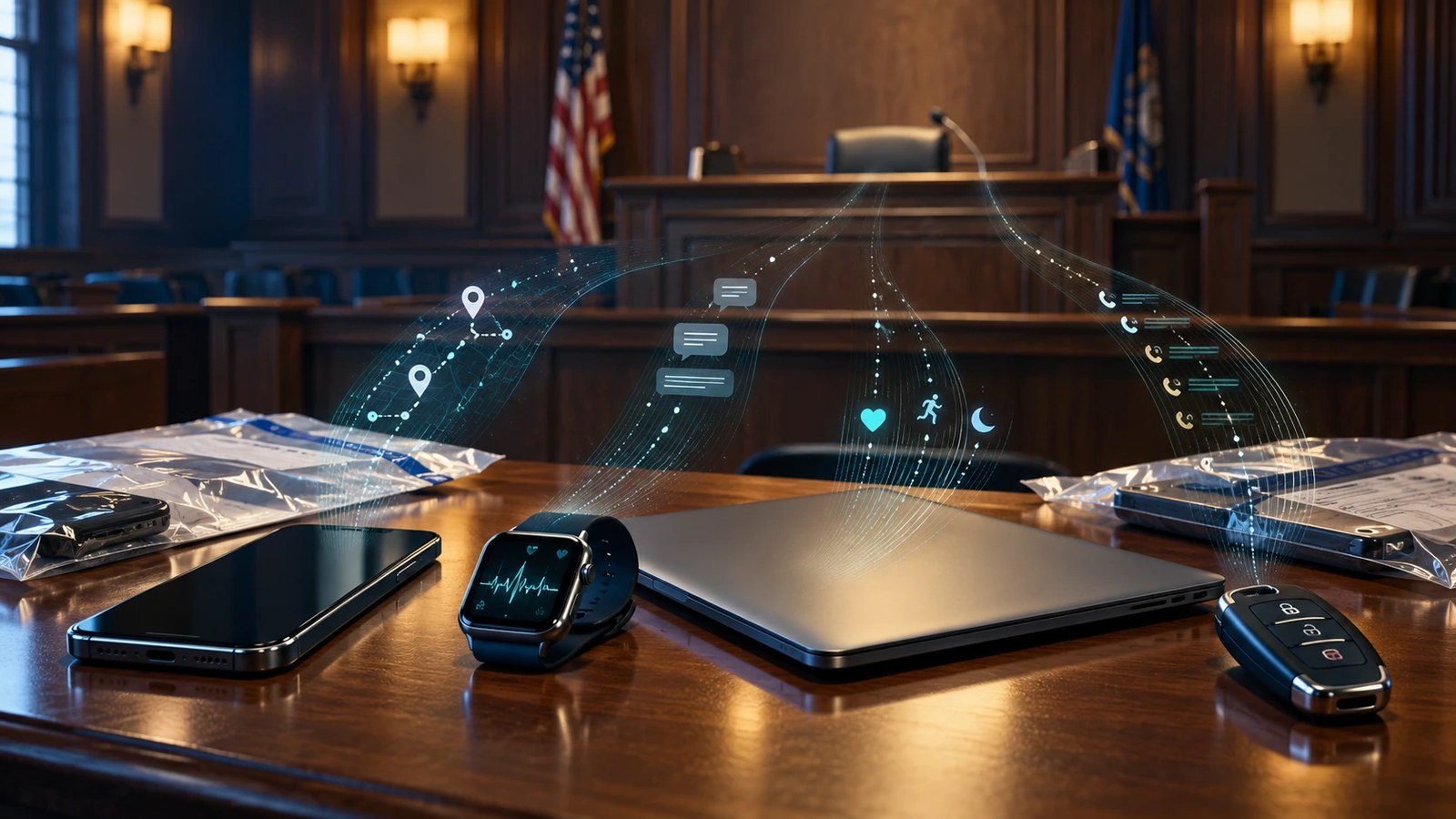
There is no murder weapon. There is no eyewitness. There is no confession. What there is, in the Ohio murder trial of former American Idol contestant Caleb Flynn, is an iPhone, an Apple Watch, a pair of AirPods, a sleep-tracking ring, a Gmail account, a disabled home camera system, and more than 100,000 text messages.
Miami County prosecutor Paul Watkins told the jury in his opening statement that “people lie, evidence doesn’t,” and that while Flynn said he was sleeping, “his devices say he was awake and moving.” (CNN) That line is the whole prosecution in one sentence. It is also the claim every criminal defense lawyer should be taking apart, because devices do not testify. People testify about what devices recorded, and the gap between those two things is where cases are won and lost.
A note before we start: Caleb Flynn has pleaded not guilty and is presumed innocent. The trial is ongoing, the State had not rested when this was written, and nothing here is a prediction of the verdict. This post is about the evidence and how it is being used, not about whether he did it.
The Case in One Paragraph
Ashley Flynn, 37, a teacher and mother of two, was shot twice in the head as she lay in bed in the family’s Tipp City, Ohio, home in the early hours of February 16, 2026. Her husband called 911 around 2:30 a.m. and reported an intruder. Prosecutors say he staged a break-in. He is charged in Miami County Common Pleas Court with aggravated murder and related counts, including tampering with evidence. The 9mm handgun Flynn told police he kept in his truck’s center console has never been found. (Court TV; Dayton Daily News)
The defense has conceded the affair and conceded the messages. Defense attorney Emily Smith told jurors that Flynn “is not on trial for being a bad husband” and that the State “found their story when they found the affair” and worked backward. (Court TV) So the real fight is not over what Flynn wrote. It is over what his devices say about roughly one hour and forty-five minutes in the middle of the night.
The Digital Evidence, Device by Device
Here is what the jury has heard so far. This is the inventory, before the hot takes.
The Messages
Alleigha Botner, the woman Flynn had an affair with, spent parts of two days on the stand reading their messages aloud. The prosecutor handed her one bound volume after another, 34 in all. (CNN) Prosecutors quoted messages in which Flynn wrote about wanting his wife dead, and one sent the night before the shooting: “I choose you. I’m free. Actions will come tomorrow, February 16, a day I’ll never forget.” Botner testified that she understood “actions” to mean he planned to ask for a divorce. (Court TV)
Flynn’s iPhone 16 Pro
Ohio BCI Special Agent Joseph Wilhelm testified that attempts to extract the phone at the police department and at the Flynn home failed, so it went to the state crime lab. (Dayton Daily News) Reporting from 404 Media says Wilhelm tried both Cellebrite and GrayKey and ultimately got a “full file system extraction” with Magnet GrayKey, which produced messages, location history, heart rate data from an Apple Watch, sleep data from an Oura ring, and AirPods connection and disconnection records. (404 Media)
Among the findings Wilhelm described:
- GroupMe, ChatGPT, Instagram and an app called “AI music song generator” were uninstalled on February 15, the day before the shooting.
- Safari browsing history had either been deleted at some point or the browser had been used in private mode.
- No text messages between Caleb and Ashley Flynn were recovered from his phone.
- A search at about 3:07 p.m. on February 15 for the best cough medicine for adults, consistent with Flynn’s account that he was sick and was sent to the couch for coughing.
Wilhelm also told the jury that “forensic tools are engineered to grab as much data from the phone as possible.” (Dayton Daily News) Hold on to that sentence. We will come back to it.
The Wearables: Apple Watch, AirPods and an Oura Ring
This is the heart of the State’s timeline. Flynn told police he moved to the couch, heard the dogs shake their collars, checked on his daughters, lay down on a bottom bunk and fell asleep until a noise woke him. (Dayton Daily News) According to WHIO’s account of the testimony, the movement and heart rate data from his Apple Watch, iPhone and AirPods showed him moving around between 12:45 a.m., when he stopped answering Botner’s messages, and the 911 call around 2:30 a.m. (WHIO) Wilhelm presented a consolidated timeline correlating heart rate, lock status and peripheral connections. (Court TV)
On cross-examination, the defense brought out that Apple device heart rate, step counts and in-ear detection can all produce false positives. (Court TV)
Ashley Flynn’s iPhone
FBI Special Agent Andrea Kinzig testified that Ashley’s phone was plugged in at 11:20 p.m. and last accessed just before 11:30 p.m. She found nothing suggesting Ashley was having an affair, which is what Flynn had told Botner. She recovered deleted messages between the spouses, including a January exchange in which Ashley wrote, “You can be honest. Is it her?” Location data put Ashley’s phone at a car wash and a shopping plaza on February 15 and at home from about 5:42 p.m. on. (Dayton Daily News)
The Cloud: Gmail and a “Snoop Report”
Bank records showed a $6.99 monthly charge for a service called Snoop Report. (Court TV) Kinzig testified that Flynn used a paid service to monitor Botner’s Instagram, that report emails had been deleted from his Gmail account, and that investigators could not determine when they were deleted. Asked why someone deletes email, she answered: “It’s often to conceal information.” (Dayton Daily News)
Cameras That Saw Nothing, and Cameras That Were Off
The Flynns had an Amazon Blink system with three cameras labeled front door, back door and living room. Amazon’s records, obtained by search warrant, showed it was last online on January 26. Kinzig testified it is unknown why it was disabled. (Dayton Daily News) The first officer on scene acknowledged his body camera failed to record because of a system malfunction. FBI agents canvassed more than 80 homes, a detective testified neighborhood video showed no activity outside the Flynn home before police arrived, and a neighbor testified her own motion cameras recorded nothing unusual that night. (Court TV)
The Other Woman’s Phone
Botner was house-sitting for her pastor that weekend. A neighbor’s Ring cameras captured her car at the pastor’s home at 6:54 p.m. on February 15, 12:20 a.m. on February 16, and 9:57 a.m. that morning. Wilhelm testified that step data from her iPhone recorded activity at 12:13 a.m. and then no steps until around 9:30 a.m. (Dayton Daily News) Botner also admitted she deleted messages after learning of Ashley’s death and lied to the FBI in her first interview, and she testified she wanted their messages deleted from Flynn’s phone to keep the affair hidden. (CNN; CNN live coverage)
Yes, There Was an AI Love Song
Investigators found AI-generated audio files and matching lyrics in Flynn’s Notes app, and prosecutors played two versions for the jury. Flynn had written to Botner that he used ElevenLabs to have an AI voice sing a song he wrote for her. (404 Media) It proves nothing about who pulled a trigger. It does show how much of a person’s inner life now lives on a phone, and how much of it a jury will be shown once the phone is open.
Hot Take 1: Devices Don’t Lie. They Don’t Testify Either.
“People lie, evidence doesn’t” is a great opening line. It is also not quite true of digital evidence, because none of this data speaks for itself. Every data point in this trial reached the jury through an analyst who chose a tool, ran an extraction, parsed a database, and built a timeline. Wilhelm’s own description of the tools is the tell: they are engineered to grab as much as possible. Grabbing everything is not the same as understanding everything.
Consider what the wearables actually measure. A watch does not detect a person. It reads a pulse through an optical sensor on whatever wrist it happens to be on. A step count is an inference from motion, and plenty of motion is not walking. In-ear detection is a sensor deciding whether an earbud is seated, not proof of who is wearing it or whether they were conscious. A sleep ring does not measure sleep; it estimates it from signals like heart rate and movement. Each of these is a reasonable proxy most of the time. None of them is a witness.
That is exactly the ground the defense chose on cross, and it was the right ground. The question for this jury is not whether the data exists. It is what the data means about a man lying in the dark between 12:45 and 2:30 in the morning.
Hot Take 2: A Phone That Doesn’t Move Proves Where the Phone Was
Here is the part of the digital case that has gotten the least attention. The State is using device data in two directions at once.
Against Flynn, device activity is offered to prove a person was awake and moving. For Botner, the absence of activity, a phone that logged no steps from 12:13 a.m. until morning plus a neighbor’s camera, helps close the door on the obvious alternate suspect. Both inferences rest on the same assumption: that the device and the person were in the same place doing the same thing.
That assumption may well be right both times. But it is one assumption, and it should be tested the same way in both directions. A phone sitting still on a nightstand proves where the phone was. A watch showing an elevated heart rate proves something was happening on the wrist wearing it. Getting from there to what a human being was doing takes a step the data cannot take on its own, and a jury deserves to hear that step described out loud, for every device, whichever side it helps.
Hot Take 3: Deletion Proves Concealment. It Doesn’t Say What Was Concealed.
The uninstalled apps are probably the most damaging digital fact in the case, because of the date. Removing GroupMe, ChatGPT and Instagram on February 15, the day before the shooting, invites the inference that someone was cleaning up before something happened.
But this trial also comes with a built-in alternative explanation. Botner testified she wanted their messages wiped to hide the affair. Flynn was a married worship leader carrying on a secret relationship with a church staff member, and both of them had every reason to erase their trail regardless of anything that happened that night. The Gmail deletions carry the same problem in a sharper form, because the FBI agent herself could not say when they happened. Kinzig’s answer, that deletion is “often to conceal information,” is true. The honest follow-up question is: conceal what? Here, there are two candidates, and only one of them is murder.
The Texas angle is worth noticing too. Texas’s tampering statute, Penal Code § 37.09, reaches destroying or concealing evidence when a person knows an investigation or official proceeding is pending or in progress, or knows an offense has already been committed. (Tex. Penal Code § 37.09) Ohio’s version, R.C. 2921.12, is broader: it also reaches a proceeding or investigation that is “about to be or likely to be instituted.” (Ohio Rev. Code § 2921.12) Coverage has not tied Flynn’s three tampering counts to specific acts, and we are not suggesting which acts they rest on. The point for Texans is simpler: under our statute, cleaning up a phone before any offense and before any investigation does not fit the elements of tampering. That does not mean a jury never hears about it. It means it comes in as circumstantial evidence the State argues from, not as a crime of its own, and the defense gets to argue the innocent explanation.
Hot Take 4: Missing Data Is Data
A home security system that went dark three weeks earlier. A body camera that malfunctioned on the first officer through the door. A neighborhood full of cameras that recorded nothing. The State is using the silence of those neighbor cameras as affirmative evidence that no intruder came or went.
That is a legitimate argument, but it has limits the jury should understand. A neighbor who testified about his own Ring cameras explained that they are triggered by motion and record for about a minute after each trigger. (Dayton Daily News) A motion-triggered camera proves what it saw. What it did not see depends on its angle, its range, its sensitivity settings, and whether anything crossed its field of view. “No footage” and “nobody was there” are different sentences.
Meanwhile the silence runs the other way on the physical side. No gun. No blood spatter found on Flynn’s clothing. No gunshot residue test, because the officer who photographed and fingerprinted him testified he was not asked to swab for it. (Court TV) When the physical evidence is thin, the digital evidence is asked to carry more weight than it was ever built to carry. That is when it deserves the hardest look.
What This Means for a Texas Case
Flynn is being tried under Ohio law, but the evidence in this trial is the evidence in almost every serious Texas case now. If you or someone you love is under investigation here, these are the questions that matter.
Did They Have a Warrant for Each Source?
Police generally need a warrant to search a phone, under Riley v. California, 573 U.S. 373 (2014), and the Texas Court of Criminal Appeals recognized a person’s privacy interest in the contents of a cell phone in State v. Granville, 423 S.W.3d 399 (Tex. Crim. App. 2014). But the phone is only the beginning. In the Flynn case, one officer testified he prepared more than 30 search warrants and eight subpoenas. (Court TV) The Google account records and the Amazon Blink records each came from a different company through separate legal process, apart from the phone itself. Each one is its own potential challenge. We explain how Texas treats stored cloud and wearable data, and why it can require more than federal law does, in our post on smart glasses and wearable evidence. The different kinds of phone extraction, including the file system extraction used on Flynn’s iPhone, and when police can make you unlock a phone, are covered in Can Police Get Into Your iPhone?
Get the Extraction, Not the Report
The timeline shown to a jury is a summary someone built. In Texas, the Michael Morton Act, Code of Criminal Procedure article 39.14, is the route to what sits underneath it. The things worth asking for:
- The complete extraction files and their hash values, so the defense expert works from the same data the State’s analyst did.
- The name and version of every tool used, including attempts that failed. In Flynn, two extraction attempts failed before the lab succeeded. Failed attempts on a live device are part of the chain of custody.
- The raw health and activity databases, not the rendered chart. Every heart rate reading, every timestamp, and the time zone and clock settings behind them.
- The analyst’s method for building the combined timeline, including what was left out.
Authentic Is Not the Same as Reliable
In Texas, getting digital evidence past authentication is not a high bar. Under Tienda v. State, 358 S.W.3d 633 (Tex. Crim. App. 2012), the judge asks only whether a reasonable jury could find the item is what the State says it is. (We cover authentication in depth in our deepfake evidence post.) The real fight is the next step: whether an expert can reliably say what the data means. Texas tests that under Kelly v. State, 824 S.W.2d 568 (Tex. Crim. App. 1992). “This is his watch’s heart rate log” is authentication. “This log proves he was awake and walking” is an expert opinion, and it has to earn its way in.
No Texas appellate court (yet) has yet decided how fitness-tracker or smartwatch data should be treated as evidence. Elsewhere, the same kind of data has both convicted and cleared people, including a Connecticut Fitbit that undercut a husband’s home-invasion story that sounds a lot like the one in Flynn. We walk through those cases, and the questions to ask about who was wearing a device and how accurate it is, in our post on wearable evidence. The short version: the data cuts both ways, and whether it helps or hurts depends on who takes the time to understand it.
Do Not Delete Anything
If you know you are under investigation, deleting messages, apps, or accounts can be charged as a separate third-degree felony in Texas, even if the underlying accusation goes nowhere. And as the Flynn trial shows, deleted data often is not deleted at all. It just becomes the most suspicious-looking exhibit in the case. Call a lawyer before you touch your phone.
The Bottom Line
The Caleb Flynn trial is being called a case about an affair. It is really a case about whether a jury will accept a device’s record of a night as a substitute for a witness to it. That question is coming to every courtroom in Texas, in DWI cases, assault cases and murder cases alike. The prosecution’s best line, “people lie, evidence doesn’t,” deserves an answer from the defense every time: evidence doesn’t lie, but it doesn’t explain itself either, and someone always has to.
We will update this post when the jury reaches a verdict.
If you are facing charges in Texas and the State’s case depends on your phone, your watch, or your accounts, the time to get a defense team that understands the data is before the data is interpreted for you. Deandra Grant Law defends clients across Dallas, Fort Worth, Allen, Denton, Waco and Rockwall. Call 214-225-7117 for a confidential consultation.
This post discusses a pending criminal case based on public reporting of courtroom testimony. The defendant is presumed innocent. This article is for informational purposes only and is not legal advice. Verify all citations before using them in any filing.
Sources
- Court TV, “Investigators say there’s no evidence that Caleb Flynn’s wife was cheating” (daily trial highlights, updated Sept. 25, 2026)
- Dayton Daily News, “Caleb Flynn murder trial: ‘We are a normal, married couple,’ Flynn says in police interview” (Sept. 25, 2026)
- Dayton Daily News, “Caleb Flynn murder trial: Text messages reveal mistress jealous, insecure about wife” (Sept. 24, 2026)
- WHIO, “Murder-for-hire plot, Apple data discussed during testimony in Day 7 of Caleb Flynn Murder Trial” (Sept. 25, 2026)
- 404 Media, “AI Love Song for Mistress Played at Murder Trial” (Sept. 25, 2026)
- CNN, “An affair, a missing gun and 100,000 messages: What we learned on Day 1 of testimony” (Sept. 19, 2026)
- CNN, “Caleb Flynn’s mistress Alleigha Botner testified in his murder trial. What we learned” (Sept. 24, 2026)
- CNN, live coverage of Alleigha Botner’s testimony (Sept. 23, 2026)
- Tex. Penal Code § 37.09 (Tampering With or Fabricating Physical Evidence)
- Ohio Rev. Code § 2921.12 (Tampering With Evidence)
- Riley v. California, 573 U.S. 373 (2014)
- State v. Granville, 423 S.W.3d 399 (Tex. Crim. App. 2014); Tienda v. State, 358 S.W.3d 633 (Tex. Crim. App. 2012); Kelly v. State, 824 S.W.2d 568 (Tex. Crim. App. 1992).
Which county your case is filed in changes how it is charged, who prosecutes it, and which court hears it.
Deandra M. Grant, JD, GC, MS, ACS-CHAL Forensic Lawyer-Scientist
She holds a Master of Science in Pharmaceutical Science and a Graduate Certificate in Forensic Toxicology, both from the University of Florida. She is the author of The Texas DWI Manual and has defended Texas DWI cases since 1994.
Is Your Phone Part of the State's Case?
Device data reaches a jury through someone's interpretation of it. Get a defense team that reads the raw extraction, not the summary. Intake answers 24/7, and if we can take your case, the consultation with an attorney is free.
Request a Free Case Evaluation
Tell us what happened. We'll respond as soon as possible.