
Smart Glasses in the Courtroom

A UK High Court judge caught a litigant receiving real-time coaching through smart glasses while being cross-examined. The witness was the sole owner and director of a Lithuanian company, and the case was an ownership fight over an English property company. The glasses were connected to his phone. Someone on the other end was feeding him answers.
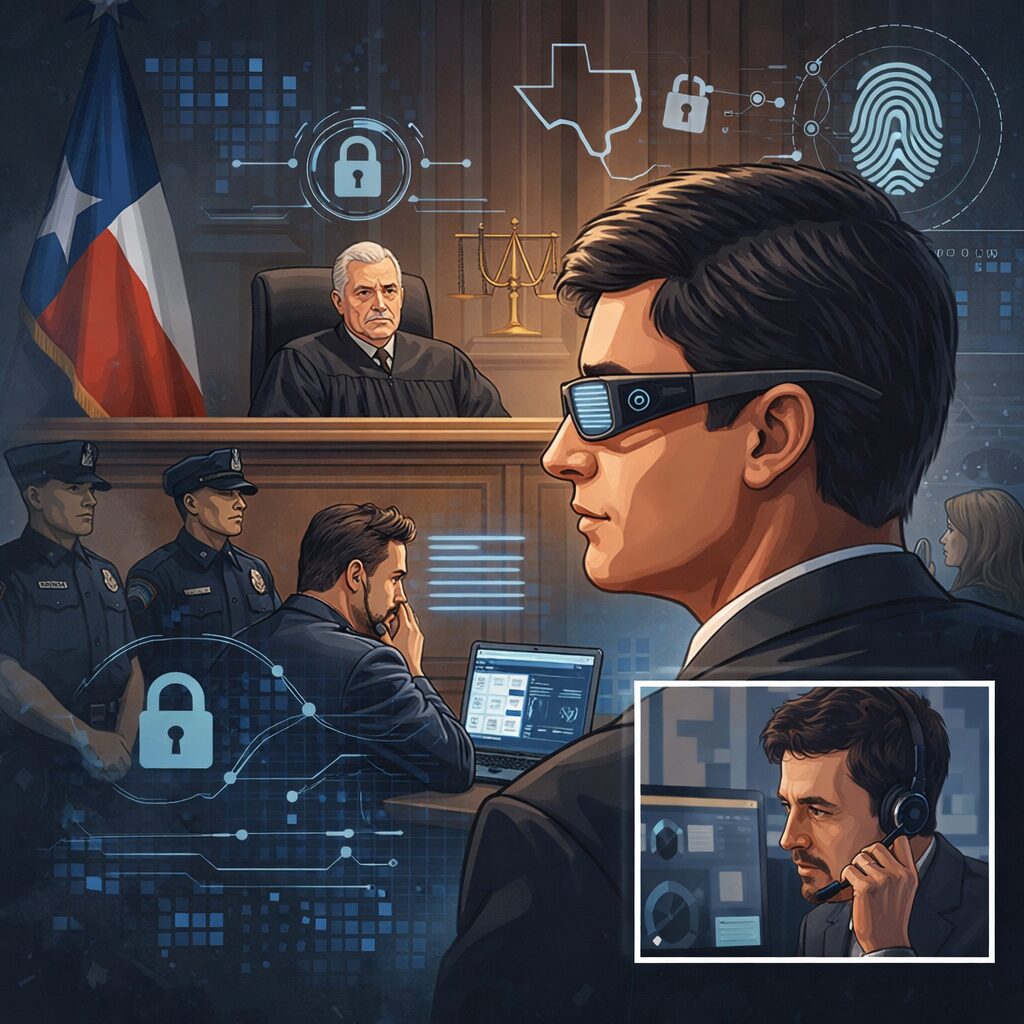
The case is UAB Business Enterprise v. Oneta Ltd, [2026] EWHC 543 (Ch), decided March 11, 2026 before ICC Judge Agnello KC in the Insolvency and Companies List. It is worth reading, because the way he was caught is more interesting than the coverage suggests.
Nobody spotted it by watching his face. Opposing counsel heard interference coming from around him and asked that the glasses come off. The court interpreter, sitting beside him in the witness box, confirmed she could hear it too. Only then did the judge order them removed.
What settled it came a moment later. While the interpreter was translating, his phone started broadcasting a voice out loud from his inner jacket pocket. He said he thought it was ChatGPT. The judge found that explanation lacked any credibility.
His call log showed repeated calls that morning to a contact saved as “abra kadabra,” including one three minutes before he entered the box. He said it was a taxi driver. The judge did not accept that, but she also declined to decide who was actually on the other end, and neither will we.
She found he had been “coached” and that his evidence was “unreliable and untruthful,” and rejected it in its entirety. Two things the coverage leaves out. The rejection did not rest on the glasses alone; it also rested on disclosure failures and witness statements the judge found were “clearly prepared by others.” And there was no contempt finding, no referral and no sanction. He simply was not believed, and his side lost.
The case is getting attention because the cheating was so brazen. The more useful question is what would happen if someone tried it in a Texas criminal courtroom, and what the wearable on your wrist is already doing in cases that have nothing to do with courtroom theatrics.
What Texas Law Actually Says About a Coached Witness
Texas Rule of Evidence 614, what everyone calls “the Rule,” does not reach this conduct. By its text it keeps witnesses from hearing other witnesses testify. A man fed answers through an earpiece by someone who never entered the courtroom is not within it.
What reaches it is Code of Criminal Procedure article 36.06, which instructs sequestered witnesses that they are not to converse with each other “or with any other person about the case.” Article 36.03(e) requires the judge to admonish every witness at the start of trial about who they may and may not talk to. So in a Texas criminal case the Rule has two halves: Rule 614 governs presence, and article 36.06 governs communication. Real-time electronic coaching is an article 36.06 problem.
Make sure the article 36.06 admonishment is actually given and appears on the record. It is routinely abbreviated or skipped entirely, and without it the contempt and exclusion arguments get much weaker.
What the Judge Can Do About It
The remedies come from Webb v. State, 766 S.W.2d 236 (Tex. Crim. App. 1989), and Bell v. State, 938 S.W.2d 35 (Tex. Crim. App. 1996): hold the witness in contempt, or refuse to let the witness testify. Admitting the testimony anyway is reviewed only for abuse of discretion, and Routier v. State, 112 S.W.3d 554 (Tex. Crim. App. 2003), confirms that Rule 614 is not a per se exclusionary rule.
Contempt runs through Government Code section 21.001(b), which is worth quoting because it is written as a duty rather than a power. A court “shall require that proceedings be conducted with dignity and in an orderly and expeditious manner.” Section 21.002 supplies the sanction: in a district court, a fine of up to $500, up to six months in the county jail, or both, with an eighteen-month cumulative ceiling.
There is an asymmetry here that cuts against the defense. Webb holds that excluding a defense witness is an abuse of discretion where neither the defendant nor counsel “consented, procured, connived or ha[d] knowledge” of the violation and the testimony is crucial. Where counsel did connive, exclusion is on the table. A lawyer who learns mid-trial that a client’s witness is wired has a problem that is not only the witness’s.
Criminal Exposure, Stated Carefully
Perjury is a Class A misdemeanor under Penal Code section 37.02. Aggravated perjury is a third-degree felony under section 37.03 when the false statement is made during an official proceeding and is material, and trial testimony qualifies. Note that “official proceeding” is defined at section 1.07(a)(33), not in chapter 37.
Be careful with witness tampering. Section 36.05 requires either a benefit offered, conferred or agreed, or coercion. A friend feeding answers for free to a willing witness has done neither, so the statute may not reach pure consensual coaching at all. The State’s better theory may be party liability under section 7.02 for the witness’s perjury. Anyone writing that coaching is “witness tampering” should check the elements first.
Evidence tampering under section 37.09 does not reach the coaching either, because spoken answers are not a record, document or thing. Wiping the glasses, deleting the messages or resetting the device once an investigation is pending is a third-degree felony.
Nobody in Texas Has Decided This
No Texas court has ruled on a witness coached electronically during testimony. Neither has any federal appellate court. The closest American authority is a Pennsylvania trial court sanctions order from a video deposition, where defending counsel whispered answers and the court barred the witness from testifying at trial on those topics and referred the lawyer to the disciplinary board.
Texas also has no statewide protocol for this, although individual judges may have their own local rules. Michigan publishes witness instructions for remote hearings that require the witness to be alone, bar reference to notes, require all other devices powered off, and forbid exchanging electronic messages during testimony. Connecticut, Ohio and Maryland have comparable guidance. Texas’s emergency orders addressed whether remote proceedings were authorized, not how a witness is supposed to behave in one.
Wearable Technology as Evidence: What Prosecutors Are Using
Smart glasses are part of a much broader shift. Wearable devices (ex. smartwatches, fitness trackers, smart rings, earbuds, and smart glasses) generate forensic data that prosecutors are increasingly using in criminal cases:
- Location data. Smartwatches and fitness trackers record GPS coordinates, step counts, and movement patterns that can place a defendant at a specific location at a specific time.
- Communication logs. Smart glasses connected via Bluetooth to a phone create connection logs, call records, and in some cases audio or video recordings. These logs can establish who the defendant was communicating with and when.
- Biometric data. Heart rate spikes, stress indicators, and sleep patterns recorded by wearable devices have been used to corroborate or contradict a defendant’s account of events. A heart rate spike at the time of an alleged offense can be used as circumstantial evidence of consciousness of guilt or, from the defense perspective, of fear consistent with self-defense.
- Audio and video recordings. Smart glasses with built-in cameras and microphones (like Meta’s Ray-Ban glasses or Omi glasses) can record conversations and interactions without the other party’s knowledge. These recordings can become evidence if captured pursuant to a search warrant or if voluntarily provided.
- App activity and notifications. Wearable devices sync with phone apps, creating a parallel record of the defendant’s digital activity: text message notifications, social media alerts, navigation directions, and ride-share confirmations.
The common thread is that wearable devices create a second forensic trail beyond the phone itself. A defendant who factory-resets a phone may not realize that a smartwatch, fitness tracker or pair of glasses retained synced data telling the same story.
The Cases That Actually Exist
The leading decision is State v. Dabate, 351 Conn. 428 (Conn. 2025), where a husband said a masked intruder killed his wife. Her Fitbit, worn on the hip, stopped registering steps at 10:05 a.m., which did not fit his account of when the intruder arrived. He was convicted and sentenced to sixty-five years, and the Connecticut Supreme Court affirmed last year.
The case defense lawyers should know is the one that went the other way. In a Wisconsin homicide, the victim’s boyfriend was the initial suspect and was jailed. His own Fitbit showed only a handful of steps overnight, consistent with bathroom trips and checking on the baby. He was released and never charged with the killing. Someone else was later convicted. A wearable kept an innocent man from a murder charge.
In a California prosecution, a ninety-year-old man was charged after his stepdaughter’s Fitbit showed a heart-rate spike and then stopped recording while his car was in her driveway. That case never reached trial. He died in custody in 2019, so nothing was ever ruled on and nobody was convicted.
Texas has one relevant decision. In Lariostrejo v. State, No. 05-23-00647-CR (Tex. App.—Dallas Dec. 2, 2024, mem. op.), investigators extracted data from an Apple Watch and showed that a text made to look like it came from the victim had actually been sent from the defendant’s watch. Useful, but that is message and pairing data, not health data, and the opinion contains no holding on admissibility.
Beyond that, no Texas appellate court has decided anything about fitness tracker, smartwatch or smart glasses data. Not on admissibility, not on the Fourth Amendment, not on reliability. There is not a single Texas opinion that so much as analyzes a Fitbit or smart watch.
Challenging Wearable Device Evidence: The Defense Perspective
The same data that prosecutors rely on can be challenged and wearable device evidence has significant vulnerabilities that a forensically trained defense team can exploit.
Who Was Wearing the Device?
A smartwatch on a nightstand records the same location data whether the defendant is wearing it or not. A fitness tracker left in a gym bag shows movement data for whoever is carrying the bag. GPS data from a wearable device proves where the device was but not necessarily where the defendant was. The prosecution must establish that the defendant was actually wearing or carrying the device at the relevant time, and that is not always provable.
Accuracy and Precision
Wearable device GPS is generally less precise than phone GPS because of smaller antennas and lower power. A smartwatch GPS fix can be off by 15 to 50 meters or more in urban environments, near tall buildings, or indoors. Fitness tracker step counts can be triggered by arm movements unrelated to walking. Heart rate data varies in accuracy depending on skin contact, device fit, and the wearer’s skin tone and body composition. The defense should evaluate the specific device’s known accuracy limitations and the conditions under which the data was recorded.
Data Extraction and Integrity
How was the data extracted, and from what? Cellebrite and GrayKey are phone tools. Neither advertises wearable extraction, and neither touches smart glasses. Oxygen Forensic Detective is the one of the three that reaches wearable data, and it says plainly that it is not intended for direct smartwatch extraction by cable. It gets there through the paired phone or the manufacturer’s cloud account.
The battleground is almost never the device on the wrist or the face. It is the paired phone and the cloud account, which means the real questions are what legal process was used to get the cloud records, and whether the extraction captured the complete dataset or a screenshot of part of it. Was the device imaged before extraction? Was chain of custody maintained from seizure through analysis to the courtroom? Was the device imaged before extraction to preserve the original data? Was the chain of custody maintained from seizure to analysis to courtroom presentation?
Doug Huff’s digital forensics training lets our defense team evaluate device extractions independently, test whether the extraction methodology was forensically sound, identify data that was omitted or misinterpreted, and put the complete digital picture in front of a jury. When the prosecution presents a curated selection of wearable device data, the defense must be equipped to show what the full dataset reveals.
Bluetooth and Connection Logs
The UK case is often described as turning on Bluetooth logs. It did not. It turned on a sound two people in the room could hear, and on a call log pulled from a phone. The judgment never uses the word Bluetooth, and it never identifies the make or model of the glasses. In Texas criminal cases, though, Bluetooth pairing records, connection timestamps, and device proximity data are becoming relevant evidence. But Bluetooth connections are not always reliable indicators of intentional use: devices can auto-connect, maintain passive connections, and show “connected” status without active communication. The defense should scrutinize what the connection log actually proves versus what the prosecution assumes it proves.
Can You Even Record With Them in Texas?
Texas Penal Code section 16.02 is an audio statute. It reaches wire, oral and electronic communications. It does not reach silent video at all. Texas is a one-party consent state, but consent is structured as an affirmative defense rather than an element, and it evaporates if the recording is made for the purpose of committing an unlawful act.
The public-place analysis does not live in an exception. It lives in the definition. An “oral communication” is one uttered by a person exhibiting an expectation that it is not subject to interception, under circumstances justifying that expectation. A conversation on a sidewalk usually is not an oral communication at all, so the statute never attaches. A conversation in a closed office is a different matter, and recording one you are not part of is a second-degree felony.
Section 21.15, invasive visual recording, is a state jail felony and it is device-neutral, so it reaches a camera mounted on a pair of glasses. But it covers intimate areas and bathrooms and changing rooms, not ordinary recording in public. Note one detail that answers the obvious defense: a posted sign announcing that recording occurs is expressly not sufficient to establish consent.
In Ex parte Thompson, 442 S.W.3d 325 (Tex. Crim. App. 2014), the Court of Criminal Appeals struck down the old improper photography statute on First Amendment grounds, holding that photography is protected expression. There is a constitutional right to photograph and record people in public in Texas, and wearing the camera on your face does not change it. The Fifth Circuit has separately recognized a First Amendment right to record police, subject to reasonable time, place and manner limits.
Getting It In and Keeping It Out
Footage from a pair of glasses is authenticated the way all electronic evidence is in Texas, under Tienda v. State, 358 S.W.3d 633 (Tex. Crim. App. 2012). The standard is lower than people assume. The trial court does not have to be persuaded the evidence is authentic. It only decides whether a reasonable jury could find it authentic, and the real question then goes to the jury.
Where no witness saw what the camera saw, the vehicle is Rule 901(b)(9), evidence describing a process or system and showing that it produces an accurate result. Texas adopted the so-called silent witness theory in Reavis v. State, 84 S.W.3d 716 (Tex. App.—Fort Worth 2002), which let a video be authenticated through testimony about the equipment, the chain of custody and the embedded timestamps rather than through an eyewitness to the events recorded.
So the foundation to attack, item by item: whose device it was and whether it was operating normally, how recording starts and where the file is stored, whether the file was exported unaltered and whether hash values were preserved, chain of custody from device to production, and the embedded metadata. Remember that the metadata is itself electronic evidence and needs its own showing.
The Warrant Question
Carpenter v. United States, 585 U.S. 296 (2018), required a warrant for historical cell-site location data, but its reasoning was location-specific and it does not obviously cover the health data on a watch. The better route now runs through Chatrie v. United States, decided June 29, 2026, which held that acquiring stored location history is a search and reasoned that materials a user reasonably views as his own stay private even when a company holds them. The majority named emails, documents, photographs and calendars. The dissent warned the logic reaches purchase history and payment logs.
Neither decision addressed wearables, and there is still no federal appellate holding that a warrant is required for fitness tracker or smartwatch cloud data. Every appellate mention of a Fitbit in a Fourth Amendment setting is dicta, most of it in dissents. The question is genuinely open.
Texas is the better argument, anyway. The stored customer data provisions that used to live in article 18.21 now sit in Chapter 18B. Article 18B.351 requires a warrant for content, and an article 18B.354 warrant requires “sufficient and substantial facts,” which is a higher showing than the ordinary article 18.01 warrant. So Texas may require a warrant, on a heightened showing, where federal law would let the State use a subpoena. A provider’s willingness to answer federal process does not cure a Texas defect.
Smart Glasses in Texas Courtrooms
Texas courtroom rules on electronic devices were written for phones, not glasses. Most Texas courts operate under local rules that prohibit recording devices and restrict cell phone use. But smart glasses look like eyeglasses, and that is an enforcement gap.
On February 18, 2026, during Mark Zuckerberg’s testimony in a Los Angeles Superior Court trial, Judge Carolyn Kuhl warned that anyone wearing recording-capable smart glasses in her courtroom faced contempt. Zuckerberg was not the one wearing them. Members of his entourage walked in with them on. No one was actually held in contempt, and the warning came from the bench rather than in a written order, so every version of the quote traces to reporters in the gallery. Texas judges have broad authority under Government Code §21.001(b) to maintain order and decorum, which includes the power to prohibit specific devices, and section 21.002 to enforce it.
Other systems have already moved. New York banned smart glasses in every court facility in the state effective July 20, 2026, with a definition broad enough to cover anything containing a camera or microphone. Philadelphia’s courts banned recording-capable eyewear in March 2026. The federal district court in Maryland now lists smart glasses by name in its standing order on electronic devices.
Texas has nothing comparable statewide though it may exist in local rules. The Northern District’s Miscellaneous Order No. 63 bars a list of devices from any court floor and names smart watches but not smart glasses, so eyewear is swept in only through the catch-all for other electronic communication devices. The Eastern and Western Districts both enumerate smartwatches, earpieces and fitness trackers, and neither mentions eyewear. State courtroom policy is local and varies by judge. If you are relying on a device order to keep glasses out of a Texas courtroom, read the actual order first, because most of them predate the problem.
For criminal defendants, the practical takeaway is straightforward: do not bring smart glasses, smartwatches with communication capability, or any connected device into a courtroom without discussing it with your attorney first. What happened in the UK case, where the witness’ credibility was destroyed and his testimony rejected in its entirety, is the best possible illustration of why attempting to use technology to gain an advantage in court will backfire catastrophically.
The Next Frontier: AI Coaching in Real Time
The UK witness was being coached by a human on the other end of a phone call. But the technology already exists to replace that human with an AI. Smart glasses with integrated AI assistants (including Meta’s Ray-Ban glasses with Meta AI) can process questions in real time and generate suggested responses. It is a matter of when, not whether, someone attempts to use an AI to provide real-time coaching during testimony.
Legally it is the same violation, and in Texas it has a statutory home rather than only a rhetorical one. A witness testifies from personal knowledge, and article 36.06 forbids a sequestered witness from conversing with any other person about the case. Whether the voice in the earpiece belongs to a human or a model, the witness is still receiving answers from outside the record. But detecting it will be harder than detecting a phone call, because AI-generated responses do not require a human on the other end making audible sounds.
Courts will need protocols for this, and Texas does not have them yet. Defense lawyers should also be ready for the possibility that prosecution witnesses, including officers, have access to the same tools. The technology cuts both ways, and the admonishment on the record protects everyone in the room including your client.
What This Means for Criminal Defense
The proliferation of wearable technology is expanding the universe of digital evidence in criminal cases. For defendants, this means more data for the prosecution to seize, analyze, and present. But it also means more data for the defense to challenge and wearable device data is often less reliable, less precise, and less forensically rigorous than traditional phone data.
At Deandra Grant Law, digital forensics is a core component of our defense practice. Doug Huff’s digital forensics training allows us to evaluate device extractions and the prosecution’s digital evidence directly, and to put the complete forensic picture in front of a judge or jury. As wearable technology generates an ever-larger share of the evidence in criminal cases, the defense team’s ability to understand, challenge, and contextualize that evidence becomes more important with every case.
If you are facing criminal charges and digital evidence is part of the prosecution’s case, whether from a phone, a smartwatch, a fitness tracker, a pair of glasses or any other connected device, call (214) 225-7117 or visit texasdwisite.com. The technology is evolving. Your defense team should be too.
Sources and Further Reading
The UK case
UAB Business Enterprise v. Oneta Ltd, [2026] EWHC 543 (Ch) (Mar. 11, 2026), ICC Judge Agnello KC, Insolvency and Companies List.
The Rule, and what a judge can do about a violation
Tex. R. Evid. 614; Tex. Code Crim. Proc. arts. 36.03, 36.05, 36.06.
Webb v. State, 766 S.W.2d 236 (Tex. Crim. App. 1989); Bell v. State, 938 S.W.2d 35 (Tex. Crim. App. 1996); Routier v. State, 112 S.W.3d 554 (Tex. Crim. App. 2003).
Tex. Gov’t Code §§ 21.001, 21.002.
Criminal exposure
Tex. Penal Code § 1.07(a)(33) (definition of official proceeding); § 7.02 (party liability); § 36.05 (tampering with a witness); §§ 37.02, 37.03, 37.09 (perjury, aggravated perjury, tampering with evidence).
Recording, consent and the First Amendment
Tex. Penal Code § 16.02 (unlawful interception); § 21.15 (invasive visual recording); Tex. Code Crim. Proc. art. 18A.001 (definition of oral communication); Tex. Civ. Prac. & Rem. Code ch. 123.
Ex parte Thompson, 442 S.W.3d 325 (Tex. Crim. App. 2014); Turner v. Lieutenant Driver, 848 F.3d 678 (5th Cir. 2017).
Authentication
Tienda v. State, 358 S.W.3d 633 (Tex. Crim. App. 2012); Tex. R. Evid. 901(b)(9); Reavis v. State, 84 S.W.3d 716 (Tex. App.—Fort Worth 2002).
The warrant question
Carpenter v. United States, 585 U.S. 296 (2018); Chatrie v. United States (U.S. June 29, 2026); Tex. Code Crim. Proc. arts. 18B.351, 18B.354.
Wearable data in criminal cases
State v. Dabate, 351 Conn. 428 (Conn. 2025); Lariostrejo v. State, No. 05-23-00647-CR (Tex. App.—Dallas Dec. 2, 2024, mem. op.).
Devices in the courtroom
N.D. Tex. Miscellaneous Order No. 63; E.D. Tex. General Order 18-06; W.D. Tex. Amended Electronic Device Order (July 2, 2025); New York Unified Court System memorandum prohibiting smart glasses (eff. July 20, 2026).
More from our blog
When the Video Might Be a Lie: How Texas Defense Lawyers Are Fighting Deepfake-Era Evidence. The authentication fight itself, including Tienda, Rule 901 and why you demand the native file.
Geofence Warrants and the Chatrie Decision. Our explainer on Chatrie, Carpenter and why Texas has no good-faith exception to save a bad warrant.
When the Evidence Is AI-Generated. The Take It Down Act, Section 1466A, and the Texas statutes that landed in 2025.
When Your ChatGPT Logs Become Evidence Against You. What a chatbot keeps, who can get it, and what process it takes.
How Can Video Evidence Be Enhanced or Authenticated for Use in Court? The forensic side of the authentication fight, including what enhancement can and cannot recover.
This post is informational and is not legal advice. Reading it does not create an attorney-client relationship.
Which county your case is filed in changes how it is charged, who prosecutes it, and which court hears it.
Deandra M. Grant, JD, GC, MS, ACS-CHAL Forensic Lawyer-Scientist
She holds a Master of Science in Pharmaceutical Science and a Graduate Certificate in Forensic Toxicology, both from the University of Florida. She is the author of The Texas DWI Manual and has defended Texas DWI cases since 1994.
Charged With a Crime?
Whatever you're facing, a DWI or any criminal charge, the sooner you have a forensic-trained team on it the more we can do. Tell us what happened and we'll review your options, at no cost and no obligation. Intake answers 24/7, and if your case is one we can take on, we schedule a free consultation with an attorney.
Request a Free Case Evaluation
Tell us what happened. We'll respond as soon as possible.