
Curtis Flowers: Six Trials, One Prosecutor, 23 Years

Curtis Flowers was tried six times for the 1996 murders of four people at a furniture store in Winona, Mississippi, all by the same district attorney. Three convictions were reversed for prosecutorial misconduct, two trials ended in hung juries, and the sixth conviction was thrown out by the U.S. Supreme Court in 2019 because the prosecutor had kept Black citizens off his juries. Witnesses and jailhouse informants recanted. Flowers was released in December 2019 after nearly 23 years, the charges were dismissed in 2020, and the case is officially unsolved. He died on October 7, 2026, at 56.Below: how one prosecutor built the same case six times, how it came apart, and how Texas law treats jury selection, informants and retrials.
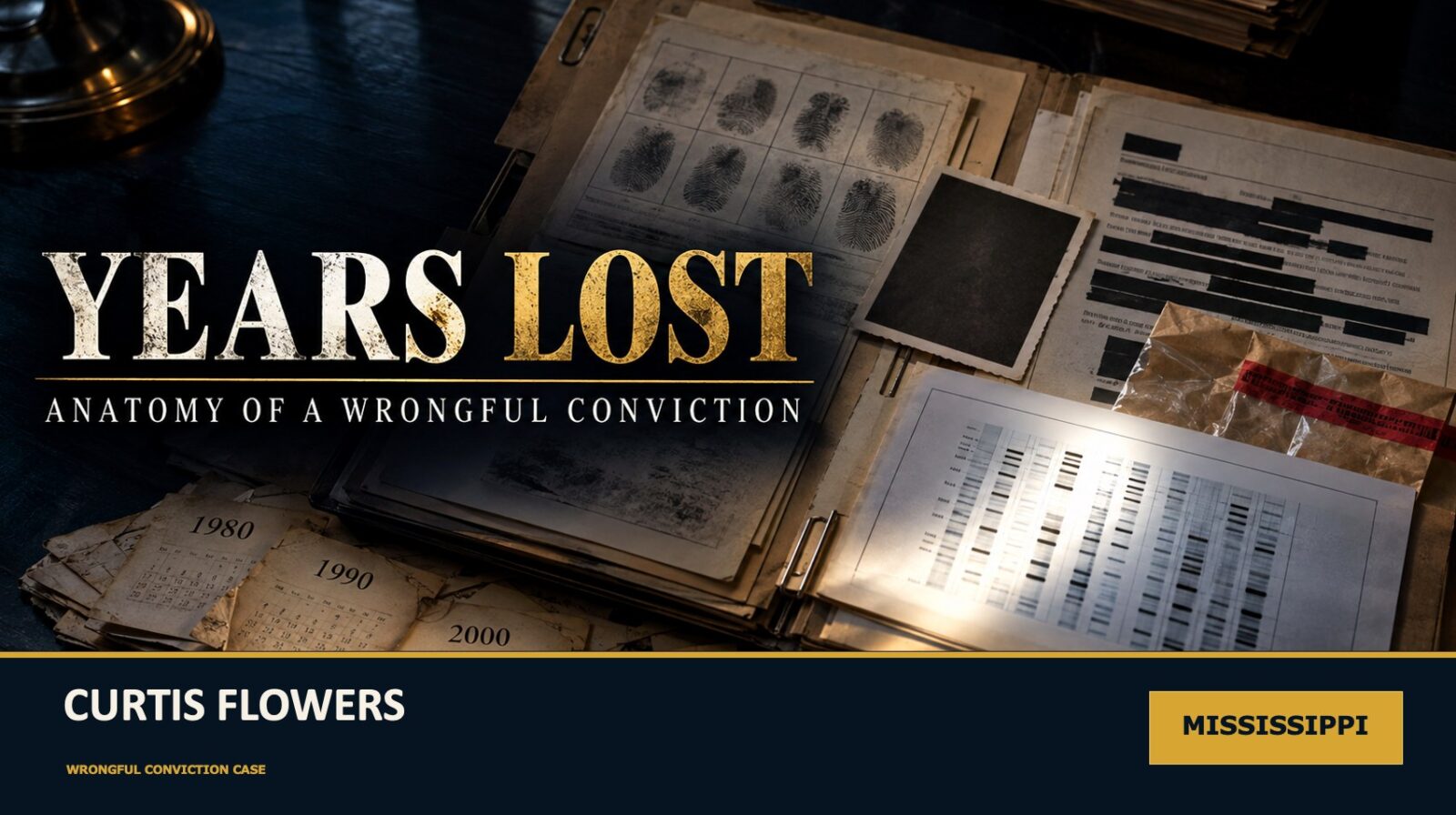
The same prosecutor tried him six times and struck 41 of the 42 Black jurors he could. Curtis Flowers was free for less than seven years. He died this month at 56.
| Case at a Glance | |
|---|---|
| Name | Curtis Flowers (died October 7, 2026, at 56) |
| Where | Winona, Montgomery County, Mississippi |
| Charge | Capital murder of Bertha Tardy, Derrick Stewart, Robert Golden and Carmen Rigby, July 16, 1996 |
| Tried | Six times, 1997 to 2010: four convictions with death sentences (three reversed by the Mississippi Supreme Court) and two hung juries |
| Years lost | Nearly 23 years in custody, nearly all of them on death row (January 1997 to December 16, 2019) |
| What went wrong | Racially discriminatory jury selection; jailhouse informants and other witnesses who later recanted; overstated firearms and gunshot residue testimony; repeated prosecutorial misconduct |
| How it came apart | Flowers v. Mississippi (U.S. 2019); APM Reports’ In the Dark investigation; the prosecutor stepped aside and the Attorney General dismissed |
| Status today | Charges dismissed with prejudice September 4, 2020; compensated $500,000; died October 7, 2026 |
| Texas law in play | Batson and Art. 35.261; Miller-El v. Dretke (Dallas County); jailhouse informant rules (Art. 38.075, Art. 39.14(h-1)); Tim Cole Act compensation |
The Road to Exoneration
- Done: Convicted1997, 1999, 2004, 2010
- Done: Conviction set asideJune 21, 2019
- Done: ReleasedDecember 16, 2019
- Done: Charges dismissed or acquittedSeptember 4, 2020
- Done: Exonerated2020
- Where it stands: Compensated$500,000, the most Mississippi allows
Flowers reached every step. He had less than seven years of freedom at the end of them.
What Happened
On the morning of July 16, 1996, four people were shot at Tardy Furniture in Winona, a small town in north-central Mississippi: the owner, Bertha Tardy, 59; employees Robert Golden, 42, and Carmen Rigby, 45; and 16-year-old Derrick “Bo Bo” Stewart, who died of his wounds days later. Thirty years later, no one stands convicted of their murders.
Curtis Flowers was 26. He had worked at the store briefly and had been let go after damaging some batteries. Investigators decided he was a disgruntled former employee, and he was arrested in January 1997.
How the Case Was Built
There was no confession, no eyewitness to the shootings and no DNA or fingerprint linking Flowers to the store. District Attorney Doug Evans built a circumstantial case from pieces:
- Route witnesses. About a dozen people said they had seen Flowers walking around town that morning, tracing a path to and from the store.
- A gun. The State said the murder weapon was a pistol stolen from a car belonging to Flowers’s uncle. The gun was never found. A firearms examiner hired for the case said a bullet dug out of a post where the uncle had practiced shooting matched the crime-scene bullets; the state crime lab had not been able to make that connection.
- Shoes and residue. Bloody footprints at the scene came from a size 10½ Fila shoe, and a box for that kind of shoe was found at his girlfriend’s home. An analyst testified that a single particle of gunshot residue on Flowers’s hand came from handling a gun “to the exclusion of all other environmental sources.”
- Jailhouse informants. Men held with Flowers testified that he had confessed to them.
Six Trials
Evans tried Curtis Flowers six times over 13 years.
- Trial 1 (1997). Convicted and sentenced to death. Reversed in 2000 by the Mississippi Supreme Court for prosecutorial misconduct.
- Trial 2 (1999). Convicted and sentenced to death. Reversed in 2003, again for prosecutorial misconduct.
- Trial 3 (2004). Convicted and sentenced to death. Reversed in 2007 because the prosecutor had discriminated on the basis of race in jury selection.
- Trial 4 (2007). Hung jury, 7 to 5 for conviction.
- Trial 5 (2008). Hung jury, 11 to 1 for conviction.
- Trial 6 (2010). Convicted and sentenced to death by a jury of 11 white jurors and one Black juror. The Mississippi Supreme Court upheld it.
What Went Wrong
The central failure was jury selection. Across the six trials, the State struck 41 of the 42 Black prospective jurors it had the chance to strike. At the first trial, Evans used every peremptory strike he had on Black prospective jurors, and the jury was all white. At the sixth, he struck five of the six Black prospective jurors, questioning them far more extensively than the white panelists he accepted.
The rest of the case did not hold up either. When the American Public Media podcast In the Dark reinvestigated the case in 2018, several route witnesses and informants recanted. One informant said his story had been “all make-believe.” Another said he had been pressured and promised a share of the reward money. The podcast also found evidence that pointed toward someone else.
How It Came Apart
On June 21, 2019, the U.S. Supreme Court reversed Flowers’s sixth conviction by a vote of 7 to 2. Writing for the Court in Flowers v. Mississippi, Justice Brett Kavanaugh pointed to the State’s “relentless, determined effort to rid the jury of black individuals” and held that the strike of at least one Black juror in the sixth trial was motivated in substantial part by discriminatory intent. The Court stressed that it was not announcing new law, only applying Batson v. Kentucky to an extraordinary record.
Flowers was released on December 16, 2019, nearly 23 years after his arrest. In January 2020, facing a motion to remove him, Evans stepped aside, and the Mississippi Attorney General’s Office took over. On September 4, 2020, it moved to dismiss the charges, and Circuit Judge Joseph Loper dismissed them with prejudice. Flowers can never be tried again for these murders.
Where Things Stand Now
In 2021, Mississippi paid Curtis Flowers $500,000, the most its compensation law allows: $50,000 for each year of wrongful imprisonment, capped at 10 years, for a man who lost nearly 23. He later settled a federal civil rights suit against Evans and investigators for $300,000.
Curtis Flowers died on October 7, 2026, at his home in Mississippi. He was 56, and he had been free for less than seven years. The cause of death had not been released at the time of writing. After his release he said: “Today, I am finally free from the injustice that left me locked in a box for nearly twenty three years.”
The murders of Bertha Tardy, Derrick Stewart, Robert Golden and Carmen Rigby remain unsolved.
How Texas Law Answers It
Race and the jury
Batson v. Kentucky (1986) bars striking prospective jurors because of race, and it applies in every state. When the defense objects, the prosecutor must give a race-neutral reason for the strike, and the judge decides whether that reason is the real one or a pretext. Texas puts the procedure in statute. Under Article 35.261 of the Code of Criminal Procedure, a defendant can raise the issue after the jury is selected and before it is sworn; if the judge finds that the State struck jurors because of race, the court must call a new panel.
The Supreme Court’s opinion in Flowers relied on Miller-El v. Dretke, 545 U.S. 231 (2005), a Dallas County capital case. There the Court found that prosecutors struck 10 of the 11 qualified Black venire members, used the jury shuffle to move Black panelists to the back, and questioned Black and white panelists differently, against the background of an office training manual that had once taught prosecutors to exclude minorities. Texas has its own history here, and Batson challenges are part of trial practice in this state for a reason.
What made Flowers winnable was the record: the side-by-side comparison of the questions asked of Black and white panelists, the reasons given for each strike, and the prosecutor’s history across trials. A Batson objection is only as good as the record the defense builds during jury selection.
Informants who change their stories
Several of the witnesses who said Flowers confessed later took it back. In Texas, Article 38.075 bars a conviction on jailhouse informant testimony unless other evidence tends to connect the defendant to the crime, and Article 39.14(h-1) requires the State to disclose an informant’s criminal history, any benefit offered, and the other cases in which he has testified. Our post on the Holberg case goes deeper.
Trying a case again and again
Neither Mississippi nor Texas limits how many times the State may retry a case after a reversal or a hung jury, and double jeopardy does not bar a retrial after a jury deadlocks. The check is the prosecutor’s judgment, and when a prosecutor has a conflict or should step aside, Texas law allows a court to appoint an attorney pro tem. In Flowers’s case, the change of prosecutor is what finally ended it.
Compensation
Mississippi caps compensation at $500,000. Under Texas’ Tim Cole Act person exonerated after nearly 23 years would be paid for every year, plus an annuity. APM Reports estimated that Flowers would have received about $1.76 million in Texas.
What This Means If You Are Charged in Texas
- Watch every strike. Note the race of every panelist, every strike and every question asked. A Batson challenge is won or lost on that record.
- Object before the jury is sworn. Article 35.261 sets the timing. A complaint raised later may come too late.
- Make the State explain how it found its witnesses. Rewards, deals, pressure and repeated interviews can shape testimony. Ask for all of it.
- Test the forensic claims. A single residue particle or a bullet match from a private examiner deserves the same scrutiny as any other evidence.
- Remember that a hung jury is not an acquittal. The State can try again. A defense has to be ready to do it all again too.
The Bottom Line
Curtis Flowers was tried six times by a prosecutor who kept Black citizens off his juries and built the same thin case each time. It took the U.S. Supreme Court, a team of reporters and a new prosecutor to end it. He came home in 2019, was cleared in 2020, and died this month at 56. The rules that protect a fair jury exist in Texas and in every state, but they protect no one unless a defense lawyer is watching jury selection closely and makes the record that lets a court see what happened.
Sources
Primary sources
- Flowers v. Mississippi, 139 S. Ct. 2228 (2019). supreme.justia.com
- Batson v. Kentucky, 476 U.S. 79 (1986); Miller-El v. Dretke, 545 U.S. 231 (2005).
Case record and coverage
- National Registry of Exonerations, Curtis Flowers case entry. exonerationregistry.org
- “After Six Trials and 23 Years, Charges Against Curtis Flowers Finally Dismissed,” Mississippi Free Press (September 2020). mississippifreepress.org
- “Mississippi to pay Curtis Flowers $500,000 for his decades behind bars,” APM Reports (March 2, 2021). apmreports.org
- In the Dark, Season Two, APM Reports. apmreports.org
- “Curtis Flowers, a Black man whose death sentence was tossed by Supreme Court, dies,” Associated Press via ABC News (October 2026). abcnews.com
- “Curtis Flowers, wrongly imprisoned, enduring six trials, dead at 56,” Mississippi Today (October 7, 2026). mississippitoday.org
This post is an informational synthesis for educational purposes and is not legal advice. It is based on court rulings, the National Registry of Exonerations and published reporting available as of October 9, 2026. The charges against Curtis Flowers were dismissed with prejudice. Informants and witnesses are described by role, and no one else has been charged in the Tardy Furniture murders. Case citations should be independently verified against the official record before use in any filing.
Which county your case is filed in changes how it is charged, who prosecutes it, and which court hears it.
Deandra M. Grant, JD, GC, MS, ACS-CHAL Forensic Lawyer-Scientist
She holds a Master of Science in Pharmaceutical Science and a Graduate Certificate in Forensic Toxicology, both from the University of Florida. She is the author of The Texas DWI Manual and has defended Texas DWI cases since 1994.
Facing a Serious Charge in Texas?
A fair trial starts with a fair jury, and that starts with the defense watching every strike. Whatever you are facing, the sooner a forensic-trained defense team is on it, the more we can do. Intake answers 24/7.
Request a Free Case Evaluation
Tell us what happened. We'll respond as soon as possible.