
Paid Witnesses, Hidden Payments and 41 Years Lost

On September 28, 2026, a Utah judge released Douglas Stewart Carter on bail after 41 years in custody, most of them on death row, for a 1985 murder in Provo. Utah’s Supreme Court had already found that police paid the State’s two key witnesses, hid the payments, and let the witnesses deny them under oath. New DNA testing then excluded Carter from blood and genetic material at the scene. He has not been exonerated: prosecutors still plan to retry him in 2027, and he is presumed innocent.Below: how the case was built, how it came apart, where it stands, and the Texas laws written against each failure.
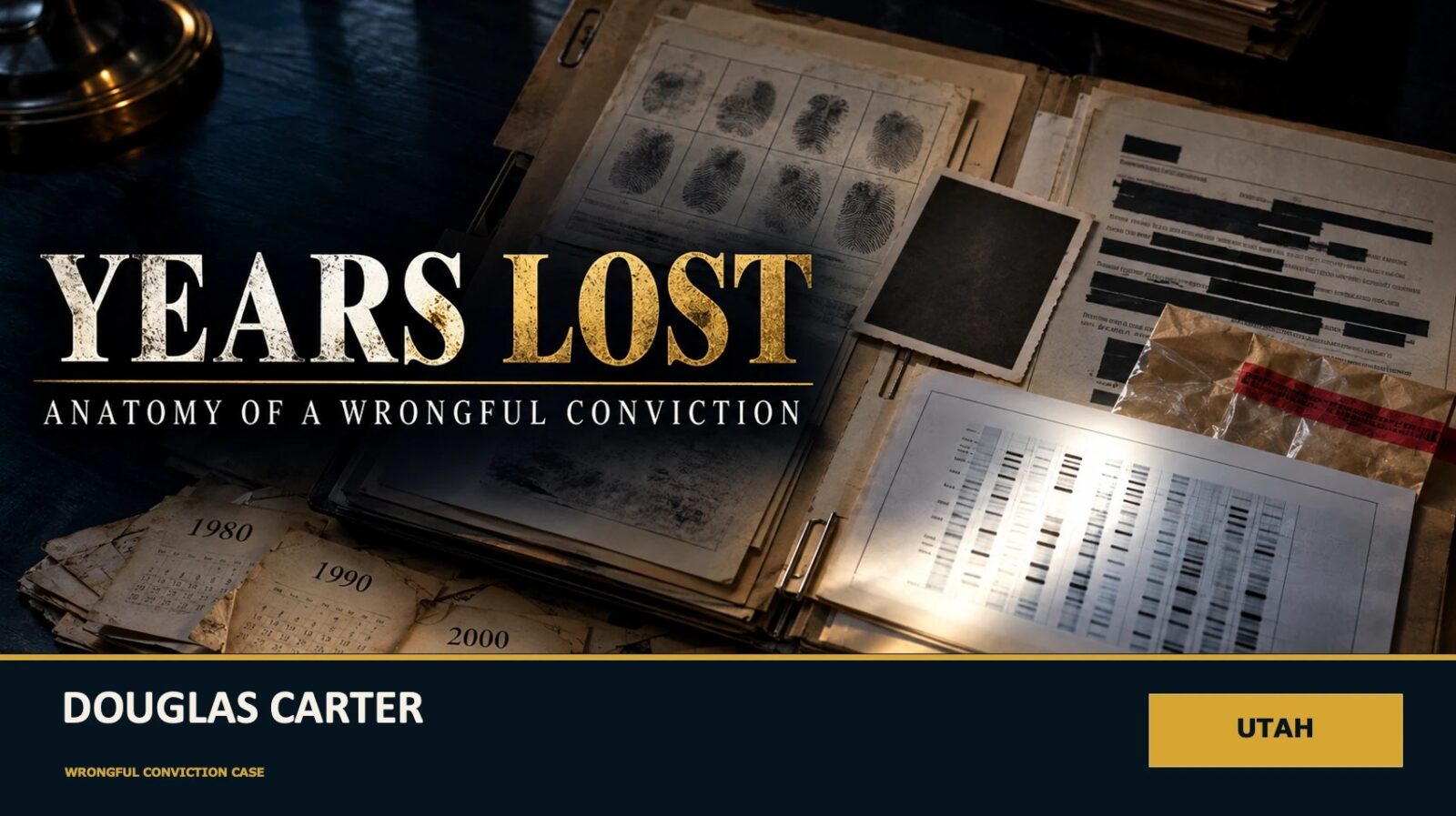
Utah’s highest court found that police paid the State’s star witnesses and hid it. New DNA excluded Douglas Carter. He walked out on bail at 71.
| Case at a Glance | |
|---|---|
| Name | Douglas Stewart Carter, 71 |
| Where | Provo, Utah County, Utah |
| Charge | Aggravated murder of Eva Olesen, February 27, 1985 |
| Convicted | 1985; death sentence set aside in 1989 and reimposed by a second jury in 1992 |
| Years lost | 41 years in custody (June 1985 arrest to September 2026 release) |
| What went wrong | Undisclosed payments to the State’s key witnesses; false testimony the prosecutor did not correct; a confession Carter says was coerced |
| How it came apart | Witnesses recanted in 2011; new trial ordered in 2022 and affirmed in 2025 (Carter v. State, 2025 UT 13); DNA excluded him in September 2026 |
| Status today | Released on bail with GPS monitoring; death penalty withdrawn; retrial set for 2027 |
| Texas law in play | Brady, Giglio and Napue; Michael Morton Act (Art. 39.14); interrogation recording (Art. 2B.0202); post-conviction DNA testing (Ch. 64) |
The Road to Exoneration
- Done: Convicted1985
- Done: Conviction set aside2022, affirmed 2025
- Where it stands: ReleasedOn bail, September 28, 2026
- Not yet: Charges dismissed or acquittedRetrial set for 2027
- Not yet: Exonerated
- Not yet: Compensated
Carter’s conviction is gone, but the charge is not. He is out on bail awaiting retrial and is not counted as an exoneree.
About This Series
Every wrongful conviction can be measured in years. Years Lost tells the stories of people convicted of crimes they did not commit, or whose convictions came apart decades later, and every entry starts with that number. The National Registry of Exonerations keeps the national running total: as of this writing, 3,864 exonerations and more than 36,226 years lost since 1989. Carter’s 41 years are not in that count, because his case is not over. Many of the cases in this series will be in the same unfinished place.
What Happened
Eva Olesen, 57, was stabbed and shot in her Provo home on February 27, 1985. She was the aunt of the city’s police chief at the time. No physical evidence tied Douglas Carter, a Chicago native who had been living with his mother in Utah, to the scene.
In June 1985 Carter was picked up in Nashville and questioned by a Provo detective, and he signed a confession. Two witnesses, Epifanio and Lucia Tovar, told the jury Carter had bragged about the killing. The jury convicted him in 1985 and he was sentenced to death. The Utah Supreme Court set aside that sentence in 1989, and a second jury sentenced him to death again in 1992. Carter has always maintained that the confession was false and that he gave it after repeated threats from police. No court has decided whether that is true.
What Went Wrong
In 2011, Carter’s legal team found the Tovars in Mexico. Their sworn declarations told a very different story from the one the jury heard. Provo officers had relocated the couple, paid their rent of roughly $400 a month along with utility and phone bills, and given them gifts. The couple said police and prosecutors coached their testimony, told them to deny the payments on the witness stand, and threatened them and their son with deportation if they did not implicate Carter.
None of this was disclosed to Carter’s lawyers. When the Tovars testified falsely about it, the prosecutor did not correct them. The Tovars’ testimony was the State’s corroboration for the confession. Without it, the confession stood alone.
How It Came Apart
In 2019 the Utah Supreme Court sent the case back for a hearing on the new evidence. In 2022, Judge Derek Pullan vacated the conviction and ordered a new trial. The State appealed, and on May 15, 2025, a unanimous Utah Supreme Court affirmed in Carter v. State, 2025 UT 13. The State did not dispute that it had suppressed favorable evidence or that the prosecutor knowingly let false testimony stand. It argued only that the violations did not matter enough to change the outcome.
The court rejected that argument. It found that the combination of “suppressing evidence, suborning perjury, and knowingly failing to correct false testimony” prejudiced Carter at both his trial and his sentencing, and it noted how rare it is to see intentional misconduct by two police officers and a prosecutor in the same case.
The ruling also led to new forensic testing. On September 22, 2026, prosecutors received results excluding Carter as the source of blood on a doorknob and of genetic material recovered from the handle of the knife used in the attack. That week the Utah County Attorney’s Office withdrew its notice that it would seek the death penalty, while maintaining that the results do not necessarily clear Carter. Prosecutors point out that the gun was never found and that Carter confessed.
Where Things Stand Now
At the September 28 bond hearing, Judge Pullan agreed that the DNA results further undercut the State’s case but found that a reasonable jury could still convict. He released Carter on conditions that include GPS monitoring and no contact with the Olesen family, who opposed his release and told the court they still want answers about Eva’s death. Carter’s lawyers have asked prosecutors to dismiss the case. Prosecutors say they are still reviewing the remaining evidence, and the retrial remains set for 2027. The defense also alleges that investigators buried leads pointing to other suspects, a claim no court has ruled on.
Carter’s attorney told the court his client was leaving with “41 years of state-induced trauma” and would need therapy to deal with it. Whatever happens at a retrial, that part cannot be undone.
How Texas Law Answers It
Carter’s case is a Utah case, but every failure in it has happened in Texas too, and Texas has answered several of them with statutes. Someone charged in Texas today has tools that did not exist for Carter in 1985.
Hidden payments to witnesses: Brady, Giglio and Napue
The constitutional floor is federal. Brady v. Maryland requires the prosecution to disclose evidence favorable to the accused that is material to guilt or punishment. Giglio v. United States applies that duty to evidence that undercuts a witness’s credibility, including any payment, benefit or deal. Napue v. Illinois adds a separate rule: a prosecutor who knows a witness is testifying falsely must correct it, even when the lie goes only to the witness’s credibility.
Carter’s trial violated all three at once. Rent money for the State’s key witnesses is textbook Giglio material, and letting those witnesses deny it under oath is a Napue violation. We covered how these rules work, and how federal habeas law can leave even a serious violation without a remedy, in our post on the Brittany Holberg case.
Hidden evidence: the Michael Morton Act
Texas learned the cost of hidden evidence through Michael Morton, who spent nearly 25 years in prison for his wife’s murder while the prosecutor held reports pointing to another man. The Legislature answered with the Michael Morton Act, which rewrote Article 39.14 of the Code of Criminal Procedure effective January 1, 2014. Three parts of it speak directly to a case like Carter’s:
- Open-file discovery on request. Once the defense asks, the State must produce offense reports, witness statements and other material evidence in its possession, custody or control, as soon as practicable.
- A disclosure duty that does not wait for a request. Article 39.14(h) requires the State to disclose any exculpatory, impeachment or mitigating information it holds, and Article 39.14(k) makes that a continuing duty that applies before, during and after trial.
- “The State” includes the police. In State v. Heath, 696 S.W.3d 677 (Tex. Crim. App. 2024), the Court of Criminal Appeals held that evidence held by a law enforcement agency counts as evidence in the State’s possession, even if the prosecutor never knew about it. In Carter’s case the payments ran through the police department, which is exactly the gap Heath closes.
Texas added specific disclosure rules for jailhouse informants in 2017, which our Holberg post walks through. None of these protections enforce themselves, and they are not beyond change: a 2025 bill that would have let courts narrow defense discovery requests passed the Texas Senate before stalling in a House committee. In our cases, the first step is a written Michael Morton Act request to the prosecutor, sent early and followed up.
A disputed confession: recording requirements
Carter’s confession was taken in a Tennessee interrogation room in 1985, and four decades later the parties still disagree about how it was obtained. Since 2017, Texas law has required a law enforcement agency to make a complete electronic recording of any custodial interrogation in a place of detention when the person is suspected of or charged with murder, capital murder, kidnapping, human trafficking or one of a list of sexual offenses. The requirement now sits in Article 2B.0202 of the Code of Criminal Procedure.
The recording has to be complete: it must start no later than when the person enters the interrogation area or receives the required warnings, and run until the questioning ends. The exceptions are narrow, such as equipment that fails despite a good-faith effort, a spontaneous statement, or a genuine public safety emergency. A recording lets a judge and jury see how a confession was produced, instead of reading only the signed result and a detective’s memory of the rest, and a missing or partial recording is something the defense can put squarely in front of both.
DNA after conviction: Chapter 64
Carter’s DNA testing came only after his conviction was thrown out. In Texas, a person who has already been convicted can ask for testing under Chapter 64 of the Code of Criminal Procedure. Under Article 64.03, the court must find that the evidence still exists in a testable condition with a reliable chain of custody, that it is reasonably likely to contain biological material, and that identity was or is an issue. The convicted person must then show by a preponderance of the evidence that he would not have been convicted if exculpatory results had been obtained.
Article 64.03(b) bars a Texas court from finding that identity was not an issue solely because the person confessed or pleaded guilty. The Legislature wrote that in because confessions are sometimes false.
Chapter 64 is also under scrutiny. In Gutierrez v. Saenz (June 26, 2025), the U.S. Supreme Court held 6-3 that a Texas death row prisoner has standing to challenge Chapter 64’s procedures in federal court as a violation of due process. The Court decided only that he may bring the challenge, not that the statute is unconstitutional, so the merits remain open.
What This Means If You Are Charged in Texas
- Make the State show its hand early. Most of Article 39.14 is triggered by a request. Send it in writing at the start of the case, and follow up when the production looks thin.
- Ask about every benefit to every witness. Rent, cash, relocation, immigration help, dropped or reduced charges. Ask in writing, by witness, and ask what the police provided, not just the prosecutor.
- Get the full interrogation recording. Start to finish, not a clip and not a summary. Compare it line by line with any written statement the police prepared.
- Find out what physical evidence exists and whether it has been tested. Evidence that is never tested before trial can be lost, degraded, or much harder to reach later.
- Do not explain yourself to the police without a lawyer. Carter’s case was built on a statement he later said was false. A lawyer in the room at questioning is the simplest protection there is.
The Bottom Line
Douglas Carter may or may not be retried, and a jury may or may not convict him again. What is already settled is that the State built its case on witnesses it was paying, hid that from the jury, and let the witnesses lie about it, and a unanimous court has now said so. Every Texas reform discussed here exists because a case like his happened here first. Those laws work only when someone uses them, early and in writing, and that is a defense lawyer’s job from the first day of a case.
Sources
Primary sources
- Carter v. State, 2025 UT 13, 570 P.3d 315 (Utah May 15, 2025). leagle.com
- Brady v. Maryland, 373 U.S. 83 (1963); Giglio v. United States, 405 U.S. 150 (1972); Napue v. Illinois, 360 U.S. 264 (1959).
- Gutierrez v. Saenz, No. 23-7809 (U.S. June 26, 2025). supremecourt.gov
News coverage
- “Man on death row for decades released on bail after DNA tests show no match to him,” Associated Press via ABC News (September 28, 2026). abcnews.com
- “Utah prosecutors say DNA evidence doesn’t match man who spent decades on death row,” Associated Press via ABC News (September 24, 2026). abcnews.com
- “Utah Supreme Court affirms ruling ordering new trial for death row inmate,” Utah News Dispatch (May 15, 2025). utahnewsdispatch.com
- “Utah to appeal judge’s decision overturning death row conviction of Douglas Stewart Carter,” KUER (November 28, 2022). kuer.org
Texas law and reference
- Tex. Code Crim. Proc. art. 39.14 (Michael Morton Act); State v. Heath, 696 S.W.3d 677 (Tex. Crim. App. 2024). statutes.capitol.texas.gov
- Tex. Code Crim. Proc. art. 2B.0202 (recording of custodial interrogation). texas.public.law
- Tex. Code Crim. Proc. art. 64.03 (post-conviction DNA testing). texas.public.law
- National Registry of Exonerations, running national totals. exonerationregistry.org
This post is an informational synthesis for educational purposes and is not legal advice. It describes a pending case based on court rulings and reporting available as of October 2026. Douglas Carter’s conviction has been vacated, he is presumed innocent, and the charge against him remains pending; nothing here is a finding about who killed Eva Olesen. Case citations should be independently verified against the official record before use in any filing.
Which county your case is filed in changes how it is charged, who prosecutes it, and which court hears it.
Deandra M. Grant, JD, GC, MS, ACS-CHAL Forensic Lawyer-Scientist
She holds a Master of Science in Pharmaceutical Science and a Graduate Certificate in Forensic Toxicology, both from the University of Florida. She is the author of The Texas DWI Manual and has defended Texas DWI cases since 1994.
Facing a Serious Charge in Texas?
Hidden evidence, paid witnesses and disputed confessions are not only history. Whatever you are facing, the sooner a forensic-trained defense team is on it, the more we can do. Intake answers 24/7.
Request a Free Case Evaluation
Tell us what happened. We'll respond as soon as possible.