
Larry Youngblood: The Bad-Faith Rule and the Innocent Man

In October 1983 a 10-year-old boy was abducted from a carnival in Tucson and sexually assaulted. Police collected his underwear and T-shirt but did not refrigerate them, and by the time anyone tested them the evidence had degraded. Larry Youngblood was convicted in 1985, largely on the boy’s identification. An Arizona appeals court threw the conviction out because the lost evidence might have cleared him. In Arizona v. Youngblood (1988), the U.S. Supreme Court reversed, holding that failing to preserve evidence that is only potentially useful does not violate due process unless the defendant shows the police acted in bad faith. Youngblood went back to prison. In 2000, newer DNA testing of what remained excluded him, and the profile later matched a man serving time in Texas. The rule that bears Youngblood’s name is still the law.Below: how a carnival abduction became a constitutional rule, why that rule makes lost evidence so hard to challenge, and what Texas requires instead.
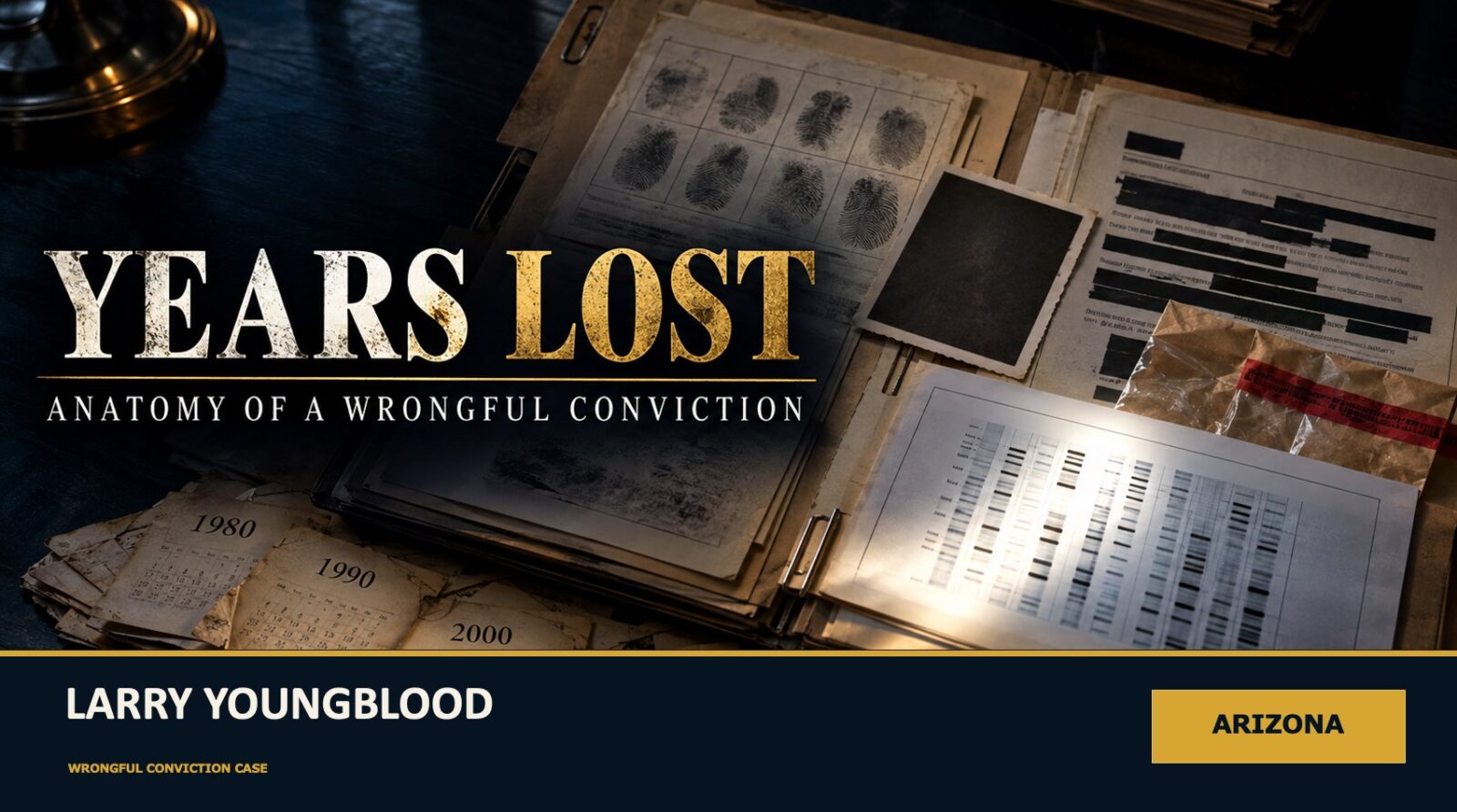
The police let the evidence spoil. The Supreme Court said that was not his problem unless they meant to do it. Twelve years later, what was left of that evidence proved he was innocent.
| Case at a Glance | |
|---|---|
| Name | Larry Youngblood |
| Where | Tucson, Pima County, Arizona |
| Convicted of | Child molestation, sexual assault and kidnapping, by a jury on February 8, 1985; sentenced to 10 years and six months |
| Years lost | About nine years in prison, in three stretches, between his arrest in December 1983 and his release in August 2000 |
| What went wrong | A child’s identification of a man who did not match his first description; clothing that police never refrigerated, so it degraded before it was tested |
| How it came apart | In 2000, at his lawyer’s request, newer DNA testing of the remaining evidence excluded him; in 2001 the profile matched a man in a Texas prison |
| Status today | Exonerated. Convictions vacated and charges dismissed in August 2000; Youngblood died in 2007 without compensation |
| Texas law in play | Preservation of biological evidence (Art. 38.43); post-conviction DNA testing (Ch. 64); lost evidence and due process (Arizona v. Youngblood, California v. Trombetta, Ex parte Napper) |
The Road to Exoneration
- Done: ConvictedJury verdict, February 8, 1985
- Done: Conviction set asideAugust 2000 (an earlier reversal was undone in 1988)
- Done: ReleasedAugust 2000
- Done: Charges dismissed or acquittedDismissed August 2000
- Where it stands: ExoneratedDNA exclusion, August 2000
- Not yet: CompensatedNo; died in 2007
An appeals court set his conviction aside in 1986. The Supreme Court put it back. It took a test that did not exist in 1983 to finish what the first court started.
What Happened
On October 29, 1983, a 10-year-old boy was taken from a church carnival in Tucson. A man drove him away and sexually assaulted him over about an hour and a half, then let him go. At the hospital, a doctor used a sexual assault kit to collect swabs and samples, and the kit went into a police refrigerator. Police also took the boy’s underwear and T-shirt. Those were not refrigerated or frozen.
The boy described his attacker as a Black man with a damaged eye. According to the National Registry of Exonerations, he described a defect in the right eye and gray hair. Larry Youngblood, then 30, had a cataract in his left eye. On November 7, 1983, police showed the boy a photo array that included Youngblood, and the boy picked him. Youngblood was arrested on December 9, 1983, and charged with child molestation, sexual assault and kidnapping.
How the Case Was Built
The case rested on the boy’s identification. The physical evidence that could have tested it was handled badly from the start. A police criminologist examined the swabs in November 1983 and confirmed sexual contact, but ran no further tests and did not examine the clothing. By the time the clothing was examined in January 1985, more than a year later, the tests failed: a blood-group test produced nothing, and a test for semen was inconclusive.
As Justice Blackmun later wrote, the samples “could have been tested, using technology available and in use at the local police department, to show either the blood type of the assailant or that the assailant was a nonsecreter.” Either result could have excluded Youngblood. Instead, the jury heard experts explain what proper storage might have shown, and the trial judge told the jurors that if the State had allowed evidence to be destroyed or lost, they could infer “that the true fact is against the State’s interest.”
The first trial ended in a mistrial. At the second, in Pima County Superior Court, the jury convicted Youngblood on February 8, 1985. He was sentenced to 10 years and six months.
The Case That Became a Rule
In 1986 the Arizona Court of Appeals reversed the conviction. It found no bad faith on the State’s part, but held that timely tests “could have produced results that might have completely exonerated” him, and that losing that chance violated due process (State v. Youngblood, 153 Ariz. 50, 734 P.2d 592 (App. 1986)). Youngblood was released.
Arizona appealed, and on November 29, 1988, the U.S. Supreme Court reversed in Arizona v. Youngblood, 488 U.S. 51 (1988). Writing for five justices, Chief Justice Rehnquist held that “unless a criminal defendant can show bad faith on the part of the police, failure to preserve potentially useful evidence does not constitute a denial of due process of law.” The police failure to refrigerate the clothing “can at worst be described as negligent.” The Court refused to read the Constitution as imposing on police “an undifferentiated and absolute duty to retain and to preserve all material that might be of conceivable evidentiary significance.”
Justice Stevens agreed with the result but not the breadth of the rule, which he called “much broader than necessary to decide this case.” Justice Blackmun, joined by Justices Brennan and Marshall, dissented. Due process, he wrote, requires “a fair trial, not merely a ‘good faith’ try at a fair trial.” Of a defendant left without the evidence that could have cleared him: “Good faith or not, this is intolerable.”
Back in Arizona, the Court of Appeals reversed again, this time under the Arizona Constitution (State v. Youngblood, 164 Ariz. 61, 790 P.2d 759 (App. 1989)), and Youngblood stayed free while the State appealed. In January 1993 the Arizona Supreme Court vacated that decision and reinstated the conviction (State v. Youngblood, 173 Ariz. 502, 844 P.2d 1152 (1993)). Youngblood went back to prison. He was paroled in 1998, and in 1999 he was returned to prison for failing to register a new address as a sex offender.
How It Came Apart
His trial lawyer, Carol Wittels, never stopped believing him. In 2000, at her request, the Tucson Police Department’s crime laboratory tested what was left of the degraded evidence with DNA methods that had not existed in 1983, with the Innocence Project consulting. The results excluded Youngblood. In August 2000 his convictions were vacated, the charges were dismissed, and he was released. According to the Arizona Justice Project, he was the first person in Arizona exonerated through post-conviction DNA testing.
The profile went into CODIS, the national DNA database. In early 2001 it matched Walter Cruise, who was serving time in a Texas prison on a cocaine conviction and, according to the Registry, had two prior Texas convictions for sex offenses against children. According to the Arizona Justice Project, Cruise was blind in one eye. In August 2002 he pleaded guilty to the 1983 attack and was sentenced to 24 years.
Where Things Stand Now
Larry Youngblood died in 2007. Arizona had no law compensating the wrongly convicted, and he received nothing.
The rule did not die with him. In 2004, in Illinois v. Fisher, 540 U.S. 544 (2004) (per curiam), the Supreme Court applied it to a defendant whose drug evidence police destroyed under routine procedures, after he had asked for it in discovery more than ten years earlier. The Court held that the bad-faith requirement turns on whether the evidence was potentially useful, not on how central it was, even when a defendant calls it his only hope for exoneration. The case that should have shown what the rule can cost an innocent person is still cited regularly to deny relief to others.
How Texas Law Answers It
Texas courts apply the federal rule. What Texas has added is a statute that tries to keep the problem from happening in the first place.
The constitutional floor
The Supreme Court divides lost evidence into two kinds. Evidence whose exculpatory value was apparent before it was destroyed, and that cannot be replaced by other reasonably available means, must be preserved, and losing it violates due process regardless of motive. That test comes from California v. Trombetta, 467 U.S. 479 (1984), which was a breath-test case: California officers did not keep breath samples from Intoxilyzer tests, and the Court held due process did not require them to. Everything else is “potentially useful,” and under Youngblood the defendant must prove bad faith.
The Court of Criminal Appeals has applied that standard strictly. In Ex parte Napper, 322 S.W.3d 202 (Tex. Crim. App. 2010), which involved DNA evidence consumed or destroyed by the old Houston Police Department crime laboratory, the court rejected the habeas court’s finding of bad faith and explained that bad faith “entails some sort of improper motive, such as personal animus against the defendant.” Mistakes, even serious ones, do not qualify on their own.
Whether the Texas Constitution’s due course of law clause demands more is a question worth raising and preserving. In Pena v. State, 285 S.W.3d 459 (Tex. Crim. App. 2009), the court of appeals had held that it does, and the Court of Criminal Appeals reversed because the defendant had not separately preserved the state constitutional claim at trial. The lesson is procedural: object under Article I, Section 19 of the Texas Constitution by name, and explain why it should be read more broadly, or the argument is gone.
The preservation statute
In 2001, the same year it created post-conviction DNA testing under Chapter 64, the Legislature enacted Article 38.43. It applies to any police agency, prosecutor’s office, court, public hospital or crime laboratory charged with handling biological evidence collected in a felony investigation, including any item with blood, semen, saliva, skin, hair or other biological material that might identify or exclude a suspect. That entity must keep the evidence:
- When no one has been caught: for at least 40 years, or until the statute of limitations runs.
- After a conviction: in a capital case, until the inmate is executed, dies or is paroled; in a prison case, until the defendant dies, finishes the sentence, or is released on parole or mandatory supervision; in a probation case, until the term of community supervision ends.
- Sexual assault kits: for at least 40 years, or until the statute of limitations runs, whichever is longer, whether or not anyone has been charged.
Evidence can be destroyed earlier only after notice. The prosecutor, clerk or other officer holding it must notify the defendant, the defendant’s last lawyer and the convicting court, and may destroy it only if no written objection arrives within the 90 days that follow. In a capital case where the State seeks death, the State must have the biological evidence DNA-tested before trial.
Youngblood’s clothing would have been covered. But the statute would not have saved it, because the damage happened in the first weeks, through storage rather than destruction. And the statute has no built-in remedy at trial. The statute itself does not say what happens at trial when it is violated, so a violation is a reason to dig, not an automatic remedy.
What finally worked, in Texas terms
Youngblood was cleared by newer testing of old, degraded evidence, followed by a database search that identified someone else. Texas’s Chapter 64 allows a request to retest evidence that was tested before if newer techniques offer a reasonable likelihood of results that are more accurate and probative. And under Article 64.035, when testing produces an unidentified profile, the court must order it compared against the FBI’s database and the state database. That database step is what cleared Martin Santillan (Case No. 35).
Find out who had custody of every item, how it was stored and when testing was first possible. A missing refrigeration log is not bad faith by itself, but the timeline is how bad faith gets proven when it exists. Ask the court to instruct the jury that it may infer the lost evidence would have been unfavorable to the State. Youngblood’s own trial judge gave that instruction.
What This Means If You Are Charged in Texas
- Ask early what was collected and where it is. Request the chain of custody and storage records for every item, not just the lab report.
- Put the State on notice to preserve. A written preservation request in the file makes later claims of routine destruction harder to defend.
- Get your own testing while you can. If the State has not tested something that could exclude your client, ask for independent testing before trial. Evidence degrades whether or not anyone means it to.
- Raise the state constitution separately. Object under the Texas due course of law clause by name, not just due process, or the argument may not survive appeal.
- Answer every destruction notice. If you receive notice under Article 38.43 that biological evidence will be destroyed, file a written objection within the 90-day window. Silence is consent.
- After conviction, think about retesting. Chapter 64 reaches evidence that was tested before if newer methods could give more accurate and probative results.
The Bottom Line
Larry Youngblood’s case gave American law one of its most consequential rules: if the police lose evidence that might have helped you, you must prove they meant to. The rule was announced in the case of a man who was innocent, and it was announced over the objection that it would leave innocent people without a remedy. What freed him in the end was the same evidence the Supreme Court had said he had no constitutional right to, tested by methods no one had in 1983. Texas has tried to answer the problem with a preservation statute and a right to post-conviction testing. Neither one fixes evidence that was ruined in the first week. The defense has to ask what was collected, where it went and how it was kept, early enough for the answer to matter.
Sources
Case record and reporting
- Arizona v. Youngblood, 488 U.S. 51 (1988). justia.com
- State v. Youngblood, 153 Ariz. 50, 734 P.2d 592 (App. 1986). courtlistener.com
- State v. Youngblood, 164 Ariz. 61, 790 P.2d 759 (App. 1989). courtlistener.com
- State v. Youngblood, 173 Ariz. 502, 844 P.2d 1152 (1993). courtlistener.com
- Larry Youngblood, National Registry of Exonerations, Case No. 10991. exonerationregistry.org
- Larry Youngblood, Innocence Project. innocenceproject.org
- Larry Youngblood, Arizona Justice Project. azjusticeproject.org
Lost evidence and Texas law
- California v. Trombetta, 467 U.S. 479 (1984). justia.com
- Illinois v. Fisher, 540 U.S. 544 (2004) (per curiam). justia.com
- Ex parte Napper, 322 S.W.3d 202 (Tex. Crim. App. 2010). courtlistener.com
- Pena v. State, 285 S.W.3d 459 (Tex. Crim. App. 2009). courtlistener.com
- Tex. Code Crim. Proc. art. 38.43 (evidence containing biological material). statutes.capitol.texas.gov
- Tex. Code Crim. Proc. ch. 64 (motion for forensic DNA testing), including art. 64.035. statutes.capitol.texas.gov
This post is an informational synthesis for educational purposes and is not legal advice. It is based on the U.S. Supreme Court’s opinions, the Arizona decisions as cited there and in secondary sources, the records compiled by the National Registry of Exonerations, the Innocence Project and the Arizona Justice Project, and the Texas statutes and cases cited, as available in November 2026. Walter Cruise is named because he pleaded guilty to the offense. The child victim is not named. Case citations should be independently verified against the official record before use in any filing.
Which county your case is filed in changes how it is charged, who prosecutes it, and which court hears it.
Deandra M. Grant, JD, GC, MS, ACS-CHAL Forensic Lawyer-Scientist
She holds a Master of Science in Pharmaceutical Science and a Graduate Certificate in Forensic Toxicology, both from the University of Florida. She is the author of The Texas DWI Manual and has defended Texas DWI cases since 1994.
Facing a Serious Charge in Texas?
When the evidence that could clear you is in the State's hands, the time to ask about it is now, not years from now. The sooner a forensic-trained defense team is tracking what was collected and how it was kept, the more can be done. Intake answers 24/7.
Request a Free Case Evaluation
Tell us what happened. We'll respond as soon as possible.