
Martin Santillan: 25 Years on One Eyewitness

Martin Santillan was convicted of capital murder in Dallas County in March 1998 and sentenced to life for the shooting of Damond Wittman outside a Deep Ellum nightclub. The State’s case was one eyewitness, a man who had first set Santillan’s photograph aside and then came back to it about 15 minutes later; three other eyewitnesses who viewed the lineup did not pick him. Santillan asked for DNA testing on his own in 2002 and was denied in 2004. Testing in 2009, 2014 and 2021, and a 2020 reanalysis, finally excluded him, and a December 2021 database search matched a woman who remembered a teenage boyfriend in a Dallas Stars jersey. The Court of Criminal Appeals found him actually innocent on February 22, 2023. In October 2026, Michael Nevarez, who was 16 when Wittman was killed, pleaded guilty to murder and a Dallas County jury assessed 21 years.Below: how one identification carried a capital murder case, why Chapter 64 did not help him, and what Texas law now asks of a lineup.
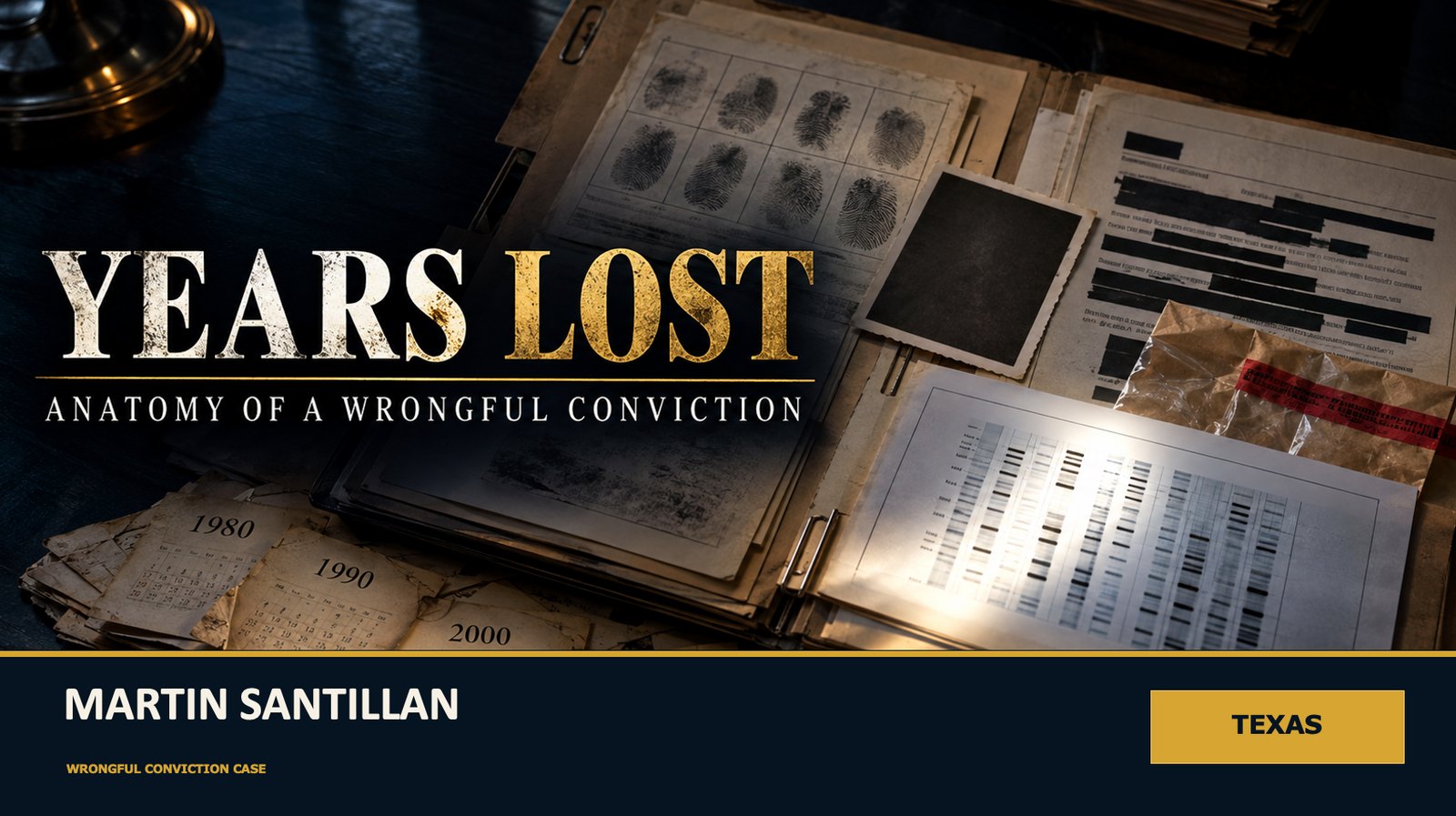
He asked a court to test the DNA in 2002 and was turned down. The answer had been on a hockey jersey the whole time, and it took three more rounds of testing and a second look at old data to read it.
| Case at a Glance | |
|---|---|
| Name | Martin Lucio Santillan |
| Where | Dallas County, Texas; the shooting was outside Club 212 in Deep Ellum |
| Convicted of | Capital murder, by a Dallas County jury on March 5, 1998; sentenced to life |
| Years lost | More than 25 years, from his arrest on July 22, 1997 to his release on bond on December 14, 2022 |
| What went wrong | A single eyewitness identification, made after the witness first set the photograph aside; three other eyewitnesses who did not pick him; a description of the gunman that did not match him; a $5,000 reward paid to the Crime Stoppers caller who named him and later testified for the State |
| How it came apart | DNA testing in 2009, 2014 and 2021, a 2020 reanalysis that read the 2014 data as excluding him, and a database match on a witness who led police to the real killer |
| Status today | Exonerated. The Court of Criminal Appeals found him actually innocent and set aside the conviction on February 22, 2023; the case was dismissed on March 22, 2023 |
| Texas law in play | Habeas corpus (Art. 11.07); actual innocence (Ex parte Elizondo); new scientific evidence (Art. 11.073); post-conviction DNA testing (Chapter 64); eyewitness identification procedures (Art. 38.20) |
The Road to Exoneration
- Done: ConvictedJury verdict, March 5, 1998
- Done: Conviction set asideFebruary 22, 2023
- Done: ReleasedDecember 14, 2022, on bond, two months before the court acted
- Done: Charges dismissed or acquittedDismissed March 22, 2023
- Where it stands: ExoneratedActual innocence, February 22, 2023
- Done: CompensatedYes
No new witness came forward and nobody confessed. A jersey sat in an evidence room until the testing got good enough to read it.
What Happened
Shortly before two in the morning on July 14, 1997, Damond Wittman was standing in the parking lot next to Club 212 in Deep Ellum. He was 21. A man he did not know asked him for a cigarette, and Wittman gave him one. The man pulled a gun and demanded money. Wittman fought him. He was shot several times and died.
The witnesses described the gunman the same way. Short hair. Young, maybe 17 or 18. A black Dallas Stars jersey. Clean-shaven, or a day’s growth at most. Nobody mentioned a mustache, a goatee or earrings.
Martin Santillan was 23 years old. He had a mustache, a goatee, a full head of hair and earrings. After a Crime Stoppers caller named him, police arrested him on July 22, 1997, eight days after the shooting.
How the Case Was Built
Brian Mackin, one of Wittman’s friends in the parking lot, was shown a photo lineup that included Santillan’s picture. He set that photograph aside without saying it was the gunman. About 15 minutes later he came back to it and identified Santillan. According to the Dallas County District Attorney’s Office, three other eyewitnesses viewed the lineup and did not identify him. Mackin’s identification was the case.
The physical evidence pointed the other way. A black Dallas Stars jersey was found a few blocks from the scene, and testing matched the blood on it to Wittman. Nothing connected Santillan to the jersey. DNA on a cigarette butt from the lot excluded him, and the prosecution argued that the butt was a different brand from the cigarette Wittman had handed the gunman.
Five witnesses testified that Santillan was at La Fantasia, a different Dallas club, from about eleven or midnight until it closed at two. He took the stand and denied the shooting. His ex-girlfriend testified that he had never owned or worn a Dallas Stars jersey, though she admitted she had earlier told police he was with her all weekend. The State called rebuttal witnesses to go after her account. One of them was the Crime Stoppers caller who had named Santillan and collected the $5,000 reward the Deep Ellum Association had offered.
On March 5, 1998, a Dallas County jury convicted Santillan of capital murder, and he was sentenced to life. The Fifth Court of Appeals affirmed on May 11, 2000.
How It Came Apart
In 2002, Santillan filed his own motion for DNA testing under Chapter 64, which the Legislature had enacted only the year before. He had no lawyer. The motion was denied in 2004.
Centurion Ministries, a New Jersey innocence organization, brought the case to the Dallas County District Attorney’s Conviction Integrity Unit in 2008. The unit agreed to testing in 2009. Orchid Cellmark could not get a profile from the inside neck of the jersey or from the cigarette butt. In 2014 Centurion asked for more testing, and Bode Technology produced a partial profile that supported no conclusion either way.
Then in 2020, Alan Keel at Forensic Analytical Crime Lab went back to Bode’s results. Not to new evidence, to the same 2014 data. He concluded that those results excluded Santillan as a contributor to the profile on the jersey. Nothing further had been tested. What changed was who was reading it.
In 2021 the laboratory retested the jersey samples with a newer kit and STRmix, a probabilistic genotyping program. It found DNA from two to four people, including two major unknown contributors, one male and one female. Both profiles went into CODIS in December 2021.
The male profile did not match anyone in the database. The female profile did. Police interviewed the woman, and she remembered a boyfriend, then 16 or 17, who had worn a Dallas Stars jersey. She remembered seeing him once with blood on his hands, and that he told her he had been in a fight and thrown the jersey away. At the District Attorney’s request, police in Colorado Springs obtained his DNA, and he was arrested in Colorado.
On December 13, 2022, Judge Audra Riley, sitting by assignment in the 265th District Court, signed agreed findings recommending relief, and Santillan walked out on bond the next day. On February 22, 2023, the Court of Criminal Appeals granted relief in a per curiam opinion, Ex parte Santillan, No. WR-49,763-02, set aside the conviction, found him actually innocent and sent the case back to Dallas County, where the indictment still stood. On March 22, 2023, prosecutors moved to dismiss it at a hearing before Judge Riley, and the case was dismissed. The judge apologized to Santillan on behalf of Dallas County and the State of Texas, calling the case a “miscarriage of justice.”
Where Things Stand Now
In October 2026, Michael Nevarez pleaded guilty to murder and a Dallas County jury assessed his punishment at 21 years. He was 16 when Wittman was killed and is 45 now. A guilty plea and a jury sentence are not a contradiction: in Texas a defendant who pleads guilty can still ask a jury to decide the punishment.
District Attorney John Creuzot called the outcome “an important step toward accountability for Damond Wittman’s murder and for his family” and “also a reminder of the profound consequences of a wrongful conviction.” He added: “Martin Santillan lost more than 25 years of his life for a crime he did not commit.” In 2023, announcing the dismissal, he had apologized “to Mr. Santillan and his family for this miscarriage of justice.”
Paul Casteleiro of Centurion Ministries, who represented Santillan with Dallas lawyer Gary Udashen, summed up the original case: “Their evidence really consisted of a lone eyewitness.”
Santillan is one of several Dallas County cases in this series. Richard Miles is the closest, and the shape is familiar: an identification, a conviction, and years spent getting a court to look again. Tim Cole is the Texas case that gave the eyewitness problem a name in this state.
How Texas Law Answers It
Three bodies of Texas law run through this case. One of them did not exist when Santillan was tried, one of them did not help him when he reached for it, and one of them is what finally worked.
The identification
Texas now regulates lineups. Article 38.20, added in 2011 by House Bill 215, requires every law enforcement agency whose officers conduct photograph or live lineup identifications to adopt a written policy based on credible research on eyewitness memory. From the start, that policy has had to address who runs the procedure: an administrator who does not know which person is the suspect, or for photo arrays, blind administration or an equivalent best practice. House Bill 34 tightened the article in 2017. The policy must now include procedures for choosing fillers who match the description of the perpetrator and do not make the suspect stand out, an instruction that the person who committed the offense may or may not be present, and documentation of the result whatever it is. Immediately after an identification, the witness must be asked to state in their own words how confident they are, and the agency must write that down. None of this governed the lineup Mackin saw in 1997.
Section 5: Evidence of compliance with the policy “is not a condition precedent to the admissibility of an out-of-court eyewitness identification.” And notwithstanding Article 38.23, the Texas exclusionary statute, a failure to conduct a lineup in substantial compliance with the policy “does not bar the admission of eyewitness identification testimony in the courts of this state.” The Legislature told agencies to fix their lineups and then said in the same article that breaking the rule excludes nothing.
What Section 5 does give you is in subsection (c), added in 2017. When a witness who made an earlier photo or live lineup identification identifies the defendant in court, that identification is admissible only if it is accompanied by the details of each prior identification, “including the manner in which the identification procedure was conducted.” That is a right to the whole procedure, not just the result. In a case like Santillan’s, the whole procedure includes a witness setting a photograph down and picking it back up a quarter of an hour later.
On expert help, Texas is genuinely open and genuinely demanding. In Tillman v. State, 354 S.W.3d 425 (Tex. Crim. App. 2011), the Court of Criminal Appeals held that the trial court abused its discretion by excluding an eyewitness identification expert whose testimony was relevant and reliable. Four years later, in Blasdell v. State, 470 S.W.3d 59 (Tex. Crim. App. 2015), the court upheld the exclusion of a different expert on the weapon-focus effect, because the record did not show the theory’s error rate or whether the scientific literature supported it, and the witness described himself as “basically self-educated.” Tillman opens the door. Blasdell is the reminder that you walk through it with a particular expert and a particular theory, and both have to carry their weight.
Post-conviction DNA testing
Chapter 64 lets a convicted person ask the convicting court to test evidence that has a reasonable likelihood of containing biological material. Under Article 64.03, a court may order testing only if the evidence still exists in a testable condition with a sufficient chain of custody, identity was or is an issue, and the convicted person shows by a preponderance of the evidence that he would not have been convicted if exculpatory results had been obtained.
Santillan filed in 2002 and lost in 2004. One later amendment matters here more than the rest. Article 64.035, added in 2011, now requires the convicting court to order any unidentified DNA profile compared against the FBI’s database and the database the Department of Public Safety maintains. A database comparison is the step that broke this case open, and it was not in the statute when Santillan was asking for help.
Habeas corpus, actual innocence and new science
What finally worked was Article 11.07, the felony writ, and the Court of Criminal Appeals granted relief on two grounds. The first was actual innocence under Ex parte Elizondo, 947 S.W.2d 202 (Tex. Crim. App. 1996), which requires the applicant to show by clear and convincing evidence that no reasonable juror would have convicted in light of the new evidence. The second was Article 11.073, the junk science writ, which allows relief when the applicant shows by a preponderance of the evidence that he would not have been convicted had the new scientific evidence been presented at trial. The trial court found both, the State agreed, and the court agreed.
Judge Kevin Yeary concurred only in the result. He has long objected to calling the Elizondo standard “actual innocence,” but he wrote that he was “convinced by the evidence presented that Applicant is in fact actually innocent of the crime for which he was convicted.”
A reward is a benefit, and a benefit paid to a State’s witness is impeachment material the State has to disclose under Brady and Giglio and under Article 39.14(h). Ask who called, what they were paid, when they were paid, and whether the payment was pending when they testified. We walk through how that duty works in our post on the Holberg case.
What This Means If You Are Charged in Texas
An identification is a piece of evidence that gets treated like a fact. The work is in taking it apart before a jury hears it.
- Ask for the procedure, not the result. Article 38.20, Section 5(c), entitles you to the details of every prior identification, including how it was conducted. Get the photo array itself, the order of presentation, the instructions read aloud, who administered it and what they knew.
- Find out what every witness said the first time. A witness who hesitated, passed, picked someone else or came back later is a different witness from the one who takes the stand and points. So is the witness who looked at the same lineup and picked no one. In Santillan’s case, three did.
- Put the original description next to your client. Not the one the witness gives at trial, after months of knowing who was arrested. The one given before anybody was in custody.
- Get the confidence statement. The statute requires the witness to say in their own words how sure they are, immediately, and requires the agency to document it. If it is missing, that absence needs an answer.
- Ask about rewards and benefits early. A reward payment, a dropped charge or a pending case belongs in your file before trial, not in a writ twenty years later.
- Preserve and test while you still can. Chapter 64 is a harder road than pretrial testing, and a denied Chapter 64 motion is not the end of the line. Santillan lost his in 2004 and was exonerated anyway, but it took 18 more years and an outside organization to do it.
The Bottom Line
Nothing connected Martin Santillan to the jersey, and the DNA the State did test excluded him. A jury convicted him of capital murder anyway, because one man pointed at a photograph he had first set aside. Twenty-four years later the jersey answered the question it had been holding the whole time, and the answer was a 16-year-old boy.
What should sit uneasily is how close this came to never happening. The testing failed in 2009 and again in 2014. The exclusion in 2020 came from someone rereading data that already existed. The break in 2021 came from a woman whose DNA nobody was looking for. Take away any one of those and Martin Santillan is still in prison, and the case against him still looks exactly as solid as it did in 1998.
Sources
Case record
- Ex parte Santillan, No. WR-49,763-02 (Tex. Crim. App. Feb. 22, 2023) (per curiam) (not designated for publication). courtlistener.com
- Ex parte Santillan, No. WR-49,763-02 (Tex. Crim. App. Feb. 22, 2023) (Yeary, J., concurring). courtlistener.com
- Martin Santillan, National Registry of Exonerations, Case No. 13511. exonerationregistry.org
- Dallas County District Attorney, announcement of the exoneration of Martin Santillan (March 22, 2023). dallascounty.org
- “Dallas man exonerated after spending 25 years in prison for murder,” KERA News (March 22, 2023). keranews.org
- “Real killer sentenced in 1997 Deep Ellum murder after innocent man spent 25 years in prison,” CBS News Texas (updated Oct. 23, 2026). cbsnews.com
Texas law
- Ex parte Elizondo, 947 S.W.2d 202 (Tex. Crim. App. 1996). courtlistener.com
- Tillman v. State, 354 S.W.3d 425 (Tex. Crim. App. 2011). courtlistener.com
- Blasdell v. State, 470 S.W.3d 59 (Tex. Crim. App. 2015). courtlistener.com
- Tex. Code Crim. Proc. art. 11.07 (felony habeas corpus). statutes.capitol.texas.gov
- Tex. Code Crim. Proc. art. 11.073 (new scientific evidence). statutes.capitol.texas.gov
- Tex. Code Crim. Proc. ch. 64 (motion for forensic DNA testing), including art. 64.035. statutes.capitol.texas.gov
- Tex. Code Crim. Proc. art. 38.20 (photograph and live lineup identification procedures). statutes.capitol.texas.gov
- Acts 2011, 82nd Leg., R.S., H.B. 215 (adding art. 38.20). capitol.texas.gov
- Acts 2017, 85th Leg., R.S., H.B. 34 (amending art. 38.20). capitol.texas.gov
This post is an informational synthesis for educational purposes and is not legal advice. It is based on the opinion of the Texas Court of Criminal Appeals, the record compiled by the National Registry of Exonerations, the Dallas County District Attorney’s Office and contemporaneous reporting. Michael Nevarez’s conviction rests on his plea; nothing here is offered as a finding about any other person. Case citations should be independently verified against the official record before use in any filing.
Which county your case is filed in changes how it is charged, who prosecutes it, and which court hears it.
Deandra M. Grant, JD, GC, MS, ACS-CHAL Forensic Lawyer-Scientist
She holds a Master of Science in Pharmaceutical Science and a Graduate Certificate in Forensic Toxicology, both from the University of Florida. She is the author of The Texas DWI Manual and has defended Texas DWI cases since 1994.
Facing a Serious Charge in Texas?
An eyewitness identification can carry a case all the way to a verdict with nothing standing behind it. The sooner someone is taking the procedure apart, the more can be done about it. Intake answers 24/7.
Request a Free Case Evaluation
Tell us what happened. We'll respond as soon as possible.