Richard Miles: Two Hidden Reports & 15 Years Lost

Richard Miles was 19 when he was arrested for a 1994 shooting at a Dallas gas station that killed one man and wounded another. He was convicted on a single eyewitness identification and overstated gunshot residue evidence, after the prosecutor told the jury there were “no other suspects.” Police files held two reports pointing to other men, and the defense never saw them. Miles was freed in 2009 and declared actually innocent by the Court of Criminal Appeals in 2012. In 2021 Texas passed the Richard Miles Act, which requires police agencies to certify that they have handed over everything the defense is entitled to see.Below: how one identification and one lab result became a conviction, what the police file held, and the Texas laws that now cover each failure.
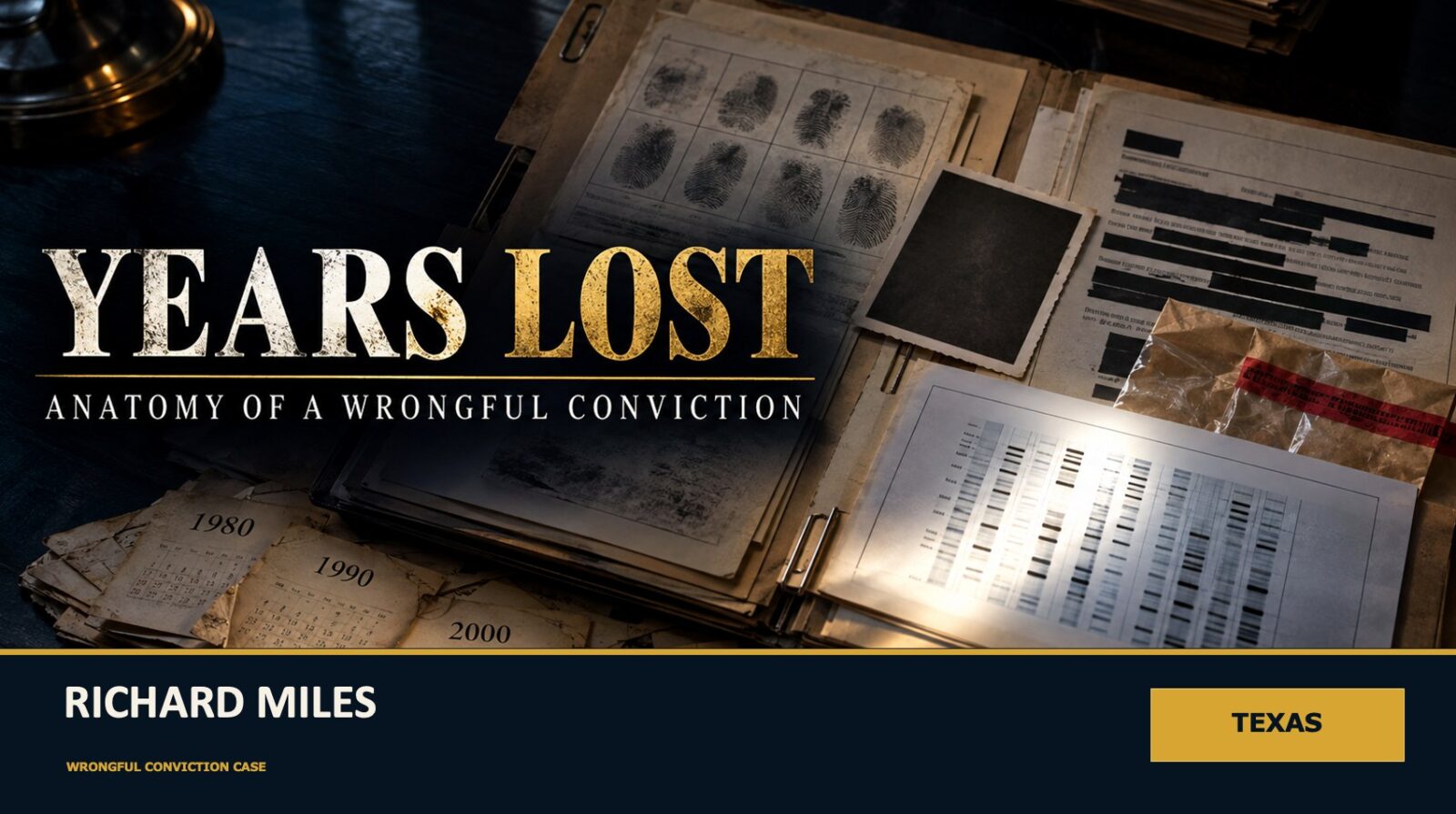
The prosecutor told a Dallas jury there were no other suspects. Two police reports in the file named other suspects. A law now carries his name.
| Case at a Glance | |
|---|---|
| Name | Richard Miles |
| Where | Dallas, Dallas County, Texas |
| Charge | Murder and attempted murder; shooting at a Northwest Highway gas station, May 16, 1994 |
| Convicted | August 1995; sentenced to 40 years for murder and 20 for attempted murder |
| Years lost | About 15 years in custody (May 1994 arrest to October 2009 release) |
| What went wrong | Suggestive eyewitness identification; overstated gunshot residue testimony; two police reports naming other suspects withheld |
| How it came apart | Centurion Ministries investigation from 2007; Dallas County DA did not oppose relief; Court of Criminal Appeals found actual innocence February 15, 2012 |
| Status today | Exonerated and compensated; founder of Miles of Freedom, a Dallas reentry nonprofit |
| Texas law in play | Richard Miles Act (Art. 2A.209); Michael Morton Act (Art. 39.14) and State v. Heath; eyewitness identification procedures (Art. 38.20); Forensic Science Commission and Art. 11.073; Tim Cole Act |
The Road to Exoneration
- Done: ConvictedAugust 1995
- Done: Conviction set asideFebruary 4, 2010
- Done: ReleasedOn bond, October 12, 2009
- Done: Charges dismissed or acquittedActual innocence, February 15, 2012
- Done: Exonerated2012
- Where it stands: CompensatedAbout $1.2 million plus an annuity
Miles was released on bond before his conviction was formally set aside, which is why the dates run out of order.
What Happened
Shortly before 3 a.m. on May 16, 1994, a gunman fired into a car at a Texaco station on Northwest Highway in Dallas. Deandre Shay Williams was killed. The man with him was badly wounded and survived.
After a police radio broadcast, officers stopped 19-year-old Richard Miles about a block and a half away, near a car dealership. He had nothing to do with the shooting. He was arrested anyway, and he would not walk free for more than 15 years.
How the Case Was Built
The State’s case rested on two pieces of evidence.
- One eyewitness. A customer at the station identified Miles, first at a show-up on the street and then from a photo lineup in which Miles was the only man wearing a white tank top. The wounded survivor and several other witnesses could not identify him. Five described the gunman as dark-skinned and over six feet tall. Miles is light-skinned and about 5 feet 9.
- Gunshot residue. A trace analyst testified that she found elevated levels of gunshot residue on Miles’s right palm.
Defense witnesses supported Miles’s alibi. In closing, the prosecutor told the jury there were “no other suspects.” In August 1995 a Dallas County jury convicted him. He was sentenced to 40 years for murder and 20 for attempted murder, and his appeal was denied in 1997.
What Went Wrong
There were other suspects, and the State had reports about them. Neither report was disclosed to the defense:
- An anonymous tip. About a year after the shooting, and three months before trial, a caller told police that a man had bragged about shooting two men near the Texaco with a nine-millimeter pistol, and that police had arrested the wrong person.
- A second name. A police report recorded that the dead man’s brother had named someone else, known by a street nickname, as the shooter.
The Dallas County District Attorney’s Office later agreed that both reports were exculpatory and had not been turned over. The rest of the case did not hold up either:
- The identification. In January 2010 the eyewitness recanted. He said the prosecutor had shown him where Miles would be sitting in the courtroom before he identified him at trial.
- The residue. In July 2010 the trace analyst who testified at trial signed an affidavit stating that the residue level on Miles’s hand would be reported as negative. A defense expert said the original testimony had overstated the results.
How It Came Apart
In 2007, Miles wrote to Centurion Ministries, a New Jersey organization that investigates wrongful convictions. Its founder, James McCloskey, rebuilt the timeline of the shooting and concluded that Miles had been about 12 minutes behind the gunman. Centurion’s investigators also turned up the undisclosed reports.
Miles’s habeas application was filed in September 2009, and the Dallas County District Attorney’s Office did not oppose it. On October 12, 2009, Judge Andy Chatham released Miles, then 34, on bond. In February 2010 the court adopted agreed findings setting aside the conviction. In October 2010, an investigator linked a previously unidentified fingerprint on the victims’ car to a man who lived near the station; no one else has been charged.
On February 15, 2012, the Texas Court of Criminal Appeals found Richard Miles actually innocent.
Where Things Stand Now
Because the Court of Criminal Appeals found him actually innocent, Miles qualified for compensation under the Tim Cole Act. He received about $1.2 million and a monthly annuity. He used his freedom to found Miles of Freedom, a Dallas nonprofit that helps people coming home from prison with documents, housing, transportation and emergency needs. He also took his case to the Legislature, which eventually wrote his name into Texas law.
How Texas Law Answers It
The Richard Miles Act
The reports that could have freed Miles were police reports. Under the Michael Morton Act, prosecutors in Texas must disclose exculpatory evidence, but before 2021 the statute put no matching duty on the police agencies that actually hold most of it. The Richard Miles Act, passed in 2021 as Senate Bill 111, changed that. It is now Article 2A.209 of the Code of Criminal Procedure.
- Certification at filing. When a police agency files a case with a prosecutor, an employee with knowledge of the case must give the prosecutor a written statement that the agency has disclosed all the documents, items and information that Article 39.14 requires to be produced.
- A continuing duty. If the agency finds or obtains more of that material after the case is filed, it must promptly send it to the prosecutor.
Three years later, the Court of Criminal Appeals reached the same place from the other direction. In State v. Heath (2024), it held that “the State” in Article 39.14 includes law enforcement, so evidence the police hold counts as evidence the State holds, whether or not the prosecutor knew about it. We covered the Morton Act and Heath in Years Lost, Case No. 01 and Case No. 02.
The Richard Miles Act gives the defense a document to ask for. If the agency’s written certification is missing, incomplete, or signed by someone who did not know the case, that is a discovery problem worth raising, and it is the first place to look when something turns up late.
Eyewitness identification
Miles was picked out at a street show-up and then from a photo lineup in which he alone wore the clothing the witness remembered. Since 2011, Article 38.20 of the Code of Criminal Procedure has required Texas law enforcement agencies to adopt written photo and live lineup policies based on eyewitness memory research. Those policies address how fillers are chosen, what witnesses are told, how results and witness statements are documented, and whether the officer running the lineup knows who the suspect is.
One limit matters. Under Article 38.20, a failure to follow the policy does not by itself keep the identification out of evidence. The defense has to use the noncompliance: on cross-examination, through an eyewitness memory expert, and in argument to the jury.
Forensic testimony that goes too far
The gunshot residue analyst later said the level she found would be reported as negative. Texas now has tools that did not exist at Miles’s trial. The Texas Forensic Science Commission, created in 2005, investigates professional negligence and misconduct in forensic analysis. Article 38.35 makes forensic analysis from an unaccredited lab inadmissible. And Article 11.073, passed in 2013, lets a convicted person seek relief when the scientific evidence used at trial has since changed or been discredited.
Compensation
The Tim Cole Act compensates people in Texas who are found actually innocent, including people like Miles whose cases did not involve DNA. The innocence finding from the Court of Criminal Appeals is what opened that door for him.
What This Means If You Are Charged in Texas
- Ask for the police agency’s Richard Miles Act certification. It should exist in every case filed with a prosecutor. Get it, read it, and check who signed it.
- Ask for every tip and every name. Anonymous calls, Crime Stoppers tips, other people mentioned in reports. Miles’s case turned on two of them.
- Get the lineup paperwork. The photo array itself, the instructions given to the witness, the witness’s confidence statement, and the agency’s written lineup policy.
- Make the State prove the forensic result. Ask for the underlying data and the lab’s reporting thresholds, not just the one-line conclusion in the report.
- Do not accept “there are no other suspects.” If the State says so, ask in writing how it knows, and what the police did with every lead they received.
The Bottom Line
Richard Miles was convicted after a jury heard there were no other suspects while two reports naming other suspects sat in the police file. He spent 15 years in prison for it, and then went to the Legislature so the next person would not. The law that carries his name is short and practical: the police have to hand over what they have and put it in writing. A defense lawyer’s job is to hold them to it, in every case.
Sources
Primary sources
- S.B. 111 (87th Leg., 2021), adding former Tex. Code Crim. Proc. art. 2.1397; Senate Research Center bill analysis. lrl.texas.gov
- H.B. 215 (82nd Leg., 2011), eyewitness identification procedures, Tex. Code Crim. Proc. art. 38.20; House committee bill analysis. capitol.texas.gov
- State v. Heath, 696 S.W.3d 677 (Tex. Crim. App. 2024).
Case record and coverage
- National Registry of Exonerations, Richard Miles case entry. exonerationregistry.org
- “Texas Court of Criminal Appeals Sets Aside Convictions Based on Actual Innocence,” Prison Legal News (February 15, 2013). prisonlegalnews.org
- Miles of Freedom, organization profile, North Texas Giving Day. northtexasgivingday.org
Texas law and reference
- Tex. Code Crim. Proc. art. 2A.209 (duties of law enforcement agency filing case). texas.public.law
- Tex. Code Crim. Proc. art. 39.14 (Michael Morton Act). statutes.capitol.texas.gov
This post is an informational synthesis for educational purposes and is not legal advice. It is based on court records, the National Registry of Exonerations, and published reporting available as of October 2026. People named in undisclosed tips or linked to evidence after Mr. Miles’s release are not identified here; none has been charged. Case citations should be independently verified against the official record before use in any filing.
Which county your case is filed in changes how it is charged, who prosecutes it, and which court hears it.
Deandra M. Grant, JD, GC, MS, ACS-CHAL Forensic Lawyer-Scientist
She holds a Master of Science in Pharmaceutical Science and a Graduate Certificate in Forensic Toxicology, both from the University of Florida. She is the author of The Texas DWI Manual and has defended Texas DWI cases since 1994.
Facing a Serious Charge in Texas?
The Richard Miles Act was written in Dallas, by a Dallas exoneree. Whatever you are facing, the sooner a forensic-trained defense team is on it, the more we can do. Intake answers 24/7.
Request a Free Case Evaluation
Tell us what happened. We'll respond as soon as possible.