
Michael Morton: A Bandana, a Green Van & 25 Years

Michael Morton spent nearly 25 years in a Texas prison for his wife’s 1986 murder. The prosecutor had reports pointing to another man, including the couple’s three-year-old son saying his father was not home, and the jury never heard them. A bloody bandana found near the house sat untested while the State fought a defense request to test it. When it was finally tested in 2011, the DNA led to a different man, who was later convicted of the murder. Morton’s case produced the Michael Morton Act, Texas’s open-file discovery law.Below: how the case was built, what the jury never heard, how the bandana broke it open, and every Texas law that came out of it.
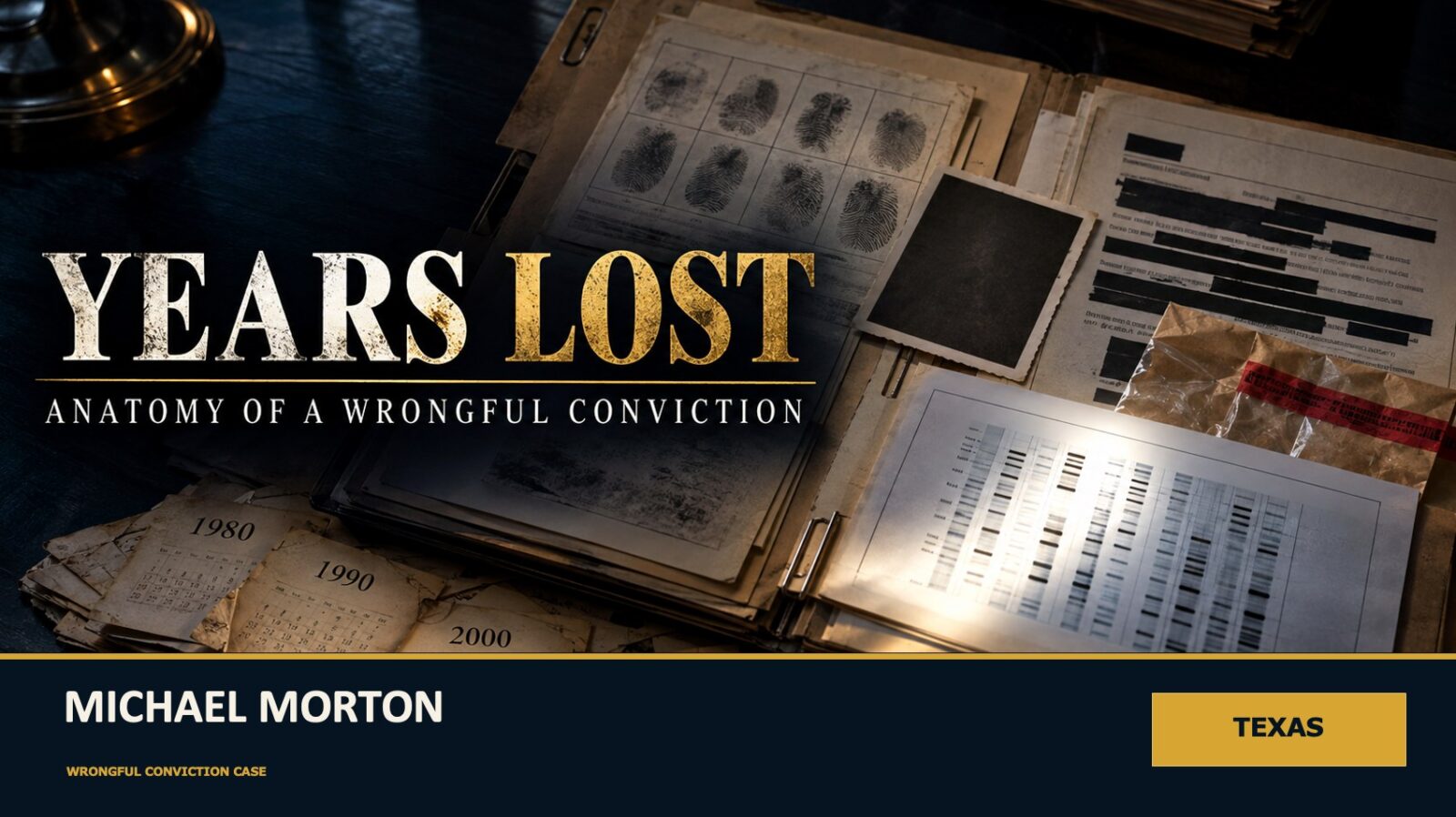
The prosecutor held reports pointing to another man. A bloody bandana sat untested for 25 years. Texas rewrote its discovery law in his name.
| Case at a Glance | |
|---|---|
| Name | Michael Morton |
| Where | Williamson County, Texas (north Austin) |
| Charge | Murder of his wife, Christine Morton, August 13, 1986 |
| Convicted | February 17, 1987; sentenced to life in prison |
| Years lost | Nearly 25 years in prison; released October 4, 2011 |
| What went wrong | Prosecutor withheld investigator reports pointing to an intruder; post-conviction DNA testing opposed for years |
| How it came apart | Court-ordered testing of a bandana found near the home; DNA matched Mark Alan Norwood through CODIS in 2011 |
| Status today | Exonerated; conviction vacated October 12, 2011 and case dismissed December 19, 2011; compensated by the State |
| What it changed | Michael Morton Act (Art. 39.14); S.B. 825 prosecutor grievance rule; a court of inquiry that ended with the prosecutor jailed and disbarred |
The Road to Exoneration
- Done: ConvictedFebruary 1987
- Done: Conviction set asideOctober 12, 2011
- Done: ReleasedOctober 4, 2011
- Done: Charges dismissed or acquittedDecember 19, 2011
- Done: Exonerated2011
- Where it stands: CompensatedAbout $1.9 million plus an annuity
Morton’s case went the full distance. Most of the cases in this series stop somewhere short of that.
What Happened
On the night of August 12, 1986, Michael Morton turned 32. He, his wife Christine and their three-year-old son, Eric, went out to dinner in Austin and came home. Early the next morning Michael left for work at a grocery store, leaving Christine a note. Later that morning Christine was found beaten to death in their bed, in the Williamson County part of Austin. Eric was in the house.
Six weeks later Michael Morton was arrested for her murder. He would not come home until October 4, 2011.
How the Case Was Built
There was no eyewitness, no confession and no physical evidence placing Michael Morton in the act. The State built a theory instead. The note Michael left that morning expressed disappointment that the birthday evening had not ended the way he hoped, and the prosecution argued it showed a motive. Prosecutors added a sexually explicit movie Michael had rented and a medical examiner’s estimate of the time of death, drawn from Christine’s stomach contents, that placed the killing before he left for work. Two defense pathologists testified that the estimate could not carry that weight.
On February 17, 1987, after about two hours of deliberation, a Williamson County jury convicted Michael Morton of murder. He was sentenced to life in prison.
What Went Wrong
The prosecutor told the court that the State had turned over everything favorable to the defense. The lead investigator’s reports went to the trial judge in a sealed file. What those reports actually contained did not reach Morton’s lawyers until 2011:
- The son’s account. Christine’s mother told the lead investigator that Eric, who was three, had described watching a “monster” attack his mother and had said his father was not home.
- The green van. Neighbors reported that before the murder a man had repeatedly parked a green van behind the Mortons’ house and walked off into the nearby woods.
- The credit card. Christine’s credit card, missing after the murder, was reportedly used at a San Antonio jewelry store in the days that followed.
- The check. A check on Christine’s account was reportedly cashed after Michael had been arrested.
Any one of those items points away from a husband who was at work and then in jail. Together they describe an intruder who took Christine’s property and kept using it. None of it was in front of the jury.
How It Came Apart
Within days of the murder, Christine’s brother found a blue bandana with what appeared to be blood on it, about 100 yards from the house. Police collected it. It played no role at trial.
In 2005, the Innocence Project and Houston lawyer John Raley asked for post-conviction DNA testing of the bandana and other evidence. Then-District Attorney John Bradley opposed the request. In 2006 the trial court allowed testing of some items but refused to test the bandana. It took until January 2010 for the Third Court of Appeals in Austin to order the bandana tested.
The results came back on June 30, 2011. The bandana carried Christine’s blood and hair and the DNA of an unknown man. The profile was run through the national CODIS database and matched Mark Alan Norwood, a man with a criminal record who had been living in Texas at the time of the murder.
Morton’s lawyers also obtained the investigator’s reports that had never been disclosed. On October 4, 2011, Judge Sid Harle recommended that the conviction be set aside, and Michael Morton walked out of prison. The Court of Criminal Appeals vacated the conviction on October 12, and the case against him was dismissed on December 19, 2011.
On January 13, 1988, about 17 months after Christine Morton’s death, Debra Masters Baker was beaten to death in her bed in Austin. Her case went unsolved for more than two decades. After the bandana match, investigators connected Norwood to that killing as well, through a hair recovered at the scene. Norwood was convicted of Christine Morton’s murder in March 2013 and sentenced to life in prison, and he was later convicted of Debra Baker’s murder.
When the wrong man goes to prison, the right one is still free.
Where Things Stand Now
Morton is free and fully exonerated. Under the Tim Cole Act, Texas compensates people who were wrongfully imprisoned with a set amount for each year served plus an annuity; Morton received about $1.9 million and a monthly annuity. No amount of money returns the years he lost, including the childhood of a son who was three when his father was taken away.
Morton’s lawyers asked for a court of inquiry, a rarely used Texas proceeding in which a judge investigates whether a crime was committed. In 2012 the Chief Justice of the Texas Supreme Court appointed Judge Louis Sturns, a former Court of Criminal Appeals judge, to hear it. In April 2013 Judge Sturns found probable cause that Ken Anderson, the prosecutor who tried Morton and by then a district judge, had committed criminal contempt by failing to comply with the trial judge’s order to produce the investigator’s reports. Anderson resigned from the bench that September. In November 2013 he pleaded to criminal contempt, was sentenced to 10 days in jail, and agreed to give up his law license.
How Texas Law Answers It
Few Texas cases have produced as much law as this one. Some of it you can use in a courtroom tomorrow.
The Michael Morton Act
Signed in May 2013 and effective January 1, 2014, the Michael Morton Act rewrote Article 39.14 of the Code of Criminal Procedure into an open-file discovery statute. On request, the State must produce offense reports, witness statements and other material evidence it holds, and it must disclose exculpatory, impeachment and mitigating information whether or not anyone asks. We walked through those duties, and the 2024 State v. Heath decision holding that “the State” includes the police, in Years Lost, Case No. 01.
Two less-discussed provisions answer the specific way Morton’s case went wrong. The State must now electronically record or otherwise document every item it gives the defense. And before a plea or a trial, the parties must acknowledge on the record what was disclosed. No one should ever again be able to tell a judge that everything was turned over without a record showing exactly what was.
Accountability for prosecutors
The Legislature also closed a timing gap that had protected prosecutors in cases like this one. Under S.B. 825, passed in 2013, a grievance alleging that a prosecutor withheld exculpatory evidence from someone later found to have been wrongfully imprisoned can be filed within four years of that person’s release, not four years from the misconduct. Grievance committees are also barred from resolving those violations with a private reprimand.
Getting the evidence tested
Morton’s DNA request took about five years to win. It was made under Chapter 64 of the Code of Criminal Procedure, the post-conviction testing statute discussed in Case No. 01. The Legislature has since loosened one of its barriers: since 2015, a court need only find a reasonable likelihood that the evidence contains biological material suitable for testing. A request still has to clear the statute’s other requirements, and as Morton’s case shows, a prosecutor can still oppose it at every step.
What This Means If You Are Charged in Texas
- Ask for the file, in writing, at the start. A Michael Morton Act request is what triggers most of Article 39.14. Send it early and follow up.
- Ask about every lead the police did not follow. Tips, other suspects, unidentified vehicles, property that turned up somewhere it should not have. In Morton’s case, those were the reports that mattered.
- Read the disclosure list before you plead or go to trial. The acknowledgment requirement exists so you can see what was turned over. Compare it to what should exist.
- Get untested evidence tested before trial, not after. Morton’s bandana was in police custody from 1986. Testing it then would have cost a lab fee. Waiting cost 25 years.
- Preserve the physical evidence. If evidence may matter later, put the State on notice that it must be kept.
The Bottom Line
Michael Morton was convicted on a theory, while the evidence of what actually happened sat in a police file and a bandana sat in a bag. Texas did not fix that by trusting people to do better. It wrote rules that require disclosure, require a record of it, and give a wrongly convicted person more time to hold a prosecutor accountable. Those rules carry his name. They work only when a defense lawyer uses them, early and in writing, in every case.
Sources
Primary sources
- S.B. 1611 (83rd Leg., 2013), the Michael Morton Act, amending Tex. Code Crim. Proc. art. 39.14. capitol.texas.gov
- House Research Organization bill analysis, S.B. 825 (83rd Leg., 2013). lrl.texas.gov
- Tex. Code Crim. Proc. art. 64.03 (post-conviction DNA testing). texas.public.law
News coverage
- “Ft. Worth Judge to Lead Ken Anderson Court of Inquiry,” The Texas Tribune (February 16, 2012). texastribune.org
- “Court of Inquiry Ends With Arrest Warrant for Anderson,” KUT (April 19, 2013). kut.org
- “Former DA Anderson Pleads Guilty to Withholding Evidence in Morton Case,” The Austin Chronicle (November 2013). austinchronicle.com
Reference
- National Registry of Exonerations, Michael Morton case entry. exonerationregistry.org
- The Texas Tribune, Michael Morton case timeline. texastribune.org
This post is an informational synthesis for educational purposes and is not legal advice. It is based on court records and published reporting available as of October 2026. Michael Morton was fully exonerated; Mark Alan Norwood was convicted of Christine Morton’s murder. Case citations and statutory references should be independently verified against the official record before use in any filing.
Which county your case is filed in changes how it is charged, who prosecutes it, and which court hears it.
Deandra M. Grant, JD, GC, MS, ACS-CHAL Forensic Lawyer-Scientist
She holds a Master of Science in Pharmaceutical Science and a Graduate Certificate in Forensic Toxicology, both from the University of Florida. She is the author of The Texas DWI Manual and has defended Texas DWI cases since 1994.
Facing a Serious Charge in Texas?
The Michael Morton Act only protects you if someone uses it. Whatever you are facing, the sooner a forensic-trained defense team is on it, the more we can do. Intake answers 24/7.
Request a Free Case Evaluation
Tell us what happened. We'll respond as soon as possible.