
L-Methamphetamine vs. D-Methamphetamine: The Science of a Drug Test That Could Convict an Innocent Person

A person uses a Vicks VapoInhaler for a stuffy nose. They are on probation. At their next urinalysis, the immunoassay screen comes back positive for methamphetamine. The lab runs a standard GC-MS confirmation: methamphetamine confirmed. No further analysis is performed. The probation officer files a motion to revoke, and a person who has never touched illicit methamphetamine faces prison over a probation violation.
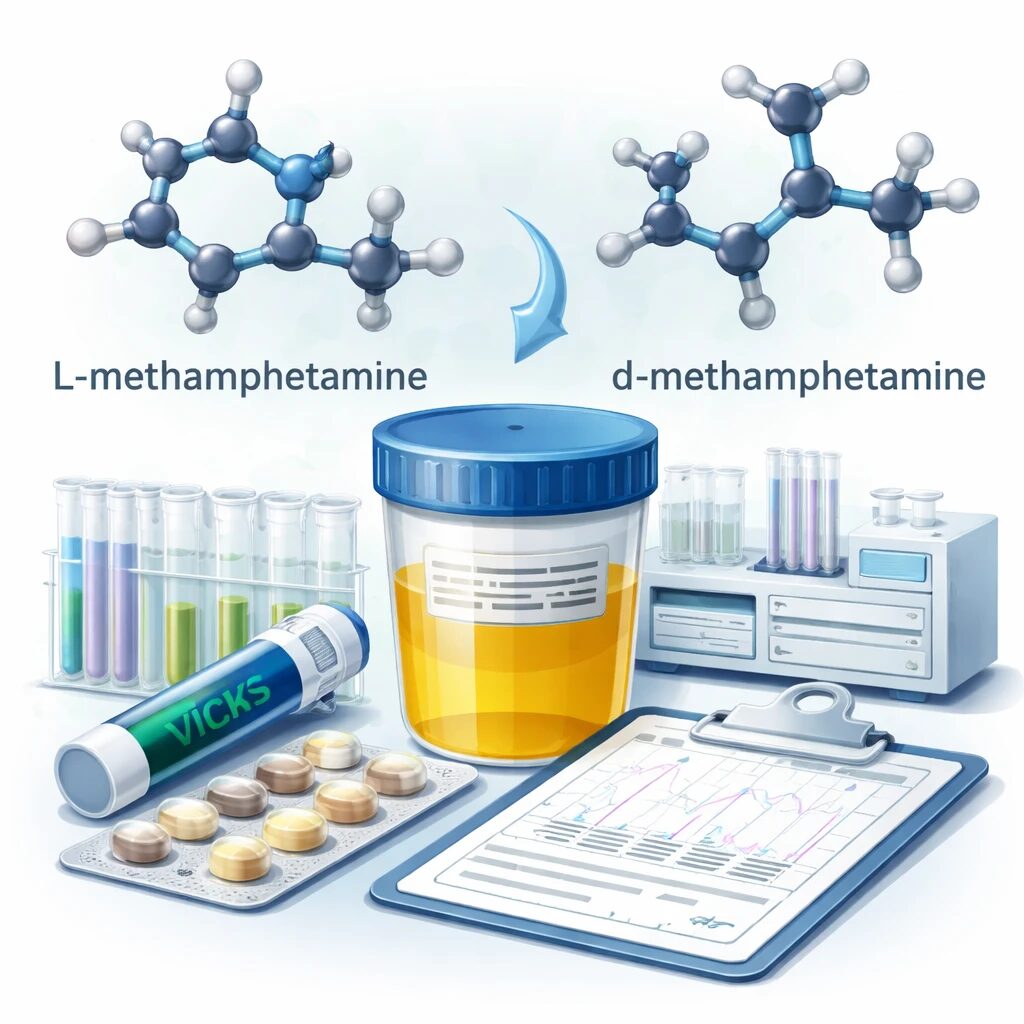
This is not hypothetical. It is a predictable consequence of a testing system that treats all methamphetamine as the same molecule, when in fact it is not.
Methamphetamine exists as two mirror-image molecules called enantiomers: d-methamphetamine, the illicit, psychoactive form, and l-methamphetamine, the form used as an over-the-counter nasal decongestant, with minimal central-nervous-system stimulant activity. The standard drug tests used by crime labs, probation departments, employers, and the military often cannot distinguish between them. Recent research has revealed additional pathways, including metabolic conversion from legal amphetamine medications, that can produce low-level methamphetamine in a person who has never used the drug in any form.
We wrote this together because the problem sits at the intersection of pharmaceutical science, forensic toxicology, and criminal defense, and because the consequences of getting it wrong are severe. What follows is the science every defense attorney, prosecutor, judge, probation officer, and defendant in a methamphetamine case needs to understand, and, just as important, the Texas legal argument that the science actually supports.
The Chemistry: Why Two Identical Molecules Are Not the Same Drug
 Methamphetamine has a chiral center, a carbon atom bonded to four different groups, so the molecule exists in two non-superimposable mirror-image forms, like a left hand and a right hand. These enantiomers have identical molecular formulas (C₁₀H₁₅N), identical molecular weights, identical melting points, and identical chemical reactivity in non-chiral environments. For most analytical purposes, they are the same molecule.
But biology is a chiral environment. Enzymes, receptors, and transport proteins are three-dimensional structures that interact differently with a molecule depending on its spatial configuration, which is why the two enantiomers have dramatically different pharmacological profiles.
D-methamphetamine (also designated S-(+)-methamphetamine) is the enantiomer that produces powerful CNS stimulation. It increases synaptic dopamine through several mechanisms, including reversal of the dopamine transporter and inhibition of monoamine oxidase. This is the form responsible for the euphoria, compulsive redosing, and addictive potential behind illicit “crystal meth,” and it is also the active ingredient in the rarely prescribed medication Desoxyn.
L-methamphetamine (also designated R-(−)-methamphetamine) has the same atoms arranged as a mirror image. That small spatial difference translates into a very different profile: potent vasoconstriction in the nasal passages but a markedly weaker ability to cross the blood-brain barrier and stimulate central dopamine release. This is why l-methamphetamine is sold as an FDA-approved over-the-counter nasal decongestant. It is the active ingredient in the Vicks VapoInhaler, under the pharmaceutical name levmetamfetamine.
From a toxicological standpoint the distinction is profound. The d-enantiomer is a drug of abuse with well-characterized neurotoxic effects at high doses. The l-enantiomer, at over-the-counter doses, produces peripheral vasoconstriction with negligible CNS effects. Treating them as pharmacologically equivalent in a forensic context is scientifically indefensible. As we explain below, though, that pharmacological point has to be translated into the right legal argument, because Texas law does not treat l-methamphetamine as harmless.
The Testing Problem: Three Steps, Two Blind Spots
Step 1: The Immunoassay Screen
The first step in virtually all drug-testing programs, whether workplace, criminal-justice, military, or clinical, is an immunoassay screen: a rapid, antibody-based test that flags amphetamine-class compounds. It is built for throughput and sensitivity, not specificity. The antibodies bind methamphetamine based on overall shape and functional groups, and the spatial difference between the enantiomers is usually too subtle for the binding site to resolve.
A controlled study by Smith et al. in the Journal of Analytical Toxicology gave the Vicks VapoInhaler to 22 healthy adults at manufacturer-recommended doses (28 inhalations over two days) and tested all 391 urine specimens with three commercial immunoassays: EMIT II Plus, KIMS II, and DRI. The EMIT II Plus assay, which carries a manufacturer-reported l-methamphetamine cross-reactivity of 38 percent, produced a 2.2 percent false-positive rate. The KIMS II assay produced a single false positive (99.6 percent specificity), and the DRI assay produced none at all (100 percent specificity).
The screening step is important to note: two of the three assays essentially never false-flagged directed VapoInhaler use, and even the outlier tripped in only about one specimen in fifty. The real exposure comes one step later. This is also why the threshold question in any of these cases is whether the positive was even confirmed at all, the presumptive-versus-confirmatory problem we cover in our post on faulty drug screens.
The reverse error exists too. A 2024 University of Bonn study (Plenert et al., Drug Testing and Analysis) documented confirmed l-methamphetamine consumption that immunoassay screening missed, because cross-reactivity was much lower for the R-enantiomer. So, the screen can both falsely include and falsely exclude (a false positive and a false negative).
Step 2: The Standard Confirmation, and Where the Real Harm Happens
When a screen is positive, the sample is typically confirmed by gas chromatography-mass spectrometry (GC-MS) or liquid chromatography-tandem mass spectrometry (LC-MS/MS), widely considered the gold standard of forensic drug confirmation.
Here is the critical point that many attorneys, judges, and probation officers do not know: standard GC-MS and standard LC-MS/MS cannot distinguish d-methamphetamine from l-methamphetamine. Both enantiomers produce identical mass spectra because they have identical structures and fragment the same way. Mass spectrometry sorts by mass and fragmentation, not by spatial configuration, so a standard confirmation reports “methamphetamine confirmed” without saying which enantiomer was present.
The Smith study showed this directly. Using a chiral-specific method (MTPA derivatization, greater than 99 percent enantiomeric purity), the researchers found zero d-methamphetamine and zero d-amphetamine in any of the 391 specimens from directed VapoInhaler use, at a limit of quantification of 10 micrograms per liter. Every positive was exclusively l-methamphetamine. A standard, non-chiral confirmation would have reported those same specimens simply as “methamphetamine positive,” indistinguishable from illicit use. If the lab stops there, and in our experience many labs do unless specifically instructed otherwise, the innocent person and the illicit user get the identical report.
Step 3: Chiral Analysis, the Test That Answers the Question
The only way to separate d- from l-methamphetamine is chiral analysis, an additional step that resolves the enantiomers before or during detection. Several validated approaches exist:
- Chiral derivatization with GC-MS. A chiral reagent converts the enantiomers into separable diastereomers. The common U.S. reagent, L-TPC, introduced by Fitzgerald et al. in 1988, carries a variable D-TPC impurity whose l-methamphetamine derivative co-elutes with the d-methamphetamine derivative, an artifact that can be mistaken for d-methamphetamine and one reason federal guidance requires a minimum of 20 percent d-methamphetamine to call a specimen positive. The Smith team used the cleaner R-(−)-MTPA chloride method to avoid it.
- Chiral HPLC or LC-MS/MS with a chiral column. A chiral stationary phase separates the enantiomers directly, without derivatization, and tandem mass spectrometry quantifies them. A recent method using Marfey’s reagent reached 1 microgram per liter sensitivity in plasma and oral fluid.
- Standard C18 column with chiral derivatization. A 2025 Restek method separated d- and l-methamphetamine and amphetamine on an ordinary reversed-phase C18 column after a simple precolumn derivatization, in under seven minutes, removing the cost-and-maintenance excuse for skipping chiral testing.
- Capillary electrophoresis with chiral selectors. CE-MS with anionic cyclodextrin selectors resolves all the enantiomers in a single run, with excellent resolution though less common in forensic labs.
All chiral methods require extra reagents, time, and expertise, and cost more than a standard confirmation. As a result, chiral analysis is not routinely performed unless it is specifically requested. In many labs, once the standard confirmation reports methamphetamine, the case is closed and the question of which methamphetamine was never asked.
Beyond Vicks: Every Source of Methamphetamine That Is Not Illicit
The VapoInhaler is the most discussed source, but a thorough evaluation has to consider the full range of lawful sources that can produce a positive:
- Vicks VapoInhaler (levmetamfetamine). About 50 mg of l-methamphetamine per inhaler. In the Smith study, directed use produced a median peak urine concentration of 62.8 micrograms per liter, with a range up to 1,440 and wide variability between people, still detectable in most subjects 11 hours after the last inhalation. Two of 22 subjects reached or exceeded the 250 microgram-per-liter federal workplace confirmation cutoff, so even directed use can land in the range that triggers confirmatory testing. No d-methamphetamine or d-amphetamine was detected in any specimen, though proficiency-testing labs have reported up to 2.5 percent d-methamphetamine in VapoInhaler extracts.
- Selegiline (Deprenyl, Eldepryl, Emsam). A MAO-B inhibitor prescribed for Parkinson’s disease, major depression (the Emsam patch), and dementia. Selegiline is metabolized to l-methamphetamine and l-amphetamine, so a patient taking it as prescribed will test positive on both immunoassay and standard confirmation, and only chiral analysis reveals the exclusively l-enantiomer pattern consistent with the medication rather than illicit use. This is the source that surprises people most.
- Benzphetamine (Didrex). A Schedule III anorectic metabolized to d-methamphetamine and d-amphetamine, a legitimate prescription source of the d-form whose chiral profile looks identical to illicit use, so prescription verification and metabolite ratios matter.
- Amphetamine N-methylation (2025 research). A 2025 study by Helander et al. showed that amphetamine itself can undergo metabolic N-methylation to low concentrations of methamphetamine. Patients on d-amphetamine ADHD medications (Adderall, Dexedrine), which contain no methamphetamine at all, produced detectable d-methamphetamine, and illicit racemic amphetamine produced methamphetamine at a matching l/d ratio, confirming the metabolic origin. The authors concluded that methamphetamine below roughly 2 percent of the amphetamine concentration does not warrant concern for separate methamphetamine use, a ratio point that is genuinely new to most defense lawyers.
- Illicit methamphetamine composition. Depending on the synthesis, illicit product may be enantiopure d-methamphetamine (most common in North America), racemic, or predominantly one enantiomer. The enantiomeric ratio can point to source and method, but only if chiral analysis is done.
The Texas Legal Correction: What the Argument Actually Is
In Texas, the argument is not that l-methamphetamine is not methamphetamine. Penalty Group 1 defines the drug as “methamphetamine, including its salts, optical isomers, and salts of optical isomers” (Texas Health and Safety Code Section 481.102(6)), and l-methamphetamine is an optical isomer.
What is lawful is not the isomer in the abstract. It is possessing l-methamphetamine in the form of an FDA-approved over-the-counter product, like the Vicks VapoInhaler, or producing it as the metabolite of a lawfully prescribed medication. The argument that works is the one this entire article is built on: a lawful product or prescription fully explains the positive result, which means the inference that the person used illicit methamphetamine does not hold. The chiral question matters not because l-methamphetamine is a free pass, but because identifying the result as l-methamphetamine points to a lawful source and defeats the illicit-use inference the State needs to carry its burden. This is the same move that a lawful explanation makes in a cannabis case, which we develop in our post on THC redistribution.
How This Reaches Innocent People: The Legal Consequences
These are not rare edge cases. They are structural vulnerabilities:
- Probation and parole revocation. A positive screen and standard confirmation, no chiral analysis, a motion to revoke, and a burden of proof that is only a preponderance of the evidence, far below beyond a reasonable doubt. The confirmation is often treated as dispositive, and the person faces incarceration over a legal nasal decongestant.
- CPS investigations. A positive methamphetamine result during a child protective services investigation can trigger removal proceedings, even where the parent used a VapoInhaler and never recognized “levmetamfetamine” on the label as a form of methamphetamine.
- Employment termination. A workplace positive, a Medical Review Officer who may or may not ask about over-the-counter medications, and an employee who does not know to mention the inhaler, ending in a confirmed positive and a lost job.
- Military separation. The military has documented cases resolved by chiral analysis. In one Navy case, chiral testing showed 95 percent d-methamphetamine, inconsistent with VapoInhaler use, and correctly confirmed illicit use. Where chiral testing is not done, the truth stays hidden and a career can be destroyed either way.
- New drug-charge prosecution. In jurisdictions that charge possession from metabolite detection, a methamphetamine confirmation without chiral analysis could support a charge where the “substance” was a legal decongestant.
What Defense Attorneys Must Do: A Forensic Toxicology Checklist
If your client faces a methamphetamine charge or a supervision violation based on a positive test, these steps are essential:
- Demand the lab’s full analytical methodology. Standard GC-MS or LC-MS/MS only, or was chiral analysis performed? Ask directly whether enantiomeric separation was done. If not, the test cannot establish that the methamphetamine detected was the controlled substance rather than a lawful source.
- Ask your client about over-the-counter medications. Specifically, the Vicks VapoInhaler, any nasal decongestant inhaler, or any product containing levmetamfetamine. Most clients will not volunteer this, because they do not know an inhaler contains a form of methamphetamine. (Examples – Equaline Nasal Decongestant Vapor Inhaler, H-E-B Vapor Inhaler Nasal Decongestant, generic vapor inhalers from CVS, Walgreens, etc)
- Ask about prescription medications. Selegiline metabolizes to l-methamphetamine; benzphetamine to d-methamphetamine; and amphetamine ADHD medications (Adderall, Dexedrine, Vyvanse) can produce low-level d-methamphetamine by N-methylation. Request pharmacy records and prescriber verification.
- Request chiral analysis of the original sample. If it was not done, move to have the remaining sample submitted for enantiomer-specific testing. Modern methods, including the 2025 Restek C18 approach, run on standard equipment in under seven minutes, so “too expensive” is increasingly untenable.
- If no sample remains, challenge the sufficiency of the evidence. A confirmation without chiral analysis tells you methamphetamine was present. It does not tell you the controlled substance was present, and the State cannot meet its burden without answering that question.
- Evaluate the methamphetamine-to-amphetamine ratio. If both were detected, the Helander study establishes that methamphetamine below roughly 2 percent of the amphetamine level is consistent with metabolic N-methylation of amphetamine, not separate methamphetamine use, which matters directly for a client on prescribed amphetamine.
- Retain a forensic toxicology expert. Enantiomers, chiral chromatography, immunoassay cross-reactivity, and metabolic pathways are not intuitive, and a board-certified toxicologist can explain to the court why a standard test is insufficient and interpret the results against the client’s medication history.
- Preserve the product and documentation. Have the client keep the inhaler or medication, the packaging, the receipt, and any pharmacy records. Contemporaneous documentation is far more persuasive than an after-the-fact explanation.
Quick Reference: Sources of Methamphetamine in Drug Tests
| Source | Enantiomer | Status in a Texas case | Key point |
| Illicit meth (street) | d-meth (usually) | Penalty Group 1 | Most common in the U.S.; may be racemic |
| Vicks VapoInhaler | l-meth only | Lawful as an approved OTC product | 50 mg per inhaler; median peak 62.8, range up to 1,440 µg/L; detectable 11+ hrs |
| Selegiline | l-meth + l-amp | Lawful as prescribed (Rx) | Metabolite; Parkinson’s / depression Rx |
| Benzphetamine | d-meth + d-amp | Lawful as prescribed (Schedule III Rx) | Metabolite mimics the illicit profile |
| Desoxyn | d-meth | Lawful as prescribed (Schedule II Rx) | Rare ADHD / obesity Rx; same form as illicit |
| Adderall / Dexedrine | Trace d-meth | Lawful as prescribed (Schedule II Rx) | N-methylation metabolite; under 2% of amphetamine level |
Note: l-methamphetamine is itself an optical isomer within Penalty Group 1 under Health and Safety Code Section 481.102(6). What is lawful is possessing it in the form of an approved over-the-counter product or as the metabolite of a lawful prescription, not the isomer as a bare chemical. Selegiline is not itself federally scheduled, though its metabolites are.
The Science Behind the Defense
The distinction between l-methamphetamine and d-methamphetamine is not a courtroom technicality. It is the difference between a result consistent with a lawful product and one consistent with an illicit controlled substance, and under Texas law that difference goes to whether the State can prove illicit use, not to whether the molecule counts as methamphetamine. The two enantiomers are identical in every way except the spatial arrangement of atoms around a single carbon, a difference invisible to immunoassay screens and to standard mass spectrometry but decisive for the inference a court is being asked to draw.
The science to resolve the question exists. Validated chiral methods are available, and recent advances have made them faster, cheaper, and deployable on standard equipment. There is no longer a credible excuse for a laboratory to report a methamphetamine positive without addressing the enantiomeric question, and no excuse for a court to treat such a result as proof of illicit use. Every attorney handling a methamphetamine case should understand this science, every laboratory should be ready to answer the enantiomeric question, and every court should require that it be answered before a person’s liberty is taken.
About the Authors
Deandra Grant, J.D., M.S. is the Managing Partner of Deandra Grant Law and an ACS-CHAL Forensic Lawyer-Scientist who teaches the ACS forensic chromatography and drug-analysis courses at Axion Analytical Labs and serves on the faculty of the Robert F. Borkenstein Drug Course at Indiana University. She holds a Master of Science in Pharmaceutical Science (Forensic Science Concentration) from the University of Florida College of Pharmacy and a Graduate Certificate in Forensic Toxicology from UF’s College of Veterinary Medicine, and she chairs the DUI Defense Lawyers Association’s Board Certification program. Stereochemistry, enantiomers, and chiral separation are core concepts in her pharmaceutical-science training.
Sol Bobst, Ph.D., DABT is a board-certified toxicologist (Diplomate, American Board of Toxicology) and the founder of ToxSci Advisors LLC. Dr. Bobst provides forensic toxicology consulting, expert-witness testimony, and scientific review to attorneys and organizations across the United States, with expertise in analytical toxicology, drug metabolism, and the interpretation of drug-testing results.
This post is general legal and scientific information for educational purposes, not legal advice. Citations should be independently verified against current sources before being relied on in any filing. If you are facing a methamphetamine test result you believe reflects a lawful product or prescription, call (214) 225-7117 for a confidential consultation.
Key References
Smith ML, Nichols DC, Underwood P, et al. Methamphetamine and amphetamine isomer concentrations in human urine following controlled Vicks VapoInhaler administration. J Anal Toxicol 38(8):524-527 (2014).
Helander A, et al. Metabolic N-methylation of amphetamine to methamphetamine. Drug Test Anal (2025).
Plenert E, et al. Immunoassay detection of R-(−)-methamphetamine. Drug Test Anal (2024).
Which county your case is filed in changes how it is charged, who prosecutes it, and which court hears it.
Deandra M. Grant, JD, GC, MS, ACS-CHAL Forensic Lawyer-Scientist
She holds a Master of Science in Pharmaceutical Science and a Graduate Certificate in Forensic Toxicology, both from the University of Florida. She is the author of The Texas DWI Manual and has defended Texas DWI cases since 1994.
Facing Criminal Charges in Texas?
The sooner a defense lawyer is involved, the more can be done to protect your record and your freedom. Talk to us today.
Request a Free Case Evaluation
Tell us what happened. We'll respond as soon as possible.