
Can a Faulty Drug Test Get New Parents Arrested?

A new mother gives birth, and somewhere in the blur of labor a nurse collects a urine sample. A rapid screen comes back positive for an illegal drug. Within hours a child-welfare worker is at the bedside, and a report has gone to the police. The mother insists she used nothing, and she is right: the culprit was a poppy-seed bagel, or a blood-pressure medication she was prescribed for her pregnancy, or the antiseptic soap used to clean the newborn. But the investigation is already moving, and the confirmatory test that would clear her, if it is ever run, will not catch up for days or weeks.
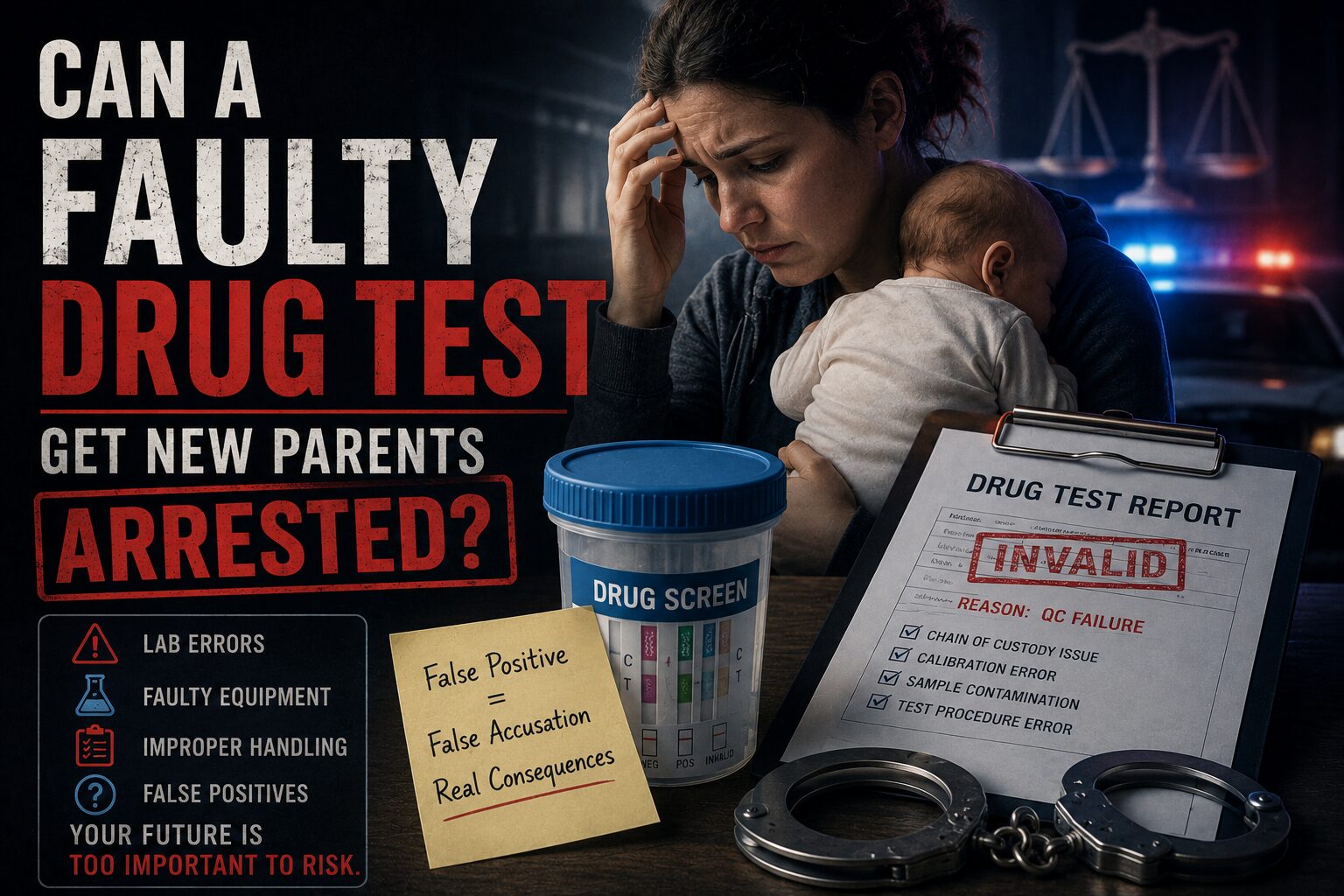
That scenario, documented this month in a Marshall Project and CBS investigation, is happening to new parents across the country, and the reporters found it falls hardest on mothers of Black newborns. It is a wrenching story on its own terms. For anyone who works in criminal defense, it is also a vivid illustration of a scientific problem that reaches far beyond delivery rooms, into DWI cases, drug-possession arrests, and probation hearings: the difference between a test that suggests a drug might be present and a test that proves it is. A positive drug test, standing alone, is not proof.
Two Kinds of Drug Test, and Only One Proves Anything
Forensic drug testing happens in two stages: The first stage is the presumptive test, also called a screening test. It is designed to be fast, cheap, and sensitive, meant to flag anything that might be a drug so it can be looked at more closely. It is not designed to be specific, and that is the whole problem. There are two kinds you will meet. In hospitals and probation offices, the screen is usually an immunoassay, which uses antibodies that latch onto a target drug. At the roadside, it is usually a colorimetric field test, the two-dollar pouch of chemicals that changes color when it touches a suspected substance. Both are presumptive. Neither identifies a specific molecule.
The second stage is the confirmatory test, and this is the one that actually identifies what is in the sample. The gold standard is mass spectrometry, usually gas chromatography-mass spectrometry (GC/MS) or liquid chromatography-tandem mass spectrometry (LC-MS/MS). These instruments first separate the compounds in a sample and then identify each one by its unique mass-spectral signature, a chemical fingerprint no other molecule shares. A confirmatory test does not say a drug is probably present. It says which molecule is there. The accepted rule across clinical and forensic toxicology is that a presumptive positive means nothing until it is confirmed by GC/MS or an equivalent method. Reporting an unconfirmed screen as a true positive is not a close call. It is scientifically indefensible.
Why Presumptive Tests Cry Wolf
Presumptive tests generate false positives because they react to the wrong things. An immunoassay antibody is built to recognize a drug, but it cannot always tell that drug apart from a chemically similar molecule, so ordinary substances set it off. Poppy seeds can produce a positive for opiates. Labetalol, a blood-pressure medication commonly prescribed during pregnancy, can read as an amphetamine. Certain antiseptic soaps and baby washes can trigger a positive for THC in a newborn’s sample. Cold medicines, antidepressants, and common pain relievers all carry their own well-documented cross-reactions.
The roadside color tests are, if anything, worse. Studies from the University of Pennsylvania’s Quattrone Center have found false-positive rates ranging from fifteen percent to nearly forty percent, and everyday substances including vitamins, sugar, chocolate, soap, and household powders have all turned these tests the color that police read as a drug. The researchers estimated that roughly thirty thousand people a year are falsely implicated by field tests, and concluded that these kits are likely the single largest cause of wrongful arrests and convictions in the United States. The manufacturers themselves warn that the tests are for presumptive use only and are not a basis for a conviction.
Texas Has Already Lived This Disaster
This is not an out-of-state problem. Texas produced the most notorious field-test scandal in the country. In Harris County, a review of drug-possession exonerations found that dozens of people had pleaded guilty to possessing substances that later laboratory testing proved were not drugs at all, and over roughly a decade the Houston crime lab identified more than three hundred convictions in which the alleged narcotics were nothing of the kind. People pleaded guilty because they were sitting in jail, could not afford to wait months for a lab result, and were staring at an official-looking positive test. The confirmatory analysis, when it finally ran, came back negative, long after the plea was entered.
The response was official and unambiguous. The Timothy Cole Exoneration Review Commission, the state body created to study wrongful convictions in Texas, singled out field drug tests for their questionable reliability and recommended that crime laboratories confirm the drug evidence in every prosecution. The science behind that recommendation is the same science in the hospital story: a presumptive test is a lead, not a verdict.
Dallas County had their own “fake drug” scandal in the early 2000’s. See here and here.
The Colorado Signal
Other states are now building that principle into law. This spring, Colorado became the first state to prohibit police from arresting a person for low-level drug possession based solely on a colorimetric field test. Officers must instead issue a summons and let a laboratory do the confirming. Colorado also requires its courts, before accepting a guilty plea in a drug-possession case, to tell the defendant on the record that these field tests have known error rates, are subject to false positives, are inadmissible in court, and that the defendant has the right to demand accredited laboratory testing first. It is a striking admission from a legislature, passed unanimously, that a positive presumptive test had been doing work it was never scientifically capable of doing.
What a Texas Defense Should Do with a Positive Test
Whether the positive came from a hospital screen, a roadside kit, or a probation cup, the defense response is the same, and it starts by refusing to treat the screen as the end of the inquiry.
- Demand the confirmatory result. If the State has only a presumptive screen, it has a presumption, not proof. Ask specifically for GC/MS or LC-MS/MS confirmation, and if there is none, say so loudly.
- Do not let a client plead on a screen. The Harris County catastrophe happened because people pleaded guilty before confirmatory testing. A presumptive positive is a reason to wait for the lab, not to give up.
- Get the validation data. Demand the specific test or reagent used, its known cross-reactants, the laboratory’s standard operating procedures and validation studies, and the analyst’s bench notes. A cross-reaction you can name is a false positive you can explain.
- Reconstruct the innocent explanation. Medications, foods, supplements, and even soaps can account for a screen. The client’s prescriptions and diet are evidence.
- Use the Texas tools. The accreditation requirements of Article 38.35, the reliability gate of the Kelly standard, and Michael Morton Act discovery all give you leverage to pull the underlying data and to keep an unconfirmed screen away from a jury.
The Bottom Line
A drug test result carries an aura of certainty that the underlying science often does not support. A presumptive screen, whether it is an immunoassay in a hospital or a color-change kit at the roadside, is built to be over-inclusive, and it routinely flags the innocent: the patient on prescribed medication, the parent who ate a poppy-seed roll, the driver with powdered sugar in the car. Only a confirmatory test, mass spectrometry performed by an accredited laboratory, actually identifies what was in the sample. Texas learned the cost of forgetting that distinction the hard way, in hundreds of wrongful drug convictions. The lesson of this series holds here with full force: the label on a result is only as good as the method behind it, and a positive test you cannot confirm is not proof of anything. Demand the confirmation, every time.
Deandra Grant is a forensic lawyer-scientist and the first attorney in Texas to earn the ACS-CHAL Forensic Lawyer-Scientist designation. She holds an M.S. in Pharmaceutical Science and a Graduate Certificate in Forensic Toxicology, and she has spent three decades challenging the drug and alcohol testing behind the State’s evidence. This post is part of the Deandra Grant Law forensic science series.
Further Reading
- The Marshall Project and CBS Sunday Morning, “How a Faulty Hospital Drug Test Can Turn New Parents Into Police Targets” (August 2026). themarshallproject.org
- University of Pennsylvania Quattrone Center for the Fair Administration of Justice, study of colorimetric field drug tests and their false-positive rates. law.upenn.edu
- ProPublica, “Texas Panel on Wrongful Convictions Calls for an End to Unverified Drug Field Tests,” on the Houston scandal and the Timothy Cole Exoneration Review Commission. propublica.org
- Colorado House Bill 26-1020 (2026), the first state law barring arrests based solely on a colorimetric field test and requiring a plea-stage advisement about their error rates. leg.colorado.gov
- On the Texas tools: Tex. Code Crim. Proc. Art. 38.35 (accredited-laboratory requirement), Art. 39.14 (Michael Morton Act), and Art. 11.073 (junk-science writ); and Kelly v. State, 824 S.W.2d 568 (Tex. Crim. App. 1992).
This post is an informational synthesis for educational purposes and is not legal advice. Case citations and statutes should be independently verified against current Texas law before use in any filing. Anyone facing charges should consult a licensed Texas attorney about the specific facts of their case.
Which county your case is filed in changes how it is charged, who prosecutes it, and which court hears it.
Deandra M. Grant, JD, GC, MS, ACS-CHAL Forensic Lawyer-Scientist
She holds a Master of Science in Pharmaceutical Science and a Graduate Certificate in Forensic Toxicology, both from the University of Florida. She is the author of The Texas DWI Manual and has defended Texas DWI cases since 1994.
Charged With a Crime?
Whatever you're facing, a DWI or any criminal charge, the sooner you have a forensic-trained team on it the more we can do. Tell us what happened and we'll review your options, at no cost and no obligation. Intake answers 24/7, and if your case is one we can take on, we schedule a free consultation with an attorney.
Request a Free Case Evaluation
Tell us what happened. We'll respond as soon as possible.