
Can You Get a Texas DWI in a Self-Driving Car?
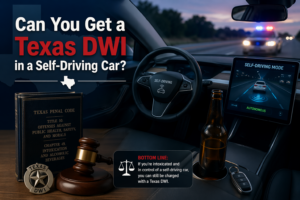
The short answer is yes and for most vehicles currently on Texas roads marketed as “self-driving,” the legal analysis is straightforward. What makes the question more interesting is understanding exactly why, what Texas law says about automated vehicles, and where the defense questions actually arise when a DWI case involves autonomous or semi-autonomous technology.
What Self-Driving Actually Means Today
The Society of Automotive Engineers defines six levels of vehicle automation (SAE J3016), ranging from Level 0 (no automation) to Level 5 (full automation in all conditions with no need for human intervention). The critical line for legal purposes runs between Level 2 and Level 3.
Levels 0, 1, and 2 all require the human driver to remain in control and monitor driving conditions at all times. Level 2 vehicles (which include Tesla’s Autopilot and Full Self-Driving (FSD) suite, GM’s Super Cruise, Ford’s BlueCruise, and similar systems) can handle both steering and speed simultaneously under certain conditions. But the driver must remain attentive and able to take control at any moment. Hands-off for stretches does not mean eyes-off or mind-off.
Level 3 vehicles allow the driver to disengage from active monitoring under defined conditions, with the vehicle alerting the human when takeover is needed. Here the common account of where the technology stands is backwards, so it is worth stating plainly. Mercedes Drive Pilot is the only Level 3 system ever certified in the United States, it was approved only in Nevada and California, it was never approved in Texas, and Mercedes is withdrawing it. The 2026 S-Class replaces it with a Level 2 system. Level 3 is retreating, not arriving.
Level 4 is a different story, and it is already on Texas streets. Waymo has operated fully driverless service with nobody in the driver’s seat in Austin since March 4, 2025, and in Dallas, Houston, and San Antonio since February 24, 2026, where it began as invitation only and dropped the waitlist on August 4, 2026. Tesla launched its Austin robotaxi service on June 22, 2025, and since January 22, 2026 it has run some of those vehicles with no safety monitor on board.
So, the accurate picture has two halves. No vehicle sold to a consumer operates above Level 2, which is true and is also the part that misleads, because a reader in Dallas can get into a car with no driver this afternoon. Every privately owned self-driving car in Texas is Level 2. The genuinely driverless vehicles here are fleet-operated, and nobody in them is sitting in a driver’s seat at all.
What Texas Law Says About Operating a Vehicle
Texas’s DWI statute (Penal Code §49.04) prohibits a person from operating a motor vehicle in a public place while intoxicated. The Legislature chose “operating” rather than “driving” deliberately, and the Texas Court of Criminal Appeals has given that word significant scope.
Denton v. State, 911 S.W.2d 388, 389 (Tex. Crim. App. 1995), settled that operating does not require the vehicle to be in motion. Denton was an unauthorized-use case involving a stolen pickup that would not start moving, not a DWI case, but its definition of operating governs Chapter 49. The court adopted the standard from Barton: the totality of the circumstances must demonstrate that the defendant took action to affect the functioning of his vehicle in a manner that would enable the vehicle’s use. Starting the engine, engaging the transmission, and adjusting controls have all qualified.
The Transportation Code’s definition of “operator” as “a person who drives or has physical control of a vehicle” (§541.001(1-a)) informs but does not limit the Penal Code analysis. Texas courts have interpreted physical control broadly (i.e. a person in the driver’s seat with the ability to take control of the vehicle’s functions is exercising physical control, whether or not they are actively doing so).
For a Level 2 vehicle with Autopilot engaged, this analysis resolves clearly: the person in the driver’s seat has physical control of the vehicle and is required by both the technology’s design and Texas law to maintain that control. They are operating the vehicle.
The Texas Automated Vehicle Statute, and Why It Does Not Apply
Texas does have an automated vehicle statute. Senate Bill 2807, passed by the 89th Legislature in 2025, rewrote it, and it now sits at Subchapter J of Chapter 545 of the Transportation Code.
Section 545.451 defines the subchapter’s terms by SAE level, and it reaches Level 3 and above. Tesla Autopilot and Full Self-Driving are Level 2. So are Super Cruise and BlueCruise. Every one of them falls outside Subchapter J entirely.
If you are in a Level 2 vehicle, there is no automated vehicle statute in play at all. There is Section 49.04 and there is Denton, and there is no provision anywhere in Texas law that reassigns responsibility away from the person in the driver’s seat. The statutory argument people reach for does not exist for the cars they are actually driving.
Where the subchapter does apply, note that it draws two lines rather than one. Section 545.451(1) defines an automated driving system as Level 3 and above. Section 545.451(2) defines an automated motor vehicle as one capable of Level 4 or Level 5. That distinction decides which provisions reach which cars.
The operator provision reaches Level 3. Section 545.454(a) is written in terms of a motor vehicle, and it provides that when the automated driving system is engaged, the automated driving system is the operator. The statute then draws a third line inside the same section: the citation rule sits in subsection (b), which is written in terms of an automated motor vehicle and so reaches Level 4 and 5 only. A Level 3 car gets the operator rule without the citation rule that sends the ticket to the owner or the authorization holder. The equipment requirements, by contrast, do reach Level 3. Section 545.455(a) is written in terms of any motor vehicle equipped with an automated driving system, and subsection (b) sets the conditions that come with it, including the recording device required by Section 547.615(a). The authorization regime is where the line moves back up. Section 545.455(c) and Section 545.456 are both written in terms of an automated motor vehicle, so the requirement to obtain department authorization before running a commercial driverless service, and the Class B misdemeanor in subsection (d) that backs it, reach Level 4 and 5 only. Section 545.453 is now titled Rules and does nothing but authorize the board of the Texas Department of Motor Vehicles to adopt them. A Level 3 car therefore gets the operator rule and the equipment requirements, but not the citation rule and not the authorization regime.
What About Riding Drunk in a Waymo?
If you have been drinking in Dallas and you get into a Waymo with nobody in the driver’s seat, are you committing a DWI?
Every part of the analysis runs the other way from the Level 2 case. Waymo operates at Level 4, so Subchapter J applies rather than sitting off to the side. Section 545.454 says the automated driving system is the operator when it is engaged. You are not in a driver’s seat, because there is no occupied driver’s seat to be in. And there is no Denton argument available to the State, because Denton asks whether you took action to affect the functioning of the vehicle in a manner enabling its use, and a passenger who requested a ride on a phone and sat down in the back has taken no such action. Note the same seam flagged above: Section 545.454 is a Transportation Code provision and does not by itself decide a Section 49.04 prosecution. The Denton point does not depend on it, and it is the stronger of the two.
So, the answer is likely no, and unlike most answers on this subject it is not a close question. Requesting a driverless ride while intoxicated is closer to taking a taxi than to driving. Two caveats worth keeping in view. No Texas court has decided it, because the technology is newer than the case law. And the analysis depends entirely on the vehicle being genuinely driverless. Put a person in the driver’s seat of a Level 2 car and every word of this paragraph stops applying.
The Tesla FSD Case: What Actually Happens
The most common real-world scenario in North Texas involves Tesla vehicles operating in Autopilot or FSD mode. Here is what law enforcement and prosecutors encounter:
- The stop. An officer observes driving behavior that suggests impairment (weaving, inappropriate speed, delayed response to traffic signals). In a vehicle operating in Autopilot mode, some of these behaviors may be caused by the system rather than the human occupant. Whether the driving behavior was generated by the human or the automation is a factual question that dashcam footage, the officer’s observations, and Tesla’s own data logs bear on.
- The field sobriety tests. If the driver is contacted and appears impaired, field sobriety tests are administered. Drowsiness from inattention while trusting Autopilot to drive, disorientation from being roused from a semi-attentive state, and the physical effects of the stop itself can all produce results on SFSTs that suggest impairment without actually reflecting alcohol or drug intoxication. Deandra Grant is a trained SFST instructor and evaluates every administration against the NHTSA protocol the officer was trained to follow.
- The vehicle data. This is where autonomous vehicle DWI cases diverge from traditional cases in an important way. Tesla vehicles generate substantial event data: speed, steering input, accelerator and brake position, whether Autopilot was engaged, whether the driver’s hands were detected on the wheel, and collision or near-collision events. This data can contradict the officer’s account of the driving or support it. It is also subject to the same chain-of-custody and authentication requirements as any other digital evidence.
Vehicle Event Data: Discovery and Defense
Event data recorders (EDRs) and advanced driver assistance system (ADAS) logs are increasingly significant evidence in DWI cases involving modern vehicles. Douglas Huff’s digital forensics training is directly applicable to this evidence.
Key discovery requests in any DWI case involving autonomous or semi-autonomous vehicle technology:
- Tesla EDR/Autopilot logs. Can be requested directly from Tesla with proper legal process or extracted from the vehicle itself by a qualified forensic examiner. These logs record whether Autopilot was active, the level of driver engagement detected, and the vehicle’s behavior in the minutes before the stop.
- Dashcam footage from the vehicle itself. Many modern vehicles record their own outward-facing and sometimes cabin-facing video. In Tesla vehicles, Sentry Mode and dashcam recordings may capture the driving behavior the officer described and may show something different.
- Authentication of the data. Vehicle data logs must be properly authenticated to be admissible. The chain of custody from vehicle to extraction to report, the qualifications of the person who extracted the data, and the methodology used to interpret it are all subject to challenge.
- Prosecution use of the data. If the prosecution intends to use vehicle data as evidence, all of the confrontation clause principles from Melendez-Diaz and Bullcoming apply. The analyst who interpreted the data is a witness whose testimony can be demanded and whose methodology can be challenged.
What About Level 3, 4 and 5 Vehicles?
The legal framework for truly autonomous vehicles (Level 3 and above) is genuinely unsettled, and not just in Texas. The core question is whether a human who is not required to monitor or control the vehicle’s operation can be said to be “operating” it in a DWI sense.
Texas has answered part of it. Section 545.454 says the automated driving system is the operator when it is engaged, which is a legislative judgment that a human occupant of a genuinely automated vehicle is not the one operating it. That is a Transportation Code provision rather than a Penal Code one, so it does not by itself decide a Section 49.04 prosecution, but it is the strongest statutory text a defendant in a Level 3 or higher vehicle will have, and no Texas court has yet construed it in a DWI case.
The litigation will come, but expect it from the fleet side rather than from consumer cars. Driverless vehicles are already carrying passengers in four Texas cities, and the operating element of the DWI statute will be tested against facts that current case law does not address. The arguments that matter will not be new ones: whether the State can prove what it says it can prove, and whether the evidence it relies on is what it claims to be.
The Bottom Line for Texas Drivers
If you are in the driver’s seat of a vehicle with Autopilot, FSD, Super Cruise, BlueCruise, or any similar system engaged, you are likely legally operating that vehicle under Texas law. The automation does not transfer the legal responsibility for the vehicle’s operation to the manufacturer. You remain subject to DWI laws.
And note what you do not have. Because Autopilot and FSD are Level 2, Subchapter J does not reach them, so there is no Texas statute that shifts operation to the car. The analysis is Section 49.04 and Denton, and under Denton a person in the driver’s seat of a moving vehicle is operating it.
If a DWI stop involves a vehicle with autonomous or semi-autonomous features, the vehicle’s own data becomes evidence and that is evidence that should be requested immediately before it is overwritten and evaluated by someone with the forensic training to understand what it actually shows.
A Note About Trial Practicalities
A jury in a Texas DWI trial is not given a definition of “operating” as part of the jury charge. That means that, while we can discuss the legal intricacies of what the law says is operating vs what is not, in a trial setting the jurors decide what does and does not amount to operating.
Talk to Deandra Grant Law
Deandra Grant Law handles DWI defense in Dallas County and throughout North and Central Texas, including cases involving advanced vehicle technology. Call (214) 225-7117 for a free, confidential consultation.
This post is general information, not legal advice. Texas automated vehicle law changed substantially in 2025 and continues to develop. Verify all citations before relying on them in any filing.
Sources
Texas statutes
- Tex. Penal Code § 49.04 (driving while intoxicated). https://statutes.capitol.texas.gov/Docs/PE/htm/PE.49.htm#49.04
- Tex. Transp. Code § 541.001(1-a) (operator means a person who drives or has physical control of a vehicle). https://statutes.capitol.texas.gov/Docs/TN/htm/TN.541.htm#541.001
- Tex. Transp. Code § 545.451 (Subchapter J definitions; automated driving system is Level 3 and above, automated motor vehicle is Level 4 or 5). https://statutes.capitol.texas.gov/Docs/TN/htm/TN.545.htm#545.451
- Tex. Transp. Code § 545.453 (rules; the TxDMV board may adopt them). https://statutes.capitol.texas.gov/Docs/TN/htm/TN.545.htm#545.453
- Tex. Transp. Code § 545.454 (vehicle operators; the automated driving system is the operator when engaged). https://statutes.capitol.texas.gov/Docs/TN/htm/TN.545.htm#545.454
- Tex. Transp. Code § 545.455 (equipment requirements and the Class B misdemeanor for unauthorized commercial driverless operation). https://statutes.capitol.texas.gov/Docs/TN/htm/TN.545.htm#545.455
- Tex. Transp. Code § 545.456 (authorization to operate an automated motor vehicle). https://statutes.capitol.texas.gov/Docs/TN/htm/TN.545.htm#545.456
- S.B. 2807, 89th Leg., R.S. (2025), Ch. 1034, eff. Sept. 1, 2025. https://capitol.texas.gov/BillLookup/History.aspx?LegSess=89R&Bill=SB2807
Case law
- Denton v. State, 911 S.W.2d 388 (Tex. Crim. App. 1995). https://www.courtlistener.com/opinion/1667241/denton-v-state/
- Barton v. State, 882 S.W.2d 456 (Tex. App.-Dallas 1994, no pet.). https://www.courtlistener.com/opinion/2465265/barton-v-state/
- Melendez-Diaz v. Massachusetts, 557 U.S. 305 (2009). https://www.courtlistener.com/opinion/145853/melendez-diaz-v-massachusetts/
- Bullcoming v. New Mexico, 564 U.S. 647 (2011). https://www.courtlistener.com/opinion/219509/bullcoming-v-new-mexico/
Automation standards and what is actually on the road
- SAE International Standard J3016 (April 2021), the levels the Texas statute incorporates by name. https://www.sae.org/standards/content/j3016_202104/
- Mercedes-Benz, U.S. availability of Drive Pilot, the world’s first certified SAE Level 3 system for the U.S. market. https://media.mbusa.com/releases/automated-driving-revolution-mercedes-benz-announces-us-availability-of-drive-pilot-the-worlds-first-certified-sae-level-3-system-for-the-us-market
- InsideEVs, the only eyes-off system for personal cars in America is dead (Drive Pilot canceled for the 2026 S-Class). https://insideevs.com/news/784404/mercedes-level-3-drive-pilot-canceled/
- Austin American-Statesman, Uber and Waymo officially launch autonomous vehicle service in Austin (Mar. 4, 2025). https://www.statesman.com/story/business/2025/03/04/uber-waymo-austin-atx-autonomous-ride-service-driverless-cars-launch/81210367007/
- Axios Dallas, Waymo launches driverless car service in Dallas (Feb. 24, 2026). https://www.axios.com/local/dallas/2026/02/24/waymo-driverless-cars-dallas
- TechCrunch, Waymo opens up robotaxi service in Dallas to everyone (Aug. 4, 2026). https://techcrunch.com/2026/08/04/waymo-opens-up-robotaxi-service-in-dallas-to-everyone/
- TechCrunch, Tesla launches robotaxi rides in Austin (June 22, 2025). https://techcrunch.com/2025/06/22/tesla-launches-robotaxi-rides-in-austin-with-big-promises-and-unanswered-questions
- Electrek, Tesla starts robotaxi rides without a safety monitor in Austin, and what that actually means (Jan. 22, 2026). https://electrek.co/2026/01/22/tesla-starts-robotaxi-rides-without-safety-monitor-in-austin-what-you-need-to-know/
The other guides in this section.
The Foundations
How that 0.08 is actually produced, by an instrument or a laboratory, and every documented way it goes wrong, is the subject of Tests & Evidence.
The Unusual Cases
Which county your case is filed in changes how it is charged, who prosecutes it, and which court hears it.
Deandra M. Grant, JD, GC, MS, ACS-CHAL Forensic Lawyer-Scientist
She holds a Master of Science in Pharmaceutical Science and a Graduate Certificate in Forensic Toxicology, both from the University of Florida. She is the author of The Texas DWI Manual and has defended Texas DWI cases since 1994.
Charged With a DWI in Texas?
Intake answers 24/7, and if your case is one we can take on, we schedule a free consultation with an attorney.
Request a Free Case Evaluation
Tell us what happened. We'll respond as soon as possible.