
Can You Get a DWI on a Horse in Texas?

No, you cannot get a DWI on a horse in Texas. The statute requires a motor vehicle, and a horse is not a device. No Texas court has held otherwise, and the one prosecutor’s office to test the question reached the same conclusion. But that does not mean riding a horse drunk is legal or consequence-free. Public intoxication, animal cruelty, obstruction charges, and civil liability are all on the table.
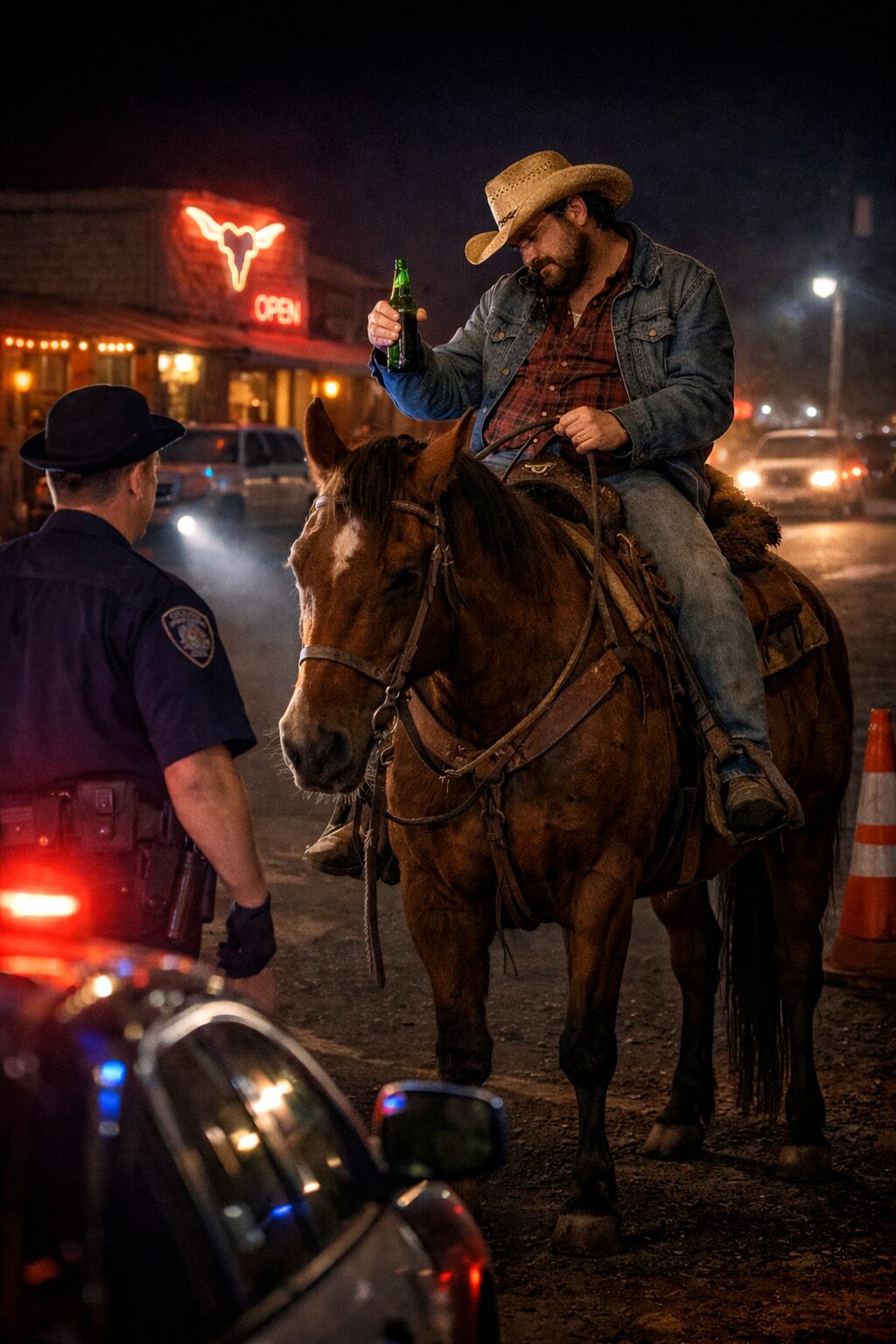
The Short Answer Is No. But You’re Not Off the Hook.
It’s one of the most-searched DWI questions in Texas, and it’s a fair one: If you are intoxicated, can you legally ride a horse home instead of driving?
Maybe you’re at a ranch party. Maybe you live in a rural area and the barn is closer than the driveway. Or maybe you just saw a viral video of a man on horseback claiming the law can’t touch him. Whatever brought you here, you deserve a straight answer from a Texas DWI attorney, not a guess from the internet.
Here’s what the law actually says, what happened when two men in Austin tested this theory in real life, and what charges you can still face if you ride a horse while intoxicated in Texas.
What Texas Law Requires for a DWI Charge
To convict someone of Driving While Intoxicated under Texas Penal Code §49.04, prosecutors must prove the following three elements beyond a reasonable doubt:
- Intoxication – You did not have the normal use of your mental or physical faculties due to alcohol, drugs, or another substance, or your blood or breath alcohol concentration was 0.08 or more.
- Operation of a motor vehicle – You were operating a motor vehicle.
- In a public place – Penal Code §1.07(a)(40) defines a public place as any place to which the public or a substantial group of the public has access, including streets, highways, and the common areas of schools, hospitals, apartment houses, office buildings, transport facilities, and shops. A public road or a store parking lot qualifies. A private pasture generally does not, which matters more than people expect if the ride never left the ranch.
The critical phrase is “motor vehicle.” That’s where a horse gets you off the DWI hook.
Why a Horse Doesn’t Qualify as a “Motor Vehicle”
Here is where most write-ups on this question go wrong. People reach for the Transportation Code, which defines a motor vehicle as a self-propelled vehicle or one propelled by electric power from overhead trolley wires, and conclude that a horse is not self-propelled. The quote is accurate. It is also the wrong statute.
A prosecution under Section 49.04 runs on the Penal Code. Section 49.01(3) defines motor vehicle by adopting Section 32.34(a)(2), which reads: a device in, on, or by which a person or property is or may be transported or drawn on a highway, except a device used exclusively on stationary rails or tracks.
Read that again and notice what is missing. No engine. No motor. No self-propulsion requirement of any kind, and nothing excluding things moved by human or animal power. A horse plainly transports a person on a highway. Every element of that definition fits except one word.
That word is device. A horse is a living animal, not a device, and that is the actual reason the answer is no. Which reason you give matters, because the self-propulsion argument would also mean a bicycle cannot support a DWI, and the Penal Code definition says nothing of the sort.
No Texas appellate court has squarely decided whether an animal is a device under this chain. The closest is a Fort Worth golf cart case, Lewis v. State, No. 02-12-00109-CR (Tex. App.—Fort Worth Apr. 18, 2013, no pet.) (mem. op.), where the court noted in a footnote that the State had read the venire the correct definition of a motor vehicle applicable to the offense of DWI, citing this same chain. The same footnote records what happened next, and it is the most useful line in the opinion: the State offered a horse and buggy as an example and elicited others from the panel, including a bicycle, a skateboard, a moped, a golf cart, and a tractor, with no objection. That is a Texas prosecutor putting a horse and buggy in front of a jury panel as a motor vehicle. The opinion is unpublished, carries no precedential value, and the merits were never reached because nothing was preserved, but it is the only Texas authority that touches the question.
Bottom line: Because Texas’s DWI statute specifically requires a motor vehicle, riding a horse while intoxicated does not satisfy the elements of DWI under current Texas law.
When Austin Put This Theory to the Test
This isn’t purely academic. In 2011, Jose Rios and Samuel Olivo Jr. rode a mule and a horse down Austin’s Sixth Street on a busy night, inviting passersby to take photos with them. Austin police pulled them over, administered field sobriety tests and charged both men with DWI.
The case made national headlines but when it reached the desk of the Travis County Attorney his office dropped the DWI charges. David Escamilla was quoted as explaining that the law requires a motor vehicle or device, and after researching similar cases across the country, his office concluded that a mule did not meet that standard.
Both men were subsequently charged with public intoxication instead which is a Class C misdemeanor carrying up to a $500 fine. This real-world example confirms what the statute says on paper: you won’t get a DWI on a horse in Texas, but that doesn’t mean you’ll walk away without charges.
Charges You Can Still Face on Horseback
Here’s where people get into trouble: they assume that no DWI means no consequences. That’s not how it works. Texas law gives officers several tools to charge an intoxicated rider, even without a motor vehicle.
Public Intoxication (Texas Penal Code §49.02)
If you appear in a public place while intoxicated to a degree that you may endanger yourself or another person, you can be arrested and charged with Public Intoxication. Sitting on a horse in the middle of a road while visibly drunk could meet this standard. It’s a Class C misdemeanor with a fine up to $500.
Animal Cruelty (Texas Penal Code §42.09)
Section 42.09 is narrower than people assume, and it is also the most serious charge on this list. It reaches nine specific acts, each of which must be committed intentionally or knowingly. There is no general endangerment provision and no reckless mental state. A rider who is simply too impaired to steer is not committing any of the nine.
Where the statute does bite is the rider who works or hauls an animal cruelly rather than one who cannot control it: transporting or confining a livestock animal in a cruel and unusual manner, or seriously overworking one. Its definition of a livestock animal includes a horse, pony, mule, donkey, or hinny. Section 42.092 is the nonlivestock provision and expressly excludes livestock, so it is not the one that applies here.
Note what this charge costs, because it is unlike everything else on this list. Every subdivision of Section 42.09 is either a Class A misdemeanor or a state jail felony, and prior convictions raise it further.
Obstruction of a Highway or Passageway
Under Texas Penal Code §42.03, if you block a road, street, sidewalk, or other passageway, you could face a Class B misdemeanor charge. An intoxicated rider weaving through traffic or refusing to move is creating exactly the kind of hazard this statute targets.
Child Endangerment
If you have a child with you on the horse while intoxicated, you could face charges under Texas Penal Code §22.041, which reaches a child younger than 15. Placing a child in a situation where they could be injured due to your impaired state is taken very seriously by Texas prosecutors, regardless of the mode of transportation.
Disorderly Conduct
Under Texas Penal Code §42.01, making unreasonable noise in a public place can result in a Class C misdemeanor, and so can abusive, indecent, profane, or vulgar language that by its very utterance tends to incite an immediate breach of the peace. That qualifier matters, because ordinary swearing in public is not the offense. A drunk rider causing a scene on horseback can easily trigger it.
Civil Liability
Beyond criminal charges, if your intoxicated horseback ride causes property damage or personal injury, you can be held financially responsible in a civil lawsuit. Homeowner’s insurance may not cover incidents involving reckless or intoxicated behavior, meaning the costs could come directly out of your pocket.
What About Bicycles, Golf Carts, and E-Bikes?
Since we’re already here, let’s address a few other common questions about non-standard vehicles and Texas DWI law:
- Traditional bicycles: Probably not, but this is less settled than the internet says. A bicycle is a device on which a person may be transported on a highway, and Section 32.34(a)(2) contains no human-power exception. California’s definition has one. North Carolina’s has one. Texas has none, and no Texas appellate court has decided the question. Anyone telling you a bicycle plainly cannot support a DWI in Texas is stating a conclusion, not a holding.
- Golf carts: Treat this as a DWI. A golf cart is a device that transports a person on a highway, so the statute reaches it on its own terms. The defendant in Lewis did not contest the point, which corroborates the reading without being the reason for it.
- Motor-assisted scooters: Transportation Code Section 551.352 applies the title’s bicycle provisions to a motor-assisted scooter, and subsection (e) says a provision applicable to a motor vehicle does not apply to one. Useful, but that is the traffic code rather than the Penal Code, so it helps the argument without ending it.
- E-bikes: Transportation Code Section 541.201(11) expressly excludes an electric bicycle from the definition of a motor vehicle, and that is the strongest thing a rider has to point to. It is also, again, a Transportation Code definition, and a DWI prosecution runs on the Penal Code one.
- Boats: Not DWI, but Texas has the separate offense of Boating While Intoxicated (BWI) under Penal Code §49.06 that carries penalties nearly identical to DWI.
How Other States Handle This Differently
Texas’s position is not universal, but be careful with what circulates about other states, because most of it is wrong.
California. Vehicle Code §21050 does give a person riding an animal on a public road the duties of a driver. But the DUI statute, §23152, reaches a vehicle, and §670 defines a vehicle as a device, excepting devices moved exclusively by human power. There have been horseback DUI arrests in California. No California appellate decision has upheld a horseback DUI conviction, and an arrest is not a conviction.
North Carolina. A 1985 decision, State v. Dellinger, 73 N.C. App. 685, 327 S.E.2d 609, did treat a horse as covered. The legislature overruled it in 1989, and G.S. 20-138.1(e) now expressly excepts horses. When North Carolina dropped its bicycle and lawnmower exceptions in 2006, it deliberately kept the horse exception. Any source telling you North Carolina treats horseback riding as vehicle operation has the current law backwards.
Kentucky. The DUI statute, KRS 189A.010(1), reaches only a motor vehicle. The provision that actually bears on riders is KRS 189.520(1), a different offense carrying different consequences.
If you’re traveling or have property in another state, don’t assume Texas rules apply. Each state defines “vehicle” differently, and that single word can mean the difference between a public intoxication ticket and a full DUI charge on your record.
What to Do If You’re Stopped on a Horse While Drinking
If law enforcement approaches you while you’re riding a horse and you’ve been drinking, the rules are the same as any police encounter:
- Stay calm and cooperative. Being argumentative or combative will not help your situation and could lead to additional charges.
- Exercise your right to remain silent. You do not have to explain how much you’ve had to drink or where you’re going. Politely decline to answer incriminating questions.
- Don’t volunteer information. Statements like “I only had two drinks” are admissions that can be used against you in court.
- Contact an attorney as soon as possible. Even a public intoxication charge creates a criminal record. An experienced defense attorney can help protect your rights and work toward the best outcome.
The Bottom Line
No, you cannot get a DWI on a horse in Texas. The statute requires a motor vehicle, and a horse is not a device. No Texas court has held otherwise, and the one prosecutor’s office to test the question reached the same conclusion.
But that does not mean riding a horse drunk is legal or consequence-free. Public intoxication, animal cruelty, obstruction charges, and civil liability are all on the table. And any criminal charge, even a Class C misdemeanor, creates a record that can follow you into job applications, background checks, and future legal proceedings.
The safest decision is always the simplest one: if you’ve been drinking, find a sober ride home. Your horse will thank you, and so will your criminal record.
Facing a DWI or alcohol-related charge in Texas?
Deandra Grant Law fights for the best possible outcome in every case.
Contact us today for a free case review.
Disclaimer: This blog post is for informational purposes only and does not constitute legal advice. Every case is different, and laws can change. If you are facing criminal charges, contact a qualified attorney to discuss the specifics of your situation.
The other guides in this section.
The Foundations
How that 0.08 is actually produced, by an instrument or a laboratory, and every documented way it goes wrong, is the subject of Tests & Evidence.
The Unusual Cases
Which county your case is filed in changes how it is charged, who prosecutes it, and which court hears it.
Deandra M. Grant, JD, GC, MS, ACS-CHAL Forensic Lawyer-Scientist
She holds a Master of Science in Pharmaceutical Science and a Graduate Certificate in Forensic Toxicology, both from the University of Florida. She is the author of The Texas DWI Manual and has defended Texas DWI cases since 1994.
Charged With a DWI in Texas?
Intake answers 24/7, and if your case is one we can take on, we schedule a free consultation with an attorney.
Request a Free Case Evaluation
Tell us what happened. We'll respond as soon as possible.