
Can You Get a DWI on a Bicycle in Texas?

The short answer is probably not. But the charges that can follow you are real, and so is the line between a bicycle and an e-bike.
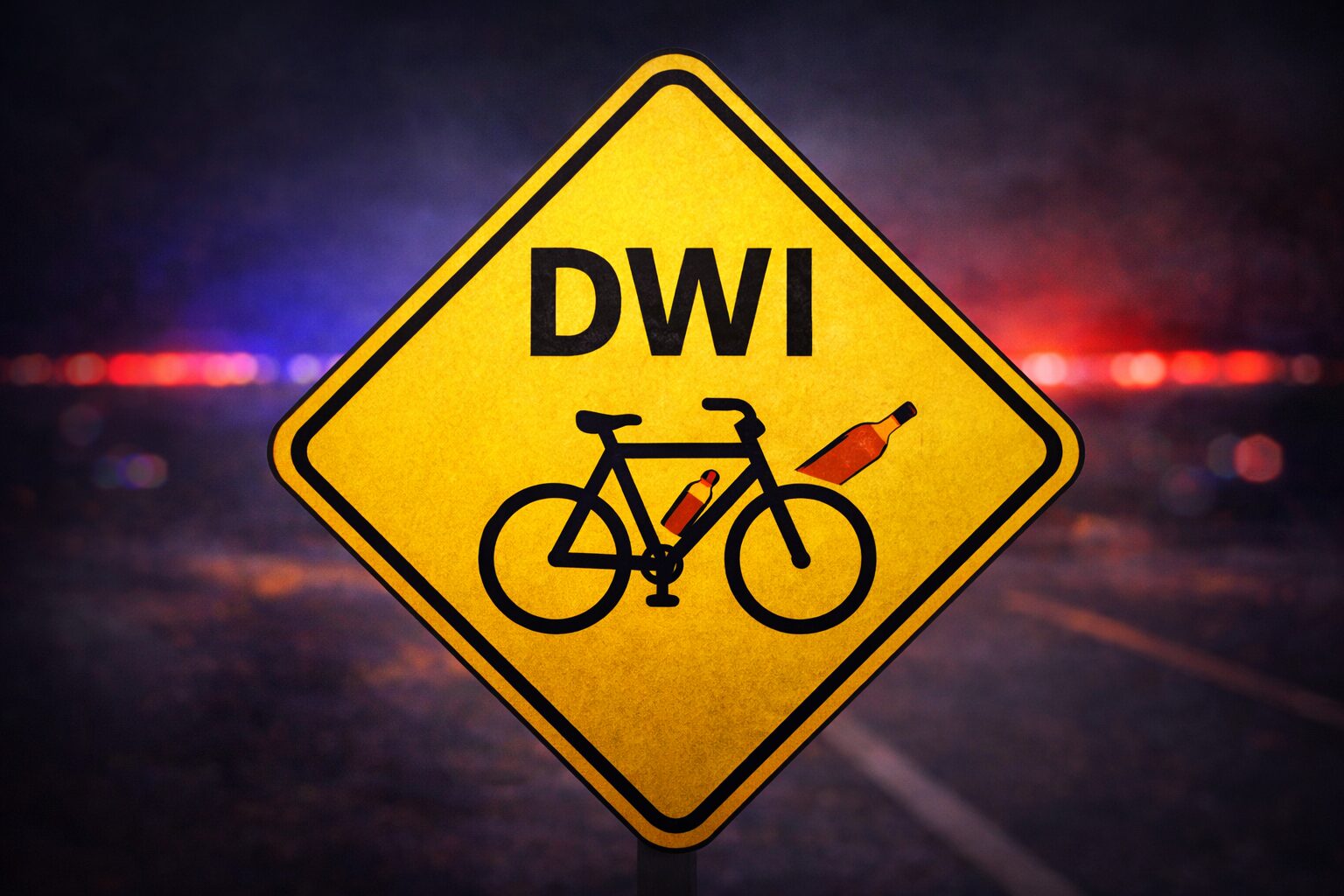
People have been asking this question since ride-share apps became common and bar districts expanded beyond easy walking distance. The thinking goes: if I am too impaired to drive, can I just ride my bike home? It seems like the responsible choice. But is it legal, and does the answer change on an e-bike or a scooter?
Here is what Texas law actually says, where the line falls between a bicycle and a motor vehicle, and what you can still be charged with even when DWI is off the table.
What Texas Law Requires for a DWI Charge
To convict someone of driving while intoxicated under Texas Penal Code Section 49.04, prosecutors must prove three elements beyond a reasonable doubt:
- Intoxication. You did not have the normal use of your mental or physical faculties due to alcohol, drugs, or another substance, or your blood or breath alcohol concentration was 0.08 or more.
- Operation of a motor vehicle. You were operating a motor vehicle.
- In a public place. Penal Code Section 1.07(a)(40) defines a public place as any place to which the public or a substantial group of the public has access, including streets, highways, and the common areas of schools, hospitals, apartment houses, office buildings, transport facilities, and shops. A public street or a store parking lot qualifies. A gated community, a closed campus, or a private apartment lot may not, and that is worth knowing if the ride never reached a public road.
The critical phrase is motor vehicle. That is where a traditional bicycle probably gets you off the DWI hook, and where an e-bike may not.
Why a Traditional Bicycle Is Probably Not a Motor Vehicle
A DWI prosecution runs on the Penal Code, and the Penal Code borrows its definition. Section 49.01(3) says motor vehicle has the meaning assigned by Section 32.34(a), and Section 32.34(a)(2) defines it as a device in, on, or by which a person or property is or may be transported or drawn on a highway, except a device used exclusively on stationary rails or tracks.
Notice that this definition is broader than most people expect. It says nothing about engines or motors, and it has no exception for things moved by human power. Read literally, a bicycle is a device that transports a person on a highway, and it technically fits.
In practice, that is not how these cases go. No Texas court has ever held that a bicycle is a motor vehicle for DWI purposes, prosecutors do not file DWI charges against cyclists, and in decades of defending these cases we have not seen one. The practical risk of a DWI conviction for riding a human-powered bicycle in Texas is very low.
It is not zero, and the reason to know that is what comes next. The moment your bicycle has a motor, the analysis gets meaningfully harder, and the arguments that protect a traditional cyclist get weaker.
One footnote for anyone who wants to check the law themselves. Most articles on this question quote the Transportation Code, which defines a motor vehicle as self-propelled. That definition is real, but it governs the Transportation Code. The Penal Code definition above is the one a DWI prosecution uses, and it is the reason the answer here is probably not rather than certainly not.
Compare the horse question, where the answer really is no, and for a reason that holds up under either definition: a horse is a living animal, not a device. We walk through that in our post on whether you can get a DWI on a horse in Texas.
The one Texas case that touches the question came out of a Fort Worth golf cart trial. In Lewis v. State, No. 02-12-00109-CR (Tex. App.-Fort Worth Apr. 18, 2013, no pet.) (mem. op.), the prosecutor walked the jury panel through what counts as a motor vehicle for DWI. The State offered a horse and buggy as its own example and drew the rest from the panel, which came back with a bicycle, a skateboard, a moped, a golf cart, and a tractor. The bicycle came from a venireperson rather than the State, and the footnote records no objection from the defense. The defendant argued the resulting definition was overbroad, and the court never reached the complaint because it was not preserved. It is an unpublished footnote that decides nothing, but it is the only Texas authority on the point.
The One Statute That Helps, and Its Limit
There is a provision worth knowing, and it is the strongest thing a rider has. Transportation Code Section 541.201(11) defines motor vehicle and expressly excludes an electric bicycle from that definition. That is a legislature saying, in terms, that an e-bike is not a motor vehicle.
Now the limit. That is a Transportation Code definition, and it governs the Transportation Code. A DWI prosecution is brought under the Penal Code and uses the Penal Code definition, which contains no such exclusion. The exclusion is useful argument. It is not controlling, and a court is not required to import it into Chapter 49.
E-Bikes, Scooters and What Is Actually Different
This page is about bicycles, so it is worth being precise about what is not one.
Motorcycles and mopeds are motor vehicles under any reading. Riding one while intoxicated is a DWI, and nothing in this post suggests otherwise.
Electric bicycles are classified by Transportation Code Section 664.001, not Section 551.351, which is the motor-assisted scooter definition. Under Section 664.001 a Class 1 e-bike assists only while the rider pedals and cuts off at 20 miles per hour, a Class 2 can propel the bicycle without pedaling, and a Class 3 assists only while pedaling with a top assisted speed of more than 20 but less than 28 miles per hour. Note that the 28 mile per hour ceiling belongs to the umbrella definition of an electric bicycle in subsection (4), not to Class 3 alone.
Those class distinctions matter enormously for where you can ride and how the Transportation Code treats you. For the DWI question they largely collapse, because the Penal Code test is whether the thing is a device, and every e-bike in all three classes plainly is. Any analysis that sorts e-bikes by whether a motor propels them is running the self-propulsion test, which is the wrong test.
Motor-assisted scooters cut the opposite way from what most write-ups say. Transportation Code Section 551.352(d) provides that a provision of that title applicable to the operation of a bicycle applies to a motor-assisted scooter, and subsection (e) provides that a provision applicable to a motor vehicle does not apply to one. Under Title 7, a scooter is treated more like a bicycle, not less.
Many shared rental scooters exceed the statutory limits in Section 551.351, or cannot be propelled by human power at all. A device that falls outside the definition of a motor-assisted scooter does not get the protection of Section 551.352, and the rider is left arguing from the Penal Code definition with nothing else to lean on. Do not assume the scooter you rented on an app is a motor-assisted scooter as Texas defines it.
Charges You Can Still Face on a Bicycle
Even on the most favorable reading of the DWI question, no DWI does not mean no consequences. Texas gives officers several tools to charge an intoxicated cyclist without ever reaching Chapter 49.
Public Intoxication, Penal Code Section 49.02
Under Penal Code Section 49.02, if you appear in a public place while intoxicated to a degree that you may endanger yourself or another person, you can be arrested. Riding drunk on a public street, weaving in traffic, running lights, or falling off your bike in an intersection can satisfy that standard. Public intoxication is a Class C misdemeanor, which carries a fine up to $500 under Penal Code Section 12.23, and it is a criminal offense that appears on a record.
Obstruction of a Highway or Passageway, Penal Code Section 42.03
Under Penal Code Section 42.03, blocking a road, street, sidewalk, or other public passageway is a Class B misdemeanor. A cyclist riding erratically down the middle of a lane, refusing to move for traffic, or blocking a crosswalk can face this charge independent of any DWI analysis.
Disorderly Conduct, Penal Code Section 42.01
Under Penal Code Section 42.01, making unreasonable noise in a public place is a Class C misdemeanor. So is fighting in a public place, and so is abusing or threatening a person in a public place in an obviously offensive manner. A cyclist causing a scene in a bar district can trigger it quickly.
Reckless Driving
This one reaches a cyclist cleanly, and the chain is worth having. Transportation Code Section 545.401(a) makes it an offense to drive a vehicle in willful or wanton disregard for the safety of persons or property. Section 541.201(23) defines a vehicle as a device, without the motor requirement. And Section 551.101(a) gives a person operating a bicycle the rights and duties applicable to a driver under Subtitle C. Reckless cycling on a public road while intoxicated can support the charge, and this is not a ticket. Section 545.401(b) allows a fine up to $200, confinement in county jail for up to 30 days, or both. The chain is clean, though no reported Texas case applies the statute to a bicycle rider, so treat the exposure as real and the precedent as untested.
Civil Liability
If your ride causes property damage or injures someone, you face civil liability regardless of whether you are charged with anything. Not being in a motor vehicle is not a defense to a negligence claim.
What to Do If You Are Stopped on a Bicycle
The rules for a police encounter on a bicycle are the same as for any other encounter.
- Stay calm and cooperative. Being argumentative will not help and may add charges.
- Exercise your right to remain silent. You are not required to answer questions about where you have been.
- Do not volunteer information. I only had two beers is an admission, not a defense.
- Contact an attorney. Even a Class C misdemeanor creates a record.
The Bottom Line
Riding a traditional, human-powered bicycle while intoxicated in Texas is very unlikely to result in a DWI. No Texas court has held that a bicycle is a motor vehicle for that purpose, and prosecutors do not charge it. Note the one wrinkle worth knowing: the Penal Code definition is broad enough that the question has never been foreclosed, so treat it as very low risk rather than no risk.
What a bicycle certainly does not protect you from is public intoxication, reckless driving, obstruction, and civil liability. Any criminal charge, even a Class C, creates a record that follows you into employment applications and background checks.
Facing an Alcohol-Related Charge in Texas?
Deandra Grant Law fights for the best possible outcome in every case. Call (214) 225-7117 for a free case review.
This post is general information, not legal advice. Every case is different and the law can change. If you are facing charges, speak with a qualified attorney about your specific situation. Verify all citations before relying on them in any filing.
The other guides in this section.
The Foundations
How that 0.08 is actually produced, by an instrument or a laboratory, and every documented way it goes wrong, is the subject of Tests & Evidence.
The Unusual Cases
Which county your case is filed in changes how it is charged, who prosecutes it, and which court hears it.
Deandra M. Grant, JD, GC, MS, ACS-CHAL Forensic Lawyer-Scientist
She holds a Master of Science in Pharmaceutical Science and a Graduate Certificate in Forensic Toxicology, both from the University of Florida. She is the author of The Texas DWI Manual and has defended Texas DWI cases since 1994.
Charged With a DWI in Texas?
Intake answers 24/7, and if your case is one we can take on, we schedule a free consultation with an attorney.
Request a Free Case Evaluation
Tell us what happened. We'll respond as soon as possible.