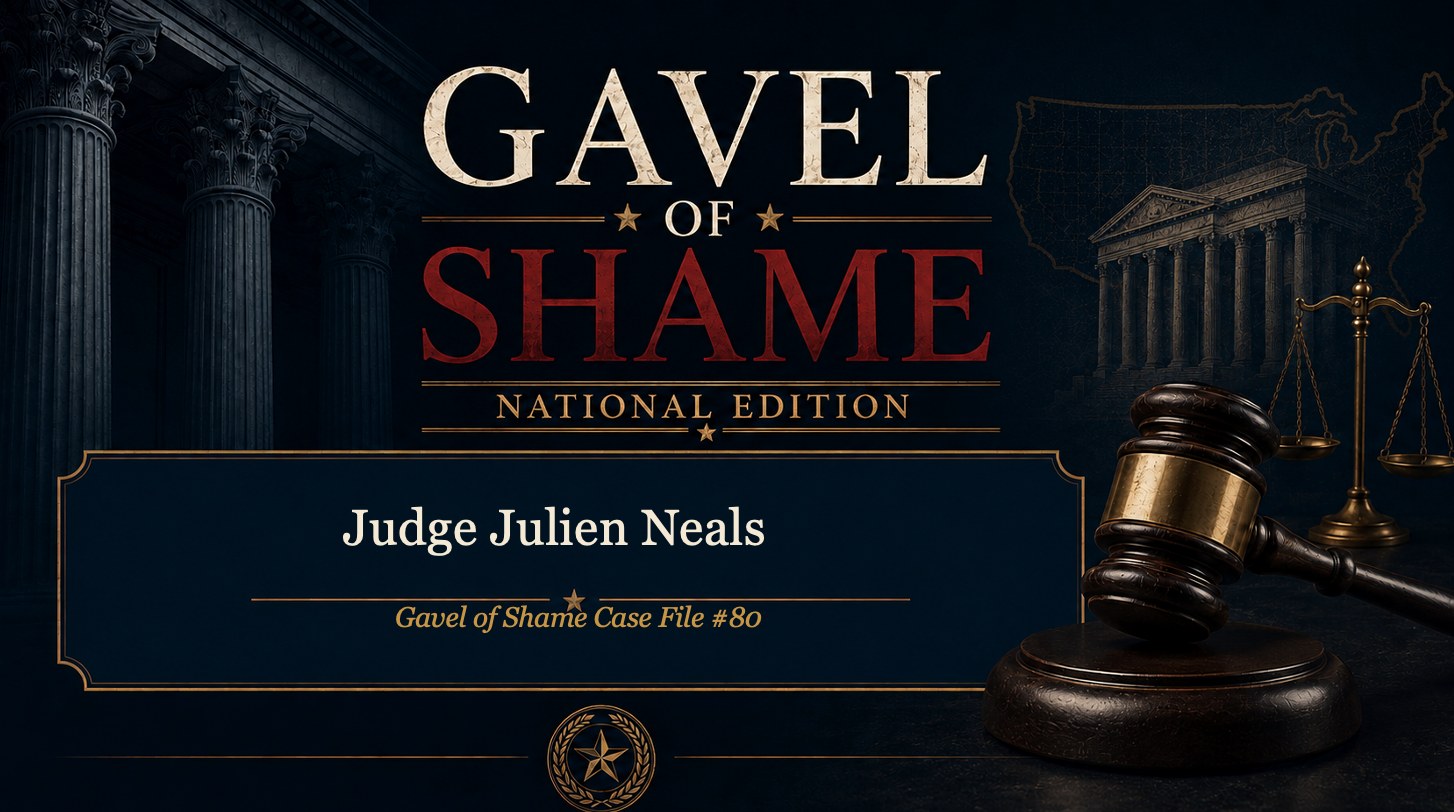
Judge Julien Neals Withdrew an AI-Tainted Opinion
On June 30, 2025, Judge Julien X. Neals of the District of New Jersey issued an opinion and order in a securities class action. Three weeks later defense counsel wrote to the court identifying quotations attributed to the defendants that they say they never made, quotations attributed to decisions that do not contain them, and case outcomes stated backwards, with motions to dismiss described as denied when they had in fact been granted. The next day the judge ordered the opinion and order struck from the docket, writing that they had been entered in error. A corrected opinion followed four weeks later, reaching the same result. The cause was a law school intern who used ChatGPT for legal research. Neals later told the Senate the intern had acted without authorization, without disclosure, and against both chambers policy and the intern’s own law school policy. The policy was real. It had been given verbally. It is now in writing. Below: what the opinion contained, what an unwritten rule is worth, and why the Texas rules that govern exactly this situation are mandatory for lawyers and merely aspirational for judges.
| CASE FILE AT A GLANCE | |
| Judge | Julien Xavier Neals, United States District Judge, District of New Jersey |
| Case | In re CorMedix Inc. Securities Litigation, No. 2:21-cv-14020 (D.N.J.), a shareholder class action under the Securities Exchange Act |
| The opinion | Issued June 30, 2025 at ECF Nos. 114 and 115, denying a motion to dismiss |
| The complaint about it | Letter from defense counsel, ECF No. 123, filed July 22, 2025, with exhibits |
| The withdrawal | Text order, ECF No. 126, July 23, 2025: the opinion and order were entered in error and the Clerk was directed to remove them from the docket. One day after the letter |
| The replacement | Opinion and order at ECF Nos. 130 and 131, August 19, 2025. The motion to dismiss was still denied, and a footnote acknowledges that a preliminary draft had been inadvertently filed |
| Cause | A law school intern used ChatGPT for legal research without authorization or disclosure, contrary to chambers policy and the law school’s own policy |
| Senate inquiry | Letter from Judiciary Committee Chairman Charles Grassley, October 6, 2025. Neals responded October 20, 2025, through the Administrative Office of the U.S. Courts |
| Discipline | None. No judicial-misconduct complaint against him appears in the public record reviewed for this file |
| Companion file | Case File No. 62 covers Judge Henry Wingate of the Southern District of Mississippi, who answered the same Senate inquiry the next day, and whose corrected order still contained a citation to a case that does not exist |
What Was Wrong With It
The errors fall into three categories.
First, the opinion put quotations in the defendants’ mouths that the defendants say they never said. Second, it attributed quotations to judicial decisions that, according to counsel, do not contain them. Third, it described the outcomes of cited cases backwards, stating that motions to dismiss had been denied in cases where they had in fact been granted.
That third category is the one a cite-checker misses. A fabricated case name fails the first time anyone types it into a database. A real case, correctly cited, with the holding inverted, looks right in every automated check and fails only if a human reads the opinion.
He Pulled It in a Day
Defense counsel filed their letter on July 22, 2025. On July 23 the court entered a text order that is three sentences long: the court was in receipt of the letter, the opinion and order of June 30 were entered in error, and the Clerk was directed to remove them from the docket, with a subsequent opinion to follow.
The replacement came on August 19, 2025. The motion to dismiss was denied again. A footnote in the final opinion says that on June 30 the court inadvertently issued a preliminary draft opinion, which it withdrew.
Two things about that sequence are worth noting. The speed is one. One day from complaint to withdrawal is about as fast as a federal court moves on anything, and the docket shows the court did not argue about it.
The outcome was the same both times. Nothing the draft got wrong changed what happened to the parties. It is also the exact argument Judge Henry Wingate of the Southern District of Mississippi made about his own order in Case File No. 62, and the Fifth Circuit gave him nothing for it, asking instead why apparently irrelevant fabricated material was in a judicial order at all. The difference between the two cases is not the defense. It is that one judge pulled the document the next day and the other did not.
The Policy Existed. Nobody Had Written It Down.
Neals’ chambers already prohibited generative AI in legal research for, or drafting of, opinions and orders. The rule was not missing. In his own words to the Administrative Office, in the past, my policy was communicated verbally to chambers staff, including interns. That is no longer the case. I now have a written unequivocal policy that applies to all law clerks and interns.
An intern used ChatGPT anyway, without authorization, without disclosure, and contrary to not only chambers policy but also the relevant law school policy. The law school contacted the judge afterward to confirm the student had violated its rules too. So this was not a gap in the rules.
A verbal policy has three failure modes and this episode hit all of them. It is not available to someone who joined after it was last said out loud. It cannot be pointed to at the moment a decision is being made. And it leaves no record, which means nobody can tell afterward whether the person knew. A written policy fixes all three.
The judge distinguished using GenAI for drafting content from commonplace research tools, which inevitably have AI functionality integrated in a manner that is unavoidable when using the tool. His chambers uses a cite-checking tool whose vendor builds AI into it, and his clerks are instructed to review and verify its work. A policy that bans the word artificial intelligence outright bans Westlaw. A policy that says what the tool may be used for, and who verifies the output, is a policy somebody can actually follow.
What He Told the Senate
On October 6, 2025, the Chairman of the Senate Judiciary Committee wrote to him, citing the three categories of error from the defense letter and asking about the use of generative AI. Neals answered on October 20, addressing his response to the Director of the Administrative Office of the U.S. Courts for transmittal to the Senator rather than writing to the Senator directly. The Mississippi judge did the same thing the next day. That routing is not an accident; it is the judiciary saying that oversight of judges runs through the judiciary.
The substance of the letter is narrow and, on the whole, candid. The June 30 decision was released in error, human error. The opinion that went out was an early draft that had not been through the chambers review process and should have never been docketed. The intern had no access to sealed, privileged, confidential or non-public case information. He invoked the Code of Conduct for United States Judges and said he took immediate and appropriate action regarding the intern. He removed the opinion from public view, he wrote, so that parties, including pro se litigants, would not think a flawed draft should be cited or relied on.
He also conceded the limit of his own position: I cannot speak to litigants’ use of GenAI tools in drafting their filings and, at this time, do not have any rules or personal preferences regarding this type of conduct.
The Chairman’s public statement on October 23, 2025, praised both judges for owning the mistakes, warned against laziness, apathy or overreliance on artificial assistance, and called for more decisive, meaningful and permanent AI policies and guidelines. It proposed no discipline and no disclosure requirement, and none has followed.
| WHAT THE JUDICIARY’S OWN GUIDANCE SAYS
The Administrative Office established an AI Task Force of judges, court executives and staff, and broadcast interim guidance Judiciary-wide on July 31, 2025. That is a month after this opinion issued, which is worth saying before anyone is measured against a rule that did not exist yet. The guidance cautions against delegating core judicial functions to AI, including decision-making and case adjudication; recommends extreme caution on novel legal questions; recommends that users review and independently verify all AI-generated output; and reminds judges and staff that they are accountable for all work performed with the assistance of AI. On disclosure it goes no further than recommending that users consider whether AI use should be disclosed and to whom. It is guidance, not a rule, and the Director described it as temporary guideposts while permanent policy is developed. As of this writing the permanent policy has not issued. |
How It Would Work in Texas
FOR A LAWYER, SUPERVISION IS A SHALL
Take the same facts and move them from chambers into a law firm, which is where most readers of this file actually live. A supervising lawyer, a law student doing research, an unauthorized ChatGPT session, and a document that goes out with fabricated quotations in it.
Texas Disciplinary Rule of Professional Conduct 5.03(a) provides that a lawyer with direct supervisory authority over a nonlawyer shall make reasonable efforts to ensure that the person’s conduct is compatible with the professional obligations of the lawyer. A law student intern is a nonlawyer. Rule 5.03(b) then makes the lawyer subject to discipline for that person’s conduct if the lawyer ordered, encouraged or permitted it, or if the lawyer is a partner or direct supervisor and, knowing of the misconduct, fails to take reasonable remedial action.
Rule 5.01(a) goes further up the chain and is the one that speaks directly to the lesson of this file. A lawyer with managerial authority in a firm shall make reasonable efforts to ensure that the firm has in effect measures giving reasonable assurance that all lawyers conform to the rules. Measures in effect. Not instincts, not understandings, not something said once at a staff meeting.
BUT CANDOR ONLY REACHES WHAT YOU KNEW
The rule people reach for first is Rule 3.03(a)(1), candor toward the tribunal, under which a lawyer shall not knowingly make a false statement of material fact or law to a tribunal. Read the adverb. A lawyer who files a brief with a hallucinated case, believing it real, has not knowingly made a false statement, and 3.03 does not reach the conduct.
On June 26, 2026 the Supreme Court of Texas gave preliminary approval to a rewritten Rule of Civil Procedure 13 under which, by signing a court filing, the signer represents that the signer reviewed the filing and verified its accuracy, including that the legal citations, quotations, and holdings are not fabricated. The Court’s own comment says the provision is adopted principally to address concerns about the improper use of artificial intelligence in filings and that verifying a filing for accuracy matters regardless of whether AI was used.
Note the design. It is a verification duty, not a disclosure duty; nothing requires anyone to announce that AI was used. And it has no knowledge requirement, so it reaches the lawyer who was fooled, which Rule 3.03 does not. Sanctions under the amended rule run from reprimand through contempt, striking the filing, dismissal, costs and fees, with a proportionality requirement and a notice-and-response step first.
Comments were due September 1, 2026 and the Court expected an effective date of October 1, 2026, but the Rules of Civil Procedure as currently published still carry the prior Rule 13, with no verification language, and still include Rule 57, which the order would repeal. Check the compiled rules before relying on the new text.
FOR A JUDGE, THE SAME DUTY IS ONLY A SHOULD
Now put the facts back in chambers. The Texas provision that corresponds to Rule 5.03 is Canon 3C(2) of the Code of Judicial Conduct, under which a judge should require staff, court officials and others subject to the judge’s direction and control to observe the standards of fidelity and diligence that apply to the judge. Canon 8B(2) makes should aspirational, not a binding rule under which a judge may be disciplined. Canon 3C(1), on discharging administrative responsibilities competently, is a should as well.
So the same failure, supervising someone who used an AI tool they were not supposed to use, is a mandatory obligation for the supervising lawyer and an aspiration for the supervising judge. What remains mandatory for a Texas judge is narrower: Canon 3B(2) provides that a judge should be faithful to the law and shall maintain professional competence in it, and Canon 2A that a judge shall comply with the law. Professional competence, not supervision. For what the Commission can and cannot do with any of it, see our explainer, Who Polices Texas Judges? The SCJC Explained.
The series has seen the other end of this before. Case File No. 55 is a Florida judge suspended thirty days, fined $10,000 and publicly reprimanded for passing along an AI-fabricated recording during a campaign, on a record with no finding she knew it was fake. Failing to verify was the whole violation. Two federal judges did the same thing inside live cases and neither was sanctioned at all.
| WRITING AN AI POLICY YOUR OFFICE CAN ACTUALLY FOLLOW
Write it down. That is the entire lesson of this file. A rule that lives only in what a supervisor said out loud is not available to the person who started last month, cannot be pointed to in the moment, and leaves no record of what anyone was told. Say what the tools may be used for, not just what is banned. A flat ban on artificial intelligence bans the research platform you already pay for, because the vendors have built it in. Separate drafting from research from citation checking, and say who verifies the output of each. Make it cover everyone, not just lawyers. In this case it was an intern. Rule 5.03 reaches nonlawyer assistants, and so should your policy: paralegals, law clerks, interns, contract staff and anyone else who touches a draft. Verify holdings, not just citations. The most dangerous error here was a real case, correctly cited, with the outcome reversed. Automated cite checking will not catch that. A person reading the case will. Build the check into the workflow, not into good intentions. Both judges in these two files responded by adding a mandatory independent review step before anything leaves. That is a process change, which is what Rule 5.01 means by measures in effect. |
How It Played in the Press
The ABA Journal had the withdrawal within two days of the text order, in July 2025, under a headline that named the problem exactly: a federal judge withdrew an opinion after a lawyer pointed out fake quotes and misstated case outcomes. Reuters tied this case to the Mississippi one later that month, on the observation that two federal judges had withdrawn rulings after attorneys questioned their accuracy. Law360 covered the corrected opinion in August.
The October 2025 wave carried the admissions and treated the matter as closed, which for this judge it largely was. The Volokh Conspiracy and the ABA Journal both covered the letters. What almost nobody wrote about is the sentence that makes this file worth publishing a year later, which is that the prohibition already existed and had never been reduced to writing. That is not a story about artificial intelligence. It is a story about management.
Where Things Stand
Judge Neals remains a United States District Judge. The securities case proceeded on the corrected opinion, went on to answer and discovery, and is being litigated normally. He has not been disciplined, and no judicial-misconduct complaint against him appears in the public record reviewed for this file. His chambers now has a written AI policy and an enhanced multi-level review process.
Whether that is the right outcome is a fair question and this file does not pretend to settle it. A Bloomberg Law analysis in October 2026 counted at least eight American cases in which judges issued orders citing AI-fabricated authority and found essentially no discipline in any of them, against a landscape in which lawyers who do the same thing are sanctioned under Rule 11 and its state analogues. On these particular facts, though, the case for leaving it alone is about as strong as it gets: a draft that should never have been docketed, pulled the day after anyone complained, replaced within a month, with the outcome unchanged and the error publicly acknowledged in the final opinion.
The useful part is not the verdict on him. It is the memo he had to write afterward, and the fact that he had to write it at all.
| Facing the System in Texas?
A citation in a brief or an order is a factual claim, and it is checkable. The errors in this case were caught by a defense lawyer who read the cases the court had cited. That is still the job, and no tool has taken it over. Deandra Grant Law handles state and federal criminal defense across Texas. If you are facing a DWI or criminal charge in Dallas, Tarrant, Collin, Denton, Rockwall, or McLennan County, put our experience to work for you. Call (214) 225-7117 • texasdwisite.com |
Sources
PRIMARY SOURCES
- Letter from Judge Julien X. Neals to the Director of the Administrative Office of the U.S. Courts, October 20, 2025, responding to the Senate Judiciary Committee. Every quotation attributed to the judge in this file comes from it, including the verbal-policy passage, the drafting-versus-research distinction and the statement about litigants’ use of AI. grassley.senate.gov (pdf)
- Letter from Senate Judiciary Chairman Charles E. Grassley to Judge Neals, October 6, 2025, for the three categories of error identified in defense counsel’s July 22, 2025 letter. grassley.senate.gov (pdf)
- In re CorMedix Inc. Securities Litigation, No. 2:21-cv-14020 (D.N.J.), public docket, for the June 30, 2025 opinion and order at ECF 114 and 115, counsel’s July 22 letter at ECF 123, the July 23 text order striking them at ECF 126, and the August 19, 2025 replacement opinion and order at ECF 130 and 131 denying the motion to dismiss. courtlistener.com
- Letter from Director Robert J. Conrad, Jr., Administrative Office of the U.S. Courts, to Chairman Grassley, October 21, 2025, for the AI Task Force, the July 31, 2025 interim guidance and its contents. grassley.senate.gov (pdf)
- Senate Judiciary Committee: Grassley releases judges’ responses owning up to AI use, calls for continued oversight and regulation (Oct. 23, 2025). judiciary.senate.gov
- Supreme Court of Texas, Misc. Docket No. 26-9054 (June 26, 2026), preliminary approval of amendments to Tex. R. Civ. P. 13, as published in the Texas Register. sos.texas.gov (pdf)
- Texas Rules of Civil Procedure as currently published, which still carry the prior Rule 13. txcourts.gov (pdf)
- Texas Code of Judicial Conduct, as amended through June 12, 2026, Canons 2A, 3B(2), 3C(1), 3C(2) and 8B. txcourts.gov (pdf)
NEWS COVERAGE
- ABA Journal: Federal judge withdraws opinion after lawyer points out fake quotes, misstated case outcomes (July 24, 2025). abajournal.com
- ABA Journal: 2 federal judges reveal AI use by staff members led to error-riddled opinions. abajournal.com
- The Volokh Conspiracy: Two federal judges apologize for issuing opinions with AI hallucinations (Oct. 24, 2025). reason.com
- Bloomberg Law: Judges citing fake AI-generated law have faced few consequences (Oct. 20, 2026), counting at least eight such cases and contrasting the treatment of lawyers and judges. news.bloomberglaw.com
TEXAS REFERENCE
- Tex. Disciplinary Rule of Prof’l Conduct 5.03, Responsibilities Regarding Nonlawyer Assistants. legalethicstexas.com
- Tex. Disciplinary Rule of Prof’l Conduct 5.01, Responsibilities of a Partner or Supervisory Lawyer. legalethicstexas.com
- Tex. Disciplinary Rule of Prof’l Conduct 3.03, Candor Toward the Tribunal. legalethicstexas.com
- Gavel of Shame Case File No. 55: the Florida judge suspended, fined and reprimanded for sharing an AI-fabricated recording she had not verified. texasdwisite.com
- Deandra Grant Law: When the Video Might Be a Lie, How Texas Defense Lawyers Are Fighting Deepfake-Era Evidence. texasdwisite.com
- Deandra Grant Law: Who Polices Texas Judges? The SCJC Explained. texasdwisite.com
- This post summarizes correspondence between the Senate Judiciary Committee, a federal district judge and the Administrative Office of the U.S. Courts, a public federal court docket, published and proposed Texas rules, and news reporting, as of November 2026. It is not legal advice. Judge Neals has not been charged with or found to have committed judicial misconduct, and no disciplinary proceeding against him appears in the public record reviewed for this file. The characterization of the errors in the June 30, 2025 opinion comes from defense counsel’s letter as described in the Senate Judiciary Committee’s correspondence; the court’s own order states only that the opinion and order were entered in error, and no court has made findings about their contents. The law student whose work is described is not named here, is not the subject of any public proceeding, and the only public account of the episode is the judge’s own. The parties and counsel in the underlying securities case are referred to by role; the case name appears because it is a public case style, and nothing here is a comment on the merits of that litigation.
Which county your case is filed in changes how it is charged, who prosecutes it, and which court hears it.
Deandra M. Grant, JD, GC, MS, ACS-CHAL Forensic Lawyer-Scientist
She holds a Master of Science in Pharmaceutical Science and a Graduate Certificate in Forensic Toxicology, both from the University of Florida. She is the author of The Texas DWI Manual and has defended Texas DWI cases since 1994.
Charged With a Crime?
Whatever you're facing, a DWI or any criminal charge, the sooner you have a forensic-trained team on it the more we can do. Tell us what happened and we'll review your options, at no cost and no obligation. Intake answers 24/7, and if your case is one we can take on, we schedule a free consultation with an attorney.
Request a Free Case Evaluation
Tell us what happened. We'll respond as soon as possible.