Rapid DNA at Booking

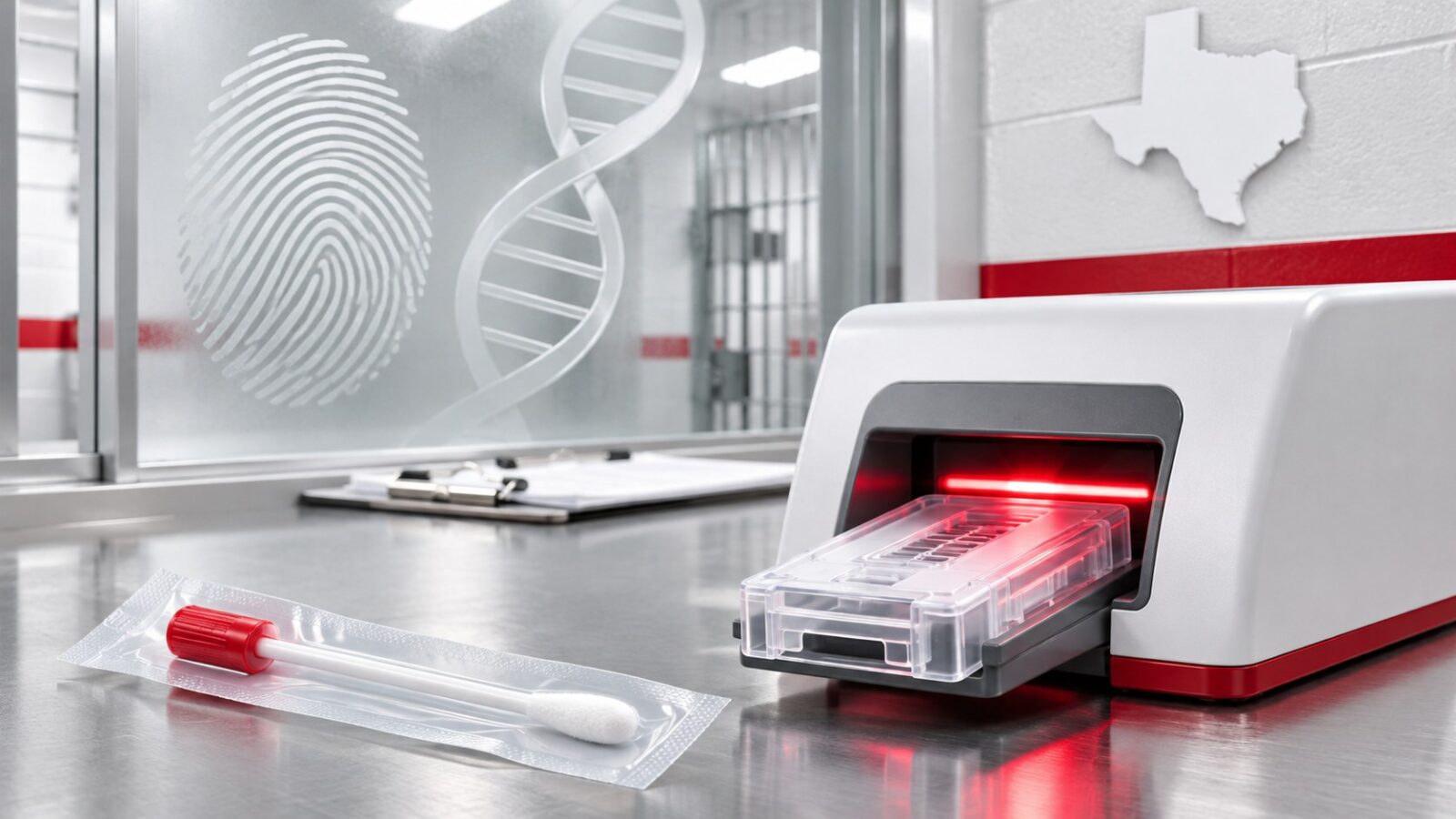
Every felony arrest in Texas already requires a cheek swab at booking. What is new is where the swab gets analyzed. Under a 2025 law, two Texas sheriff’s offices now run DNA profiles on an instrument at the jail and search them against the national database the same day, instead of mailing the swab to the state laboratory in Austin. A hit from that search is an investigative lead, not proof, and the instrument at the jail is not an accredited crime laboratory.
What Happened in Montgomery County
On October 15, 2026, the Texas Department of Public Safety moved its Rapid DNA pilot into its second phase, and the two participating agencies, the Williamson County and Montgomery County sheriff’s offices, began entering arrestee samples into the rapid system and into the Combined DNA Index System, known as CODIS. Eight days later, on October 23, Montgomery County recorded the program’s first investigative lead. According to the DPS announcement, a sample taken from a suspect booked into the Montgomery County Jail on a felony theft charge was linked to a 2024 case. DPS has not said what kind of case, and says the investigation is ongoing.
The selling point is time. DPS says felony arrest and convicted offender samples sent to its CODIS laboratory in Austin take an average of 25 days to process, and that figure runs from the day the lab receives a sample, so it does not count the days a swab spends in the mail from a county jail. Under the pilot statute, a rapid instrument must produce a profile in no more than two hours without sending the sample to a crime laboratory, and DPS says participating agencies now get information about felony arrestees “in near real time.” KLBK reported that the technology could help investigators solve cold cases faster. The first year of the two-year pilot, which began September 1, 2025, went to installing instruments, connecting systems and training.
Who Has to Give DNA After a Texas Arrest
Before September 1, 2023, Texas took DNA at arrest only for a list of specified felonies. House Bill 3956 replaced that list with a single phrase. Government Code section 411.1471 now applies to anyone “arrested for any offense punishable as a felony,” and it puts the duty on the agency doing the booking: immediately after fingerprinting, at the same location, the agency “shall require the defendant to provide one or more specimens for the purpose of creating a DNA record.” The rule applies to offenses committed on or after September 1, 2023.
The sample is usually a cheek swab. The statute lets an agency use any method the DPS director approves by rule, and requires that rule to prohibit taking a blood sample to create a DNA record. It is triggered by a felony arrest, not a conviction, so no charge has to be proven, or even filed. And misdemeanors work differently: the same section reaches certain misdemeanors only after a conviction, never at booking.
The constitutional backdrop is Maryland v. King, 569 U.S. 435 (2013). The Supreme Court held that when officers make an arrest “supported by probable cause to hold for a serious offense” and bring the suspect to the station, “taking and analyzing a cheek swab of the arrestee’s DNA is, like fingerprinting and photographing, a legitimate police booking procedure that is reasonable under the Fourth Amendment.” Id. at 465-66.
But the Maryland law the Court upheld was narrower than the law in Texas. It reached crimes of violence and burglary, and a sample could not be processed or placed in a database before arraignment, the point at which, the Court noted, “a judicial officer ensures that there is probable cause.” Id. at 443. Texas reaches any felony arrest and has no such waiting period. The FBI’s rapid booking program is built for that kind of law: it requires a state collection law with “no additional requirements (i.e., determination of probable cause) for the analysis of that Arrestee DNA sample.” So a Texas swab can be analyzed and searched before any judge has looked at the arrest. King did not decide whether that is constitutional. For DNA police collect without an arrest at all, see Can Police Take Your DNA Off a Fork?
What Changed in 2025: Police Agencies Running DNA
The pilot rests on Senate Bill 1723, passed in 2025, which did two things. First, it created a new kind of participant in the state DNA database: an “authorized law enforcement agency,” meaning a police or sheriff’s agency the DPS director has authorized to perform rapid DNA analyses. Until then, the records in the database came from DNA laboratories. Now a DNA record can also be “the results of a rapid DNA analysis performed by an authorized law enforcement agency.” The director must set standards for rapid DNA that “meet or exceed” the FBI’s quality assurance and proficiency testing standards for forensic DNA analysis, and may inspect and audit those agencies the way he can a laboratory.
Second, it created the pilot itself, in Government Code section 411.1465. DPS had to begin implementing it in two counties by September 1, 2026, may expand it to additional counties, and must report to the Legislature by January 1, 2028. The section expires September 1, 2028. The Legislature appropriated just over $5 million for it.
DPS says its report will let the Legislature consider “possible additional funding or expansion of the program,” which can sound as if expansion needs the Legislature’s approval. While the pilot lasts, it does not. The statute already lets DPS add counties while the pilot runs. What the Legislature has to decide is whether the program survives its 2028 expiration, and whether to pay for it beyond that.
For the pilot, the statute limits rapid DNA to “a reference buccal swab sample” processed in not more than two hours “without submitting the sample to a crime laboratory.” But the general definition SB 1723 added to the database statute is broader. There, rapid DNA analysis means the fully automated processing of “a known reference or forensic sample” to produce a database-eligible profile within 24 hours. A forensic sample is evidence from a crime scene. Nothing in the pilot uses crime-scene evidence. The FBI’s booking standards say they “are not applicable to the use of a Rapid DNA System on a forensic casework sample (crime scene sample),” and the FBI’s May 2026 guide reported that “no Rapid DNA cartridges/chips have been approved for forensic sample use.” But the Texas definition does not rule that use out, and crime-scene evidence, often small, degraded or mixed, is exactly where these instruments are least proven.
A Hit Is a Lead, Not Proof
A CODIS hit means a profile from one source matched a profile already in the database. In the Montgomery County case, the booking swab matched a profile connected to the 2024 case, and DPS calls the result what it is, an investigative lead. It tells detectives where to look. It does not establish when or how DNA came to be wherever it was found, and the evidence sample carries every limitation it had before the match. We explain that difference in What a DNA Match Does Not Tell You.
Rapid DNA also changes what happens after a hit. Under the FBI’s booking standards and its National Rapid DNA Booking Operational Procedures Manual, a booking profile is searched immediately against the DNA Index of Special Concern, which holds profiles from unsolved crimes of special concern such as homicides, sexual assaults, kidnappings and terrorism cases, and then against the rest of CODIS, usually within 24 hours. According to the FBI’s Guide to All Things Rapid DNA, a match to that special index produces “an immediate notification to the booking agency, arresting agency and investigating agency.” The notice is immediate by design.
The same guide lists as a benefit that rapid booking “eliminates arrestee confirmation process since identity is confirmed prior to enrollment in CODIS.” In the traditional workflow, a database hit to an arrestee’s profile is followed by a second look to confirm the sample belongs to that person. With rapid booking, the only thing tying the profile to the person is the link made at the jail, which the manual requires be made by fingerprint identification at collection and by linking the arrestee’s booking information to the swab “in a manner that prevents sample switches.”
The booking standards provide that “any arrestee DNA sample remaining in Rapid DNA cartridges shall be disposed of,” so there may be nothing left of the booking swab to retest. Operator training is set by the state, and the FBI guide says “only minimal training is required,” comparable to running a fingerprint scanner. The guide reports that an instrument produces a full profile from a reference swab “about 85-90% of the time,” and notes that rapid systems “are not as sensitive as other non-Rapid DNA laboratory techniques.”
Federal law made room for all of this in the Rapid DNA Act of 2017, which lets profiles in the national index come either from accredited laboratories or from “criminal justice agencies using Rapid DNA instruments approved by the Director of the Federal Bureau of Investigation.” 34 U.S.C. § 12592(b)(2). That is a rule about what goes into the federal database. It says nothing about what a Texas jury may hear, which is a separate question.
The Accreditation Question
Here is the Texas-specific problem. Article 38.35 of the Code of Criminal Procedure makes a forensic analysis, and expert testimony about it, inadmissible if the crime laboratory that performed it was not accredited by the Texas Forensic Science Commission at the time. The article defines forensic analysis to include an examination or test “performed on physical evidence, including DNA evidence,” and it defines a crime laboratory to include “a public or private laboratory or other entity that conducts a forensic analysis.” A sheriff’s office running an instrument at a booking desk is not an accredited crime laboratory. The Commission’s rules list forensic biology, including DNA and “individual characteristic database” work, as an accreditable discipline, and nothing in its list of disciplines exempt from accreditation covers rapid DNA.
SB 1723 amended the DNA database chapter of the Government Code. It did not amend Article 38.35. Its companion, Senate Bill 2460, stated the premise plainly in its statement of intent: “As written, current law does not allow for DNA testing of forensic samples outside of an accredited laboratory.” What the Legislature passed authorizes police agencies to put rapid profiles into the database. It does not make those results admissible as evidence.
In practice this will most likely play out the way any CODIS hit does. The State treats the rapid result as a lead, obtains a fresh reference sample, often by warrant, and has an accredited laboratory compare it to the evidence. That confirmatory comparison is what a jury would actually hear about. The defense questions are whether the confirmation happened, whether it was truly independent of the rapid result, and what the State plans to do if it did not. No Texas appellate court has yet decided whether a booking-station rapid analysis is a “forensic analysis” by a “crime laboratory” under Article 38.35. If the State ever tries to prove identity with the rapid result itself, that is an objection worth making and an issue worth preserving.
The Oversight Is Still Being Built
The Forensic Science Commission has been working on this, and its own minutes show how unfinished the framework is. At its January 30, 2026 meeting, the Commission heard that a statewide Rapid DNA working group had developed a revised version of the FBI’s memorandum of understanding between accredited laboratories and law enforcement agencies, and was creating guidance on which sample types are suitable for the technology. At the July 31, 2026 meeting, the group reported plans to develop an operator training curriculum with DPS, and the Commission’s Licensing Advisory Committee reported that it had discussed “potential parameters for a Rapid DNA operator/collector license” and was “considering what level of licensure to require for Rapid DNA operators.”
As of the most recent minutes the Commission has published, the licensing question for the people running these instruments was still open. Samples started going into CODIS on October 15, 2026. That does not mean anyone has done anything wrong. It means the guardrails are arriving after the machines, and anyone whose case involves a rapid result is entitled to ask which guardrails were in place on the day the swab was run. We follow the Commission’s work every quarter in the Forensic Science Commission Dispatch.
What to Ask For If Rapid DNA Is in Your Case
Under the Michael Morton Act, Article 39.14, the State must produce, on the defendant’s timely request, material evidence in the possession, custody or control of the State or anyone under contract with it. The current version applies to offenses committed on or after January 1, 2014. These are the items to request by name:
- Whether the profile came from a rapid instrument at booking or from the DPS laboratory, with the date and location of each step.
- The DPS director’s written authorization for the agency to perform rapid DNA analyses, and any DPS inspection or audit of that agency.
- The operator’s training records and any license or certification, given that the Commission’s licensing standard was still being developed.
- The chain of custody from swab to instrument to database upload, including the fingerprint record linked to the swab and how the agency confirmed whose swab it was.
- Whether any part of the booking swab was kept after the run, since the FBI’s standards require any sample left in the cartridge to be disposed of.
- The instrument’s run data and electronic profile, and any rerun or failed run.
- The CODIS match report, any automatic hit notification and who received it, and any confirmation of the match by an accredited laboratory, with that laboratory’s report and bench notes.
- The confirmatory reference sample, how it was obtained, and whether the analyst who compared it already knew the rapid result.
- The memorandum of understanding between the agency and the accredited laboratory that supports it.
A confirmation performed by an analyst who already knew what answer to expect is a weaker confirmation, and the memorandum shows who was actually responsible for quality at the booking desk. If an analyst is going to testify about any of it, our guide to impeaching a forensic analyst covers the rest.
If the Case Is Dismissed: Getting the DNA Record Removed
HB 3956 also changed what happens to the DNA record when a felony case ends without a conviction, and the change runs in the defendant’s favor. Section 411.1471(e) now puts the burden on the court. As soon as practicable after an acquittal or a dismissal, or after habeas relief based on actual innocence, the court must notify the agency that took the specimen and DPS and request that the DPS director expunge the DNA record. The agency must then destroy its record of the collection, DPS must destroy the specimen and its record of receipt, and the court must notify the defendant and the defendant’s lawyer once the notices have gone out.
That section is triggered by an acquittal or a dismissal. If charges were never filed, an expunction is the route, and Article 55A.131 confirms that the records covered by an expunction order include the DNA record, the record of collection and the record of transfer to DPS. Under section 411.151, DPS does not have to remove a record if the person is otherwise required to give a sample, for example because of a prior qualifying conviction. And the same section provides that DPS’s failure to expunge a record is not, by itself, grounds to exclude evidence derived from it. If your case is dismissed, confirm in writing that the notice went out. Do not assume it did.
The Bottom Line
Rapid DNA does not change who has to give a sample in Texas. HB 3956 settled that in 2023: every felony arrest. What it changes is the speed and the setting. A swab that used to sit in the mail and then in a queue in Austin can now be analyzed at the jail and searched against unsolved cases the same day. That is a real investigative advantage, and the first hit came in eight days. It is also DNA analysis performed outside an accredited laboratory, by operators whose licensing standard the Commission was still writing, under a statute that authorizes the database entry without making the result admissible. Speed is a reason to ask more questions, not fewer.
Deandra Grant holds a Master of Science in Pharmaceutical Science and a Graduate Certificate in Forensic Toxicology, and she and her team challenge forensic evidence, including DNA, across North and Central Texas. If a DNA result is part of your case, call (214) 225-7117.
Further Reading
- Texas DPS, “Rapid DNA Pilot Program Produces ‘Hit’ Days After Going Live” (Nov. 2, 2026), and KLBK coverage (Nov. 10, 2026).
- S.B. 1723, 89th Leg., R.S. (2025) (rapid DNA analysis and the pilot program), with the Senate Research Center bill analysis; and the S.B. 2460 bill analysis (statement of intent on accredited laboratories).
- H.B. 3956, 88th Leg., R.S. (2023) (DNA at booking for every felony arrest; court-initiated expunction of the DNA record).
- Tex. Gov’t Code § 411.1471 (felony arrestee specimens), § 411.1465 (rapid DNA pilot), § 411.142 (database standards) and § 411.151 (expunction of DNA records).
- Tex. Code Crim. Proc. art. 38.35 (accreditation and admissibility), art. 39.14 (discovery) and art. 55A.131 (DNA records in expunction).
- 37 Tex. Admin. Code § 651.5 and § 651.7 (disciplines subject to and exempt from accreditation).
- Texas Forensic Science Commission minutes, January 30, 2026 and July 31, 2026 (statewide Rapid DNA working group; operator licensing).
- FBI, National Rapid DNA Booking Operational Procedures Manual (eff. Sept. 1, 2020) and Standards for the Operation of Rapid DNA Booking Systems by Law Enforcement Booking Agencies (eff. Sept. 1, 2020).
- FBI, Guide to All Things Rapid DNA, version 3.0 (May 1, 2026, as posted by the Louisiana State Police) and the 2024 edition on the FBI’s site.
- Maryland v. King, 569 U.S. 435 (2013); Rapid DNA Act of 2017, Pub. L. No. 115-50, codified at 34 U.S.C. § 12592(b)(2).
- Related on this site: What a DNA Match Does Not Tell You, Can Police Take Your DNA Off a Fork?, and the Forensic Science Commission Dispatch.
This post is an informational synthesis for educational purposes and is not legal advice. DPS has not identified the person whose booking sample produced the Montgomery County lead, and an investigative lead is not proof of anything. Details reflect statutes, Commission minutes and reporting available in November 2026. Anyone facing charges should consult a licensed Texas attorney about the specific facts of their case.
Which county your case is filed in changes how it is charged, who prosecutes it, and which court hears it.
Deandra M. Grant, JD, GC, MS, ACS-CHAL Forensic Lawyer-Scientist
She holds a Master of Science in Pharmaceutical Science and a Graduate Certificate in Forensic Toxicology, both from the University of Florida. She is the author of The Texas DWI Manual and has defended Texas DWI cases since 1994.
Charged With a Crime?
Whatever you're facing, a DWI or any criminal charge, the sooner you have a forensic-trained team on it the more we can do. Tell us what happened and we'll review your options, at no cost and no obligation. Intake answers 24/7, and if your case is one we can take on, we schedule a free consultation with an attorney.
Request a Free Case Evaluation
Tell us what happened. We'll respond as soon as possible.