Anthony Graves: 18 Years on a Killer’s Lie

In August 1992, Bobbie Davis, her 16-year-old daughter and four grandchildren were killed in Somerville, Texas, and their house was set on fire. Robert Earl Carter, the father of one of the children, was arrested and named Anthony Graves as his accomplice. No physical evidence tied Graves to the crime, and he was convicted in 1994 almost entirely on Carter’s testimony. The night before Carter testified, he told District Attorney Charles Sebesta that he had done it all himself. Sebesta did not tell the defense, and at trial he drew testimony that Carter had always named Graves. In 2006 the Fifth Circuit ordered a new trial. In 2010 a special prosecutor found no credible evidence against Graves, the charges were dismissed, and he went home after more than 18 years. Sebesta was later disbarred.Below: how one co-defendant’s word carried a capital case past the accomplice rule, what the prosecutor kept back, and what Texas law now requires.
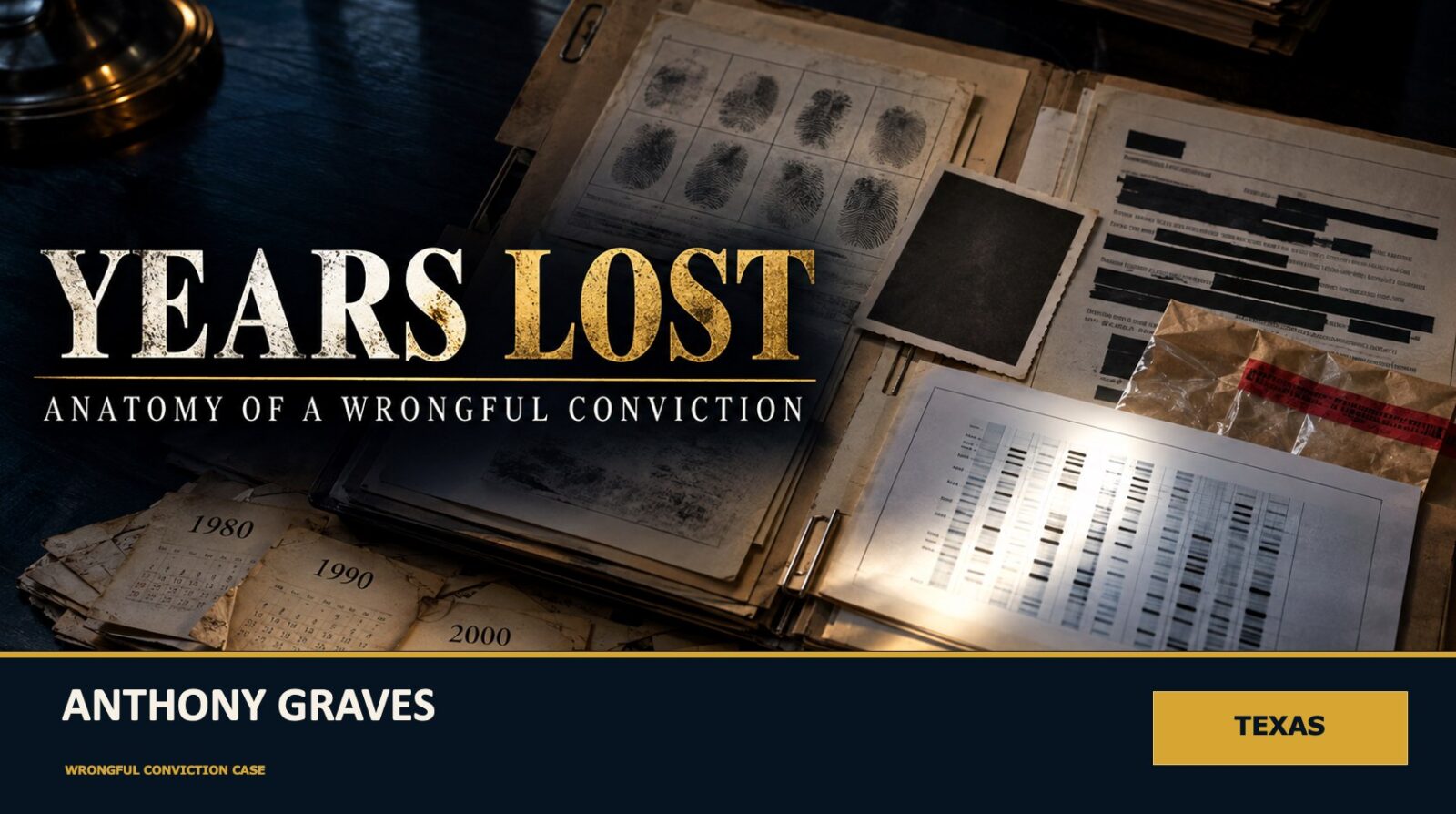
The night before he testified, the State’s star witness told the district attorney he did it all himself. The jury never heard that. The man he named spent more than 18 years locked up.
| Case at a Glance | |
|---|---|
| Name | Anthony Charles Graves |
| Where | Somerville, Burleson County, Texas; tried in Brazoria County |
| Convicted of | Capital murder, by a jury on November 1, 1994; sentenced to death |
| Years lost | More than 18 years, from his arrest on August 22, 1992 to his release on October 27, 2010 |
| What went wrong | A conviction resting almost entirely on a co-defendant’s testimony; the prosecutor withheld the co-defendant’s mid-trial statement that he acted alone, and another implicating his own wife, then drew testimony he knew left a false impression |
| How it came apart | Carter recanted, including in his last words before his execution in 2000; the Fifth Circuit found the withheld statements material in 2006; a special prosecutor’s review found no credible evidence against Graves |
| Status today | Exonerated. Charges dismissed October 27, 2010; the prosecutor was disbarred, and the disbarment was upheld in 2016 |
| Texas law in play | Accomplice-witness corroboration (Art. 38.14); disclosure duties (Brady, Art. 39.14); false impressions (Napue, Ex parte Chabot); capital habeas (Art. 11.071, Ex parte Graves); prosecutor grievances (Gov’t Code 81.072) |
The Road to Exoneration
- Done: ConvictedJury verdict, November 1, 1994
- Done: Conviction set asideMarch 3, 2006 (Fifth Circuit)
- Done: ReleasedOctober 27, 2010
- Done: Charges dismissed or acquittedDismissed October 27, 2010
- Where it stands: ExoneratedOctober 27, 2010
- Done: CompensatedYes
No DNA test freed Anthony Graves. The truth was in the district attorney’s file the night before the key witness took the stand.
What Happened
Early on August 18, 1992, a house burned in Somerville, a small town in Burleson County. Inside were the bodies of Bobbie Davis, 45, her 16-year-old daughter Nicole, and four of her grandchildren, ages 4 to 9. They had been stabbed, beaten or shot, and the house had been doused with gasoline and set on fire.
Robert Earl Carter, 26, was the father of the youngest child, 4-year-old Jason. The child’s mother had filed a paternity suit against him. At the funeral, Texas Rangers noticed that Carter was wrapped in bandages for burns. They questioned him that afternoon, and he gave a statement naming Anthony Graves as the main killer and admitting only a limited role for himself. Graves, also 26, was a cousin of Carter’s wife. He was arrested on August 22, 1992.
Before the grand jury, Carter took it all back. He testified that neither he nor Graves was involved, and that he had given Graves’s name after hours of interrogation: “I said Anthony Graves off the top of my head.” Graves testified before the grand jury too, denied any involvement and accounted for where he had been. Both men were indicted. Carter was tried first, convicted of capital murder in February 1994 and sentenced to death.
How the Case Was Built
Graves was tried in October 1994 in Brazoria County. There was no confession and no physical evidence placing him at the scene, and none of the weapons was ever found. As the Fifth Circuit later put it, the case “rests almost entirely on Carter’s testimony.” Carter testified that he and Graves went to the house together, that Graves carried a knife and attacked Bobbie Davis, and that he himself shot Nicole and set the fire.
Carter was an accomplice, so Texas law required other evidence tending to connect Graves to the crime. The State offered three things, as the Court of Criminal Appeals later summarized them:
- A knife that was never found. His former boss testified that he had given Graves a switchblade made from a kit, identical except for the handle to one he made for himself. The medical examiner testified that the boss’s knife, or one with a similar blade, could have made the wounds. Texas Ranger Ray Coffman testified that it fit the marks on the victims’ skull caps “like a glove.” A defense expert testified that other knives with similar blades were also consistent.
- Words overheard in the jail. Graves and Carter were held in cells facing each other. Several people, including a jailer and a former sheriff’s department employee, testified that they overheard Graves make incriminating remarks to Carter. The Fifth Circuit noted that these witnesses were “effectively cross-examined” on the reliability of the jail intercom, whether they could really recognize Graves’s voice, and why they did not report the remarks right away.
- His own grand jury testimony. Graves had told the grand jury, “No sir, I never owned a knife, period.” Two witnesses testified they had seen him with the switchblade.
On November 1, 1994, the jury convicted Graves of capital murder, and he was sentenced to death. The Court of Criminal Appeals affirmed on April 23, 1997.
What the Jury Never Heard
Carter testified under a deal. One of its terms was that no one would ask him about his wife. The negotiations came to a head on the evening of October 21, 1994, the second day of testimony, when Carter met with District Attorney Charles Sebesta. According to the federal court’s findings, Carter almost immediately said, “I did it all myself, Mr. Sebesta. I did it all myself.” When Sebesta said that could not be true, Carter changed his story to Graves and a third man called “Red.” After a polygraph examiner concluded he was lying about his wife, he changed it again and said his wife had been there with him and Graves, and had used the hammer.
None of that was disclosed to the defense. The next morning Sebesta told the judge only that Carter had taken a polygraph whose “basic question involved his wife” and had shown deception. He did not mention that Carter had said he acted alone, or what Carter had said about his wife. Then he put Carter on the stand and had him confirm that, apart from the grand jury, he had always named Graves. Ranger Coffman confirmed the same thing.
Graves’s lawyers first learned of the “I did it all myself” statement years later. In September 2000, Sebesta acknowledged it on national television: “he did tell us, ‘Oh, I did it myself. I did it.’ He did tell us that.”
How It Came Apart
Carter recanted. In a 1998 deposition he said he had acted alone, but the state court excluded it because Graves’s lawyer had not given the State notice so it could cross-examine. He recanted again in a May 2000 deposition that Sebesta attended. On May 31, 2000, minutes before he was executed, Carter said: “It was me and me alone. Anthony Graves had nothing to do with it. I lied on him in court.”
The state courts never reached the merits of the withheld statements; they dismissed those claims as an abuse of the writ. Graves also argued that his first habeas lawyer had been ineffective, and in January 2002 the Court of Criminal Appeals held, six to three, that “competency of prior habeas counsel is not a cognizable issue on habeas corpus review” and dismissed it as an abuse of the writ (Ex parte Graves, 70 S.W.3d 103 (Tex. Crim. App. 2002)).
The federal courts did reach them. On March 3, 2006, the Fifth Circuit held that Carter’s statement that he acted alone and his statement implicating his wife were both favorable to Graves and, taken together, material, and it ordered the writ granted unless Texas retried him (Graves v. Dretke, 442 F.3d 334 (5th Cir. 2006)). The court also wrote: “Perhaps even more egregious than District Attorney Sebesta’s failure to disclose Carter’s most recent statement is his deliberate trial tactic of eliciting testimony from Carter and the chief investigating officer, Ranger Coffman, that the D.A. knew was false.”
Graves remained locked up while the State prepared to try him again. District Attorney Bill Parham brought in Kelly Siegler, a former Harris County prosecutor, as special prosecutor. After reviewing the case, she said, “we found not one piece of credible evidence that links Anthony Graves to the commission of this capital murder,” and “He is an innocent man.” The charges were dismissed, and Graves walked out on October 27, 2010.
Where Things Stand Now
Graves filed a grievance against Sebesta. It was first rejected as too late under the State Bar’s four-year limitations period. A 2013 law changed that: for a grievance alleging that a prosecutor violated the duty to disclose evidence, the clock now starts only when the wrongfully imprisoned person is released (S.B. 825, codified at Government Code § 81.072(b-1)). Graves refiled. The State Bar disbarred Sebesta for his conduct in the case, and in February 2016 the Board of Disciplinary Appeals upheld the disbarment.
Graves went on to advocate for criminal justice reform and, in 2015, was appointed to the board of the Houston Forensic Science Center, Houston’s crime laboratory. He told his story in a memoir, Infinite Hope.
The law that let Graves hold his prosecutor to account came out of another case in this series, Michael Morton’s (Case No. 02).
How Texas Law Answers It
This one happened in Texas, so the question is not how Texas would have handled it. The question is which of these protections existed in 1994, which did not, and which held up.
The accomplice rule worked, and it was not enough
Under Article 38.14, “a conviction cannot be had upon the testimony of an accomplice unless corroborated by other evidence tending to connect the defendant with the offense committed.” Carter was an accomplice as a matter of law: he was charged with, and convicted of, the same capital murder (Druery v. State, 225 S.W.3d 491, 498-99 (Tex. Crim. App. 2007)). So the rule applied, and the State had to bring something besides Carter.
It did, and the Court of Criminal Appeals held that it was enough. That is the lesson. The corroboration only has to tend to connect the defendant to the offense (Ambrose v. State, 487 S.W.3d 587, 593-94 (Tex. Crim. App. 2016)), and courts judge it by its combined force rather than piece by piece (Smith v. State, 332 S.W.3d 425, 442 (Tex. Crim. App. 2011)). A knife no one could produce, compared to a different knife; remarks overheard through a jail intercom by witnesses who did not report them right away; and a denial of ever owning a knife cleared that bar. The Fifth Circuit called the knife only “marginally linked” to the crime and found “no direct evidence linking him with Carter or with the murder scene other than Carter’s testimony.” The accomplice rule is a floor. It keeps a conviction from resting on an accomplice alone. It does not ask whether the accomplice is telling the truth. Who counts as an accomplice in the first place is its own question, and we walked through it in Case No. 08.
The instruction itself is not something the defense has to win. When the evidence raises the issue, the trial court must give it on its own (Zamora v. State, 411 S.W.3d 504, 510-13 (Tex. Crim. App. 2013)). The work for the defense is in attacking the corroboration, piece by piece, in front of the jury.
The statement made the night before
Brady v. Maryland already required Sebesta to disclose Carter’s statements in 1994. What Texas has added since is a statute that makes the timing explicit. Under the Michael Morton Act, Article 39.14(h) requires the State to disclose “any exculpatory, impeachment, or mitigating document, item, or information” in its possession that tends to negate guilt, and Article 39.14(k) makes the duty continuing: if the State discovers such information “at any time before, during, or after trial,” it “shall promptly disclose” it. A cooperating co-defendant who tells the prosecutor in the middle of trial that he acted alone is the plainest case that subsection could describe. The Act applies to offenses committed on or after January 1, 2014.
Testimony that leaves a false impression
Sebesta’s questions did not ask Carter to say anything untrue about the crime. They asked him to confirm a history of consistency that Sebesta knew was false, and then had the lead investigator confirm it too. Under Napue v. Illinois, 360 U.S. 264 (1959), a prosecutor may not knowingly let false testimony stand. Texas goes further: in Ex parte Chabot, 300 S.W.3d 768 (Tex. Crim. App. 2009), the Court of Criminal Appeals held that the use of material false testimony violates due process even when the prosecutor did not know it was false, and in Ex parte Weinstein, 421 S.W.3d 656 (Tex. Crim. App. 2014), it held that the testimony is material if there is a “reasonable likelihood” it affected the jury’s judgment.
The writ you get to file
Ex parte Graves is still the law, and it bears his name. A death-sentenced applicant in Texas gets appointed counsel for the initial application under Article 11.071, but if that lawyer misses something, the miss is not itself a ground for a later application.
Ask on the record, before the cooperating witness testifies and again before cross-examination, whether he has said anything to the State since the last disclosure. Under Article 39.14(k) the duty does not stop when trial starts. If the State discloses part of something, like a polygraph result, ask what was said.
What This Means If You Are Charged in Texas
- Get the whole deal. Every term of a cooperating witness’s agreement is impeachment, including the unusual ones. Carter’s deal included a promise that no one would ask about his wife. That term was a clue to what he was protecting.
- Count the corroboration. When the State’s case is an accomplice, list every piece of non-accomplice evidence and attack each one. Ask whether the knife in the courtroom is the knife in the case, and whether a voice overheard through a wall can really be identified.
- Watch for borrowed consistency. When the State asks its witness to confirm that he has always told the same story, find out whether that is true. A false picture of consistency is false testimony even if each answer sounds harmless.
- Treat the first writ as the only writ. In Texas, a later application cannot rest on the argument that habeas counsel missed something the first time.
- Know the grievance clock. For a prosecutor’s failure to disclose, the limitations period for a State Bar grievance runs from release, not from trial.
The Bottom Line
Anthony Graves was convicted of killing six people on the word of the man who killed them. Texas law required that word to be corroborated, and it was, by evidence the federal court later found barely connected him to anything. What would have broken the case was sitting in the district attorney’s office the night before Carter took the stand: Carter saying he did it all himself. The jury never heard it, and it heard the opposite instead. It took 18 years, a dead man’s last words, a federal court and a special prosecutor willing to look at the file to send Graves home. Texas has since written the duty to disclose into a statute and given exonerees time to hold prosecutors to it. Neither change undoes what happened, and neither works unless defense lawyers ask the questions Graves’s lawyers never had the chance to ask.
Sources
Case record and reporting
- Graves v. Dretke, 442 F.3d 334 (5th Cir. 2006). ca5.uscourts.gov
- Graves v. Cockrell, 351 F.3d 143 (5th Cir. 2003) (quoting Graves v. State, No. 72,042 (Tex. Crim. App. Apr. 23, 1997) (not designated for publication)). ca5.uscourts.gov
- Ex parte Graves, 70 S.W.3d 103 (Tex. Crim. App. 2002). txcourts.gov
- Anthony Graves, National Registry of Exonerations, Case No. 10485. exonerationregistry.org
- “Anthony Graves Becomes 12th Death Row Inmate Exonerated in Texas,” Death Penalty Information Center (Oct. 28, 2010). deathpenaltyinfo.org
- “Texan says accomplice innocent in last words,” Deseret News (June 1, 2000). deseret.com
- “Disbarment of Former District Attorney Upheld,” Texas Tribune (Feb. 8, 2016). texastribune.org
- “New Law Gives Texas Exoneree Chance to Hold Former DA Accountable,” Innocence Project (Jan. 21, 2014). innocenceproject.org
- “Ex-death row inmate Anthony Graves appointed to Houston crime lab board,” CBS News (June 25, 2015). cbsnews.com
Texas law
- Brady v. Maryland, 373 U.S. 83 (1963). justia.com
- Napue v. Illinois, 360 U.S. 264 (1959). justia.com
- Druery v. State, 225 S.W.3d 491 (Tex. Crim. App. 2007). courtlistener.com
- Ambrose v. State, 487 S.W.3d 587 (Tex. Crim. App. 2016). courtlistener.com
- Smith v. State, 332 S.W.3d 425 (Tex. Crim. App. 2011). courtlistener.com
- Zamora v. State, 411 S.W.3d 504 (Tex. Crim. App. 2013). justia.com
- Ex parte Chabot, 300 S.W.3d 768 (Tex. Crim. App. 2009). courtlistener.com
- Ex parte Weinstein, 421 S.W.3d 656 (Tex. Crim. App. 2014). courtlistener.com
- Tex. Code Crim. Proc. art. 11.071 (capital habeas corpus). statutes.capitol.texas.gov
- Tex. Code Crim. Proc. art. 38.14 (testimony of accomplice). statutes.capitol.texas.gov
- Tex. Code Crim. Proc. art. 39.14 (discovery). statutes.capitol.texas.gov
- Tex. Gov’t Code § 81.072 (attorney discipline standards). statutes.capitol.texas.gov
- Acts 2013, 83rd Leg., R.S., S.B. 825 (prosecutor grievance limitations). capitol.texas.gov
This post is an informational synthesis for educational purposes and is not legal advice. It is based on the published opinions of the Fifth Circuit and the Texas Court of Criminal Appeals, the record compiled by the National Registry of Exonerations, and contemporaneous reporting, as available in November 2026. Carter’s statements about his wife were never tested at a trial; she is described by role. Case citations should be independently verified against the official record before use in any filing.
Which county your case is filed in changes how it is charged, who prosecutes it, and which court hears it.
Deandra M. Grant, JD, GC, MS, ACS-CHAL Forensic Lawyer-Scientist
She holds a Master of Science in Pharmaceutical Science and a Graduate Certificate in Forensic Toxicology, both from the University of Florida. She is the author of The Texas DWI Manual and has defended Texas DWI cases since 1994.
Facing a Serious Charge in Texas?
When the State's case depends on a witness who has made a deal, the deal and everything the witness has said belong in front of the jury. The sooner a defense team is asking for them, the more can be done. Intake answers 24/7.
Request a Free Case Evaluation
Tell us what happened. We'll respond as soon as possible.