
Carl Case: Declared Innocent After 44 Years

Carl Case was 19 when he was arrested for the rape and murder of Nancy Mitchell, a Carlsbad teenager whose body was found near Six Mile Dam in January 1982. The case rested on three teenage witnesses, two of whom testified under grants of immunity. Two later recanted, one citing police pressure and the other a story he made up to win immunity after six months in jail. A recorded interview with the third, in which he admitted a sexual encounter with Mitchell days before she disappeared, was never transcribed or given to the defense. Federal judges ordered relief three times and were reversed three times. In October 2026 a New Mexico district judge found Case actually innocent, and he walked out of prison on October 27. The State has appealed, so the ruling is not final.Below: how three shaky witnesses carried a 1982 murder case, why it took 44 years, and how Texas would handle the same evidence.
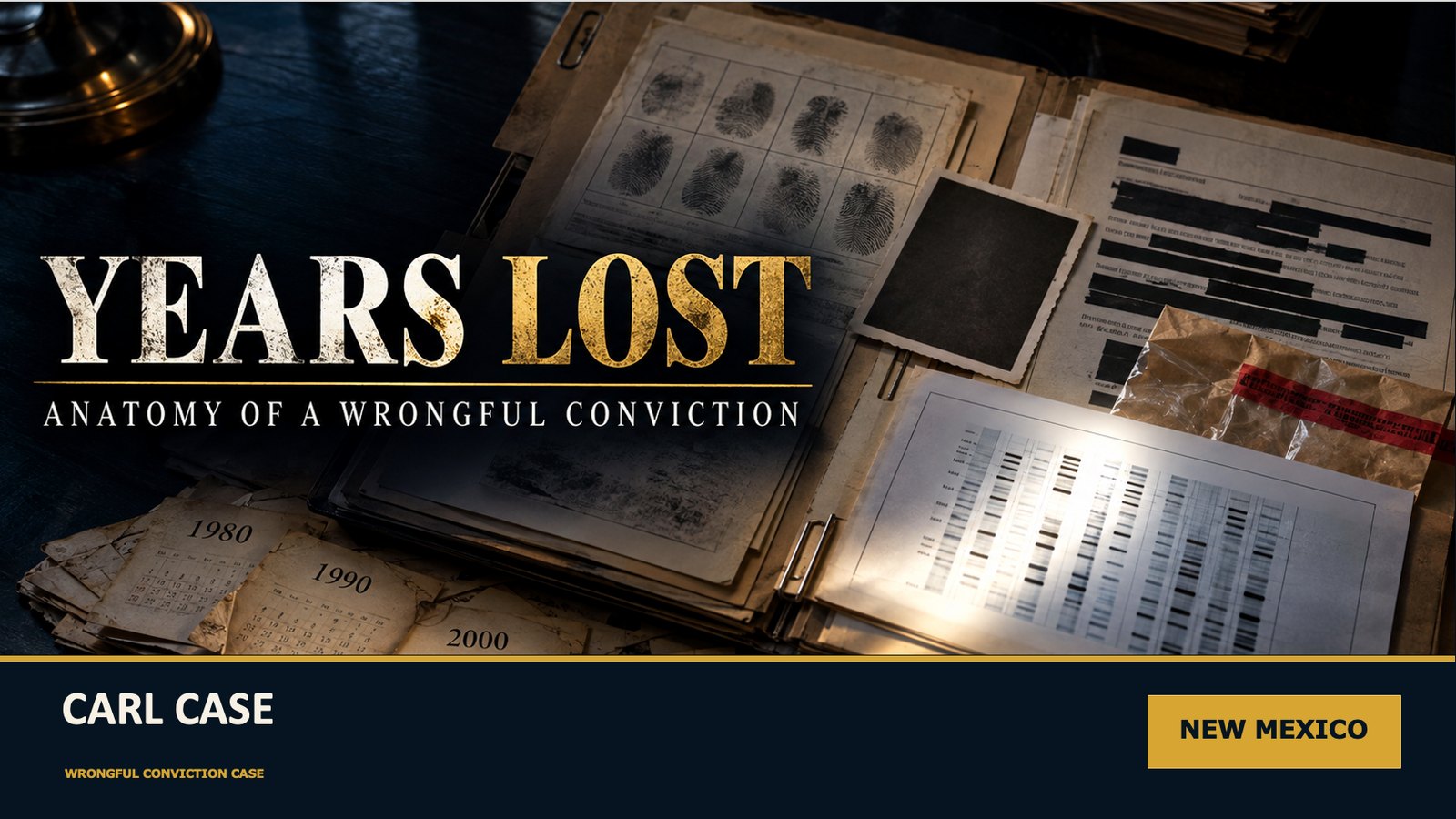
Three teenagers put him at the dam. Two have since said their stories were false. The third had told police something the jury never heard. And the insects say Nancy Mitchell may have been dead before the night it supposedly happened.
| Case at a Glance | |
|---|---|
| Name | Carl Case |
| Where | Near Carlsbad, Eddy County, New Mexico |
| Convicted of | First-degree murder and first-degree criminal sexual penetration, by a jury on October 26, 1982; life plus 18 years |
| Years lost | About 44 years, from his 1982 arrest to his release on October 27, 2026 |
| What went wrong | Teenage witnesses who later recanted, one citing police pressure, two of the three testifying under immunity; an undisclosed recorded interview with the third witness; a time-of-death theory later contradicted by insect evidence |
| How it came apart | Two witnesses recanted in 2003; the missing interview surfaced in the State’s file; DNA found no male DNA; forensic entomology moved the likely date of death to mid or late December 1981 |
| Status today | Declared actually innocent and released October 27, 2026; the State has appealed; not exonerated while the appeal is pending |
| Texas law in play | Actual innocence (Ex parte Elizondo); who decides a Texas writ (Art. 11.07, Ex parte Reed); accomplice witnesses (Art. 38.14); recorded statements and Brady (Art. 39.14); new science (Art. 11.073) |
The Road to Exoneration
- Done: ConvictedOctober 26, 1982
- Done: Conviction set asideOctober 2026 (State appealing)
- Where it stands: ReleasedOctober 27, 2026
- Not yet: Charges dismissed or acquittedNot yet; appeal pending
- Not yet: ExoneratedDeclared actually innocent by the trial court; not final
- Not yet: CompensatedNo
A judge has said Carl Case did not do it. Until the appeal is decided, that finding can still be taken away.
What Happened
In early December 1981, Nancy Mitchell, a Carlsbad teenager, ran away from home. She stayed with friends and in motels around town. The last sighting no one disputes was December 21, when she left an apartment with an 18-year-old friend, Bobby Autry, who said he later dropped her off at a Dairy Queen.
On January 30, 1982, her body was found near Six Mile Dam outside Carlsbad. She had been dead for weeks. The autopsy found blows to the head and upper body and a skull fracture, and the cause of death was exposure. Police arrested six young men, including Carl Case, who was 19.
How the Case Was Built
The State’s theory was that Mitchell was attacked at the dam on New Year’s Day 1982 by a group of young men. Three teenagers testified (Audrey Knight, Bobby Autry and Paul Dunlap) that Case was there and took part. Their stories conflicted with each other, and the conflicts were aired at trial.
- Dunlap was 17, arrested for the murder himself, and held for six months while the State tried to prosecute him as an adult. The day before an appeals court ruled against the State on that question, he accepted complete immunity in exchange for testimony against Case and the others.
- Autry was interviewed four times. He first denied knowing anything. In his second interview, on February 3, 1982, he admitted he had undressed with Mitchell in his car on December 19 and had partially penetrated her before she pushed him away. After failing a polygraph in March, he received immunity and gave a final statement placing Case and others at the dam on New Year’s Day.
- Knight told police she saw the men leave a party with Mitchell and then saw Mitchell pinned in a car at the dam.
Case did not testify to an alibi. According to the federal appeals court’s account of the record, his lawyer told him there was little to support one, and Case took the stand and said he was at the dam that night with several of the others and with Mitchell. He said there was no rape, that one of the men struck her once, and that she fell down an embankment and did not get up. At a later hearing he said he had made that story up. Knight, for her part, testified years later that she changed her own story once Case changed his.
The defense also called two witnesses who said they saw Mitchell weeks after New Year’s Day. The State’s expert told the jury he could “absolutely exclude” that possibility. On October 26, 1982, the jury convicted Case of first-degree murder and first-degree criminal sexual penetration. He was sentenced to life plus 18 years. The New Mexico Supreme Court affirmed in State v. Case, 100 N.M. 714, 676 P.2d 241 (1984).
How It Came Apart
Few cases show the limits of post-conviction review the way this one does. A federal district judge granted Case habeas relief in 1985 and again in 1988 over a juror-misconduct claim; the Tenth Circuit reversed both times, ending that round in Case v. Mondragon, 887 F.2d 1388 (10th Cir. 1989).
The recantations surfaced in 2003, when Knight told the father of Curtis Worley, one of Case’s co-defendants, that she had made up her testimony. Law students and lawyers from the University of New Mexico’s Innocence and Justice Project followed up, and in December 2003 two of the students visited Dunlap, who recanted too. Both testified under oath at state evidentiary hearings in late 2005 and early 2006. Knight said she was never at the dam and invented her account under police pressure. Dunlap said he testified falsely because he had spent six months in jail, was threatened with prosecution as an adult, and was offered immunity for implicating the others. In June 2005, while the state petition was pending, two of the law students went through the district attorney’s file and found the February 3 Autry interview on a tape no one had transcribed. New DNA testing found no male DNA or sperm cells on the evidence.
The state courts denied relief. In Case v. Hatch, 2008-NMSC-024, 144 N.M. 20, 183 P.3d 905, the New Mexico Supreme Court held that the recantations were not newly discovered evidence because the inconsistencies had already been before the jury, and that the Autry interview was not material. It also set a new test for recantations: a court must be left “with a firm belief that but for the perjured testimony, the defendant would most likely not have been convicted.”
In 2011 a federal district judge granted relief a third time after hearing the recanting witnesses in person (Case v. Hatch, 773 F. Supp. 2d 1070 (D.N.M. 2011)). Taken together, the judge wrote, the inconsistencies in the State’s witnesses “render the evidence against Mr. Case among the weakest in which a guilty verdict may be sustained.” The Tenth Circuit vacated that grant in 2013, holding that the strict standard for a second federal petition had not been met (Case v. Hatch, 731 F.3d 1015 (10th Cir. 2013)). The Supreme Court declined to review it.
What finally worked was a claim New Mexico did not recognize when Case was convicted. In Montoya v. Ulibarri, 2007-NMSC-035, 142 N.M. 89, 163 P.3d 476, the New Mexico Supreme Court held that a prisoner may bring a freestanding claim of actual innocence, and win it by proving “by clear and convincing evidence that no reasonable juror would have convicted him in light of the new evidence.” Case’s new evidence included forensic entomology: experts read the development of insect larvae visible in photographs of Mitchell’s body against local temperature records and concluded she likely died in mid or late December 1981, before the New Year’s Day attack the State had described.
In October 2026, District Judge Lisa Riley of New Mexico’s Fifth Judicial District found that Case had met that burden. She heard from Mike Tweedy, who was convicted as a juvenile in the same case and says he turned down the State’s offer of immunity, and found his testimony “highly credible, extremely compelling and very reliable.” The State’s own witnesses never agreed about Tweedy. Knight testified that he held Mitchell’s hands and covered her mouth in the car. Dunlap said Tweedy was not in the car and was not at the scene, and he testified for the defense at Tweedy’s own trial. Judge Riley also wrote that Autry’s later conduct showed “a guilty conscience over Nancy Mitchell’s murder.” Autry was charged at first but was given immunity and never prosecuted, and he has since died.
Where Things Stand Now
Carl Case walked out of the Penitentiary of New Mexico at sunset on October 27, 2026. “They believed in me,” he said of his lawyers. “They were the only ones that did, so I believed in them.”
The State has appealed through the New Mexico Department of Justice, and Case’s lawyers say they expect to defend the ruling in the New Mexico Supreme Court. Judge Riley ordered him released anyway after his lawyers argued the law requires it while the appeal is pending.
The State starts that appeal with a precedent built on this same record. Curtis Worley, the co-defendant whose father heard Knight’s first recantation, won a new trial in state district court, and in 2020 the New Mexico Supreme Court reversed it in State v. Worley, 2020-NMSC-021. The court assumed the Autry statement had been suppressed and was favorable to the defense, held that it was not material, and held that Knight’s and Dunlap’s recantations were not new evidence. No justice dissented. That is the first thing the State will put in front of the appellate court. What the 2020 court did not have was the insect evidence, and Judge Riley’s ruling relies on it.
Until the appeal is resolved, the innocence finding is not final, and this series does not call him exonerated. It is a ruling from the judge who heard the evidence, and that is not nothing.
How Texas Law Answers It
Case’s path to freedom ran through New Mexico law, but every turn of it has a Texas counterpart, and a few of them would have played out differently here.
Who can set you free
In New Mexico, the district judge who heard the evidence granted the writ and ordered Case released. A Texas district judge cannot do that on a felony conviction. Under Article 11.07, the trial court gathers evidence and makes findings, but only the Court of Criminal Appeals can grant relief, and it is the ultimate factfinder (Ex parte Reed, 271 S.W.3d 698, 727-28 (Tex. Crim. App. 2008)). Two posts in this series show what that means in practice. In Case No. 07, the trial judge found Melissa Lucio actually innocent and she is still on death row. In Case No. 10, the Court of Criminal Appeals made the actual innocence finding for Kerry Max Cook itself.
The standard itself is the same. New Mexico’s test in Montoya tracks Texas’s own, from Ex parte Elizondo, 947 S.W.2d 202 (Tex. Crim. App. 1996): clear and convincing evidence that no reasonable juror would have convicted in light of the new evidence.
Witnesses who were in it themselves
Dunlap and Autry both testified under immunity, but Texas would not treat them the same way. Under Article 38.14, a conviction cannot rest on an accomplice’s testimony unless other evidence tends to connect the defendant to the offense. Who counts as an accomplice is narrower than it sounds. Under Druery v. State, 225 S.W.3d 491, 498-99 (Tex. Crim. App. 2007), a witness charged with the same offense, or one the evidence clearly shows could have been, is an accomplice as a matter of law, but in every case there must be evidence of an affirmative act by the witness to help commit the charged offense. Being at the scene is not enough, and neither is taking part in some other offense. A grant of immunity is not the test either. Dunlap fits: he was charged with the murder, and the State’s own evidence put him in the attack, so his testimony would have needed corroboration (see also Ambrose v. State, 487 S.W.3d 587, 593-94 (Tex. Crim. App. 2016)). Autry probably does not. He had been charged too, but the charge alone does not settle it: he testified that he ran home when the attack began, and the conduct he admitted, the encounter with Mitchell days earlier, is a different offense. Under Texas law his word would likely have gone to the jury with no corroboration requirement at all. And Knight’s account and Case’s own testimony could have supplied corroboration for Dunlap, which is why the accomplice rule is a safeguard and not a guarantee. We walked through the rule in Case No. 05.
The tape not transcribed
The Autry interview sat in the State’s file on a tape no one had transcribed. Under Brady v. Maryland, the question is whether undisclosed favorable evidence was material, and New Mexico’s highest court said this was not. Texas has since changed the starting point. The Michael Morton Act, Article 39.14, applies to offenses committed on or after January 1, 2014, and requires the State to produce recorded statements of witnesses on request and to disclose impeachment information without one, before, during and after trial. A recorded interview in which the State’s key witness admits a sexual encounter with the victim is not a close call under that statute. We told the story behind it in Case No. 02.
When the science moves the timeline
The State’s case depended on a date. Insect evidence now points to a different one. In Texas, Article 11.073 lets a court grant relief when new scientific evidence, unavailable at trial, shows by a preponderance of the evidence that the person would not have been convicted. We explained the junk science writ in our post on Kerry Max Cook.
Recantations
New Mexico’s courts rejected Knight’s and Dunlap’s recantations in 2008 because the jury had already heard their contradictions. Texas courts approach recantations warily too. In Ex parte Mayhugh, 512 S.W.3d 285 (Tex. Crim. App. 2016), the Court of Criminal Appeals said they “should not be accepted without close scrutiny nor, generally, without strong corroboration by independent evidence.” In Case’s case, that corroboration eventually came from somewhere no one expected: insects in old photographs.
Find out how each witness came to testify: whether the witness was ever a suspect, charged, held, polygraphed or told they failed, and what they were offered and when. Ask for every recorded interview, not just the transcribed ones. If a witness’s story changes after a polygraph or after an offer, that sequence belongs in front of the jury. In Texas, what the witness did, not the deal, decides whether he is an accomplice whose word needs corroboration.
What This Means If You Are Charged in Texas
- Think hard before testifying to a version of events you cannot support. Case’s own trial testimony placed him at the dam. Decisions made under pressure in 1982 were still being weighed against him in 2013.
- Get every recording. Ask for each interview of each witness, in recorded form, and listen to all of them. The interview that mattered here was never transcribed.
- Map the deals. Immunity, dropped charges and the timing of each offer are impeachment. A deal alone does not make a witness an accomplice under Article 38.14; what the witness did can.
- Test the timeline. If the State’s case depends on when something happened, the defense needs its own expert on that question before trial, not decades later.
- Keep going. Case lost in state court, won and lost in federal court three times, and was still found innocent 44 years later. A denial is not always the end.
The Bottom Line
Carl Case was convicted on the word of three teenagers. Two had been pressured or were in jail themselves, and one had told police something about the victim that the jury never heard. He made his own situation worse with a story on the witness stand that he later disowned. For four decades every court that agreed something had gone wrong was overruled by a court that said it was not enough. A trial judge has now found him innocent, and the State is fighting that. Whatever happens on appeal, the case is a reminder that witnesses who are in trouble themselves, recordings no one listens to, and a timeline no one tests can put a man in prison for most of his life.
Sources
Case record and reporting
- “Convicted killer Carl Case declared innocent, released after 44 years in prison,” Santa Fe New Mexican (Oct. 28, 2026). santafenewmexican.com
- “After 44 years in prison, New Mexico man exonerated of 1982 rape and murder conviction,” KRQE (Oct. 30, 2026). krqe.com
- State v. Case, 100 N.M. 714, 676 P.2d 241 (1984). courtlistener.com
- Case v. Mondragon, 887 F.2d 1388 (10th Cir. 1989). courtlistener.com
- Case v. Hatch, 2008-NMSC-024, 144 N.M. 20, 183 P.3d 905. courtlistener.com
- Case v. Hatch, 773 F. Supp. 2d 1070 (D.N.M. 2011). courtlistener.com
- Case v. Hatch, 731 F.3d 1015 (10th Cir. 2013). courtlistener.com
- Montoya v. Ulibarri, 2007-NMSC-035, 142 N.M. 89, 163 P.3d 476. courtlistener.com
- State v. Worley, 2020-NMSC-021, 476 P.3d 1212. courtlistener.com
Texas law
- Ex parte Elizondo, 947 S.W.2d 202 (Tex. Crim. App. 1996). courtlistener.com
- Ex parte Reed, 271 S.W.3d 698 (Tex. Crim. App. 2008). courtlistener.com
- Druery v. State, 225 S.W.3d 491 (Tex. Crim. App. 2007). courtlistener.com
- Ambrose v. State, 487 S.W.3d 587 (Tex. Crim. App. 2016). courtlistener.com
- Ex parte Mayhugh, 512 S.W.3d 285 (Tex. Crim. App. 2016). courtlistener.com
- Brady v. Maryland, 373 U.S. 83 (1963). justia.com
- Tex. Code Crim. Proc. art. 11.07 (felony habeas corpus). statutes.capitol.texas.gov
- Tex. Code Crim. Proc. art. 11.073 (new scientific evidence). statutes.capitol.texas.gov
- Tex. Code Crim. Proc. art. 38.14 (testimony of accomplice). statutes.capitol.texas.gov
- Tex. Code Crim. Proc. art. 39.14 (discovery). statutes.capitol.texas.gov
This post is an informational synthesis for educational purposes and is not legal advice. It is based on the published state and federal court opinions in Mr. Case’s case and on reporting by the Santa Fe New Mexican and KRQE as available in October 2026. The district court’s finding of actual innocence is on appeal and is not final. Bobby Autry was initially charged, received immunity and was never prosecuted; statements about him reflect his own recorded interview and the district court’s findings as reported. Case citations should be independently verified against the official record before use in any filing.
Which county your case is filed in changes how it is charged, who prosecutes it, and which court hears it.
Deandra M. Grant, JD, GC, MS, ACS-CHAL Forensic Lawyer-Scientist
She holds a Master of Science in Pharmaceutical Science and a Graduate Certificate in Forensic Toxicology, both from the University of Florida. She is the author of The Texas DWI Manual and has defended Texas DWI cases since 1994.
Facing a Serious Charge in Texas?
When the State's case depends on what witnesses say and when something happened, both can be tested. The sooner a forensic-trained defense team is asking how every witness came to testify, the more can be done. Intake answers 24/7.
Request a Free Case Evaluation
Tell us what happened. We'll respond as soon as possible.