
Kerry Max Cook: 47 Years to Be Declared Innocent

Kerry Max Cook was 21 when he was arrested for the 1977 murder of Linda Jo Edwards in Tyler. He was tried three times and sentenced to death twice, on the word of a jailhouse informant who later admitted he lied, a fingerprint an officer claimed he could date to the time of the murder, and the testimony of a man who later admitted lying about his own relationship with the victim. Cook spent about 20 years in custody, most of them on death row, before his release in 1997. On June 19, 2024, the Texas Court of Criminal Appeals declared him actually innocent, 47 years after his arrest.Below: how three trials were built on the same bad evidence, how it came apart, and the Texas laws that now cover each failure.
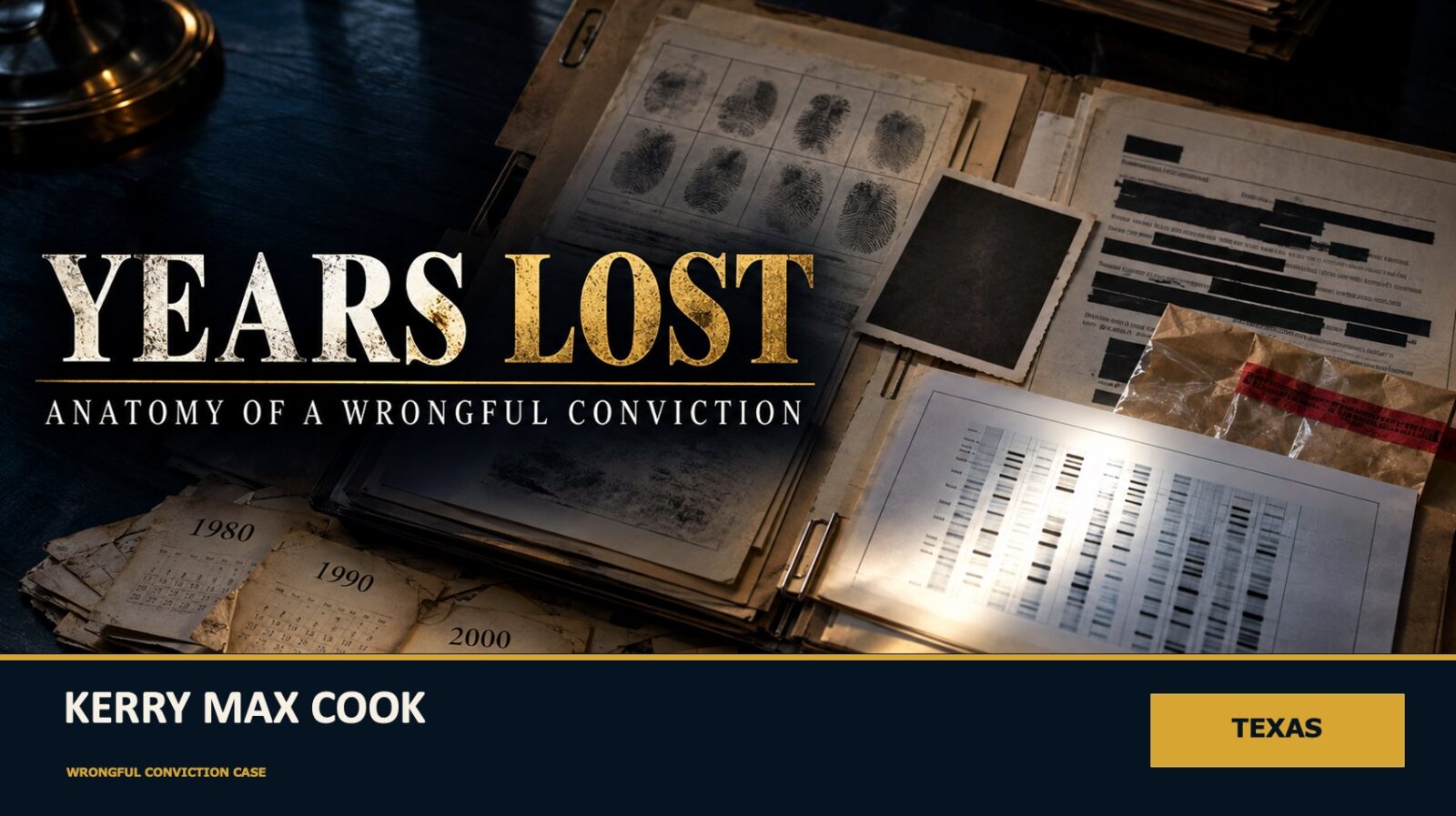
A cellmate who lied to save himself. A fingerprint “aged” to fit the crime. A key witness who admitted he lied. Three trials, two decades on death row.
| Case at a Glance | |
|---|---|
| Name | Kerry Max Cook |
| Where | Tyler, Smith County, Texas |
| Charge | Capital murder of Linda Jo Edwards, 21, found June 10, 1977 |
| Convicted | 1978 (death sentence); retrial ended in a hung jury in 1992; convicted again in 1994 (death sentence); no contest plea in 1999 to avoid a fourth trial |
| Years lost | About 20 years in custody (August 1977 arrest to November 1997 release on bond); 47 years until the innocence ruling |
| What went wrong | Jailhouse informant who recanted; fingerprint “age” testimony with no scientific basis; a key witness’s false testimony; withheld evidence; destroyed evidence |
| How it came apart | DNA excluded Cook and matched the witness who had testified falsely; he admitted lying in 2016; Court of Criminal Appeals found actual innocence June 19, 2024 |
| Status today | Exonerated; charges dismissed October 4, 2024; federal civil rights suit filed November 2024 |
| Texas law in play | Jailhouse informant rules (Art. 38.075, Art. 39.14(h-1)); junk science writ (Art. 11.073); false testimony (Ex parte Chabot); actual innocence (Ex parte Elizondo); evidence preservation (Art. 38.43) |
The Road to Exoneration
- Done: Convicted1978, 1994, and a 1999 no contest plea
- Done: Conviction set asideJune 19, 2024
- Done: ReleasedOn bond, November 11, 1997
- Done: Charges dismissed or acquittedOctober 4, 2024
- Where it stands: ExoneratedJune 19, 2024
- Not yet: CompensatedNo award reported; civil suit pending
Cook walked out of jail in 1997, but the law still called him a murderer until 2024.
What Happened
In June 1977, Linda Jo Edwards, a 21-year-old secretary at Texas Eastern University, was murdered in her apartment in Tyler. Her roommate found her body on the morning of June 10.
Edwards had been having an affair with James Mayfield, the university’s head librarian. In August, a fingerprint examiner matched prints on Edwards’s patio door to Kerry Max Cook, 21, and he was arrested on August 5, 1977.
How the Case Was Built
Cook was convicted of capital murder in June 1978 and sentenced to death. Over the next two decades the State tried him three times, and its case rested on the same pieces each time:
- A cellmate’s story. A man jailed with Cook testified that Cook confessed. In August 1978, the informant pleaded guilty to involuntary manslaughter in his own case and received two years. In 1992 he recanted: “I lied on him to save myself.”
- A fingerprint with a time stamp. A Tyler police lieutenant testified that Cook’s prints on the patio door were 6 to 12 hours old, which placed Cook at the door around the time of the murder. He later conceded that there was no scientific basis for dating a fingerprint and that the estimate was his personal opinion.
- A changed identification. The roommate first described a figure with silver hair and white shorts and did not identify Cook. She identified him at trial after a chance encounter in an elevator.
- The other man’s testimony. Mayfield testified at two trials that he had not had sexual contact with Edwards for about three weeks before her death.
The 1978 conviction was reversed in 1991. A 1992 retrial ended in a hung jury, split 6 to 6. A third jury convicted Cook in 1994 and again sentenced him to death. In 1996 the Court of Criminal Appeals reversed that conviction too, finding misconduct by the State, but allowed a fourth trial.
How It Came Apart
Centurion Ministries posted a $100,000 bond, and on November 11, 1997, Cook walked out of the Smith County Jail. On February 16, 1999, the morning jury selection was to begin in his fourth trial, he pleaded no contest to murder in exchange for a 20-year sentence and credit for time served. He told the court he was not admitting guilt. He had already spent most of his adult life on death row and took the certainty of freedom.
Two months later, DNA results came back on semen stains on Edwards’s underwear. They excluded Cook. Testing later matched the stains to Mayfield. A hair recovered from the victim that Cook’s lawyers had asked to test had been destroyed by the State without notice to the defense.
In 2016, under a grant of immunity, Mayfield admitted that he had had sex with Edwards on June 8, 1977, a day or two before her death, contradicting his testimony at two trials. Smith County prosecutors agreed that Cook’s conviction should be vacated because of that false testimony, but they would not concede that he was innocent, and the trial judge declined to recommend an innocence finding. For eight more years, Cook remained, in the eyes of the law, a convicted murderer.
On June 19, 2024, the Court of Criminal Appeals set aside the conviction and declared Kerry Max Cook actually innocent. Writing for the court in a 106-page opinion, Judge Bert Richardson said the case “contains it all”: “uncontroverted Brady violations, proof of false testimony, admissions of perjury and new scientific evidence.” The court found that the evidence pointed to Mayfield and criticized the original prosecutors for “intentional deception.” Smith County asked for more DNA testing; the court denied the request. On October 4, 2024, the charges were dismissed.
Where Things Stand Now
In November 2024, Cook filed a federal civil rights lawsuit against the City of Tyler, Smith County and several former law enforcement officials, alleging that investigators ignored evidence pointing to Mayfield, concealed evidence and destroyed evidence. As far as public reporting shows, the suit is pending and no compensation has been awarded. Mayfield has never been charged with Linda Jo Edwards’s murder.
Cook told his own story in Chasing Justice, published in 2007, years before the law caught up with him.
How Texas Law Answers It
Cook’s case reads like a catalog of the problems Texas has spent the last 20 years writing laws about.
Jailhouse informants
Since 2009, Article 38.075 of the Code of Criminal Procedure has barred a conviction based on the testimony of a jailhouse informant unless other evidence tends to connect the defendant to the crime. Since 2017, Article 39.14(h-1) has required prosecutors to disclose an informant’s criminal history, any deal or benefit offered for the testimony, and the other cases in which the informant has testified. We walked through those rules, and the federal Giglio duty behind them, in our post on the Brittany Holberg case.
Forensic testimony that goes beyond the science
No accepted method dates a latent fingerprint, yet a jury heard that Cook’s prints were 6 to 12 hours old. In 2013 Texas became the first state to pass a junk science writ. Article 11.073 lets a convicted person seek relief when relevant scientific evidence was not available at trial or contradicts the scientific evidence the State relied on, and a 2015 amendment made clear that it covers an expert whose own opinion has changed. Before the State’s expert opinion reaches a jury at all, Kelly v. State lets the defense demand a hearing on whether it is reliable.
False testimony, known or not
Mayfield’s false account of his relationship with the victim went uncorrected through two trials. In Ex parte Chabot, 300 S.W.3d 768 (Tex. Crim. App. 2009), the Court of Criminal Appeals held that a conviction obtained through material false testimony violates due process even if the prosecutor did not know the testimony was false. Where the prosecutor does know, the federal rule of Napue v. Illinois, discussed in Case No. 01, applies with full force.
Proving innocence after a plea
Texas recognizes a freestanding claim of actual innocence on habeas, but the standard is demanding: under Ex parte Elizondo, 947 S.W.2d 202 (Tex. Crim. App. 1996), the applicant must show by clear and convincing evidence that no reasonable juror would have convicted in light of the new evidence. Cook’s 1999 no contest plea did not bar that claim; as we covered in Case No. 04, Ex parte Tuley holds that a plea does not foreclose proof of innocence. The court also made a point worth repeating: the State has to prove guilt beyond a reasonable doubt, and an innocent person should not have to prove innocence beyond all doubt.
The State destroyed a hair Cook’s lawyers had asked to test. Under Article 38.43 of the Code of Criminal Procedure, Texas now requires the State to preserve evidence containing biological material in many serious cases, and in capital cases until the defendant is executed, dies, or is released. If evidence in your case may contain biological material, put the State on notice in writing that it must be kept.
What This Means If You Are Charged in Texas
- Demand everything about every informant. Criminal history, deals, benefits, prior testimony. Then make the State show independent corroboration.
- Challenge forensic opinions before trial. Ask for a Kelly hearing and make the State’s expert show the science behind the conclusion, not just the conclusion.
- Look hard at every witness with a reason to point elsewhere. A witness’s own relationship to the victim, and anything he might be hiding, belongs in front of the jury.
- Lock down the physical evidence. Request testing early and put preservation in writing, so evidence cannot quietly disappear.
- A plea is not always the end. If you or someone you love pleaded to something you did not do, Texas law leaves a path to prove it.
The Bottom Line
Kerry Max Cook was convicted on a lie told to save a cellmate, a fingerprint opinion with no science behind it, and the testimony of the man the evidence now points to. Three juries heard some version of that case. It took 47 years, DNA testing, and a witness’s admission under immunity for the State’s highest criminal court to say what Cook had been saying since 1977. Every Texas protection described here exists because cases like his happened first. They only work if a defense lawyer uses them, early and in writing.
Sources
Case record
- National Registry of Exonerations, Kerry Max Cook case entry. exonerationregistry.org
- “Texas Court of Criminal Appeals Finds Kerry Max Cook Actually Innocent 46 Years After His Original Conviction,” Death Penalty Information Center (June 2024). deathpenaltyinfo.org
News coverage
- “Texas court finds Kerry Max Cook innocent of 1977 murder, ending decades-long quest for exoneration,” ABC13 Houston (June 2024). abc13.com
- “Man exonerated in Tyler murder sues city, Smith County after 20 years on death row,” KLTV (November 15, 2024). kltv.com
Texas law and reference
- Ex parte Cook, No. WR-84,565-01 (Tex. Crim. App. June 19, 2024). courtlistener.com
- Ex parte Elizondo, 947 S.W.2d 202 (Tex. Crim. App. 1996). courtlistener.com
- Ex parte Chabot, 300 S.W.3d 768 (Tex. Crim. App. 2009). courtlistener.com
- Ex parte Tuley, 109 S.W.3d 388 (Tex. Crim. App. 2002). courtlistener.com
- Kelly v. State, 824 S.W.2d 568 (Tex. Crim. App. 1992). courtlistener.com
- Napue v. Illinois, 360 U.S. 264 (1959). justia.com
- Brady v. Maryland, 373 U.S. 83 (1963). justia.com
- Giglio v. United States, 405 U.S. 150 (1972). justia.com
- Tex. Code Crim. Proc. arts. 11.073 (junk science writ), 38.075 (informant corroboration), 38.43 (preservation of biological evidence), 39.14(h-1) (informant disclosure).
This post is an informational synthesis for educational purposes and is not legal advice. It is based on the court record, the National Registry of Exonerations and published reporting available as of October 2026. James Mayfield has never been charged with Linda Jo Edwards’s murder; statements about him reflect his own 2016 admission and the findings of the Court of Criminal Appeals. The jailhouse informant and the victim’s roommate are described by role. The allegations in Mr. Cook’s civil lawsuit have not been decided. Case citations should be independently verified against the official record before use in any filing.
Which county your case is filed in changes how it is charged, who prosecutes it, and which court hears it.
Deandra M. Grant, JD, GC, MS, ACS-CHAL Forensic Lawyer-Scientist
She holds a Master of Science in Pharmaceutical Science and a Graduate Certificate in Forensic Toxicology, both from the University of Florida. She is the author of The Texas DWI Manual and has defended Texas DWI cases since 1994.
Facing a Serious Charge in Texas?
Informants, forensic opinions and witnesses with something to hide are not only history. Whatever you are facing, the sooner a forensic-trained defense team is on it, the more we can do. Intake answers 24/7.
Request a Free Case Evaluation
Tell us what happened. We'll respond as soon as possible.