
Justin Wolfe: 25 Years on the Triggerman’s Word

In March 2001, Owen Barber shot and killed Daniel Petrole, a marijuana supplier, in Bristow, Virginia. Barber avoided a capital murder charge by testifying that his friend Justin Wolfe, then 19, had hired him, and in 2002 a jury convicted Wolfe of capital murder and sentenced him to death. Barber was the only witness who tied Wolfe to the killing. Years later, a federal court found that prosecutors had withheld a police report showing that a detective raised Wolfe’s name and the death penalty before Barber ever accused him, and Barber recanted under oath. The convictions were vacated, but Wolfe stayed in prison through a second prosecution and a 2016 plea. In September 2026 a Virginia judge vacated his murder conviction, and Wolfe was released after pleading guilty to marijuana distribution and entering a plea that did not admit guilt to criminal solicitation. The Commonwealth’s own appeal had failed when the Supreme Court denied review in April 2026. He has not been exonerated.Below: how one accomplice carried a capital case, how it came apart, and why Texas would have asked for more before a jury could convict on his word.
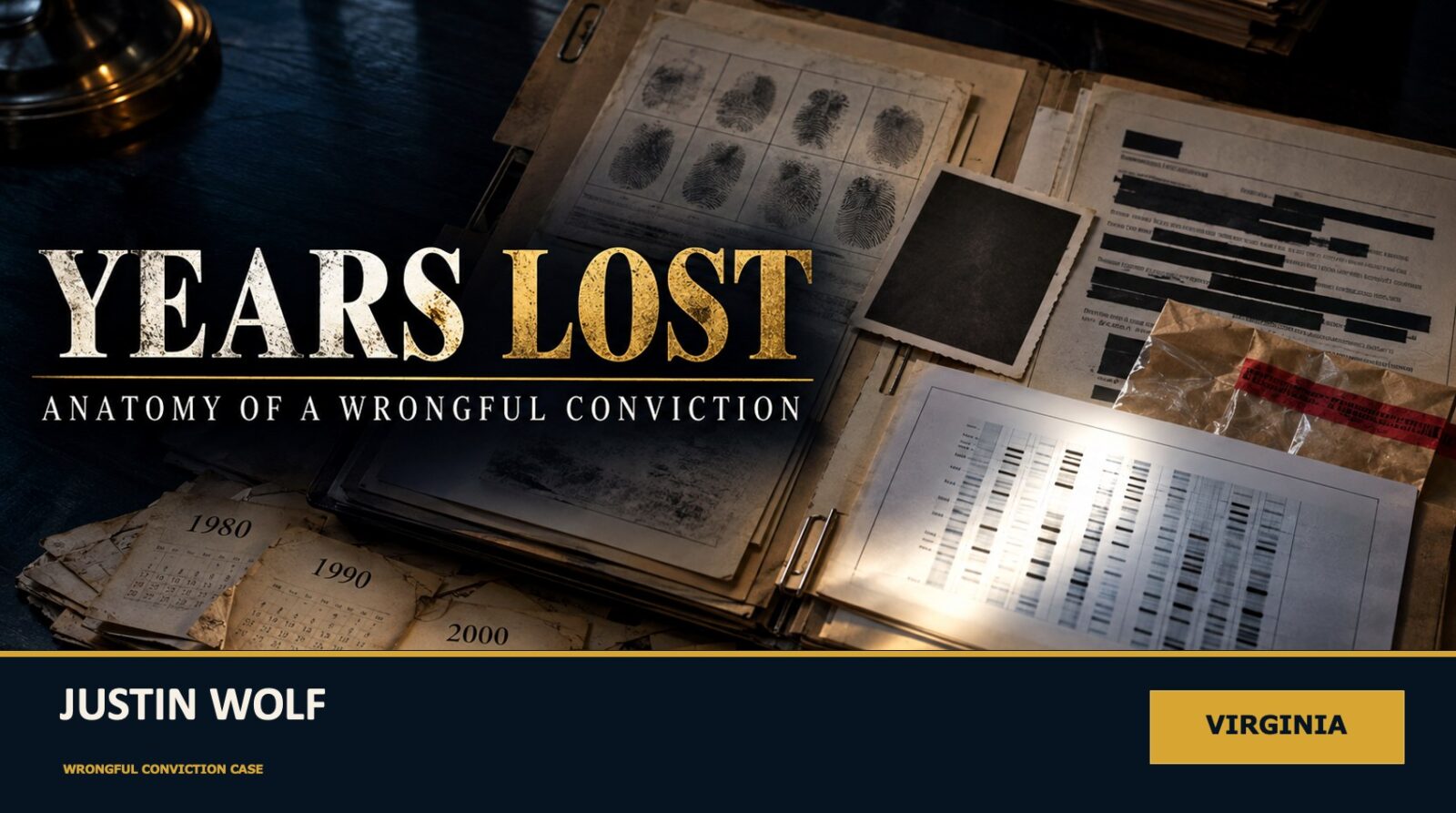
The man who pulled the trigger said Wolfe hired him. A detective had suggested the story first, and the State kept that report for nine years. This case came apart. It has not been made whole.
| Case at a Glance | |
|---|---|
| Name | Justin Michael Wolfe |
| Where | Prince William County, Virginia |
| Convicted of | Capital murder (murder for hire), use of a firearm, and conspiracy to distribute marijuana, by a jury on January 22, 2002; sentenced to death |
| Years lost | About 25 years, from 2001 to his release on September 28, 2026 |
| What went wrong | A conviction resting on the triggerman, who testified under a deal that spared him a capital charge; a suppressed police report showing a detective suggested Wolfe’s name first; other withheld impeachment evidence |
| How it came apart | Barber recanted in 2005 and again under oath in 2010; a federal court granted habeas relief in 2011 and the Fourth Circuit affirmed in 2012; a 2023 declaration from Barber reopened the case in 2025, and the Supreme Court denied the Commonwealth’s petition in April 2026 |
| Status today | Released September 28, 2026, after his murder conviction was vacated and he pleaded to lesser charges; not exonerated |
| Texas law in play | Accomplice-witness rule (Art. 38.14); disclosure of deals and impeachment evidence (Art. 39.14, Brady, Giglio); threats to defense witnesses (Webb v. Texas) |
The Road to Exoneration
- Done: ConvictedJanuary 22, 2002; again by plea in 2016
- Done: Conviction set aside2011 (federal habeas); 2016 plea conviction vacated September 2026
- Where it stands: ReleasedSeptember 28, 2026
- Not yet: Charges dismissed or acquittedPleaded to lesser charges
- Not yet: ExoneratedNot exonerated
- Not yet: CompensatedNo
Wolfe is free and no longer convicted of murder. He is not exonerated, and the plea that freed him says why.
What Happened
On March 15, 2001, Owen Barber shot and killed Daniel Petrole in Bristow, Virginia. Both were 21 and dealt marijuana in northern Virginia; Petrole was a supplier. Barber told a friend what he had done, the friend went to police, and Barber fled to San Diego, where he was arrested.
Justin Wolfe was 19, a high school friend of Barber’s and another dealer who bought his supply from Petrole. Prosecutors said Wolfe owed Petrole $60,000 and hired Barber to kill him. That figure was the prosecution’s trial argument rather than a court finding. Hiring a killer is what made the case capital murder under Virginia law, Va. Code Ann. section 18.2-31(2).
How the Case Was Built
Barber was the case. As the Fourth Circuit later put it, he was “the prosecution’s key witness” and “the only witness to provide any direct evidence regarding the ‘for hire’ element of the murder offense and the involvement of Wolfe therein.” In exchange for testifying that Wolfe hired him, the Commonwealth dropped its capital murder charge against Barber. He pleaded guilty to non-capital murder and was sentenced to 60 years, 22 of them suspended.
On January 22, 2002, a Prince William County jury convicted Wolfe of capital murder, using a firearm in a felony and conspiring to distribute marijuana. He testified and denied any part in the killing. He was sentenced to death, plus 33 years on the other counts.
What the jury never saw was a report by Detective Sam Newsome about the flight that brought Barber back from California on April 14, 2001. Newsome wrote that he told Barber police believed he had killed Petrole for someone else and “we believed that person was Justin Wolfe,” and that cooperating “could simply be the difference between Capitol [sic] murder or First Degree, execution or life in prison.” Barber had not yet named Wolfe. The detective named him first.
How It Came Apart
In December 2005, Barber signed an affidavit taking back his trial testimony and clearing Wolfe. Within months he tried to withdraw the affidavit; he later explained that he feared what would happen if he broke his cooperation deal. Two other men, Barber’s former roommate and a former cellmate, swore that Barber had told them he acted alone.
A federal court ordered discovery, and the Commonwealth had to turn over hundreds of documents it had never produced, including the Newsome report. At a 2010 evidentiary hearing, Barber recanted under oath. Asked whether officials had simply asked him for the truth, he answered: “they said they wanted the truth, but at the same time they said that this is what you have got to say or you are getting the chair.” The district court found his recantation credible.
In July 2011, the court granted habeas relief in Wolfe v. Clarke, 819 F. Supp. 2d 538, 571-72 (E.D. Va. 2011). It found that prosecutors had withheld eight items or groups of favorable evidence, including evidence impeaching Barber and other witnesses and evidence suggesting an alternate theory of the murder, and that they had presented Barber’s testimony while holding information indicating it was false, which it held violated Giglio and Napue. That July order spoke of the conviction and sentence in the singular; a second order on August 30, 2011 entitled Wolfe to a new trial on all charges. In August 2012 a divided Fourth Circuit affirmed in Wolfe v. Clarke, 691 F.3d 410 (4th Cir. 2012), resting on the Newsome report alone and expressly declining to reach the other withheld evidence or the Giglio and Napue findings, which therefore remain the district court’s and have never been reviewed. The panel did not condone the rest. It called the suppression “entirely intentional,” described the office policy behind it as “flabbergasting,” and recorded the Commonwealth’s own concession that but for Barber’s testimony Wolfe probably would not have been prosecuted. Id. at 423-24.
Then the case went backward. On September 11, 2012, weeks after that ruling, Commonwealth’s Attorney Paul Ebert, his assistant and Detective Newsome interviewed Barber at the Augusta Correctional Center, recording him without his knowledge, and told him he could face perjury charges and the return of his capital murder charge. Barber invoked the Fifth Amendment and refused to testify at a retrial. The district court ordered Wolfe released and barred a retrial. A divided Fourth Circuit agreed he had to be released but held that barring the retrial went too far in Wolfe v. Clarke, 718 F.3d 277 (4th Cir. 2013). The Commonwealth then reindicted him on nine counts, six of them new, including a capital count that again carried the death penalty. Facing that, and without his only exculpatory witness, Wolfe pleaded guilty on March 29, 2016 to murder, use of a firearm in a felony and conspiracy to distribute marijuana. The agreement set a range of 29 to 41 years and the court imposed the maximum. He had also written a letter admitting a role, and he apologized at sentencing. The later federal rulings do not treat that plea as something that never happened; the claim is that it was not voluntary.
On April 12, 2023 Barber signed a new declaration clearing Wolfe, saying it would not benefit him in any way. A federal district court dismissed Wolfe’s challenge to the 2016 plea, but in July 2025 a unanimous Fourth Circuit vacated that ruling in Wolfe v. Dotson, 144 F.4th 218 (4th Cir. 2025). Judge Stephanie Thacker wrote: “Twenty-four years ago, the Commonwealth decided that Appellant was a guilty man. From that moment, the Commonwealth has done everything in its power to ensure Appellant dies in prison, eschewing the Constitution, ethical strictures, and Appellant’s own repeated and consistent assertions of actual innocence.” The holding is narrower than the language. The court found a meritorious gateway claim of actual innocence under Schlup, which allowed an otherwise time-barred petition to proceed, and remanded for the district court to decide the substantive claims of vindictive prosecution and intimidation of Barber. No court has ruled on those. The Commonwealth sought review and the Supreme Court denied certiorari on April 20, 2026, which is what cleared the way for September.
Where Things Stand Now
In September 2026, Prince William County Circuit Judge Carroll A. Weimer Jr., the same judge who imposed the 41-year sentence in 2016, vacated Wolfe’s murder conviction. Under an agreement with Commonwealth’s Attorney Amy Ashworth, who was not the prosecutor at trial, Wolfe pleaded guilty to marijuana distribution and entered a plea that did not admit guilt to criminal solicitation. Local reporting describes that as a no contest plea; the Associated Press called it an Alford plea. The sentence was 28 years with three suspended, satisfied by time served, and he walked out on September 28, 2026, at 45.
Ashworth called it a “just and appropriate outcome” and said: “Significant information was not disclosed during the first trial, and allegations of witness intimidation arose during the retrial.” She added that there are no winners here. Petrole’s family said: “Nothing that happens in a courtroom can bring Danny back or undo what was taken from our family.” Wolfe said: “I did 25 years for a marijuana case, something that you can go buy at the store now.”
This series uses the word exoneration carefully. Wolfe is free and no longer convicted of murder, but he resolved the case with new pleas rather than an acquittal, a dismissal or a finding of innocence. He maintains that he had nothing to do with Petrole’s death, and the Fourth Circuit described that claim as repeated and consistent. The complication worth stating is that he wrote a letter admitting a role before the 2016 plea and apologized at sentencing. That is the subject of the involuntary-plea claim rather than something outside it. Barber remains convicted of non-capital murder on his 60-year sentence. The case came apart. It has not been made whole.
How Texas Law Answers It
Wolfe’s case raises a question Texas answered by statute long ago: can a jury convict on the word of an accomplice alone?
The accomplice-witness rule
Under Article 38.14 of the Code of Criminal Procedure, “a conviction cannot be had upon the testimony of an accomplice unless corroborated by other evidence tending to connect the defendant with the offense committed; and the corroboration is not sufficient if it merely shows the commission of the offense.” A witness charged with the same offense or a lesser-included one, as Barber was, is an accomplice as a matter of law, though there must still be some evidence that the witness affirmatively acted to assist in the charged offense (Druery v. State, 225 S.W.3d 491 (Tex. Crim. App. 2007)).
The test is simple to state. Courts “eliminate the accomplice testimony from consideration and then examine the remaining portions of the record to see if there is any evidence that tends to connect the accused with the commission of the crime” (Malone v. State, 253 S.W.3d 253, 257 (Tex. Crim. App. 2008), which is an informant case applying the same standard; for the rule stated in an accomplice case see Ambrose v. State, 487 S.W.3d 587, 593 (Tex. Crim. App. 2016)). Motive and opportunity are not enough on their own, though they count alongside other evidence (Smith v. State, 332 S.W.3d 425, 442 (Tex. Crim. App. 2011), which also requires a court to weigh the combined force of all the non-accomplice evidence rather than discounting each theory one at a time). A debt between drug dealers is motive. It is not, by itself, a connection to a killing.
Virginia imposes no corroboration requirement. A Virginia jury may convict on an accomplice’s uncorroborated testimony, and the protection is a cautionary instruction, which the trial court has a duty to give where corroboration is lacking and which it is error to refuse (Dillard v. Commonwealth, 216 Va. 820, 821 (1976); Holmes v. Commonwealth, 76 Va. App. 34, 55-57 (2022)). Texas is in the minority here. By one recent survey about sixteen states require corroboration of accomplice testimony and the rest, Virginia among them, do not. Whether the Commonwealth’s other evidence against Wolfe would have cleared the Texas bar is not something we can answer from the record; the federal courts described other witnesses who backed Barber, and found the State had also withheld evidence impeaching them. What Texas law guarantees is that the question gets asked, and that a jury is told an accomplice’s word is not enough.
The deal and everything behind it
A witness testifying to escape the death penalty has every reason to say what the State wants. That is why Giglio v. United States requires disclosure of deals, and why Brady v. Maryland requires disclosure of evidence favorable to the accused and material to guilt or punishment. Impeachment evidence counts, and that branch traces to Giglio and to United States v. Bagley, 473 U.S. 667, 676 (1985), rather than to Brady itself. In Texas, Article 39.14 now requires the State to produce offense reports and witness statements on timely request and, without any request, any exculpatory, impeachment or mitigating document, item or information in its possession, custody or control that tends to negate the guilt of the defendant or would tend to reduce the punishment. Note the statutory word: information, which is broader than evidence and does not turn on admissibility. Subsection (k) adds that if the State later discovers such material, before, during or after trial, it must promptly disclose its existence to the defendant or the court. A report like Newsome’s, showing who first said the defendant’s name, is exactly what that statute reaches. Where the State presents testimony it knows to be false, or allows false testimony to go uncorrected, Napue v. Illinois applies; we covered it in Case No. 01, and the Michael Morton Act’s own origin story is in Case No. 02. One caution on that last point: Napue speaks in terms of knowledge, and the Wolfe district court reached its false-testimony finding on an on-notice, reckless-disregard standard that the Fourth Circuit never reviewed.
Pressure on a defense witness
Barber did not testify at a retrial because, after a prison interview about perjury and capital charges, his lawyer told him to stay silent. The leading Supreme Court case on driving a defense witness off the stand came out of Texas. In Webb v. Texas, 409 U.S. 95, 98 (1972), the Court reversed a Texas conviction because the trial judge’s threatening warning to the defendant’s only witness “effectively drove that witness off the stand,” depriving the defendant of due process. Two Justices dissented on the adequacy of the record. Federal courts have applied the same principle to pressure from prosecutors, United States v. Morrison, 535 F.2d 223, 227-28 (3d Cir. 1976), and Texas courts of appeals ask whether a warning from the judge or the prosecutor kept the witness from making a free and voluntary choice whether to testify, Davis v. State, 831 S.W.2d 426, 438 (Tex. App.-Austin 1992, pet. ref’d). The Court of Criminal Appeals has not squarely so held.
The judge has to give the accomplice-witness instruction when the evidence raises it, with or without a request (Zamora v. State, 411 S.W.3d 504, 510-13 (Tex. Crim. App. 2013)). Object on the record anyway and state the ground, because an unpreserved complaint is reviewed only for egregious harm, which strong corroboration usually defeats. Make the State identify its corroboration before the jury retires. Get every report from the first interview of the cooperating witness, not just the signed statement. Find out exactly what was promised, suggested or threatened, by whom and when. And if a cooperating witness later wants to recant, make sure his lawyer and yours are involved before anyone from the State talks to him again.
What This Means If You Are Charged in Texas
- Make the State corroborate its accomplice. Article 38.14 requires evidence beyond the accomplice that tends to connect you to the offense. Motive alone does not.
- Get the first interview. The question is not only what the cooperating witness said, but what he was told before he said it. Ask for every offense report, recording and note from the first contact.
- Demand the deal in writing. Charges dropped, a death penalty taken off the table, a sentence recommendation: all of it is impeachment the jury is entitled to hear.
- Treat a recantation as evidence to be protected. Recantations get withdrawn under pressure. Lock them down through counsel, with corroboration, as early as possible.
- A plea is not always the end. Wolfe pleaded in 2016 and kept fighting. The federal courts reopened his case because the pressure on his only witness bore on whether that plea was voluntary.
The Bottom Line
A man who killed someone named the friend a detective had already named for him, and saved his own life by doing it. A jury heard him and sent Justin Wolfe to death row. The report showing where the accusation started stayed in the State’s files for nine years, and when the triggerman tried to take it back, he was warned about perjury and the death penalty. Texas would have asked a different question at trial: take the accomplice away, and what is left? In Wolfe’s case, that question might have saved 25 years.
Sources
Case record
- Wolfe v. Clarke, 819 F. Supp. 2d 538 (E.D. Va. 2011). courtlistener.com
- Wolfe v. Clarke, 691 F.3d 410 (4th Cir. 2012). courtlistener.com
- Wolfe v. Clarke, 718 F.3d 277 (4th Cir. 2013). courtlistener.com
- Wolfe v. Dotson, 144 F.4th 218 (4th Cir. 2025) (No. 24-6840, decided July 7, 2025; Thacker, J., for a unanimous panel). courtlistener.com
- “Judge vacates Virginia man’s murder conviction; he walks free after 25 years,” Associated Press (Sept. 30, 2026). news4jax.com
- “Justin Wolfe, Former Virginia Death Row Prisoner, Released on Plea Deal After Federal Court Found Significant Prosecutorial Misconduct,” Death Penalty Information Center (2026). deathpenaltyinfo.org
- “Justin Wolfe speaks out after returning home from prison, 25 years later,” WJLA (Sept. 30, 2026). wjla.com
Law
- Tex. Code Crim. Proc. art. 38.14 (testimony of accomplice). statutes.capitol.texas.gov
- Tex. Code Crim. Proc. art. 39.14 (discovery). statutes.capitol.texas.gov
- Druery v. State, 225 S.W.3d 491 (Tex. Crim. App. 2007). courtlistener.com
- Malone v. State, 253 S.W.3d 253 (Tex. Crim. App. 2008). courtlistener.com
- Smith v. State, 332 S.W.3d 425 (Tex. Crim. App. 2011). courtlistener.com
- Holmes v. Commonwealth, 76 Va. App. 34 (2022) (published). vacourts.gov
- Brady v. Maryland, 373 U.S. 83 (1963). justia.com
- Napue v. Illinois, 360 U.S. 264 (1959). justia.com
- Giglio v. United States, 405 U.S. 150 (1972). justia.com
- Dillard v. Commonwealth, 216 Va. 820, 224 S.E.2d 137 (1976). courtlistener.com
- Ambrose v. State, 487 S.W.3d 587 (Tex. Crim. App. 2016). courtlistener.com
- Zamora v. State, 411 S.W.3d 504 (Tex. Crim. App. 2013) (accomplice-witness instruction is a sua sponte duty). justia.com
- United States v. Bagley, 473 U.S. 667 (1985). justia.com
- United States v. Morrison, 535 F.2d 223 (3d Cir. 1976). courtlistener.com
- Davis v. State, 831 S.W.2d 426 (Tex. App.-Austin 1992, pet. ref’d). courtlistener.com
- Dotson v. Wolfe, No. 25-664 (U.S.) (certiorari denied Apr. 20, 2026). supremecourt.gov
- Webb v. Texas, 409 U.S. 95 (1972). justia.com
This post is an informational synthesis for educational purposes and is not legal advice. It is based on the published federal court opinions and on reporting by the Associated Press, WJLA and the Death Penalty Information Center as available in October 2026. Mr. Wolfe has not been exonerated; he resolved the case with pleas to marijuana distribution and criminal solicitation and maintains his innocence of Daniel Petrole’s murder. Statements about Owen Barber and investigators reflect findings and quotations in the court opinions. Case citations should be independently verified against the official record before use in any filing.
Which county your case is filed in changes how it is charged, who prosecutes it, and which court hears it.
Deandra M. Grant, JD, GC, MS, ACS-CHAL Forensic Lawyer-Scientist
She holds a Master of Science in Pharmaceutical Science and a Graduate Certificate in Forensic Toxicology, both from the University of Florida. She is the author of The Texas DWI Manual and has defended Texas DWI cases since 1994.
Facing a Serious Charge in Texas?
When the State's case rests on someone who has a deal to protect, the deal is part of the case. The sooner a defense team is asking what was promised, suggested and threatened, the more can be done about it. Intake answers 24/7.
Request a Free Case Evaluation
Tell us what happened. We'll respond as soon as possible.