
Home »


Do You Need Legal Help?

"Deandra Grant Law fights hard for their clients and is always willing to go above and beyond. They are the best firm for DWI cases in DFW and beyond. Definitely hire them to represent you in any pending cases."
- P. Williams
"Deandra Grant made a tough situation so much better. She listened to my concerns and helped me so much with my case. I would recommend her to anyone needing legal services."
- M. Haley
"Deandra Grant Law handled my case with diligence and professionalism. Deandra Grant's reputation is stellar and now I know why. She has a team of individuals who provide quality service."
- N. Coulter
As Seen On







Download Our Free Texas Federal Guide
Learn what you should and shouldn't be doing to help your federal defense case.
Texas Federal Fraud Lawyers
Federal fraud is not a single charge. It is a family of related offenses, each defined by its own statute, its own elements, and its own penalty structure. Bank fraud under 18 U.S.C. §1344 and wire fraud under 18 U.S.C. §1343 are different crimes even though they are often charged together. Healthcare fraud under 18 U.S.C. §1347 has its own evidentiary framework built around billing data and medical necessity. Aggravated identity theft under 18 U.S.C. §1028A adds a mandatory two-year consecutive sentence that cannot be reduced by any sentencing factor.
Understanding which specific statutes are charged, what the government must prove under each, and where the defense has room to operate requires federal criminal defense experience in the specific fraud category at issue. Generic fraud defense is not effective federal defense.
Of Counsel James Lee Bright leads Deandra Grant Law’s federal fraud defense practice. Lee has defended clients against the full spectrum of federal fraud charges for more than 25 years, across all four Texas federal districts. Partner Douglas Huff’s digital forensics training directly applicable to the electronic evidence (emails, financial transaction records, device data, and metadata) that forms the evidentiary foundation of virtually every federal fraud prosecution.
What Makes Fraud a Federal Crime
Both state and federal law prohibit fraud, and the same conduct can sometimes be charged in either system. Federal jurisdiction attaches when the fraud involves interstate commerce: using electronic communications across state lines (wire fraud), using the postal service or commercial carriers (mail fraud), targeting a federally insured financial institution (bank fraud), or defrauding a federal healthcare program (healthcare fraud). The involvement of federal agencies, federal programs, or interstate communications almost always establishes federal jurisdiction.
The federal government’s resources for investigating and prosecuting fraud cases significantly exceed those of most state prosecutors’ offices. Federal fraud investigations are conducted by specialized agents (FBI Financial Crimes, IRS Criminal Investigation, HHS-OIG, FDIC-OIG, SEC Enforcement, and HIS) who work cases for months or years before charges are filed. By the time a grand jury indictment issues, the government’s evidentiary record is typically extensive.
Federal Fraud Statutes and Penalties
Mail fraud — 18 U.S.C. §1341: Any scheme to defraud using U.S. mail or commercial carriers. Up to 20 years per count; 30 years if a financial institution is affected.
Wire fraud — 18 U.S.C. §1343: Any scheme to defraud using interstate electronic communications. Up to 20 years per count; 30 years if a financial institution is affected. The most broadly charged federal fraud statute.
Bank fraud — 18 U.S.C. §1344: Scheme to defraud a financial institution or obtain its funds by false pretenses. Up to 30 years and a fine up to $1,000,000.
Healthcare fraud — 18 U.S.C. §1347: Scheme to defraud a healthcare benefit program. Up to 10 years; 20 years if serious bodily injury results; life if death results.
Identity theft — 18 U.S.C. §1028: Production, transfer, or use of false identification documents. 5 to 25 years depending on the offense.
Aggravated identity theft — 18 U.S.C. §1028A: Mandatory 2-year consecutive sentence added to the underlying felony sentence. Cannot run concurrently. Cannot be reduced. The Supreme Court’s decision in Dubin v. United States (2023) narrowed this statute significantly.
Securities fraud — 18 U.S.C. §1348: Scheme to defraud in connection with securities or futures. Up to 25 years.
Bankruptcy fraud — 18 U.S.C. §157: False statements in bankruptcy proceedings. Up to 5 years.
Tax fraud — 26 U.S.C. §7201: Willful tax evasion. Up to 5 years and a fine up to $250,000.
Federal loan fraud — 18 U.S.C. §1014: False statements to influence a federally insured financial institution on a loan application. Up to 30 years.
The Fraud Cases We Defend
Deandra Grant Law handles the full spectrum of federal fraud charges. Each of the following has dedicated sub-page coverage with detailed analysis of the specific elements, defense strategies, and sentencing consequences:
- Wire fraud and mail fraud — the intent element, loss calculations, materiality, and digital evidence challenges
- Bank fraud — the two theories of liability, false pretense analysis, and the financial institution knowledge requirement
- Money laundering — §1956 concealment laundering and §1957 spending laundering; cryptocurrency tracing; forfeiture
- Federal loan fraud — PPP and EIDL fraud, the willfulness element, reliance on professional advice, statute of limitations
- Tax fraud — the Cheek willfulness defense, IRS-CI investigation methodology, civil resolution as an alternative
- Healthcare fraud — Medicare and Medicaid billing fraud, the Anti-Kickback Statute, medical necessity, billing data statistical challenges
- Identity theft and aggravated identity theft — the Dubin standard, knowledge element, mandatory consecutive sentence, digital device attribution
- Securities fraud — scheme to defraud in securities transactions, materiality, and scienter requirements
Recent Blogs
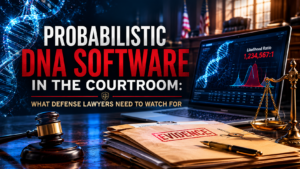
Probabilistic DNA Software in the Courtroom: What Defense Lawyers Need to Watch For
This month Cybergenetics (the company behind the TrueAllele probabilistic genotyping system) announced the launch of [...]
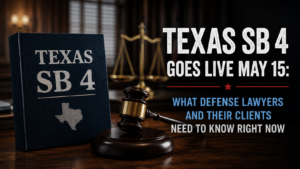
Texas SB 4 Goes Live May 15: What Defense Lawyers and Their Clients Need to Know Right Now
On April 24, 2026, the en banc Fifth Circuit vacated the preliminary injunction that had [...]

How Forensic Misconduct Can Unravel a Conviction: The Missy Woods Case and What It Means for Texas
For 29 years, Yvonne “Missy” Woods was a star analyst at the Colorado Bureau of [...]

Can the Algorithm Convict You? TrueAllele and a Defendant’s Right to Cross-Examine the Code
In March 2026, the U.S. Court of Appeals for the Third Circuit handed prosecutors a [...]

Can a Texas Warrant Expire or Does It Follow You Forever?
One of the most common misconceptions about warrants in Texas is that they eventually expire [...]

How Child Sexual Assault Cases Are Investigated in Texas And Where the Process Can Go Wrong
If you have been accused of sexually assaulting a child in Texas, you are likely [...]
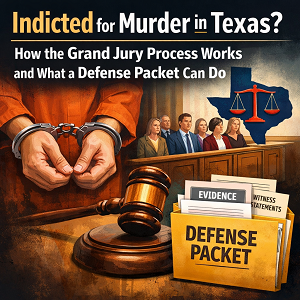
Indicted for Murder in Texas? How the Grand Jury Process Works and What a Defense Packet Can Do
When you are under investigation for murder in Texas, the grand jury proceeding is often [...]

Civil Demand Letters After a Shoplifting Arrest in Texas: What They Are and What to Do
A few weeks after a shoplifting arrest in Texas, many people receive a certified letter [...]
How Federal Fraud Cases Are Defended
The intent element. Every federal fraud statute requires proof of knowing, intentional conduct. Business failures, accounting errors, reliance on professional advisors, misunderstandings about legal requirements, and good-faith business judgments are not fraud. The government must prove that the defendant knew their representations were false and intended to cause financial harm. This element is the most frequently contested issue in federal fraud cases.
Loss amount challenges. Federal fraud sentencing under U.S.S.G. §2B1.1 is driven primarily by the calculated loss amount. The loss calculation adds sentencing levels that can produce sentences far longer than the base offense alone would suggest. Independently challenging the loss calculation (identifying legitimate transactions included in the government’s figure, disputing the methodology, and presenting alternative calculations) can significantly reduce the Guidelines range.
Digital evidence. Federal fraud prosecutions are built on electronic records: emails, financial transaction data, account records, device contents, and metadata.
Fourth Amendment challenges. Federal fraud investigations involve search warrants for financial records, email accounts, and devices. The scope and execution of those warrants are subject to challenge. Evidence obtained through overbroad searches or defective warrants may be suppressed.
If you are facing federal fraud charges in Texas, call (214) 225-7117 for a free, confidential consultation with James Lee Bright. Or schedule online at texasdwisite.com.
Client Reviews

“Deandra Grant Law – Criminal & DWI Defense handled my case with diligence and professionalism. Deandra Grant’s reputation is stellar and now I know why. She has a team of individuals who provide quality service.”
N. Coulter


(214) 225-7117
Experienced DWI Defense