
Home »


Do You Need Legal Help?
ARVE error: <a href="https://nextgenthemes.com/plugins/arve/documentation/installation/">ARVE Pro</a> license not activated or valid

"Deandra Grant Law fights hard for their clients and is always willing to go above and beyond. They are the best firm for DWI cases in DFW and beyond. Definitely hire them to represent you in any pending cases."
- P. Williams
"Deandra Grant made a tough situation so much better. She listened to my concerns and helped me so much with my case. I would recommend her to anyone needing legal services."
- M. Haley
"Deandra Grant Law handled my case with diligence and professionalism. Deandra Grant's reputation is stellar and now I know why. She has a team of individuals who provide quality service."
- N. Coulter
New! AI Legal Avatar — Get 24/7 Answers on Texas DWI Law, Penalties, and Defenses
Our AI Legal Avatar provides instant, plain-language answers to your questions about Texas DWI laws—like penalties, license suspension, and defense strategies—anytime, day or night. While it's a helpful starting point, it doesn't replace the clarity and advocacy of our experienced DWI attorneys.
As Seen On






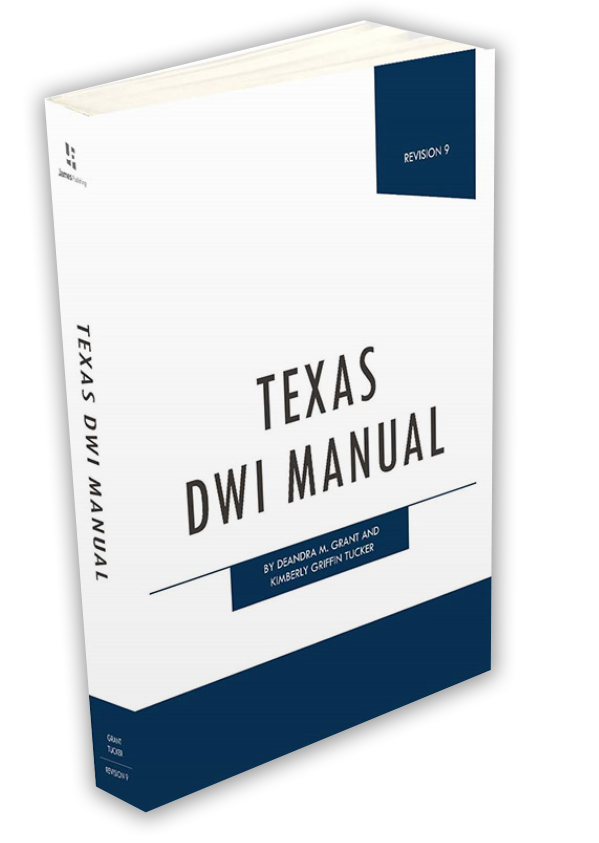
Texas DWI Manual
By Attorney Deandra Grant
Fighting DWI charges can present many challenges, not only for the defense, but prosecutors as well. This is why it is important to be armed with the necessary knowledge so you understand the DWI process.
Attorney Deandra M. Grant is the co-author of the Texas DWI Manual, offering legal advice to both clients and fellow attorneys.
Learn MoreFactors That Affect Field Sobriety Tests
Field sobriety tests are presented to juries as objective evidence of intoxication. They are not. The three standardized tests (Horizontal Gaze Nystagmus (HGN), Walk and Turn, and One Leg Stand) have documented accuracy limitations, known sources of error, and conditions under which their results are scientifically unreliable. Any officer who administers these tests in conditions that deviate from the validated protocol, to a subject with physical or medical characteristics outside the studied population, is generating results that cannot carry the scientific weight the prosecution will claim they carry.
Managing Partner Deandra M. Grant is a trained SFST instructor who administers and grades the SFST component of the ACS-CHAL Forensic Lawyer-Scientist examination and the DUIDLA Board Certification examination. She holds the ACS-CHAL Forensic Lawyer-Scientist designation along with a Master’s Degree in Pharmaceutical Science and a Graduate Certificate in Forensic Toxicology. Partner Douglas E. Huff holds the same ACS-CHAL designation. When we challenge SFST results, we do so from the position of people who teach these tests and know precisely what proper administration requires.
How the Standardized Field Sobriety Tests Are Supposed to Work
The HGN, Walk and Turn, and One Leg Stand were developed and validated by NHTSA through a series of laboratory and field studies beginning in the late 1970s. The validation studies established accuracy rates that apply under one specific condition: the tests are administered exactly as specified in the NHTSA standardized manual, in conditions comparable to those in the validation studies, to subjects from the same general population as those studied.
These conditions are rarely fully present during a roadside stop. The accuracy claims the prosecution relies on (HGN at 88%, Walk and Turn at 79%, One Leg Stand at 83% in the original studies) do not apply when any material element of the validated administration protocol is absent. And because officers administer these tests in the field rather than in controlled conditions, departures from the protocol are common.
Related Videos
Physical Characteristics That Affect SFST Performance
Age
The NHTSA validation studies for the Walk and Turn and One Leg Stand were conducted primarily on subjects between the ages of 18 and 65. Balance degrades naturally with age due to reduced vestibular function, diminished muscle strength, and changes in proprioception. The NHTSA manual acknowledges that individuals over 65 may have difficulty with balance tests for reasons unrelated to alcohol. A driver in this age range who loses balance or uses arms for steadiness is exhibiting behavior that may be entirely typical of their age group.
Weight
The One Leg Stand has an explicit validation limitation: the test was not studied on individuals who are 50 or more pounds overweight. The NHTSA manual states this directly. An officer who administers the One Leg Stand to an overweight individual and scores balance difficulties as clues of impairment is applying a test to a subject outside its validated population.
Physical Injuries and Musculoskeletal Conditions
Injuries or conditions affecting the legs, knees, ankles, feet, or back directly impair performance on the Walk and Turn and One Leg Stand for reasons unrelated to intoxication. A driver with a recent knee injury, a chronic hip condition, or foot pain cannot maintain the required stance and movement pattern without discomfort that affects performance. Officers are required to ask whether the subject has any physical conditions that might affect their ability to perform the tests but this inquiry is frequently perfunctory or omitted entirely.
Inner Ear Disorders and Vestibular Conditions
The vestibular system, housed in the inner ear, is the primary mechanism of balance. Conditions that affect it (benign paroxysmal positional vertigo (BPPV), labyrinthitis, vestibular neuritis, and Meniere’s disease) cause balance disturbances and can independently produce nystagmus. A driver with an active inner ear condition may fail the Walk and Turn, One Leg Stand, and HGN tests for reasons entirely unrelated to alcohol. Because these conditions are not always visible or disclosed during a brief roadside encounter, they are frequently missed in the officer’s assessment.
Fatigue
Significant fatigue produces physical and cognitive effects that closely resemble alcohol impairment: reduced coordination, impaired divided attention, difficulty following multi-step instructions, and slowed reaction time. A driver coming off a double shift, returning from a long drive, or running on minimal sleep may perform poorly on all three standardized tests for reasons that have nothing to do with alcohol consumption. The divided attention tasks that the SFSTs are designed to reveal as impaired are also the tasks most affected by sleep deprivation.
Footwear
The NHTSA manual specifies that a subject wearing heels more than two inches high should be given the opportunity to remove their shoes before performing balance tests. Officers who fail to make this offer (or who administer the tests to a driver in boots, wedges, or elevated footwear without documentation of why the offer was declined) have deviated from the protocol. Balance difficulties attributable to footwear cannot be scored as evidence of intoxication.
Nervousness and Anxiety
A roadside stop at night, with flashing lights and a uniformed officer, is a stressful situation for most sober drivers. Anxiety produces physical effects (trembling, difficulty concentrating, altered gait, and performance anxiety on coordinated tasks) that are indistinguishable from mild intoxication in SFST scoring. An officer who attributes every physical manifestation of nervousness to alcohol without investigating whether the subject was already anxious before any alcohol-related observations is conflating cause and effect.
Related Blogs
HGN: Nystagmus Has More Than 47 Causes Other Than Alcohol
Horizontal Gaze Nystagmus (the involuntary jerking of the eyes as they track a moving stimulus) is presented to juries as the most reliable of the three standardized tests because it is involuntary and not subject to conscious control. What is not always explained is that HGN has more than 47 documented causes that have nothing to do with alcohol.
Non-alcohol causes of HGN include: inner ear disorders (BPPV, labyrinthitis, Meniere’s disease, vestibular neuritis); neurological conditions including multiple sclerosis, brain stem lesions, cerebellar dysfunction, and traumatic brain injury; naturally occurring pathological nystagmus that is present at baseline in a percentage of the population; certain prescription medications including anticonvulsants, sedatives, and some antihistamines; fatigue; and gaze-evoked nystagmus that is present at extreme lateral gaze in many people regardless of impairment.
An officer who observes HGN clues but does not know (and does not ask) whether the driver has any inner ear condition, neurological history, or relevant medication use cannot reliably attribute the observed nystagmus to alcohol. Cross-examination on the officer’s knowledge of alternative HGN causes and whether they made any inquiry before attributing the nystagmus to intoxication is a standard component of an effective SFST challenge.
Environmental Conditions That Affect SFST Reliability
Testing Surface
Walk and Turn and One Leg Stand require a dry, hard, level, non-slippery surface. Gravel shoulders, cracked or uneven pavement, wet surfaces, sloped roadways, and grass do not meet this standard. Maintaining the required positions on an unstable or uneven surface is physically more difficult than on the ideal surface and difficulty that arises from the surface, not from the subject, should not be scored as a clue of impairment.
Lighting Conditions
HGN observation requires that the officer clearly see the subject’s eyes tracking the stimulus throughout the test. Poor ambient lighting, flashing emergency lights in the peripheral field, and glare from oncoming headlights all compromise observation quality. The NHTSA protocol requires adequate lighting, and tests conducted under poor lighting conditions produce observations of reduced reliability.
Weather and Temperature
Cold temperatures cause muscle stiffness and reduce fine motor control. High winds create physical challenges for maintaining static balance positions. Rain and adverse weather affect both the testing surface and the subject’s physical comfort and concentration. None of these conditions were present in the controlled environments used for the NHTSA validation studies, and the accuracy figures from those studies do not apply when these conditions are present.
Traffic and Distractions
Performing divided attention tasks alongside active traffic (with vehicles passing at speed, horns, emergency vehicle sounds, and the physical stress of standing near a travel lane) imposes external cognitive demands not present in the validation environment. Distraction from traffic is an independent factor that can affect performance on multi-step balance tests.
Protocol Deviations: When Officers Administer the Tests Incorrectly
SFST accuracy depends entirely on protocol compliance. The NHTSA manual specifies the exact sequence of instructions, the demonstration requirements, the stimulus movement for HGN, the clue observation criteria, and the scoring standards. Deviations from any element of this protocol undermine the scientific foundation of the results.
Common protocol deviations the defense examines in every SFST case include:
- HGN stimulus movement speed. The stimulus must move at a specified pace across the visual field. Too fast or too slow affects whether maximum deviation nystagmus can be accurately observed.
- HGN holding time at maximum deviation. The NHTSA protocol requires holding the stimulus at maximum lateral deviation for a minimum of four seconds per eye to observe sustained nystagmus. Officers who do not hold the stimulus long enough cannot accurately score this clue.
- Walk and Turn instruction phase. The subject must maintain the heel-to-toe stance throughout the entire instruction phase, before the walking begins. Officers who begin scoring before the walking phase starts (or who do not observe the instruction phase stance) are not following the protocol.
- Number of steps. The Walk and Turn requires nine steps in each direction. An officer who instructs a different number, or who does not count steps accurately, is not administering the test as validated.
- One Leg Stand counting method. The subject must count out loud by thousands while maintaining the raised-foot position. Officers who do not specify the counting method or who deviate from this requirement are not following the validated protocol.
- Failure to ask about physical conditions. The NHTSA manual requires the officer to ask whether the subject has any physical conditions that might affect their ability to perform the tests before administering them. An officer who skips this inquiry has failed a required step.
What We Do with This Information
In every case involving SFST evidence, Deandra Grant Law obtains the officer’s dashcam and bodycam video, the officer’s training records and SFST certification documentation, and any available information about the subject’s relevant physical and medical history. The video is reviewed against the NHTSA protocol to identify specific deviations in instruction, demonstration, stimulus movement, holding time, clue observation, and scoring.
Because Deandra Grant administers and grades these tests professionally she approaches this review with the eye of an examiner who knows exactly what a properly administered test looks like. Protocol deviations that would be invisible to an attorney reviewing video without that training become the basis for specific, grounded cross-examination that challenges the scientific reliability of the results in a way a jury can understand and credit.
If your DWI case involves field sobriety test results, call (214) 225-7117 for a free consultation. Or schedule online at texasdwisite.com.
Client Reviews

“Deandra Grant Law – Criminal & DWI Defense handled my case with diligence and professionalism. Deandra Grant’s reputation is stellar and now I know why. She has a team of individuals who provide quality service.”
N. Coulter


(214) 225-7117
Experienced DWI Defense